For Those Still Obsessed with Altcoins, Just Buy HOOD

Odaily星球日报Publicado a 2026-06-16Actualizado a 2026-06-16

Resumen

The author expresses bullish sentiment on Robinhood (HOOD) stock, citing multiple positive catalysts. Recent monthly operational data shows record highs in key metrics like total assets, funded customers, and margin balances. On the news front, Robinhood launched its own prediction market (Rothera), received approval to act as an IPO underwriter, and was selected to manage the new "Trump Accounts" for U.S. newborns, ensuring a long-term user base. Insiders and institutions are also buying or raising price targets. The core investment thesis, however, focuses on HOOD's evolving valuation narrative. Historically viewed as a "crypto proxy," its stock price was highly correlated with Bitcoin and its revenue heavily dependent on cryptocurrency trading fees. Recent data indicates this dependence is waning: crypto-related revenue hit a multi-quarter low of 13% of total revenue in Q1 2026, and the stock price has recently decoupled from BTC's trend. The author argues HOOD is transforming into a more diversified platform. Its growth is now driven by equities, options, prediction markets, and IPO-related services. This reduces its cyclical vulnerability to crypto bear markets. Crucially, if the crypto market recovers, HOOD would still benefit from increased trading activity. Therefore, for investors still hoping for gains from altcoins but concerned about their risks and liquidity, the author suggests HOOD offers a compelling alternative with higher safety margins—it can rise with a ...

Original | Odaily Planet Daily(@OdailyChina)

Author|Azuma(@azuma_eth)

Recently, Robinhood (HOOD) stock has performed quite strongly, even briefly breaking back above $100 last night, although it unfortunately couldn't hold that level by the close. Personally, I remain optimistic about HOOD's future performance.

During this downtrend cycle, HOOD has been one of the few targets I have consistently been accumulating (including via rotation). So, I've been wanting to write an article about HOOD for a long time. In previous Odaily Tea Chat sessions, I briefly shared the accumulation logic. Today, taking advantage of the favorable stock price movement, I want to elaborate on it in detail. It must be stated that this is not investment advice and does not represent the platform's view; it is merely my personal thoughts when accumulating HOOD.

Multi-dimensional Analysis of Positive Factors

Regarding the reasons for HOOD's recent rise, you can find many positive explanations across different dimensions.

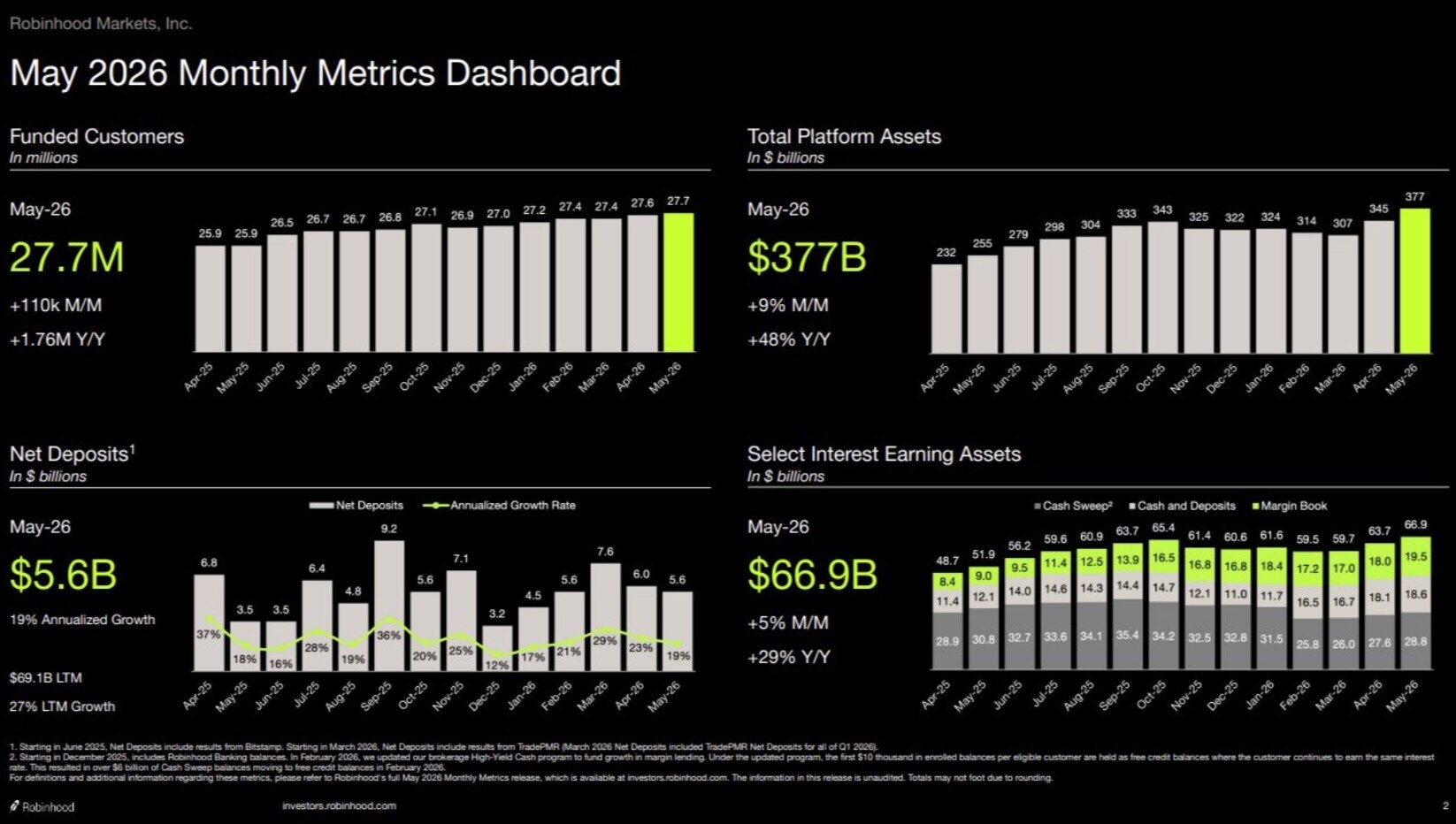
First, looking at fundamentals, Robinhood released its May operational data last week, details as follows.

  • Total Assets: $377 billion, a record high;
  • Funded Customers: 27.7 million, a record high;
  • Margin Book: $19.5 billion, a record high;
  • Event Contracts: 3.9 billion, a record high;
  • Cash & Deposits: $18.6 billion, a record high;
  • Options ADV: 11.6 million contracts, tying the historical record;
  • Equity Volume: $315 billion, the second-highest historical point;
  • Options Contracts: 231 million contracts. The second-highest historical point;
  • The only "lagging" data point is Crypto Volume: $12.2 billion, ranking only 16th in historical monthly data...
Some positive factors on the news front might be more effective in stirring investor sentiment.

  • First, regarding the rapidly growing prediction market, Robinhood has started intercepting Kalshi's flow by building its own prediction market, Rothera. Going forward, related revenue is expected to no longer need to be shared with Kalshi. For details, please refer to the article we published yesterday: 'The First Prediction Market Concept Stock Has Appeared!'.
  • Second, regarding the IPO front, SpaceX's historic IPO brought record-breaking traffic to Robinhood. More crucially, Robinhood's brokerage and clearing arm, Robinhood Securities, was approved last week to act as an IPO underwriter. This means Robinhood is expected to play a more central role in future IPO activities (e.g., Anthropic, OpenAI).
  • Third, Robinhood has been selected by the US Treasury Department to serve as the broker and initial trustee for the "Trump Account." The so-called "Trump Account" is a tax-deferred investment account plan authorized by President Trump on June 9, 2025, under the "Big and Beautiful" Act. It aims to establish government-funded savings accounts for children of US citizens born between January 1, 2025, and January 1, 2029. This means that tens of millions of newborn American children in the coming years will, by default, use Robinhood as their brokerage platform. Details can be found in 'Robinhood Gets a Batch of New Investors, the Oldest is 1, the Youngest is -3'.

There are also some more direct signals in market movements.

  • Robinhood director Meyer Malka has been continuously increasing his holdings of HOOD recently. Over the past week or two, Malka has accumulated over $50 million worth of HOOD.
  • Institutions have also given HOOD more positive price targets. Goldman Sachs maintains a "Buy" rating and has raised its target price from $105 to $108; Mizuho has set a target of $115; Piper Sandler is the most optimistic, giving a target price expectation of $135.

Personally, my initial main reason for accumulating HOOD was optimism about its Q2 earnings report. First, expecting a massive explosion in stock trading-related revenue this quarter under the epic US stock market conditions, and second, the potential surge in prediction market trading volume due to the World Cup, along with the revenue intercept effect of Rothera.

However, the reason for later rotating a significant portion of my holdings (mainly remaining crypto assets) into HOOD follows another logic. This is what this article truly wants to discuss.

The Altcoin Alternative

In early May, a friend asked me what I had bought recently, and I mentioned HOOD. But at that time, HOOD had just dropped from above $90 due to a disappointing Q1 earnings report (mainly due to an unexpected $100 million expense related to the "Trump Account"), and the short-term trend looked quite bad.

My friend asked why. I briefly explained the reasons above. He thought for a moment and said, unfortunately, his positions were mostly trapped, and he had little ammunition left. I asked him what he was holding; unsurprisingly, it was mostly altcoins.

I said to him at the time: "Instead of still holding onto altcoins, why not just rotate into HOOD."

The background for this judgment is that for a long time, cryptocurrency-related revenue has been a significant part of Robinhood's total revenue, and HOOD's stock price movement has been strongly correlated with cryptocurrencies. However, recently, there have been signs that Robinhood is breaking through its dependence on the crypto business and is positively decoupling from this correlation.

First, let's look at Robinhood's cryptocurrency-related revenue over the past five quarters. It's not hard to see that the overall proportion of this revenue stream is on a downward trend, and the Q1 proportion has dropped to its lowest level since 2025.

  • 2025 Q1, Total Revenue $927 million, Crypto Revenue $329 million, share 35%;
  • 2025 Q2, Total Revenue $989 million, Crypto Revenue $160 million, share 16%;
  • 2025 Q3, Total Revenue $1.274 billion, Crypto Revenue $268 million, share 21%;
  • 2025 Q4, Total Revenue $1.283 billion, Crypto Revenue $221 million, share 17%;
  • 2026 Q1, Total Revenue $1.067 billion, Crypto Revenue $134 million, share 13%.

Now, look at the direct comparison between HOOD and BTC price fluctuations. Since the beginning of the year, HOOD mostly followed a similar trend to BTC, but a significant divergence has recently appeared.
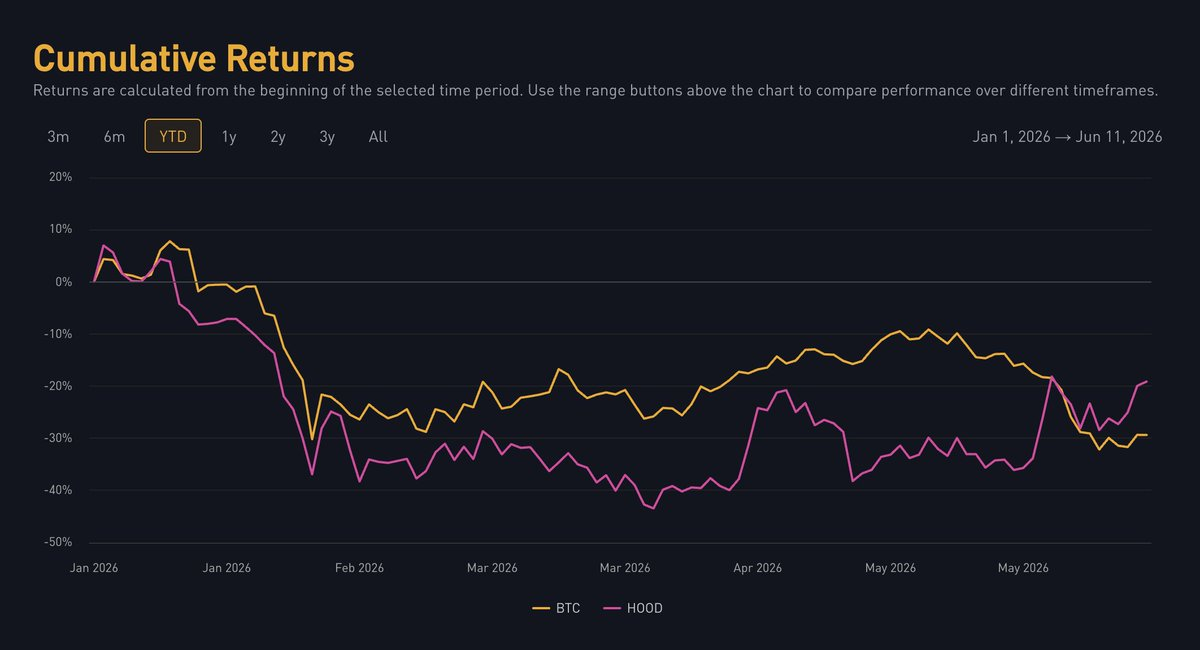
Emphasizing these two points mainly aims to illustrate that the valuation logic surrounding HOOD is beginning to change. In the past, HOOD was often seen as a "shadow stock" of the crypto market, its business performance showing clear cyclicality with crypto bull and bear markets — when the crypto market skyrocketed, retail investors rushed into Robinhood to trade altcoins frantically, commission income surged, and the stock price soared; when the crypto market was sluggish and retail investors withdrew, Robinhood's revenue would quickly decline.

But now, Robinhood is no longer as highly dependent on the crypto business as before. Even if the crypto market continues its current half-dead state, its stock trading, prediction markets, Pre-IPO business, and the newly added underwriting business can still potentially support its earnings growth.

This does not mean the cryptocurrency market will no longer affect HOOD. On the contrary, if the crypto market returns to a bull market in the future, Robinhood's crypto trading revenue will likely explode again, and HOOD can still enjoy the benefits of industry growth.

In more straightforward terms: the crypto space can still affect HOOD, but HOOD no longer depends on the crypto space — if a crypto bull market returns, HOOD will still rise with it; if the crypto space remains half-dead, HOOD doesn't care.

For all those who still hold expectations for altcoins but are increasingly worried about liquidity drying up, narrative failure, and value capture problems, instead of continuing to pin hopes on some token waiting for its next narrative cycle, the current HOOD might be an option with a higher margin of safety.


Preguntas relacionadas

QWhat are the main reasons the author gives for being optimistic about Robinhood (HOOD) stock's future performance?

AThe author is optimistic due to several key factors: strong operational data for May (record highs in Total Assets, Funded Customers, etc.), positive news developments (like Robinhood building its own prediction market Rothera and being approved as an IPO underwriter), being selected to manage the 'Trump Account' program for millions of newborn US citizens, significant insider buying by director Meyer Malka, and upward price target revisions from major investment banks.

QAccording to the article, what recent trend is observed in Robinhood's revenue dependence on cryptocurrency?

AThe article states that Robinhood's revenue dependence on cryptocurrency has been decreasing. The share of crypto-related revenue in total revenue has dropped from 35% in Q1 2025 to 13% in Q1 2026. This indicates the company is reducing its reliance on the crypto market for its financial performance.

QHow does the author describe the recent relationship between HOOD's stock price and Bitcoin's price movements?

AThe author notes that while HOOD's price often mirrored Bitcoin's movements for much of the year, a recent and significant divergence has occurred. This suggests HOOD's valuation is starting to decouple from the crypto market.

QWhat is the author's core argument for why investors with a 'meme coin obsession' should consider investing in HOOD instead?

AThe author argues that HOOD offers a safer alternative with higher security margins. While it can still benefit from a future crypto bull market, its growing non-crypto businesses (stock trading, prediction markets, IPO underwriting, the 'Trump Account' program) can support its growth even if the crypto market remains stagnant. This makes it less risky than betting on individual altcoins with uncertain prospects.

QWhat specific new business opportunities or roles does the article mention that could drive Robinhood's future growth?

AThe article highlights several new growth drivers: 1) Its own prediction market, Rothera, which allows it to retain more revenue. 2) Approval for its subsidiary, Robinhood Securities, to act as an IPO underwriter for major upcoming listings. 3) Being selected as the broker and initial trustee for the government-funded 'Trump Account' savings program for millions of American newborns.

Lecturas Relacionadas

The World Cup is Here: The Battle for Entry into Prediction Markets Has Begun

The 2026 FIFA World Cup has begun, and alongside the on-field competition, a new off-field battleground is emerging: prediction markets. These blockchain-based platforms, which convert crowd wisdom into tradable probabilities, are gaining significant traction. However, their complexity—involving wallets, gas fees, and smart contracts—has historically limited participation to crypto-native users. Centralized exchanges (CEXs), like Gate, are tackling this adoption barrier. By integrating with leading prediction market protocol Polymarket, Gate simplifies the user experience. Users can participate directly with their exchange account and USDT, bypassing complex Web3 steps. Gate offers a streamlined "Prediction Mode" for casual users and a professional "Trading Mode" with advanced tools. Key features include two-way trading (allowing users to buy or sell positions before event resolution), support for diverse markets (sports, crypto, macroeconomics), and a suite of information tools like a "Smart Money" leaderboard, wallet tracking, and AI-powered insights. For the World Cup, Gate launched a dedicated hub aggregating schedules, standings, and relevant markets. This allows fans to seamlessly follow games and trade on outcomes, transforming passive viewing into active participation where they can monetize their predictions and trade on shifting consensus throughout a match. The article argues that prediction markets have proven their value in event forecasting. The next challenge is mass adoption. The competition is shifting from building effective protocols to creating accessible user entry points. By lowering technical barriers and building a complete ecosystem for information and trading, platforms like Gate aim to transition prediction markets from a niche crypto tool to a mainstream platform for expressing and trading on collective intelligence.

Odaily星球日报Hace 11 min(s)

The World Cup is Here: The Battle for Entry into Prediction Markets Has Begun

Odaily星球日报Hace 11 min(s)

Spain Held to a Draw by Cape Verde, Jucom Prediction Market Witnesses Historic Upset

In a major upset at the 2026 FIFA World Cup, tournament favorites Spain were held to a surprising 0-0 draw by debutants Cape Verde in their Group H opener on June 16, Beijing time. Despite dominating possession (74%) and recording 27 shots with an expected goals figure of 2.16, Spain failed to break down a resilient Cape Verde defense, with their 40-year-old goalkeeper Vozinha making 7 saves to earn Man of the Match. Pre-match predictions on the Jucom prediction market had heavily favored Spain, assigning them a 92% win probability. The actual result, a goalless draw, triggered significant volatility across related prediction markets. This outcome forces a market-wide reassessment of several key probabilities, including Spain's likelihood of winning the group and the tournament itself, while Cape Verde's previously near-zero chance of advancing is now being re-evaluated. The event highlights both the efficiency and the inherent limitations of prediction markets. While prices aggregate known information, football's low-scoring, high-variance nature means unquantifiable in-game factors can lead to unlikely results. The core value of such markets lies not in perfect foresight but in their ability to dynamically reflect how new information is incorporated into collective expectations. Platforms like Jucom, which track outcomes from single matches to the final champion, provide a real-time lens into how global consensus evolves with each game.

链捕手Hace 15 min(s)

Spain Held to a Draw by Cape Verde, Jucom Prediction Market Witnesses Historic Upset

链捕手Hace 15 min(s)

Standard Chartered Bank Places a 40x 'Bet', Calls for UNI to Rise to $100

Standard Chartered Bank’s digital asset research head, Geoff Kendrick, initiated coverage on Uniswap with a highly bullish long-term price target of $100 for its UNI token by 2030—a roughly 40-fold increase from its ~$2.60 trading price at the time of the report. The bank’s thesis hinges on the exponential growth of tokenized real-world assets (RWA), projected to surge from ~$340 billion to $4 trillion by 2028. It expects the share of these assets deployed in DeFi to rise from 3.5% to 30%, driving total DeFi TVL to around $2.7 trillion. As the leading decentralized exchange (DEX), Uniswap is positioned to capture a significant portion of this liquidity influx. A key catalyst is Uniswap’s “fee switch,” activated in late 2024, which directs a portion of protocol fees to UNI token buybacks and burns. This transforms UNI from a pure governance token into a yield-generating, deflationary asset, narrowing its valuation gap with centralized exchanges like Coinbase. The report draws an analogy: Coinbase operates like Netflix (centralized, high-cost), while Uniswap functions like YouTube (open, user-generated, network-effect driven). Despite its dominant market share and recent institutional adoption—such as BlackRock’s BUIDL fund and Fidelity’s stablecoin using Uniswap for liquidity—the path faces challenges. Competition from Solana-based DEXs and aggregators threatens user mindshare, while regulatory delays or setbacks in RWA adoption could slow the projected growth. Furthermore, UNI remains down over 92% from its 2021 peak, reflecting persistent market skepticism. Ultimately, Standard Chartered’s report signals a shift in traditional finance’s perception of DeFi, valuing network effects and cash flow potential. However, realizing the $100 target depends on Uniswap successfully navigating intense competition, regulatory hurdles, and the multi-year timeline for massive tokenized asset adoption.

marsbitHace 39 min(s)

Standard Chartered Bank Places a 40x 'Bet', Calls for UNI to Rise to $100

marsbitHace 39 min(s)

Trading

Spot
Futuros
活动图片




