Xpeng and NIO Compete on Computing Power, Li Auto Shifts Architecture

marsbitPublicado a 2026-06-16Actualizado a 2026-06-16

Resumen

On June 15, 2026, Li Auto unveiled details of its self-developed chip, Mahe M100, for its new L9 Livis model. CTO Xie Yan stated the goal was not just a faster chip, but a fundamentally different one, targeting the chip architecture itself. While competitors like NIO, Xpeng, and Huawei highlight TOPS (computing power) figures for their self-developed chips, Li Auto’s Mahe M100 focuses on redesigning the underlying architecture. It employs a "dynamic data flow architecture" to address memory bandwidth bottlenecks in large model inference, claiming up to 3x the effective computing power of Nvidia's Thor U for its specific workloads and a 40% reduction in latency. The chip's design was peer-reviewed and accepted at ISCA 2026. However, this performance is highly optimized for Li Auto's own VLA2.1 algorithm, meaning it may not generalize as well to other tasks. Li Auto aims to achieve full-stack in-house development with Mahe M100, covering chip, compiler, OS, AI algorithms, and domain controller—a level of vertical integration few competitors match. Beyond the chip, CEO Li Xiang introduced a new strategic narrative: the "embodied intelligent vehicle," defined as an integration of an EV, a professional driver, an AI computer, and a life assistant. This shifts competition from features like large screens to systemic AI capabilities. A key commitment was that Li Auto's Mahe VLA autonomous driving model will match Tesla's FSD V14 by Q4 2026, with specific OTA milestones set for J...

On June 15th, Li Auto detailed the specifics of its in-house developed chip, Mahe M100, during a launch event. This chip is designed for the next-generation L9 Livis. CTO Xie Yan emphasized: It's not just about creating a chip that's faster than before, but about creating a fundamentally different type of chip. This 'difference' refers to the chip architecture.

In 2026, amidst a wave of automakers developing their own chips, TOPS is the most commonly used marketing metric. The NIO Shenji NX9031, Xpeng Turing, and Huawei MDC 810 Pro all prominently feature their computational power figures. Li Auto has chosen to fundamentally alter the underlying architecture.

The Mahe M100 aims to prove that architecture is more important than raw compute numbers. But whether it's right or not still needs to be tested by the market.

01. The Divergence in Chip Development Amidst Compute Power Inflation

Developing in-house chips has become a common choice for leading domestic automakers.

The NIO Shenji NX9031 is the world's first 5nm high-performance autonomous driving chip. Its special feature is its self-developed ISP, which improves pedestrian recognition rate by 40% in low-light conditions of 1 lux at night, showing significant reinforcement at the perception layer.

Xpeng's Turing chip also demonstrates clear customization, specifically designed for Xpeng's autonomous driving large model, with plans to extend to flying cars and robots.

Huawei has taken another path, using Ascend for MDC, emphasizing complete alignment between cloud training and vehicle-side inference, "one minute of training in the cloud, one minute of following in the vehicle."

These companies' chips are variants of the von Neumann architecture: a central processing unit, with data being shuttled back and forth between computing units and memory. The more advanced the process node, the faster the data moves, but the Mahe M100 aims to change the very act of moving data itself.

02. Altering the Underlying Logic

The von Neumann architecture wasn't a problem in the era of general-purpose computing, but large model inference is a different computational paradigm. VLM inference involves large-scale matrix parallelism, not sequential instruction execution. The bottleneck is almost entirely in memory bandwidth; the overhead of data repeatedly moving in and out of memory directly consumes a significant portion of the effective computing power.

The concept of the dynamic dataflow architecture is to allow data to flow along the computational graph, eliminating the need to repeatedly store it back in memory. Li Auto claims the result is that a single Mahe M100 chip offers approximately 3 times the effective computing power of NVIDIA's Thor U, with a 40% reduction in end-to-end latency.
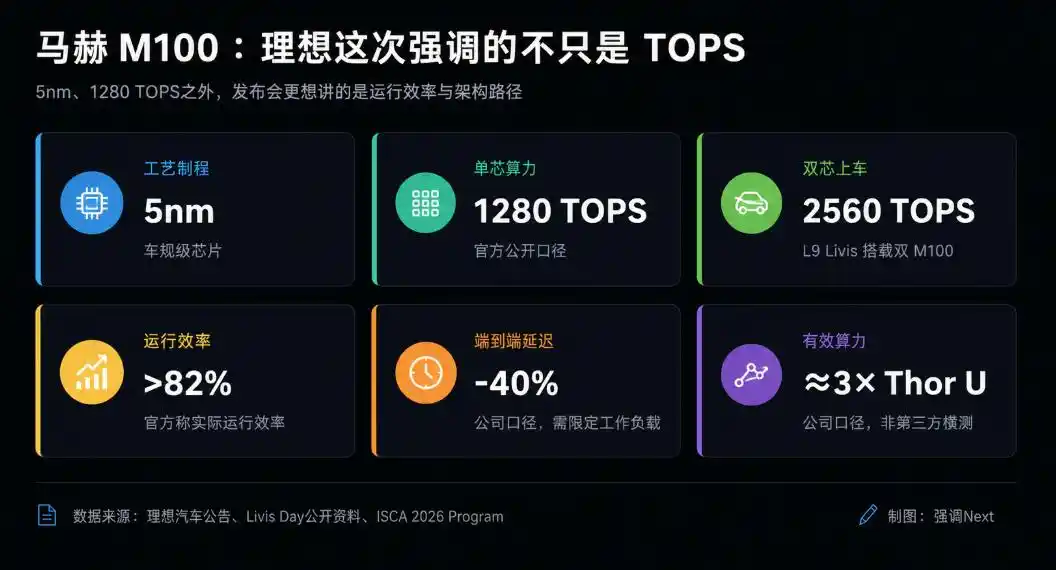
How credible is this "3 times" claim? There is one piece of external verification. The architecture paper for the Mahe M100 was accepted into the Industry Track of ISCA 2026. ISCA is a top-tier academic conference in computer architecture. Papers in the Industry Track undergo peer review, and the design details of the architecture are public. Li Auto is the first automobile manufacturer ever to be selected for this track since its establishment.

However, the 3x figure comes with its prerequisites. Effective computing power depends on the specific workload. The 3x performance achieved while running Li Auto's VLA2.1 algorithm may not hold up under a different system. The Mahe M100 is an algorithm-native chip, developed simultaneously with the model, deeply optimized for the company's own algorithms. It runs its own models best; performance on general tasks may vary.

This shares similarities with the design logic of Xpeng's Turing chip and Tesla's FSD Chip. The difference is that Tesla and Xpeng didn't make a paradigm shift at the architecture level; the Mahe M100 has made fundamental changes to the underlying logic. Whether an automaker can successfully bring a completely new architecture to reliable mass production is itself an unprecedented challenge.

With the deployment of the Mahe M100, Li Auto has achieved full-stack in-house development across chips, compilers, operating systems, AI algorithms, and domain controllers. This closed-loop system is uncommon among its peers.

NIO has its own chip but different levels of OS dependency. Xpeng develops its own chip but its compiler and OS still rely on external solutions. Huawei has a closed loop, but it is not a vehicle manufacturer. The strategic significance of Li Auto's chain lies in making it less susceptible to NVIDIA's supply chain control, keeping data within its own platform, and fully owning the optimization space for software-hardware synergy.

03. First-Mover Positioning in "Embodied AI"

The chip was only one of the stars of the launch event. Li Xiang also proposed a "Four-in-One" definition for embodied AI cars during the presentation: an electric vehicle, a professional driver, an AI computer, and a life assistant.

This marks a significant departure from Li Auto's past brand narrative.

In 2023, the L9 penetrated the 300,000 to 500,000 RMB market with its "Large Six-Seat Family SUV" positioning, followed by a generation of similarly styled models. The problem with this positioning is its low replication cost. Competitors like the AITO M9, NIO ES9, and Zeekr 9X have entered the fray. Refrigerators, screens, and large sofas have become industry standards, making it hard for any player to differentiate, leading only to price wars.

The "Embodied AI Car" shifts the competitive dimension from configurations to system capabilities. Within this framework, refrigerators and rear-seat screens are basic features. The differentiation point becomes "whose system can perceive, think, and grow." Defining a new category itself is a strategic asset; whoever articulates it first gains positioning.

Li Auto has matched this narrative with a relatively complete technological chain: the Mahe M100 computing foundation, the Mahe VLA2.1 autonomous driving large model, the Mahe Mind-Pro and Mind-Edge edge-side foundation models, and the Starlink OS for full-stack integration, with each layer having corresponding product implementations.

The launch event demonstrated features like the vehicle moving to music, a 4D racing simulator, and command-based parking – these are tangible experiences. Li Xiang also stated during the launch that autonomous driving is only the "first half" of embodied AI, with general-purpose humanoid robots being the "second half," but the specific timeline and implementation path for the second half remain unclear.

04. The Q4 Mandate

There was another crucial statement during the launch: Li Auto's autonomous driving large model, Mahe VLA, will comprehensively benchmark against Tesla's FSD V14 in Q4 of this year.

Li Xiang's consistent style is to make public commitments, using external pressure to drive internal execution. Having stated Q4 benchmarking against FSD V14, everyone will use that ruler to measure them by year-end.

In terms of technical route, Li Auto's choice is highly isomorphic to Tesla's: end-to-end + VLA large model + primarily vision-based. Huawei follows a path of lidar + multi-sensor fusion + a hybrid of rules and neural networks, offering stable short-term engineering implementation with lower compute demands. However, in the long run, if the vision-based + large model route ultimately prevails, Huawei's system may face greater switching costs. Li Auto is betting on the same technological belief as Tesla. Whether this judgment is correct will become clearer by year-end.

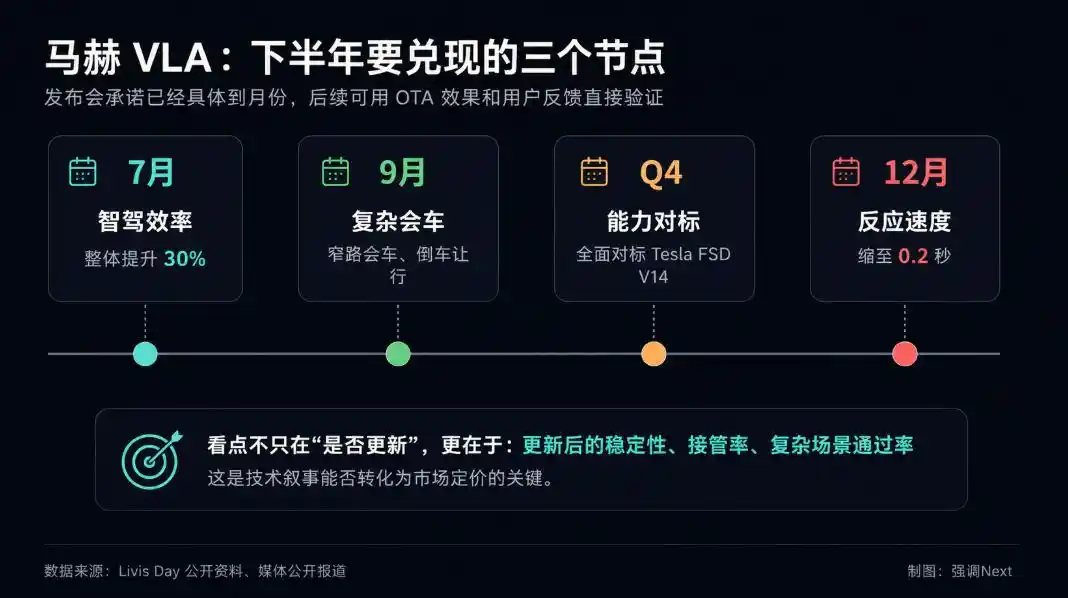
The OTA promises for the second half of the year are specified by month. July: a 30% improvement in autonomous driving efficiency. September: implementation of narrow-road meeting/backing-up yielding. December: vehicle response speed reduced to 0.2 seconds. Each milestone has clear technical indicators, providing data for comparison by year-end.
05. Several Data Points Beyond the Launch Event

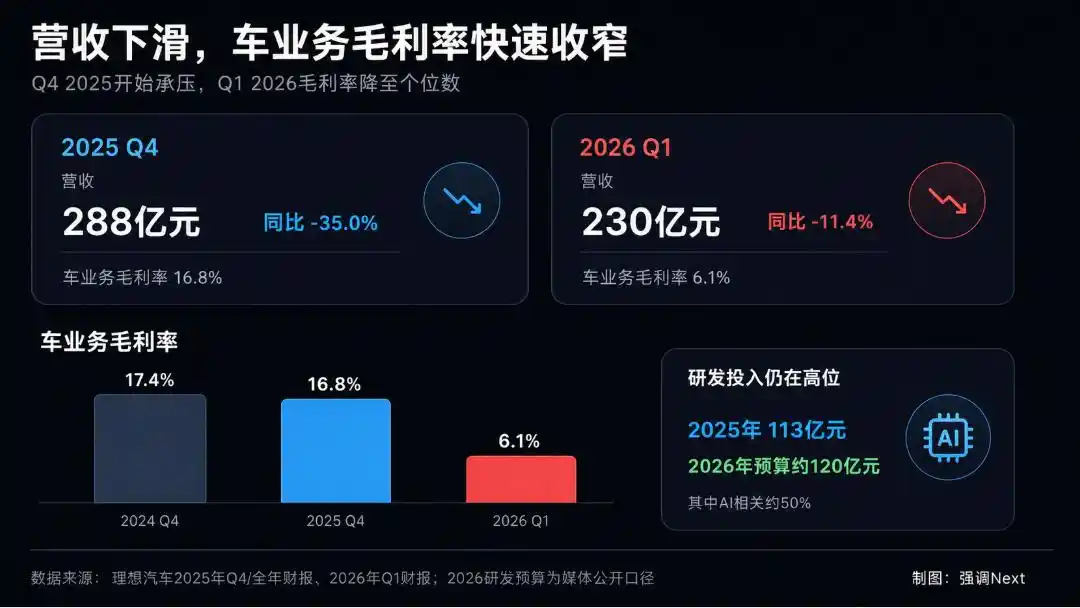
Li Auto's current financial situation is not easy. Since Q4 2025, its revenue has declined year-over-year, and automotive business gross margins have noticeably narrowed. Meanwhile, the R&D budget for 2026 remains around 12 billion RMB, with approximately 50% allocated to AI-related areas, essentially flat compared to 11.3 billion RMB and 50% in 2025. R&D investment is not decreasing, yet profitability pressure persists.
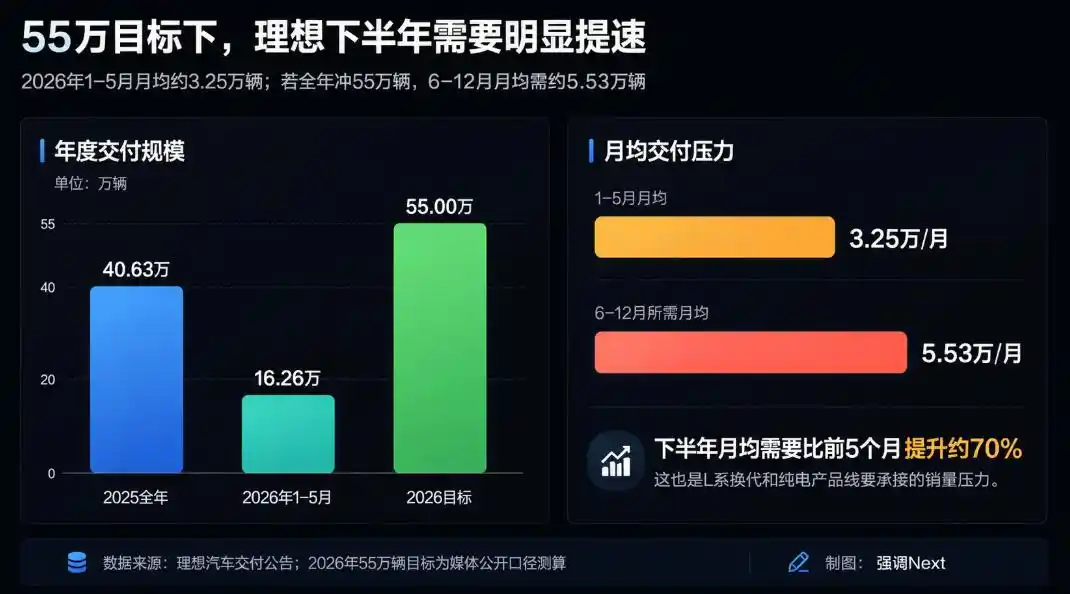
In terms of sales, Li Auto's target for 2026 is 550,000 units. Actual deliveries in 2025 were 406,000 units. May 2026 saw single-month deliveries of 33,000 units, still showing a year-over-year decline. The L9 Livis received over 10,000 non-refundable deposits within two weeks of launch, showing stable performance in the 500,000+ RMB market. However, overall delivery volume still relies on the full model changeover of the L series and the release of the pure electric product line in the second half of the year.
At the chip level, the deep binding of the Mahe M100 with its own algorithms is a design choice that brings advantages in software-hardware synergy efficiency. This also means that if future technological routes require adjustment, the switching cost would be higher than for manufacturers using third-party chip solutions. Xpeng's Turing, NIO's Shenji, and Tesla's FSD Chip face similar situations; this is an industry-wide characteristic of in-house developed, algorithm-native chips.

06. Q3 Will Reveal the Cards

The initial effects of the new L9 launch, the subsequent L8 update, and the first July OTA milestone will all be reflected in the Q3 financial report.

Xie Yan said he needed to create a completely different chip. Having the architecture paper pass peer review counts as external validation of the design concept. But the journey from design to mass production, and then to real user feedback in daily driving, is still long. The July OTA milestone is the first test; the year-end benchmarking against FSD V14 is an even more critical one.

This article is from the WeChat public account "EmphasizeNext" (ID: leo89203898), author: Yixiu, editor: Xiaobai


Preguntas relacionadas

QWhat is the key design choice that differentiates Li Auto's self-developed Mach M100 chip from its competitors?

ALi Auto's Mach M100 chip adopts a dynamic dataflow architecture, moving away from the traditional von Neumann architecture. This approach focuses on reducing the data movement bottleneck (data shuttling between memory and compute units) inherent in AI model inference, aiming to improve effective computing power and lower latency, rather than just increasing raw TOPS.

QAccording to the article, what is Li Auto's strategic goal with its 'Embodied Intelligent Vehicle' concept, and how does it differ from its previous branding?

ALi Auto's strategic goal with the 'Embodied Intelligent Vehicle' concept is to shift the competitive dimension from hardware configurations (like large screens and refrigerators) to system capabilities in perception, reasoning, and growth. This differs from its previous 'family SUV' branding focused on space and comfort. The new concept aims to establish a new product category and gain a first-mover positioning in the evolving smart car market.

QWhat specific public commitment did Li Xiang make regarding Li Auto's autonomous driving technology for Q4 2026?

ALi Xiang committed that Li Auto's Mach VLA intelligent driving large model will be comprehensively benchmarked against Tesla's FSD V14 in the fourth quarter of 2026. This public commitment uses external pressure to drive internal execution, with the results being measurable by year-end.

QWhat are the potential advantages and risks associated with Li Auto's full-stack in-house development approach (chip, OS, AI algorithm, etc.)?

AAdvantages: It creates a closed-loop system that prevents supply chain constraints (e.g., from Nvidia), keeps data within its own platform, and allows for deep, autonomous software-hardware co-optimization. Risks: The chip is algorithm-native, deeply optimized for its own models. This creates high switching costs if future technology paths require significant changes, and it may not perform as well on generic tasks compared to more general-purpose chips.

QWhat financial and sales challenges does Li Auto face in 2026, according to the article?

AFinancially, Li Auto faces pressure with year-on-year revenue decline since Q4 2025 and narrowing gross margins for its vehicle business, while maintaining high R&D investment (around 12 billion RMB, 50% AI-related). Sales-wise, it aims for 550,000 deliveries in 2026, but actual 2025 deliveries were 406,000, and monthly deliveries in May were down year-on-year. It relies on the new L9 Livis and upcoming full-line model refreshes and pure-electric products to boost sales in the second half of the year.

Lecturas Relacionadas

Standard Chartered Bank Places a 40x 'Bet', Calls for UNI to Rise to $100

Standard Chartered Bank’s digital asset research head, Geoff Kendrick, initiated coverage on Uniswap with a highly bullish long-term price target of $100 for its UNI token by 2030—a roughly 40-fold increase from its ~$2.60 trading price at the time of the report. The bank’s thesis hinges on the exponential growth of tokenized real-world assets (RWA), projected to surge from ~$340 billion to $4 trillion by 2028. It expects the share of these assets deployed in DeFi to rise from 3.5% to 30%, driving total DeFi TVL to around $2.7 trillion. As the leading decentralized exchange (DEX), Uniswap is positioned to capture a significant portion of this liquidity influx. A key catalyst is Uniswap’s “fee switch,” activated in late 2024, which directs a portion of protocol fees to UNI token buybacks and burns. This transforms UNI from a pure governance token into a yield-generating, deflationary asset, narrowing its valuation gap with centralized exchanges like Coinbase. The report draws an analogy: Coinbase operates like Netflix (centralized, high-cost), while Uniswap functions like YouTube (open, user-generated, network-effect driven). Despite its dominant market share and recent institutional adoption—such as BlackRock’s BUIDL fund and Fidelity’s stablecoin using Uniswap for liquidity—the path faces challenges. Competition from Solana-based DEXs and aggregators threatens user mindshare, while regulatory delays or setbacks in RWA adoption could slow the projected growth. Furthermore, UNI remains down over 92% from its 2021 peak, reflecting persistent market skepticism. Ultimately, Standard Chartered’s report signals a shift in traditional finance’s perception of DeFi, valuing network effects and cash flow potential. However, realizing the $100 target depends on Uniswap successfully navigating intense competition, regulatory hurdles, and the multi-year timeline for massive tokenized asset adoption.

marsbitHace 11 min(s)

Standard Chartered Bank Places a 40x 'Bet', Calls for UNI to Rise to $100

marsbitHace 11 min(s)

For Those Still Obsessed with Altcoins, Just Go All-in on HOOD

Title: "For Those Still Fixated on Altcoins, Just Bet on HOOD" The article argues that Robinhood (HOOD) stock is a compelling alternative for investors still holding onto hopes for altcoin rallies. It highlights HOOD's recent strong performance, briefly touching $100, and expresses continued optimism. The bullish thesis is multi-faceted: HOOD's operational data for May showed record highs in key metrics like total assets and funded customers, though crypto volume was weaker. Positive catalysts include Robinhood launching its own prediction market (Rothera) to capture more revenue, gaining approval to act as an IPO underwriter for major upcoming listings, and being selected to manage the new "Trump Account" government savings program for millions of future US newborns. Insider and institutional buying, along with raised price targets, provide further confidence. The core argument is that HOOD is successfully decoupling from the crypto market's fortunes. While crypto-related revenue was once a major contributor, its share of total revenue has been declining, hitting 13% in Q1 2026. Although HOOD's price historically moved with Bitcoin, a recent divergence is noted. The author posits that Robinhood's growing equity trading, prediction markets, and IPO-related businesses can drive growth independently of a crypto bull market. Thus, HOOD offers asymmetric exposure: it stands to benefit if the crypto market recovers but is no longer wholly dependent on it. For those disillusioned with altcoins' risks, HOOD presents a potentially safer way to maintain exposure to the fintech and speculative trading space.

marsbitHace 20 min(s)

For Those Still Obsessed with Altcoins, Just Go All-in on HOOD

marsbitHace 20 min(s)

For Those Still Obsessed with Altcoins, Just Buy HOOD

The author expresses bullish sentiment on Robinhood (HOOD) stock, citing multiple positive catalysts. Recent monthly operational data shows record highs in key metrics like total assets, funded customers, and margin balances. On the news front, Robinhood launched its own prediction market (Rothera), received approval to act as an IPO underwriter, and was selected to manage the new "Trump Accounts" for U.S. newborns, ensuring a long-term user base. Insiders and institutions are also buying or raising price targets. The core investment thesis, however, focuses on HOOD's evolving valuation narrative. Historically viewed as a "crypto proxy," its stock price was highly correlated with Bitcoin and its revenue heavily dependent on cryptocurrency trading fees. Recent data indicates this dependence is waning: crypto-related revenue hit a multi-quarter low of 13% of total revenue in Q1 2026, and the stock price has recently decoupled from BTC's trend. The author argues HOOD is transforming into a more diversified platform. Its growth is now driven by equities, options, prediction markets, and IPO-related services. This reduces its cyclical vulnerability to crypto bear markets. Crucially, if the crypto market recovers, HOOD would still benefit from increased trading activity. Therefore, for investors still hoping for gains from altcoins but concerned about their risks and liquidity, the author suggests HOOD offers a compelling alternative with higher safety margins—it can rise with a crypto bull run but isn't reliant on one.

Odaily星球日报Hace 24 min(s)

For Those Still Obsessed with Altcoins, Just Buy HOOD

Odaily星球日报Hace 24 min(s)

Trading

Spot
Futuros

Artículos destacados

Cómo comprar HOUSE

¡Bienvenido a HTX.com! Hemos hecho que comprar Housecoin (HOUSE) sea simple y conveniente. Sigue nuestra guía paso a paso para iniciar tu viaje de criptos.Paso 1: crea tu cuenta HTXUtiliza tu correo electrónico o número de teléfono para registrarte y obtener una cuenta gratuita en HTX. Experimenta un proceso de registro sin complicaciones y desbloquea todas las funciones.Obtener mi cuentaPaso 2: ve a Comprar cripto y elige tu método de pagoTarjeta de crédito/débito: usa tu Visa o Mastercard para comprar Housecoin (HOUSE) al instante.Saldo: utiliza fondos del saldo de tu cuenta HTX para tradear sin problemas.Terceros: hemos agregado métodos de pago populares como Google Pay y Apple Pay para mejorar la comodidad.P2P: tradear directamente con otros usuarios en HTX.Over-the-Counter (OTC): ofrecemos servicios personalizados y tipos de cambio competitivos para los traders.Paso 3: guarda tu Housecoin (HOUSE)Después de comprar tu Housecoin (HOUSE), guárdalo en tu cuenta HTX. Alternativamente, puedes enviarlo a otro lugar mediante transferencia blockchain o utilizarlo para tradear otras criptomonedas.Paso 4: tradear Housecoin (HOUSE)Tradear fácilmente con Housecoin (HOUSE) en HTX's mercado spot. Simplemente accede a tu cuenta, selecciona tu par de trading, ejecuta tus trades y monitorea en tiempo real. Ofrecemos una experiencia fácil de usar tanto para principiantes como para traders experimentados.

247 Vistas totalesPublicado en 2025.04.27Actualizado en 2026.06.02

Cómo comprar HOUSE

Discusiones

Bienvenido a la comunidad de HTX. Aquí puedes mantenerte informado sobre los últimos desarrollos de la plataforma y acceder a análisis profesionales del mercado. A continuación se presentan las opiniones de los usuarios sobre el precio de HOUSE (HOUSE).

活动图片