According to AI insights from Investment Community, Beijing Zhongshu Ruizhi Technology Co., Ltd. ("Zhongshu Ruizhi"), a domestic industrial-grade causal intelligence and high-reliability decision-making AI company, recently announced the completion of a strategic financing round amounting to several hundred million RMB. This round of investment was jointly led by the China Internet Investment Fund (CIIF), Suzhou Chuang Tou's National Social Security Fund, Financial Street Capital, ICBC Capital, Kunlun Capital, etc., with existing shareholders also increasing their follow-on investments.
Just three months ago, Zhongshu Ruizhi had already completed a Series B funding round at the hundred-million-yuan level.
Securing two substantial funding rounds within such a short period reflects not only the capital market's high recognition of its underlying original technology and scaled implementation results but also signifies that this AI enterprise, regarded by the industry as the "Chinese version of Palantir," has officially entered a new development stage marked by accelerated technological iteration, wide-scale scenario replication, and large-scale performance realization. This rapid rise can be described as a microcosm of the explosion in China's AI intelligent market.
Tsinghua Female PhD
Builds the "Chinese Version of Palantir"
The founding team of Zhongshu Ruizhi emerged from Tsinghua University, led by its Chairman, Dr. Han Han, and is based in Zhongguancun, Haidian.
She holds a Ph.D. from Tsinghua University's Electronic Engineering Department and was a senior visiting scholar at Columbia University. During her time at Tsinghua, she delved deep into data engineering and AI algorithms. After graduation, she joined the China Academy of Information and Communications Technology (CAICT). There, Dr. Han Han was deeply involved in national-level top-level design for big data and artificial intelligence, serving as a core drafting member for multiple national policies. She also holds dozens of invention patents and has long been tracking global AI technology and industry trends.
At the end of 2019, as large model technology began to emerge globally, Dr. Han Han recognized a new opportunity and resolutely entered the industry, formally founding Zhongshu Ruizhi in April 2020—with the mission of "enabling AI to move from the digital world to the physical world." The company focuses deeply on the high-reliability, strong-decision-making industrial AI track, concentrating on enterprise-grade full-stack AI Agent infrastructure.
At that time, this team aimed to solve a world-class challenge: China possesses the world's most complex and largest energy and industrial systems, accumulating massive amounts of data that are difficult to utilize effectively. Existing data infrastructure is designed for human analysts and cannot meet the needs of AI Agents for complex decision-making, with no mature technical models available for reference even overseas.
Therefore, Zhongshu Ruizhi had to, without precedent, build entirely new intelligent operating systems for these critical industries through independent innovation.
Since its establishment, Zhongshu Ruizhi has gathered a large number of master's and doctoral talents specializing in complex system modeling and industrial energy AI, possessing a composite capability for original innovation in underlying model technology, frontier theoretical research, and practical experience in large-scale industrial scenarios—the most distinctive label for this team is not only "top academic achievers" but also "AI craftsmen who best understand the industry."
Technological breakthroughs are the real game-changer. Relying on three independently developed core underlying technologies—the original Meta-Causal Cognition Theory, causal models, and the dynamic ontology engine—Zhongshu Ruizhi directly addresses industry pain points that generative large models have long struggled to solve: AI hallucination, insufficient reasoning capabilities, lack of temporal logic, unverifiable decisions, and conflicts among multi-source rules. This truly provides industrial scenarios with trustworthy, explainable, and closed-loop executable intelligent decision-making capabilities.
Specifically, general large models learn correlations from vast amounts of text, akin to memorizing countless on-site photos, guessing patterns through phenomena; whereas causal models grasp the functional relationships between equipment and processes, like obtaining a device's schematic diagram. Photos help you recognize scenes you've seen; a schematic allows you to judge what might happen in unseen situations. In scenarios with extremely low fault tolerance, such as energy dispatch, safety production, and high-end manufacturing, it can predict changes, deduce consequences, making every AI decision traceable, controllable, and justifiable.
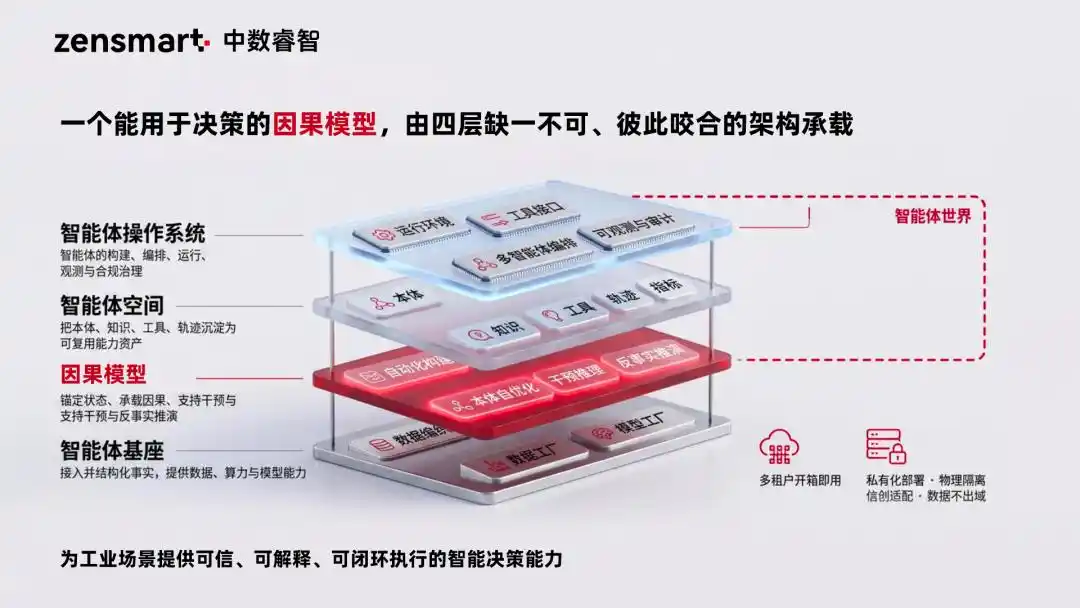
Causal Model Product Matrix
Beyond technology, Zhongshu Ruizhi is also actively participating in industry top-level construction. The company's original Meta-Causal Cognition Theory fills a domestic gap in underlying theories for trustworthy AI in complex industries. At the 2026 World Artificial Intelligence Conference (WAIC), Zhongshu Ruizhi officially released the "Causal World Model Technology System Blue Book," promoting the establishment of industry consensus on trustworthy AI evaluation and possessing industry discourse power in the next-generation physical AI track.
During this period, investors flocked in.
In 2025, it was notable that Zhongshu Ruizhi completed a 200 million RMB A+ funding round, co-led by CDH VGC and the Beijing AI Fund, with participation from Taiya Investment, Xiangcheng Financial Holding, Sichuan Cultural Investment, etc. This became one of the largest financing rounds in the domestic enterprise-grade agent sector at that time.
Less than a year later, Zhongshu Ruizhi completed another hundred-million-yuan-level Series B financing round, co-led by Tsinghua Holdings Jinyin Capital, Yuanhe Zhongyuan, and Shangxianhu Fund, with Guangdong Expressway following as an investor. Existing shareholder CDH VGC continued to increase its investment.
Now, with the backing of diversified national-level shareholders, Zhongshu Ruizhi will further connect its closed loop of "original underlying technology - production scenario implementation - global market expansion," opening up ample space for long-term growth.
Why Did CIIF Invest?
Commercial implementation is the best touchstone for technological barriers.
Relying on its core technology and product system, Zhongshu Ruizhi has become one of the first domestic enterprise-grade agent operating system providers to achieve scaled commercial implementation: To date, it has served more than 50 central state-owned enterprises, state-owned enterprises, and industrial group clients in sectors like power, petroleum, and aerospace, implementing over 800 highly complex production scenarios. Its cross-industry product capability has been rigorously tested in real-world applications.
In terms of operational quality and company development, Zhongshu Ruizhi has broken free from the dilemma faced by the vast majority of AI startups—"heavy on concepts, weak on implementation, reliant on financing for survival." It has achieved leapfrog growth commercially, doubling its revenue in 2025, establishing a fundamental profile characterized by high technological barriers, high customer repurchase rates, and high business certainty.
In other words, Zhongshu Ruizhi already possesses strong self-generating capabilities, a rarity among new-generation AI enterprises.
From technological paradigm and product architecture to service models and core customer groups, Zhongshu Ruizhi highly aligns with the global renowned industrial decision-making platform Palantir and has achieved technological surpassing. It is also one of the few hard-tech companies in China capable of delivering batch projects of pure software AI solutions worth tens of millions of RMB.
Regarding this round of financing, Dr. Han Han, Founder and Chairman of Zhongshu Ruizhi, stated that the funds will primarily be allocated to three directions: First, continuing to tackle frontier fundamental theories, iterating causal models to perfect original innovation at the foundational model layer, building a fully localized, domestically-produced intelligent base, and deepening the technological moat. Second, replicating mature benchmark applications, expanding the market footprint in main sectors, while increasing overseas service coverage to drive steady revenue growth. Third, continuously attracting high-end talent to achieve organizational leapfrog improvement and deliver high-quality industrial AI capabilities.
Currently, the AI industry is approaching a crucial inflection point—the industry is moving away from the popularity contest of general large models competing in conversational prowess. Industrial AI, which can truly enter the physical industry, assist in critical decision-making, and create tangible industrial value, is becoming the direction favored by both policy and capital.
As this round's investor, CIIF, indicated, at this pivotal moment when artificial intelligence is transitioning from the capability competition of general large models to deeply empowering the real economy, industrial-grade causal intelligence is an important component in constructing China's modernized digital foundation and fostering new quality productive forces.
"China possesses the world's most complex and stringent critical infrastructure decision-making scenarios, with the most urgent demand for trustworthy, explainable, and closed-loop executable decision-making AI. Zhongshu Ruizhi's high-reliability decision-making AI products have already achieved scaled commercial implementation in core areas such as power, petroleum, and aerospace. CIIF will continue to support the company's original innovation in underlying theories and ecosystem building, promoting close collaboration between local enterprises and central/state-owned enterprises as well as key industries like energy and high-end manufacturing. This aims to define the decision-making paradigm and trustworthy standards for industrial intelligence from the ground up, jointly propelling China to gain discourse power in rule-making within the global physical AI track, and safeguarding the security of critical infrastructure with an autonomous, controllable new-generation AI base to serve the construction of a cyberpower."
The implications as a bellwether are clear.
This article is from the WeChat public account "Investment Community AI," author: Yang Jiyun