New Insider Trading in Prediction Market Exposed: It's Impossible to Lose When You Sit in That Position

marsbitPublicado a 2026-08-20Actualizado a 2026-08-20

Resumen

PolyBeats reported on August 19 about a user who achieved a 120% return in just 89 seconds by betting that Russia would capture Konstantynivka on a prediction market platform, where the probability (and price) surged from 43% to 92%. This trade was notably the 14th in a series of perfect predictions related to the Russia-Ukraine war by this account, with a total profit of approximately $17,500. Eleven of these trades saw the probability jump to near 100% within five minutes of the purchase. The article suggests these consistent gains point to potential insider knowledge. The key is that these prediction markets on Polymarket settle based not on real-time battlefield events, but on whether the Institute for the Study of War (ISW) updates its official interactive map to show an area as controlled by Russia. Therefore, profiting reliably doesn't require military intelligence, but merely advance knowledge of when and where ISW will update its map. This mirrors a prior incident in November 2025, where an unauthorized, temporary edit to the ISW map regarding Myrnohrad allowed a trader to make over a 10,000% return before the edit was reversed. While ISW has since added safeguards like "pending review" statuses and duration requirements for map changes, the article argues the 14-trade winning streak indicates someone with access to the map update process—like an ISW staffer—could exploit the time gap between an internal decision and its public release, turning administrative knowl...

According to PolyBeats, on August 19th Beijing time, an individual achieved a 120% return within a mere 89 seconds by predicting "whether Russia could occupy a certain area on the battlefield".

This person spent $4,000 buying "Russia will seize Konstantynivka this month" on a platform called a prediction market. The probability of this event occurring was only 43% at the time. 89 seconds later, this probability rose to 92%.

On this platform where probability is price, if the event ultimately occurs, the probability will be fixed at 100%, and the position's value will rise accordingly. This mysterious figure completed placing the order, experiencing a surge, and taking profits off the table in under two minutes: in an era where various trading models are emerging endlessly, such a lucky trade is not uncommon.

The suspicious thing about this person is that Konstantynivka was his 14th such operation.
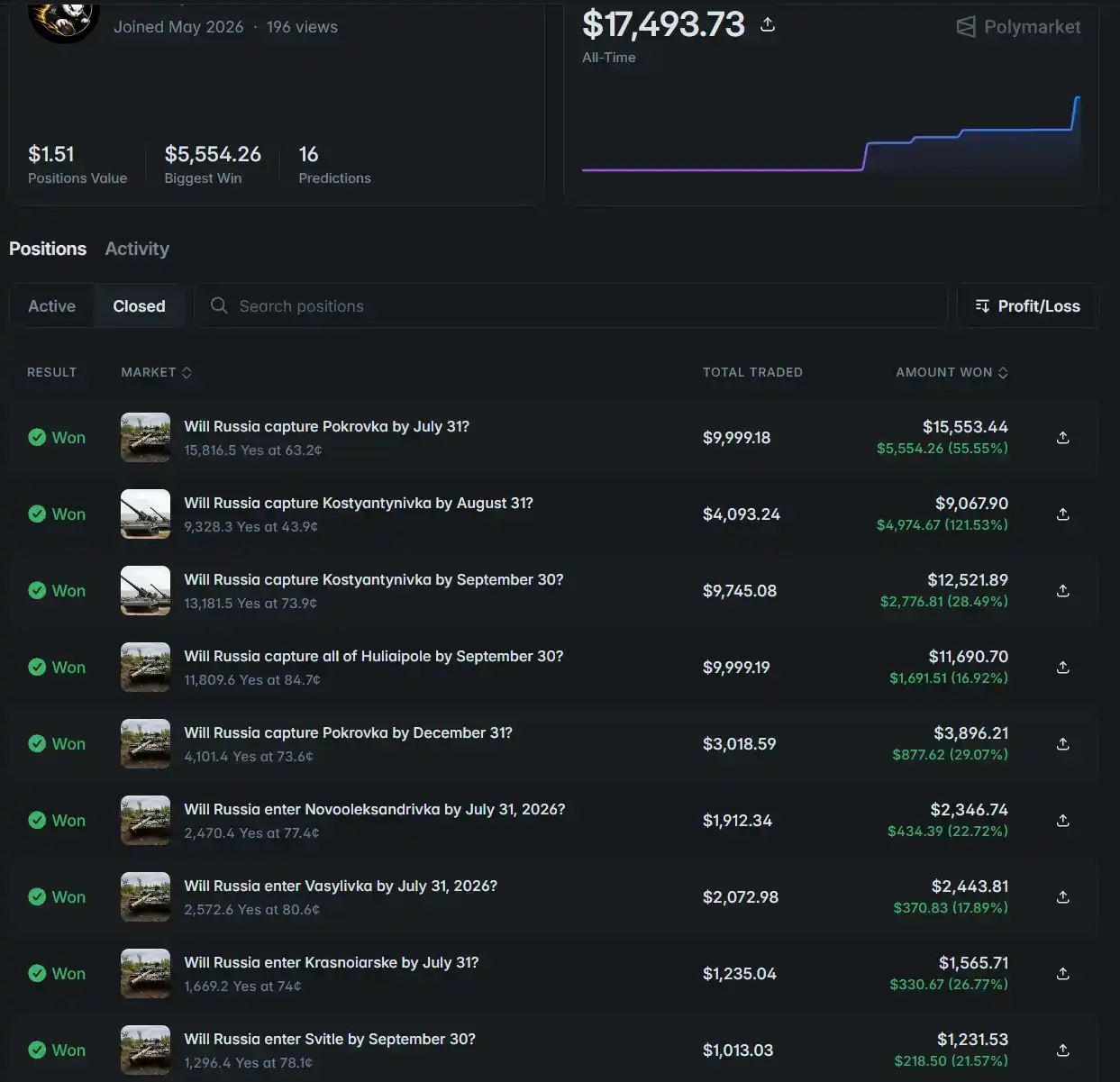
14 Predictions on Military Developments All Correct

The account's transaction records, as concluded by PolyBeats statistics, indicate that this person's account made 14 prediction trades related to the Russia-Ukraine war, all of which were correct, with a total realized profit of approximately $17,500.

They did not cover the same city, nor the same timeframe: from Maliivka, Pokrovka, to Huliaipole and Konstantynivka; some were "will Russia seize" and others were "will Ukraine re-enter". But the operations were almost like copies from the same template.

Even more bizarrely, this account not only got all 14 predictions right, but for 11 of these trades, the probability surged to near 100% within 5 minutes after the buy order.
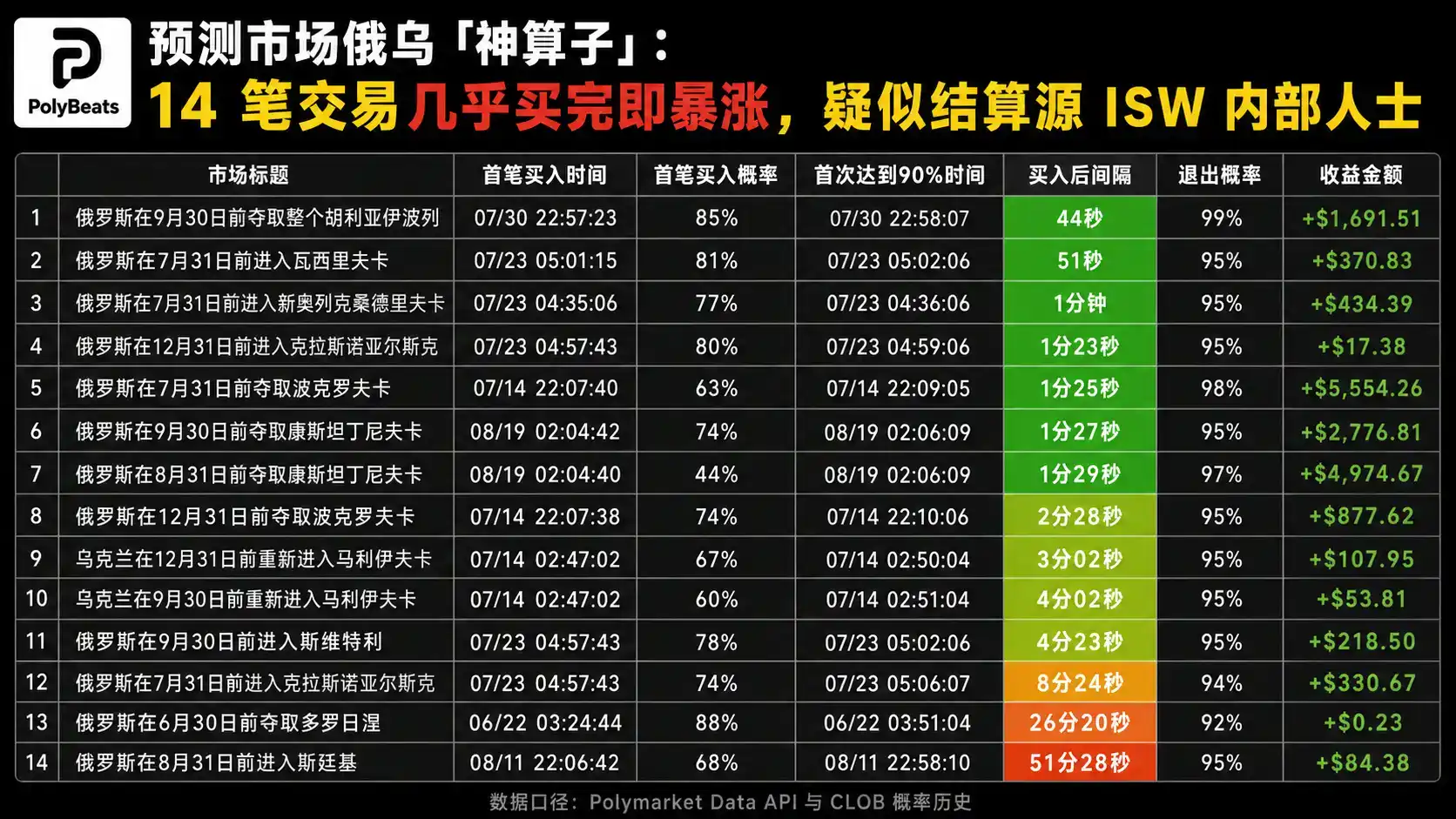
Guessing the development of the war situation correctly 14 times in a row and buying before the market probability soars is difficult. But if what one knows ahead of time is not the battlefield situation, but the map update time, things become much simpler.

Prediction Market Settlement Source: A Breeding Ground for Insiders

Almost all Russia-Ukraine occupation market titles on Polymarket follow one template:

"Will Russia seize [Region Name] by [Date]?"

While the question seems straightforward, what actually determines the answer is not when the gunfire starts.

Polymarket rules point out that only when the Russia-Ukraine battlefield map produced by ISW — the Institute for the Study of War — marks the specific area as under Russian control, and meets the duration requirement specified in the rules, will the market settle to "Yes" — the corresponding probability will settle at 100%.
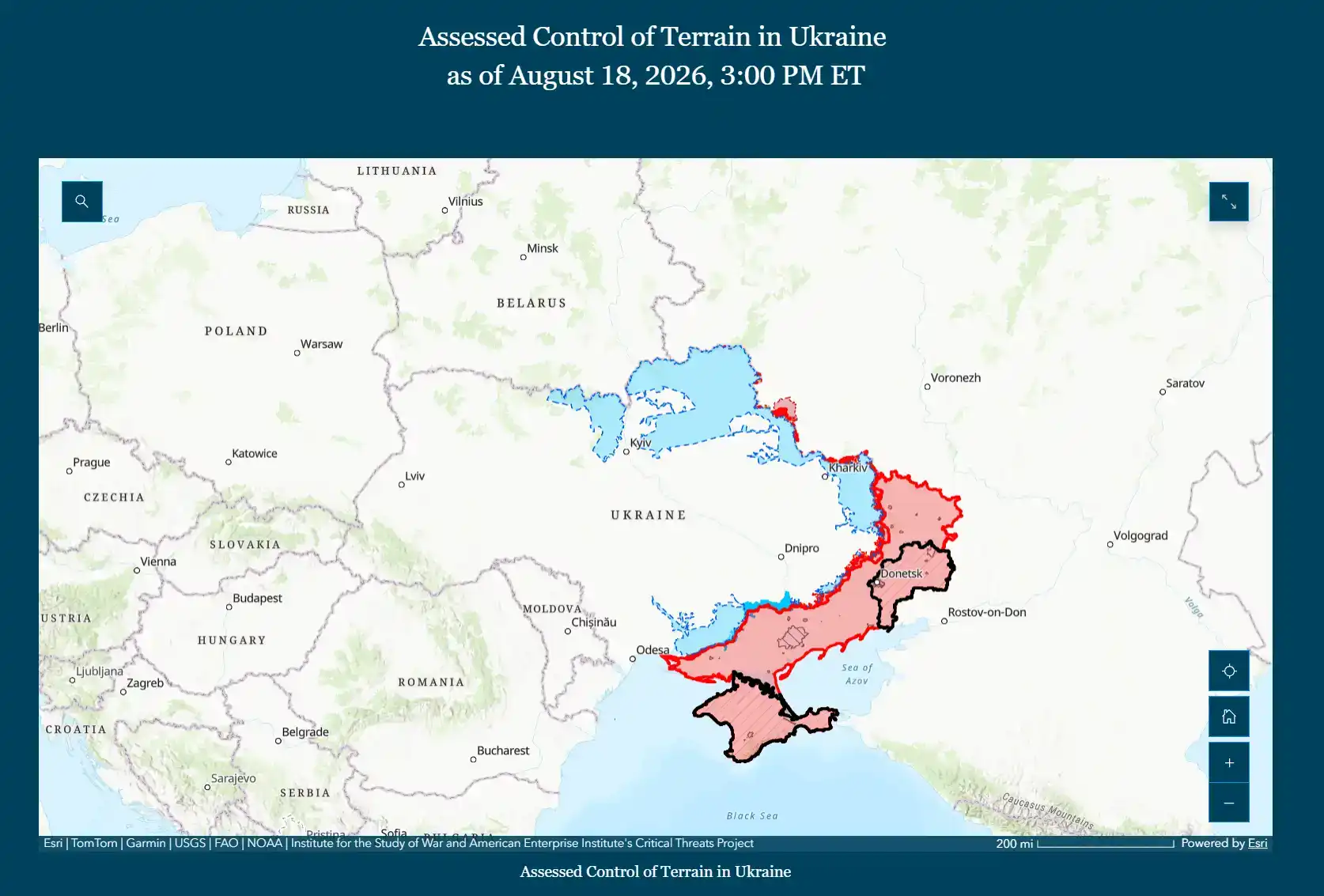
In other words, even a soldier standing in an occupied area cannot act as an insider to profit stably and long-term in such a market: even if the occupation actually occurs, as long as ISW, the settlement source, does not update the map, this market will also settle to "No".

In such a market, only one kind of person can achieve a perfect profit record like the account mentioned above: they don't need to know the frontline situation, understand Russia-Ukraine geopolitics and military strategy, or even follow any international current affairs news. They only need to know in advance which area ISW is about to mark as under Russian control, and when that update will take effect publicly.

This group of people is the technical staff responsible for updating the war status at ISW. They only need to go to the corresponding market on the prediction market to build a long position moments before clicking the mouse to confirm updating the ISW map, and they can complete a handsome profit within a minute.

Sounds like a conspiracy theory? Last year, ISW was already embroiled in a similar farce.

Employee Alters Data on Open-Source Intelligence Platform, Earns Hundreds of Times Return

In November 2025, prediction markets had already demonstrated in advance how this mechanism could spiral out of control.

At that time, the market question was "Will Russia seize Myrnohrad by November 15th?". The rules were almost identical to those described earlier — as long as the ISW map showed the Russian military controlled any part of the specified street intersection, the result could be judged as "Yes".

The biggest difference from the current rules was that the rules at the time did not have a "waiting period": as soon as the map changed, the market's settlement conditions could be met.

And on the evening of the 15th, with only a few hours left until the deadline, the probability for "Yes" was already less than 3% — with no geopolitical news reporting the occupation of Myrnohrad, everyone had already assumed this market would ultimately settle to "No".

However, at that moment, the ISW map suddenly showed the area as occupied; before most people could even react, the probability for "Yes" was instantly pushed to 100%.

In the following days, just as traders questioned that this map marking had no substantive evidence, ISW publicly admitted that between the night of November 15th and 16th, an "unauthorized, unapproved" edit occurred on the interactive map; this edit was removed before the normal workflow began on the 16th and did not represent its official battlefield assessment.

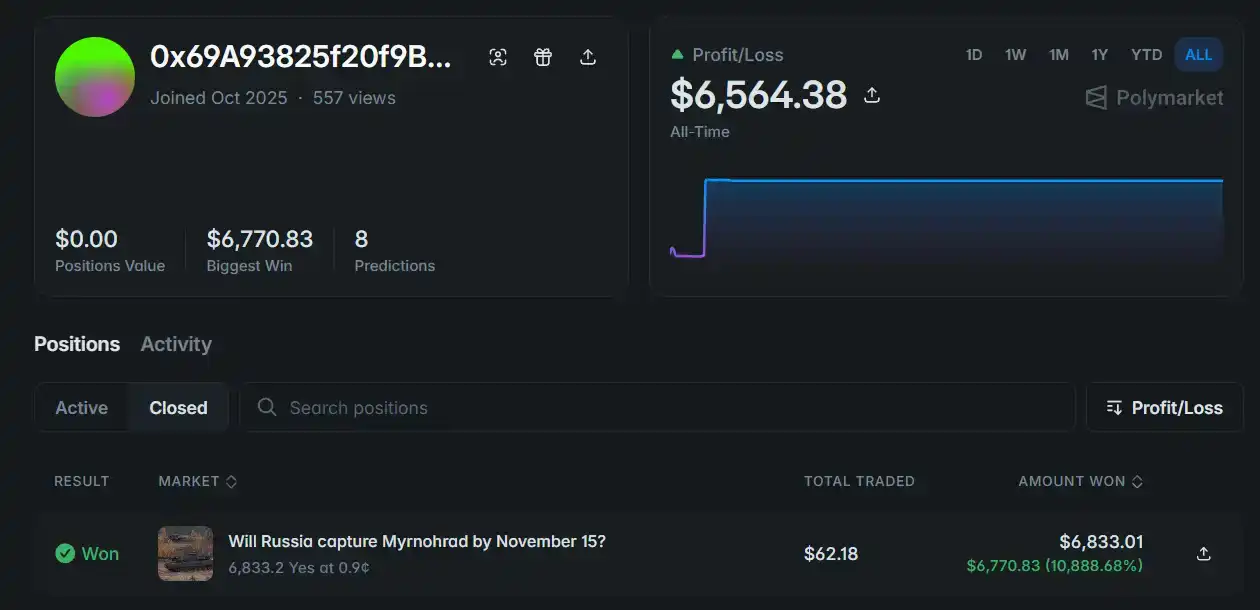
The map was withdrawn, but the market was not. Accounts that predicted "Yes" when the probability was approaching zero made a fortune through this "unauthorized edit". Among them, 0x69A9 achieved an excess return of 10,888.68% by buying when the probability was only 0.9%.
After the Myrnohrad incident, ISW stated that its map is continuously revised on weekdays and should not be understood as real-time battlefield conditions; it later also added status prompts like "Editing" and "Finalized". Related prediction markets later added stricter persistence requirements: the map status needs to persist across the next full update cycle to become a settlement basis.

As of now, this 14-time winning streak oracle has not publicly revealed their name, nor have they been charged by any institution; ISW has also not admitted to having employees profiting from map updates.

But the timeline of the 14-time winning streak is already laid out there: almost every time, it placed a bet when a city was considered "not yet determined" by the market; almost every time, it waited to sell when the market was close to certainty; almost every time, it captured the price difference between "not yet known by anyone" and "known by everyone".

In the past, an ordinary ISW employee responsible for updating the map might have been just an anonymous cog in the vast open-source intelligence system. What they held in their hands was merely a mark about to change color, an update about to be released, and a few seconds before clicking confirm.

This information originally could not be traded, and perhaps no one cared.

But when a map can determine the final settlement of a market, those few seconds before the mouse click gain a price. A person doesn't need to leak top-secret military information, manipulate the battlefield, or even change any facts; they just need to know a mark is about to appear sooner than everyone else to turn the authority granted by their position into one transaction after another of nearly guaranteed profit.

Innovation opens up a market where everyone can predict the future, but it also opens another door: when the settlement source can be seen in advance, altered in advance, or traded in advance, you and I can all become insiders.

Preguntas relacionadas

QWhat is the core mechanism that allowed the suspicious trader to profit consistently according to the article?

AThe trader did not need to know actual battlefield conditions. Instead, they had advance knowledge of when the Institute for the Study of War (ISW) map would be updated to show a specific area as Russian-controlled. Since Polymarket prediction markets settled based on the ISW map status, knowing the exact timing of a pending map update allowed for near-certain profitable trades.

QWhich organization's data serves as the official settlement source for the mentioned Polymarket contracts on the Russia-Ukraine war?

AThe Institute for the Study of War (ISW) and its interactive battlefield map serve as the official settlement source for these Polymarket prediction contracts.

QWhat was the key incident in November 2025 that exposed a vulnerability in this prediction market system?

AIn November 2025, the ISW map was subject to an 'unauthorized, unapproved' edit that briefly marked the town of Myrnohrad as Russian-controlled just hours before a market deadline. This caused the corresponding market to settle at 100% 'Yes,' allowing traders who bought at near-zero probability to make massive profits, even though the edit was quickly reverted and did not reflect an official assessment.

QHow did the rules for Polymarket's war prediction contracts change after the November 2025 incident?

AAfter the incident, prediction markets added stricter durability requirements. A map status change now needs to persist through the next full update cycle to become a valid settlement criterion, rather than being based on a single instantaneous edit.

QWhat statistical pattern makes the anonymous trader's activity highly suspicious?

AThe trader made 14 separate predictions on the outcomes of different battles or territorial control events, and all 14 were correct. Furthermore, 11 of those trades saw the market probability spike to nearly 100% within 5 minutes of the trader placing their buy order, indicating they acted just before the decisive public information (the ISW map update) was released.

Lecturas Relacionadas

190 Million: 688286 Completes Two Acquisitions Within Two Months

In August 2026, Suzhou MEMSIC Semiconductor Co., Ltd. (688286.SH), despite reporting a net loss of RMB 20.62 million for the first half of the year, announced two significant acquisitions within two months, totaling approximately RMB 189 million. The company first acquired a 51.82% stake in Suzhou Novosense Electronic Technology Co., Ltd., entering the industrial gas sensor market. Shortly after, it launched a fundraising plan to acquire a 54% stake in Beijing Pudan Optoelectronics Co., Ltd., targeting the fiber-optic gyroscope core components sector. These moves represent a strategic pivot for MEMSIC, historically reliant on the consumer electronics market (e.g., MEMS microphones, pressure sensors), which is facing slowing growth and intense price competition. By acquiring Novosense and Pudan, MEMSIC aims to diversify into higher-margin industrial (e.g., chemical safety, environmental monitoring) and high-reliability sectors (e.g., aerospace, defense), leveraging their respective expertise in chemical sensing and high-precision inertial navigation. The article details the background of founder Li Gang and MEMSIC's 19-year journey, from its pioneering role in China's MEMS industry to its 2020科创板 listing and subsequent financial struggles amidst market downturns. The recent acquisitions are framed as a critical attempt to transform from a consumer electronics-focused chipmaker into a "full-scenario sensing platform" company. However, risks are noted, including the challenge of integrating the acquired companies, Pudan Optoelectronics' current unprofitability, and the overall financial strain on MEMSIC as it navigates this transition. The success of this strategic shift remains uncertain.

marsbitHace 10 min(s)

190 Million: 688286 Completes Two Acquisitions Within Two Months

marsbitHace 10 min(s)

Lawson Convenience Store Tests Stablecoin Payments Again: Three Coins, Three Chains, But Japanese Regulators Haven't Given the Nod

Lawson convenience stores have conducted a second-phase pilot test of stablecoin payments in partnership with payment solution provider NetStars, moving stablecoins from exchanges to physical checkout counters. The experiment, conducted at a Tokyo store, tested payments using three stablecoins—USDC, USDT, and JPYC—across three blockchains: Solana, Morph, and Polygon. A key development was the inclusion of USDT, which is not currently on Japan's approved list of electronic payment assets. The test linked Lawson's existing POS system with NetStars' "Stablecoin Pay" service to verify that stablecoin payments could be processed without disrupting store operations. It assessed payment speed, user experience, and handling of various transaction scenarios. Payments were typically completed within five seconds. Users paid with stablecoins via MetaMask, while stores received yen settlements. NetStars covered the blockchain gas fees upfront, charging users a separate "processing fee" that also included potential foreign exchange costs for dollar-denominated stablecoins. Company executives stated the pilot was preparatory, aimed at understanding technical feasibility and challenges ahead of potential wider adoption. They highlighted the appeal of globally-traded stablecoins like USDC and USDT for foreign visitors to Japan, alongside the domestic use case for yen-pegged JPYC. However, the legal and operational framework for converting received USDT into yen remains under discussion with Japanese financial authorities. No timeline for a commercial rollout was given, pending further market demand, user needs, and final economic conditions like fee structures.

marsbitHace 10 min(s)

Lawson Convenience Store Tests Stablecoin Payments Again: Three Coins, Three Chains, But Japanese Regulators Haven't Given the Nod

marsbitHace 10 min(s)

Trading

Spot
活动图片