Bitcoin Liquidates Over $1 Billion in Short Positions Within an Hour, Marking Largest Squeeze Since 2021

华尔街日报Publicado a 2026-08-20Actualizado a 2026-08-20

Resumen

Bitcoin experienced a sharp surge above $70,000, triggering a massive short squeeze where over $1 billion in short positions were liquidated within approximately one hour—marking the largest such event since 2021. The rapid price increase was driven not by new buying but by forced buybacks from leveraged short positions, amplifying the uptrend. This shift occurred as Bitcoin held support around $60,000, reversing a months-long selling trend. Concurrently, improved risk sentiment was supported by policy developments, including former President Trump meeting with crypto industry executives and the U.S. Securities and Exchange Commission proposing exemptions for certain digital asset registrations. On the macro front, the U.S. Treasury's announcement to expand its bond buyback program lowered yields and boosted risk assets. Chain data from CryptoQuant indicates a notable change, with large holders accumulating approximately 43,000 Bitcoin (worth around $2.75 billion) over the past 60 days, signaling a reversal from previous selling pressure. Analysts highlight that the rally was primarily fueled by short covering, reflecting restored buyer confidence as market narratives shifted.

A sharp reversal in the Bitcoin market has triggered a large-scale liquidation of short positions.

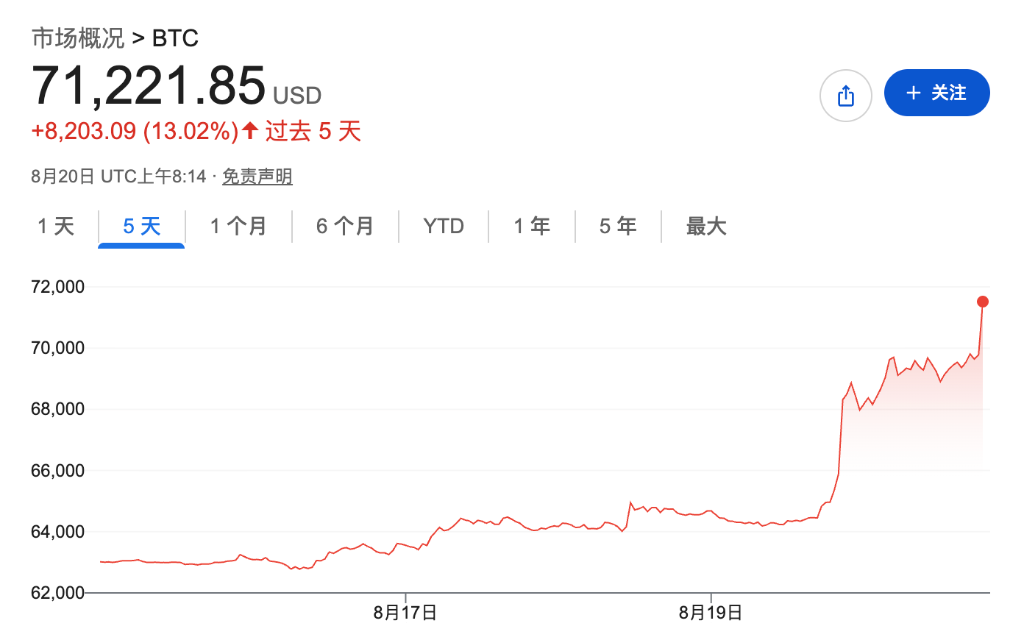
On August 20, Bitcoin broke through $70,000, hitting its highest level since June 2. As the price surged rapidly, a significant accumulation of short positions in the market faced concentrated liquidation. Within approximately one hour, over $1 billion worth of Bitcoin short positions were forcibly liquidated, marking a rare wave of short liquidations on a scale not seen since 2021.

The core driver of this move was not simply new buying, but rather the collective stop-loss exits from the substantial short positions accumulated earlier as prices rose quickly, creating significant passive buying pressure that further amplified gains. Concurrently, news of Trump meeting with crypto industry executives and the U.S. Treasury's expansion of treasury buyback scale also provided support for risk asset sentiment.

It is worth noting that on-chain capital flows have also shifted recently. According to CryptoQuant data, as of August 19, large holders (whales) had accumulated a net increase of approximately 43,000 Bitcoins over the past 60 days, valued at around $2.75 billion at current prices. This trend began when Bitcoin fell near $60,000, signaling a reversal of the selling pressure that had persisted for several months.
Over $1 Billion in Shorts Liquidated Within an Hour

According to data from crypto analytics platform CoinGlass, more than $1 billion worth of Bitcoin short positions were forcibly liquidated in just about an hour.

Previously, Bitcoin had undergone several weeks of consolidation, repeatedly finding support around $60,000, allowing short positions to accumulate steadily in the market. When the price suddenly broke upward, leveraged shorts faced margin calls or stop-loss pressure, forcing them to buy back Bitcoin to close their positions. This further drove up prices, creating a typical "short squeeze" scenario.

Joshua Lim, Co-Head of Markets at FalconX, noted that trading desks and news headlines in the crypto market had been dominated by selling pressure over the past few weeks, but Bitcoin consistently held near the $60,000 level, after which market sentiment and narratives began to shift.

Axel Rudolph, Chief Technical Analyst at IG, pointed out that the rapid surge toward $70,000 was primarily driven by short covering, reflecting a recovery in buyer confidence.

Policy and Macro News Improve Risk Appetite Simultaneously

On the news front, Trump's meeting with executives from Coinbase Global, Payward, and Blockchain at the White House further heightened market focus on the U.S. digital asset regulatory environment.

At the same time, the U.S. Securities and Exchange Commission proposed this week to exempt certain digital asset issuance projects from securities registration filing requirements. Trump had also previously indicated he would consider suggestions from regulatory bodies for the government to further increase its Bitcoin holdings.

On the macro front, the U.S. Treasury announced an expansion of its Treasury buyback program, stating that liquidity support repurchases for 10- to 30-year securities would "at least double." Following the news, U.S. Treasury yields and the dollar weakened, providing some support to risk assets overall.

Adam McCarthy, Head of Research at crypto liquidity and market data firm LO:TECH, stated, "Shorting Bitcoin had been a relatively clear trade in the market, and the Treasury buyback news served as one of the catalysts prompting renewed capital inflows into risk assets."


Preguntas relacionadas

QWhat was the approximate amount of Bitcoin short positions liquidated in about an hour on August 20th, and how does this event compare historically?

AApproximately over $1 billion worth of Bitcoin short positions were liquidated in about an hour. This event marked the largest short liquidation wave for Bitcoin since 2021, making it a historically significant occurrence.

QAccording to the article, what was the primary driver behind Bitcoin's sharp rally to above $70,000, rather than simply new buying pressure?

AThe primary driver was not simply new buying pressure, but a concentrated liquidation of previously accumulated short positions. As the price rose rapidly, leveraged short sellers were forced to buy Bitcoin to cover their positions (stop-loss or margin calls), creating significant passive buying that amplified the price increase, leading to a classic 'short squeeze'.

QWhat data indicates a reversal in the selling trend of large Bitcoin holders (whales), and what was the net increase over 60 days?

AAccording to CryptoQuant data, large holders (whales) have been net accumulating Bitcoin. Over the past 60 days leading up to August 19th, they net accumulated approximately 43,000 BTC, which is worth about $2.75 billion at current prices. This trend began when Bitcoin fell near the $60,000 level, signaling a reversal from the previous months of selling.

QName two key news events mentioned that helped improve risk sentiment and support the price of risk assets like Bitcoin.

ATwo key news events were: 1) Former President Donald Trump meeting with executives from major crypto companies like Coinbase and Blockchain.com, which drew attention to the U.S. regulatory environment for digital assets. 2) The U.S. Treasury Department's announcement to at least double the size of its buyback operations for longer-term securities, which led to lower bond yields and a weaker dollar, providing support for risk assets.

QHow did analysts like Axel Rudolph from IG characterize the nature of the rapid price move towards $70,000?

AAnalysts like Axel Rudolph from IG characterized the rapid price move towards $70,000 as being primarily driven by 'short covering' (short sellers buying back Bitcoin to close their positions). This reflects a restoration of confidence among buyers in the market.

Lecturas Relacionadas

GnosisDAO Approved Transition of Gnosis Chain to Ethereum Economic Zone

GnosisDAO has approved a proposal (GIP-153) for Gnosis Chain to transition from an independent Layer 1 blockchain into a zk-rollup within the Ethereum Economic Zone (EEZ). The move, supported by a significant majority of $GNO token holders, will see the network's validator set dissolved, with transaction computation and security ultimately relying on Ethereum. The upgrade is slated for late 2026 or early 2027, pending EEZ technology readiness. This migration will make Gnosis Chain the first deployed implementation of the EEZ framework, a project developed by Gnosis and ZisK with Ethereum Foundation backing. The core goal of EEZ is to unify Ethereum's fragmented Layer 2 ecosystem by enabling synchronous operations and direct contract calls between different rollups, eliminating the need for vulnerable cross-chain bridges. This aims to preserve liquidity and improve user experience while addressing scalability trade-offs. The change will allow native Gnosis Chain smart contracts to interact directly with Ethereum's mainnet within a single transaction, accessing its assets and liquidity. Analysts, including from Standard Chartered, suggest EEZ could reduce reliance on hack-prone bridges and increase asset composability, potentially boosting overall activity within the Ethereum ecosystem. The existing Gnosis Chain applications, user balances, and xDAI gas token will be maintained throughout the transition.

cryptonews.ruHace 5 min(s)

GnosisDAO Approved Transition of Gnosis Chain to Ethereum Economic Zone

cryptonews.ruHace 5 min(s)

Meta on Trial in the U.S.: 29 States Accuse Company of Harming Children

On August 18, 2026, a trial against Meta began in a federal court in Oakland, California. A coalition of 29 states, led by California, Colorado, Kentucky, and New Jersey, accuses the company of intentionally designing addictive features for Facebook and Instagram, concealing known risks to minors' mental health, and collecting data from children under 13 without parental consent. The lawsuit alleges violations of the federal Children’s Online Privacy Protection Act (COPPA) and state consumer protection laws. State prosecutors argue Meta exploited young users for profit, causing them physical and mental harm. Meta denies the allegations, stating a long-term commitment to youth safety and contesting direct links between social media use and declining teen well-being. The plaintiffs seek financial compensation and injunctions to force Meta to remove features like infinite scroll and visible likes, implement time limits for minors, and delete data of under-13 users. The bench trial, presided over by Judge Yvonne Gonzalez Rogers, is expected to last 6–8 weeks. Testimony from former and current employees, including former staffer Arturo Béjar, has begun. The outcome could set a significant precedent for regulating how tech companies interact with minors and handle their data, potentially influencing future lawsuits against other platforms. The case reflects a broader regulatory shift, examining how algorithms and AI systems shape child behavior, not just platform content.

cryptonews.ruHace 8 min(s)

Meta on Trial in the U.S.: 29 States Accuse Company of Harming Children

cryptonews.ruHace 8 min(s)

Trading

Spot
活动图片