Storj Labs Files for Bankruptcy Protection: Can Token Holders Exchange for Company Equity?

Foresight NewsPublicado a 2026-07-27Actualizado a 2026-07-27

Resumen

Storj Labs, parent company of decentralized cloud storage platform Storj, filed for Chapter 11 bankruptcy protection on July 26 in the U.S. District Court for the Northern District of West Virginia. The company stated its network will operate normally and token functions will be unaffected. Notably, Storj plans to propose a mechanism in its reorganization plan allowing STORJ token holders a path to equity in the restructured company—an unprecedented offer in the crypto industry. However, its feasibility depends on whether any residual value remains after creditor repayments, as token holders are low in the legal priority hierarchy. Founded in 2014, Storj is an early decentralized infrastructure project. It reported a 7x increase in Annual Recurring Revenue (ARR) to approximately $30 million in 2024. In October 2025, it was acquired by Inveniam Capital Partners. Less than a year later, the merged entity entered bankruptcy proceedings. Storj attributed the filing to historical debts from past operations and acquisitions, stating they were too large to be absorbed by business growth. The company also plans to refocus on its core decentralized storage business, likely divesting Valdi, a GPU computing company acquired in 2024. The proposed token-to-equity conversion faces significant legal hurdles. Under U.S. bankruptcy law, creditors are paid before equity holders, and utility token holders are not automatically recognized as equity members. The details—such as eligibility, all...


Written by: ChandlerZ, Foresight News


Storj Labs, the parent company of the decentralized cloud storage platform Storj, filed for Chapter 11 bankruptcy protection in the U.S. Bankruptcy Court for the Northern District of West Virginia on July 26.
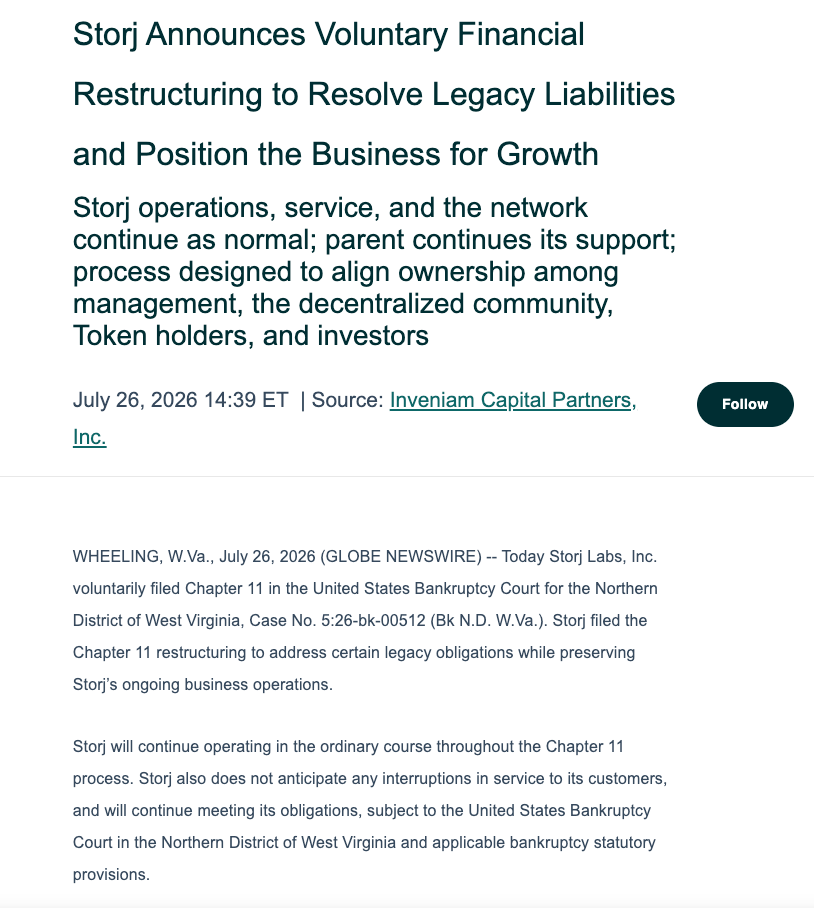


Storj stated that the network will continue to operate normally, token functionality will remain unaffected, and it plans to include in its reorganization plan a path for STORJ token holders to obtain equity in the restructured company. This proposed token-to-equity swap is unprecedented in the crypto industry, and its implementation hinges on whether there is residual value after creditors are repaid.


Bankruptcy Within a Year of Acquisition


Storj was founded in 2014 and is one of the earliest decentralized infrastructure projects in the crypto industry. Its core business is building a distributed cloud storage network via blockchain incentive mechanisms, encouraging global node operators to contribute idle hard drive space as an alternative to centralized storage services like Amazon S3. Users pay for storage and bandwidth with the STORJ token, and node operators are rewarded in STORJ.


In its early stages, the project received seed funding from Google Ventures, Qualcomm Ventures, and Techstars. It raised approximately $30 million through a token sale in 2017. In 2024, Storj achieved a 7x growth in Annual Recurring Revenue (ARR), reaching about $30 million, with a team size of 81 people. That same year, Storj also acquired GPU computing company Valdi, expanding its business from pure storage to compute power leasing.


In October 2025, Inveniam Capital Partners, focused on data assetization, acquired Storj through a reverse triangular merger. CEO Colby Winegar remained in his position, and Executive Chairman Ben Golub joined the Inveniam board. On the day the acquisition was announced, the STORJ token fell by 18%. Less than a year later, the merged entity entered bankruptcy proceedings.


In a public letter, Storj attributed the bankruptcy to historical debts, stating that the liabilities primarily stemmed from previous operations and acquisitions, predating the current business strategy, and were too large to be naturally absorbed through business growth. The company claimed its current operations are streamlined, but the burdens of the past can only be resolved through a court-supervised reorganization. The company also stated it would divest non-core businesses brought in by previous acquisitions during the restructuring to refocus on its core decentralized storage business.


The GPU computing company Valdi, acquired in July 2024, is the most likely asset to be divested. Valdi brought Storj a compute network of over 16,000 GPUs globally, originally the core of Storj's expansion into AI computing. However, from a bankruptcy restructuring perspective, this acquisition itself may be one of the sources of increased debt. Divesting Valdi means Storj will return to the pure storage track, abandoning its previous positioning as a full-stack distributed cloud platform.


Token-to-Equity Swap: Promise or Empty Promise?


The most notable proposal in the official public letter is providing a path for token holders to company equity. Storj management indicated plans to propose a mechanism in the reorganization plan allowing token holders to participate in the equity distribution of the restructured company, realigning company ownership among management, the decentralized community, token holders, and investors.


Kaloyan Raev, Director of Software Engineering at Storj, was quite measured in his wording in the public letter, stating the company would give users a seat and sincere intent, not a guaranteed outcome. The company has not yet disclosed eligibility criteria (whether a token snapshot or lock-up is required), the proportion of equity available for distribution, or the specific participation mechanisms. All terms need to be formulated during the reorganization process and approved by the court.


The core obstacle to this proposal lies in the priority rules of bankruptcy law. In Chapter 11 reorganization, creditor repayment takes precedence over equity holders. Token holders are legally closest to the position of equity holders, at the very end of the repayment sequence. Only after creditors are fully or proportionally repaid can residual value potentially flow to token holders.


There is no bankruptcy precedent in the crypto industry for a token-to-equity swap. In the WTT lawsuit involving crypto miner Giga Watt's bankruptcy after raising about $22 million via an ICO, the court ruled that utility token holders did not qualify as members of the company. This means token holders cannot automatically gain equity status; separate rights must be created through the reorganization plan. The FTX bankruptcy case set precedents in crypto asset valuation but dealt with creditor claims, which is entirely different from the token-to-equity path proposed by Storj.


Another noteworthy variable is the concentration of token holdings. The total STORJ supply is 425 million tokens, with approximately 30% (about 130 million) still held by Storj Labs. If the company's own token holdings also participate in the equity conversion, there is a potential conflict of interest between management and external token holders.


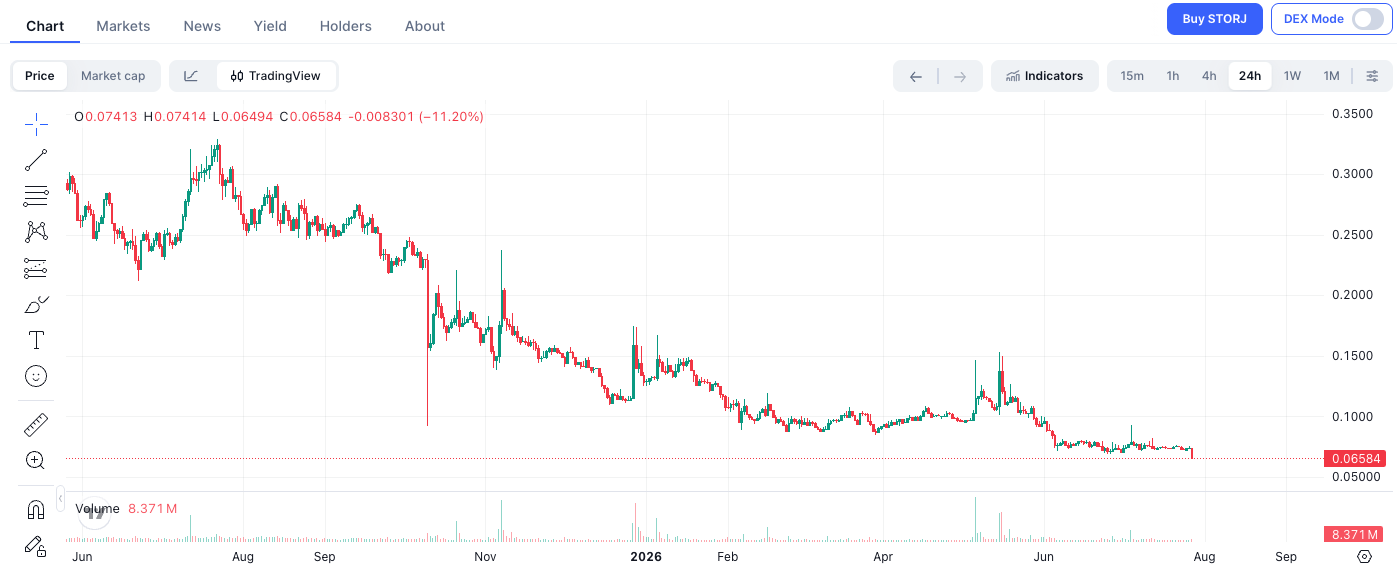
The STORJ token is currently priced around $0.06584, with a total market capitalization of approximately $27.97 million. The price fell 11.2% in the 24 hours following the news announcement.


A Marginal Player in the Decentralized Storage Race


Storj's scale in the decentralized storage sector is far smaller than its top competitors. Filecoin's current market capitalization is approximately $607 million, nearly 20 times that of STORJ, with a network capacity exceeding 1.8 EiB. In early 2026, Filecoin officially launched its Onchain Cloud roadmap, supporting automated data repair, perpetual renewals, and liquid staking of storage power via the Filecoin Virtual Machine (FVM), positioning itself as a decentralized alternative to AWS. Arweave follows another path, capturing the market for NFT metadata and blockchain historical state storage with its one-time payment for permanent storage model.


In comparison, Storj's advantage lies in retrieval speed. Storj uses Erasure Coding to split files into over 80 fragments distributed across global nodes, requiring only 29 fragments to reconstruct a file, achieving millisecond-level retrieval latency, performance close to that of centralized cloud providers. This gives Storj some competitiveness in hot data storage (video streaming, application data), but its market share is far behind Filecoin's.


During bankruptcy restructuring, whether node operators and enterprise clients will migrate to Filecoin or Arweave due to uncertainty is a real risk for the Storj network. For STORJ token holders, the key variables to monitor include: the specific terms of the token-to-equity swap in the reorganization plan and court approval progress, how the company's 30% token holdings will be handled, and whether the post-Valdi-divestiture business can support valuation.

Criptos en tendencia

Preguntas relacionadas

QWhat is the main reason Storj Labs cited for filing for Chapter 11 bankruptcy protection?

AStorj Labs cited historical legacy debts from previous operations and acquisitions, which were incurred prior to the current business strategy. The company stated that the scale of this debt was too large to be digested through natural business growth.

QWhat unprecedented proposal has Storj made for its STORJ token holders during the restructuring process?

AStorj has proposed creating a path for STORJ token holders to potentially acquire equity in the restructured company. This is presented as an effort to realign company ownership among management, the decentralized community, token holders, and investors. However, this is an unprecedented proposal in the crypto industry and its implementation is not guaranteed.

QAccording to the article, what is the major legal hurdle for Storj's proposal to convert tokens to equity?

AThe major legal hurdle is the priority rules in bankruptcy law. In Chapter 11 restructuring, creditors are paid before equity holders. Token holders are positioned similarly to equity holders at the end of the payment priority sequence. They would only receive any value after creditors are fully or partially satisfied.

QWhat key non-core asset acquired in 2024 is Storj likely to divest during its restructuring?

AStorj is likely to divest Valdi, a GPU computing company acquired in July 2024. This acquisition was part of Storj's expansion into AI computing, but divesting it means the company will refocus on its core decentralized storage business.

QHow does Storj's market position in decentralized storage compare to its main competitor, Filecoin?

AStorj is a much smaller player compared to Filecoin. Filecoin's market capitalization is approximately $607 million, which is nearly 20 times larger than STORJ's market cap of around $28 million. Filecoin's network capacity exceeds 1.8 EiB, and it is positioning itself as a decentralized alternative to AWS.

Lecturas Relacionadas

Huang Xiaoming, Li Bin, Lei Jun, Liang Wenfeng... Changxin IPO Feast, Who's the Biggest Winner?

Changxin Technology's IPO on the Shanghai STAR Market created significant wealth for its stakeholders. Founder Zhu Yiming and his family saw their wealth surge nearly 300%, with his stake in Changxin alone valued at approximately 80 billion RMB. Over 6700 employees benefited, creating at least 237 new millionaires. Several prominent figures also profited. Liang Wenfeng, founder of Deepseek, saw a paper gain of 827 million RMB through his funds' participation. Kong Jianping, founder of Nano Labs, holds an indirect stake worth around 940 million RMB, representing a roughly 44x return on his 2020 investment. Former Midea executive Huang Xiaoming gained approximately 503 million RMB. Strategic investors included industry partners. Nio, represented by founder William Li, pledged 158 million RMB for shares now showing a paper gain of about 740 million RMB. Similarly, a Xiaomi subsidiary acquired shares resulting in an over 736 million RMB gain, though the company clarified this is a corporate investment, not directly attributable to founder Lei Jun's personal wealth. Founder Zhu Yiming further plans to donate shares worth over 37.6 billion RMB for future employee incentives. The IPO solidified Changxin's position as a leading domestic memory chip maker, triggering a widespread wealth creation event for its network of founders, employees, and investors.

Odaily星球日报Hace 12 min(s)

Huang Xiaoming, Li Bin, Lei Jun, Liang Wenfeng... Changxin IPO Feast, Who's the Biggest Winner?

Odaily星球日报Hace 12 min(s)

Aave's Stable Vault

This article explores Aave's recently launched "Stable Vaults," a product designed to bridge the gap between traditional finance users and DeFi yield. It argues that while DeFi offers transparency and potentially higher returns, its complexity and volatility are major barriers for mainstream adoption. The core problem is that users pay for convenience and simplicity, often accepting lower returns to avoid decision-making and technical hurdles. Stable Vaults allow fintech apps, neobanks, or payment platforms (operators) to integrate with Aave's lending markets once and offer their users a "savings account" with a fixed, predictable yield (e.g., 4%). The operator absorbs the underlying market volatility; if Aave's pool pays 6%, the operator pockets the 2% difference, but if it pays only 2%, the operator covers the shortfall to maintain the promised 4% for users. The piece analyzes this model from three perspectives: 1. **The User:** Gains simplicity, a fixed rate, and familiar app features (customer support, account recovery). However, they lose potential upside, accept a lower fixed yield, and take on new counterparty risks from the operator and its proprietary backend systems. 2. **The Operator (e.g., a neobank):** Can monetize idle user balances easily, generating significant fee income (the spread between the fixed rate and the actual yield) with minimal integration effort, turning a cost center into revenue. 3. **Aave:** Gains "sticky," loyalty-based deposits that are less likely to flee during minor yield fluctuations, securing a stable revenue stream crucial for its tokenomics (like buybacks). It becomes a back-end infrastructure provider for the broader consumer finance ecosystem. The author acknowledges that while sophisticated users can access higher yields directly on Aave, most people prefer convenience and security over optimization. They reference behavioral studies showing that too many choices lead to inaction. Therefore, Stable Vaults represent an acceptance of human nature—prioritizing safety, predictability, and ease—and a strategic move for Aave to capture stable, large-scale deposits from mainstream finance applications. Examples like Rise (payroll) and Kraken are already using similar embedded yield models.

marsbitHace 17 min(s)

Aave's Stable Vault

marsbitHace 17 min(s)

Trading

Spot

Artículos destacados

Cómo comprar STORJ

¡Bienvenido a HTX.com! Hemos hecho que comprar STORJ (STORJ) sea simple y conveniente. Sigue nuestra guía paso a paso para iniciar tu viaje de criptos.Paso 1: crea tu cuenta HTXUtiliza tu correo electrónico o número de teléfono para registrarte y obtener una cuenta gratuita en HTX. Experimenta un proceso de registro sin complicaciones y desbloquea todas las funciones.Obtener mi cuentaPaso 2: ve a Comprar cripto y elige tu método de pagoTarjeta de crédito/débito: usa tu Visa o Mastercard para comprar STORJ (STORJ) al instante.Saldo: utiliza fondos del saldo de tu cuenta HTX para tradear sin problemas.Terceros: hemos agregado métodos de pago populares como Google Pay y Apple Pay para mejorar la comodidad.P2P: tradear directamente con otros usuarios en HTX.Over-the-Counter (OTC): ofrecemos servicios personalizados y tipos de cambio competitivos para los traders.Paso 3: guarda tu STORJ (STORJ)Después de comprar tu STORJ (STORJ), guárdalo en tu cuenta HTX. Alternativamente, puedes enviarlo a otro lugar mediante transferencia blockchain o utilizarlo para tradear otras criptomonedas.Paso 4: tradear STORJ (STORJ)Tradear fácilmente con STORJ (STORJ) en HTX's mercado spot. Simplemente accede a tu cuenta, selecciona tu par de trading, ejecuta tus trades y monitorea en tiempo real. Ofrecemos una experiencia fácil de usar tanto para principiantes como para traders experimentados.

139 Vistas totalesPublicado en 2024.12.12Actualizado en 2026.06.02

Cómo comprar STORJ

Discusiones

Bienvenido a la comunidad de HTX. Aquí puedes mantenerte informado sobre los últimos desarrollos de la plataforma y acceder a análisis profesionales del mercado. A continuación se presentan las opiniones de los usuarios sobre el precio de STORJ (STORJ).

活动图片