Strategy Opens Path to Bitcoin Sale — Michael Saylor Explains Why It Makes Sense

cryptonews.ruPublicado a 2026-07-28Actualizado a 2026-07-28

Resumen

Michael Saylor, Executive Chairman of Strategy Inc. (NASDAQ: MSTR), outlined the company's potential funding sources for future buybacks of its Series A Variable Rate Perpetual Preferred Stock (STRC). These buybacks could be financed through the sale of Bitcoin or MSTR shares, depending on market conditions. This strategy is seen as attractive when STRC trades significantly below its $100 par value, allowing the company to repurchase shares at a discount and reduce future dividend obligations. Strategy aims to maintain STRC trading near its $100 par value with high liquidity and low volatility. The company, adhering to its digital credit capital concept, will not issue new STRC shares below par. In the week ending July 26, Strategy repurchased approximately $25 million worth of STRC shares at an average price of $86.52 per share, taking advantage of the discount. Strategy has increased its USD reserve to a record $3.75 billion, but this reserve is reserved exclusively for preferred stock dividends and debt repayment. Therefore, future STRC buybacks will be funded separately, primarily through the issuance of MSTR common stock or the sale of Bitcoin when deemed economically justified by management. This approach provides flexibility to execute discounted buybacks without impacting funds earmarked for dividends and debt.

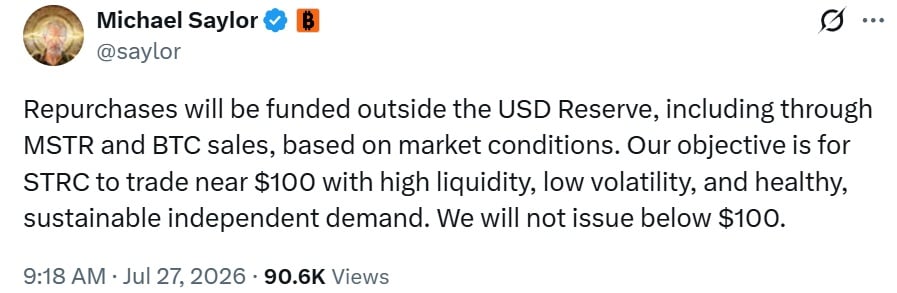
Michael Saylor, Executive Chairman of Strategy Inc. (Nasdaq: MSTR), stated in a July 27th post on X that future share repurchases of STRC could be funded through sales of Bitcoin or MSTR shares, depending on market conditions. STRC are Strategy's Series A Variable-Rate Perpetual Preferred Shares with a $100 liquidation preference, whose dividend rate is reviewed monthly by management.

Selling Bitcoin could become an attractive financing option when the price of STRC is trading significantly below $100, allowing the company to repurchase the preferred shares at a discount.

Saylor stated that the company aims to maintain STRC trading at a level close to its $100 liquidation preference, with high liquidity, low volatility, and stable independent demand. As part of Strategy's digital hybrid capital concept, the company does not intend to issue additional STRC shares below $100.
Discount Repurchases Dictate Purchase Pace

During the week ended July 26, the company repurchased 288,930 STRC shares for approximately $25 million at an average price of $86.52 per share, as reported by the company on July 27.

Saylor presented Strategy as a regular and disciplined buyer when the price is below $100, with repurchase volumes increasing at larger discounts and tapering as STRC approaches its stated preference. Under the repurchase authorization for preferred securities, approximately $975 million remains available, providing management with significant capacity for future transactions. At the latest average purchase price, the company acquired each STRC share at a $13.48 discount to its stated preference before accounting for future dividend savings.

Strategy's President & CEO, Phong Le, explained:

"At prices below $100 per share, repurchasing STRC shares represents an attractive capital investment as it allows for the reduction of future preferred dividend obligations at a discount."

"We intend to adjust purchase volumes based on both price and liquidity — increasing them at larger discounts and decreasing them as the market price of STRC shares approaches the $100 per share mark — while allowing independent market demand to form a healthy and sustainable market," he added.

In the terms of the STRC shares and the dividend policy, the current annualized dividend rate is stated as 12%, along with factors management considers during monthly assessments.

U.S. Dollar Reserve Remains Separate from Repurchase Program

Additionally, Strategy increased its U.S. dollar reserve by $525 million through the sale of MSTR common shares, bringing its balance to a record $3.75 billion. This reserve covers approximately 25 months of expected preferred dividend payments and, per a policy approved by Strategy's board of directors, remains designated exclusively for preferred dividend payments and debt obligations.

This restriction means future STRC repurchases will be funded from other sources, including the sale of MSTR shares and, as noted by Saylor, the sale of Bitcoin when justified by market conditions.

Instead of using the U.S. dollar reserve, Strategy now has two primary channels to fund STRC share repurchases: issuance of MSTR shares and sale of Bitcoin when management deems it economically sensible. This flexibility allows the company to repurchase preferred shares at a discount without impacting funds reserved for dividend payments and debt obligations.

end-content

Preguntas relacionadas

QWhat two primary funding sources can Strategy Inc. use for future STRC share buybacks, according to Michael Saylor?

AAccording to Michael Saylor, the two primary funding sources for future STRC share buybacks are the sale of MSTR common stock and the sale of Bitcoin, when deemed economically justified by management.

QWhat is the stated goal of Strategy Inc. regarding the trading price of its STRC preferred shares?

AThe stated goal is for the STRC preferred shares to trade close to their $100 par value, with high liquidity, low volatility, and sustained independent demand.

QHow does Strategy Inc. plan to adjust its STRC buyback volume in relation to the share price?

AStrategy plans to adjust buyback volumes based on price and liquidity: increasing purchases when the discount to the $100 par value is significant and scaling back as the market price approaches the $100 per share mark.

QWhat is the purpose of Strategy's separate USD reserve, and how much does it currently hold?

AThe separate USD reserve is intended exclusively for paying dividends on the preferred shares and repaying debt obligations. As reported, it currently holds a record $3.75 billion.

QWhy does buying back STRC shares at a discount below $100 represent an attractive capital investment for Strategy?

ABuying back STRC shares below $100 is attractive because it allows the company to retire preferred shares at a discount, thereby reducing future dividend payment obligations.

Lecturas Relacionadas

AI is Killing 'Poor People's Entertainment'

AI Is Eliminating 'Entertainment for the Poor' This article discusses the rising cost of video gaming, arguing that AI is making digital entertainment increasingly expensive. It follows the example of a frugal gamer who, accustomed to waiting for discounts and buying second-hand games, now faces a new reality. Video game consoles like the PS5 Pro and Switch 2 are increasing in price post-launch, breaking the traditional pattern of降价 over time. Game prices are also rising, with major titles like GTA 6 launching at $80. Furthermore, the industry is moving towards eliminating physical media, exemplified by Sony's plan to stop PS disc production by 2028. This shift blocks the二手 market, a key cost-saving avenue for players. Even Valve's anticipated affordable Steam Machine launched with a high price and disappointing specs. Manufacturers cite inflation, supply chain issues, and rising development costs, but a core driver is the AI boom. AI data centers now consume semiconductor and memory resources once prioritized for consumer electronics like game consoles. This competition from a more profitable sector drives up hardware costs. Additionally, developing modern AAA games with massive teams over many years is astronomically expensive, pushing publishers towards digital-only distribution and subscription models to secure recurring revenue. The article suggests this trend extends beyond gaming. Video streaming, music platforms, cloud storage, and AI tools are increasingly locked behind complex subscription tiers. While AI promises future benefits, it is currently making digital entertainment and services more costly. The era of progressively cheaper, accessible online entertainment is ending, forcing consumers to pay more upfront for future technological promises.

marsbitHace 6 min(s)

AI is Killing 'Poor People's Entertainment'

marsbitHace 6 min(s)

The Demise of the Trillion-HKD ETF Myth: SK Hynix Plummets, Hong Kong Switches from 'Double Leverage' to 'Flexible Leverage', South Korea Restricts Leveraged ETF Investments

South Korea's AI-driven bull market has taken a sharp downturn, severely impacting SK Hynix's stock and prompting regulatory tightening in both Hong Kong and South Korea on single-stock leveraged products. The CSOP SK Hynix Daily Leveraged (2x) ETF, once the world's largest single-stock leveraged ETF with over HKD 130 billion in assets, saw its value plummet by over 80% as SK Hynix shares fell nearly 46% from their June peak, erasing more than HKD 100 billion. In response, Hong Kong's Securities and Futures Commission (SFC) revised its regulatory framework. Starting August 3rd, fixed 2x leverage for single-stock leveraged and inverse products will shift to a dynamic "flexible leverage" mechanism, where daily leverage can vary up to a maximum of 2x. This aims to balance market development with investor protection but has sparked debate about changes to the products' core features and potential reduced appeal for risk-seeking investors. Simultaneously, South Korean authorities announced plans to further restrict single-stock leveraged ETFs following two consecutive days of market circuit breakers. Proposed measures include capping individual investors' allocations to such products at 20% of their total financial investment assets, increasing trading costs, and enhancing suitability requirements. The Finance Minister publicly apologized, acknowledging insufficient initial risk assessment. Analysts note that while the long-term fundamentals for South Korean semiconductor firms like SK Hynix remain solid, short-term market volatility is heightened due to concentrated leveraged bets and shifting global risk sentiment. The regulatory moves in both markets signal a clear shift from encouraging innovation towards prioritizing risk control, reminding investors of the amplified risks inherent in leveraged products.

marsbitHace 12 min(s)

The Demise of the Trillion-HKD ETF Myth: SK Hynix Plummets, Hong Kong Switches from 'Double Leverage' to 'Flexible Leverage', South Korea Restricts Leveraged ETF Investments

marsbitHace 12 min(s)

After the Privatization of the Internet, Silicon Valley Begins Privatizing Human Civilization

"The Privatization of Human Civilization" The article critiques how AI companies like Anthropic are systematically acquiring and digitizing millions of books—sometimes by destroying physical copies—to build proprietary training datasets for models like Claude. While a lawsuit resulted in a settlement, the author argues the deeper issue transcends copyright: it is about the privatization and centralized control of human knowledge and civilization. This process coincides with a powerful Silicon Valley ideology, exemplified by Marc Andreessen's "Techno-Optimist Manifesto" and movements like e/acc (Effective Accelerationism). This worldview frames technological growth and speed as inherently moral, portraying caution, regulation, and public dissent as obstacles to progress. It often envisions intelligence itself, rather than human well-being, as the ultimate goal, potentially sidelining present human concerns. Figures like Peter Thiel and Curtis Yarvin express skepticism towards democratic processes as too slow, suggesting more centralized, founder-led governance is efficient. This logic extends to AI, where a small team within a company defines the model's "constitution"—its rules, values, and definitions of truth and safety—effectively governing how millions understand the world. Thus, the scanned books symbolize a new form of control. Knowledge isn't erased but is ingested into private, opaque systems. The original, decentralized, and contestable nature of books and public knowledge is replaced by a curated, company-controlled output. The public's access to their own cultural heritage becomes mediated by corporate AI, which remembers civilization only in the form its creators dictate. This is not book-burning but a subtler, potentially more complete privatization of human memory and understanding.

marsbitHace 21 min(s)

After the Privatization of the Internet, Silicon Valley Begins Privatizing Human Civilization

marsbitHace 21 min(s)

Net Profit Soars 1299.9%, Samsung's Q2 Reports the Most Profitable Quarter in History

Samsung Electronics posts record-breaking Q2 2026 results, driven primarily by explosive AI-driven demand for its semiconductor business. Revenue surged 130% year-on-year (YoY) to 171.5 trillion won, while operating profit skyrocketed 1,813.8% to 89.49 trillion won. Net profit reached 71.62 trillion won, a 1,299.9% increase YoY. The Device Solutions (DS) division, which includes memory chips, was the core engine, contributing over 99% of total operating profit. Sales for the DS unit hit a record 127.5 trillion won, with memory revenue reaching 120.8 trillion won, fueled by AI server demand for products like HBM. The company has begun mass production of next-generation HBM4. In contrast, the Device eXperience (DX) division, covering mobile phones and consumer electronics, reported an operating loss of 0.8 trillion won due to rising component costs, highlighting a significant performance split within the company. Other segments showed improvement: Samsung Display's profit rose to 0.7 trillion won, and Harman's profit recovered to 0.4 trillion won. Financially, Samsung's position strengthened dramatically, with cash and equivalents reaching 190 trillion won and operating cash flow hitting a record 105.1 trillion won. The company also engaged in significant share buybacks and dividend payments. Looking ahead, Samsung expects sustained strong demand from AI infrastructure, though acknowledges softer demand in some consumer segments.

marsbitHace 47 min(s)

Net Profit Soars 1299.9%, Samsung's Q2 Reports the Most Profitable Quarter in History

marsbitHace 47 min(s)

Trading

Spot
活动图片