闪迪(SNDK)股票7月16日盘中下跌9.98%:背后推手曝光

投研日志Publicado a 2026-07-17Actualizado a 2026-07-17

Resumen

近一月多位分析师给出公司评级为买入。目标价预测平均价为$2087.01,最高价为$3250.00,最低价为$1000.00。

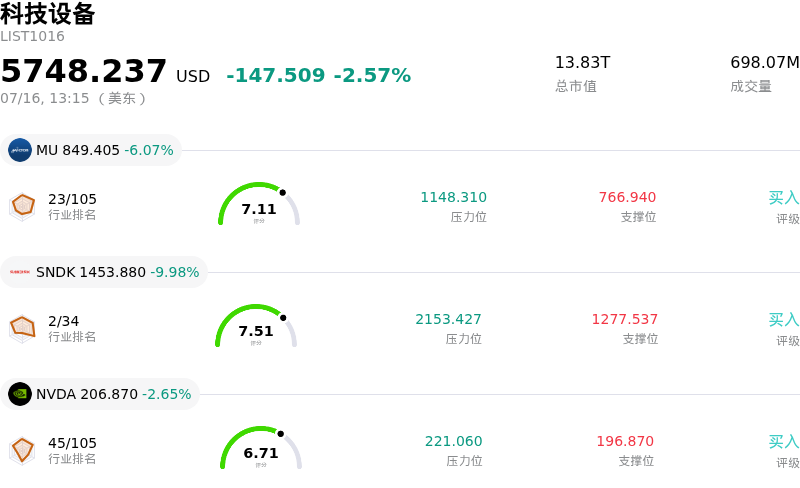
闪迪 (SNDK) 盘中下跌9.98%, 所属行业科技设备下跌2.57% ,公司涨幅跑输行业涨幅,行业成交额前三股票 美光科技 (MU) 下跌 5.80%;闪迪 (SNDK) 下跌 9.98%;英伟达 (NVDA) 下跌 2.46%。
今日是什么导致了闪迪(SNDK)股价下跌?

市场估值急剧下降的主要原因似乎是前瞻性营收指引的大幅下调。管理层指出,企业级存储需求的放缓速度快于预期,且全球闪存市场持续面临价格压力。这表明,存储产品的周期性见顶可能比分析师最初预测的时间来得更早,随着投资者重新评估本财年余下期间的增长预期,导致股价迅速被重新定价。

半导体行业内部的竞争压力正在加剧,尤其是竞争对手近期取得了技术里程碑。有报道称,主要竞争对手已提前成功实现下一代高密度存储的量产,这引发了市场对潜在市场份额流失以及全球市场即将出现供过于求的担忧。随着行业在数据中心和消费电子领域均面临库存调整,该公司在维持其利润率方面面临重大障碍,这进一步压制了投资者情绪。

除了公司自身的基本面外,整体宏观经济环境也是造成下行压力的原因之一。近期数据显示通胀压力持续存在,且美联储可能采取更具紧缩性的货币政策,这削弱了整个科技领域的资本支出前景。此外,影响全球半导体供应链的持续贸易复杂性继续营造出不确定性的氛围。行业特有的逆风与谨慎的宏观背景相互交织,促使机构投资者在其投资组合中转向更为防御性的仓位配置,从而引发了资金从风险资产中的显著撤退。

闪迪(SNDK)技术分析

闪迪 (SNDK) 技术面来看,MACD(12,26,9)数值-112.798,处于中性状态,RSI数值44.463处于中性状态,Williams%R数值84.301处于超卖状态,注意关注。

闪迪(SNDK)媒体舆情

闪迪 (SNDK) 公司舆情热度来看,当前热度67,处于很热状态;公司市场舆情方向来看,当前舆情指数处于中性状态。

闪迪(SNDK)基本面分析

闪迪 (SNDK) 处于科技设备行业,最新年度营业收入$7.36B,处于行业10,净利润$-1.64B,处于行业41。「公司简介」

近一月多位分析师给出公司评级为买入。目标价预测平均价为$2087.01,最高价为$3250.00,最低价为$1000.00。

Lecturas Relacionadas

Who Is Shaping Ethereum's Future: The Takeover by Token-Holding Companies Could Be the Best Thing for ETH in Years

**Title: Who is Building Ethereum's Future? Corporate ETH Holders Take Over Funding, Possibly the Best Thing for ETH in Years.** **Summary:** The Ethereum Foundation is scaling back due to fiscal concerns, but publicly traded companies holding large amounts of ETH, like Bitmine and SharpLink, are stepping in to fund protocol development. These firms collectively hold nearly 5% of ETH's circulating supply and are using their staking yields to pay for R&D. Unlike MicroStrategy, which merely accumulates Bitcoin, these ETH treasury companies are reinvesting profits directly into the protocol's development—potentially allowing all ETH holders to benefit from this free "spillover." Key drivers for this shift include these companies' stalled business model. Their "flywheel" of issuing stock to buy more ETH broke as their stock prices fell below the net value of their crypto holdings (mNAV < 1). With their ETH holdings also deeply underwater, simply waiting for price appreciation failed. By funding Ethereum's roadmap—through new non-profits like ETH Labs and Ethereum Institutional—they aim to increase the utility and value of the underlying asset that dominates their balance sheets. This creates a new alignment of interests: these companies are highly incentivized to see Ethereum succeed and are less likely to sell en masse. However, risks remain. The exact funding amounts are undisclosed, and these treasury firms themselves are vulnerable if ETH prices fall further, which could halt their contributions. **Additional Context:** The article also contrasts Jito's new "token-centric" proposal (JIP-38), which credibly directs platform fees to token buybacks, with Venice's less concrete promises, highlighting the importance of where revenue legally lands and who controls the mechanisms. Other notable industry updates include the rise of TradFi perpetuals on Hyperliquid, new Bitcoin staking via Stacks, and various DeFi product launches.

marsbitHace 12 min(s)

Who Is Shaping Ethereum's Future: The Takeover by Token-Holding Companies Could Be the Best Thing for ETH in Years

marsbitHace 12 min(s)

Visa Takes Another Step Upstream in the Stablecoin Industry

Visa has launched the Visa Stablecoin Platform (VSP), a comprehensive enterprise platform enabling banks and fintechs to handle stablecoins directly within Visa's existing payments and treasury workflows, covering approximately 15,000 financial institutions and over 200 million merchants. The platform launches with the new OUSD stablecoin and also supports USDC and USDG, providing integrated wallet infrastructure, controls, and workflows for various institutional use cases. This move marks Visa's strategic progression within the stablecoin ecosystem. It began as a user, piloting USDC for settlement in 2021, later evolving into a distributor through cards like Bridge and empowering banks with its VTAP platform. VSP consolidates these capabilities into a unified hub, positioning Visa as the central entry point for its stablecoin services rather than an issuer. Crucially, Visa is opting not to issue its own stablecoin, a move that would create conflicts with partners like Circle and Paxos and entail significant regulatory burdens. Instead, Visa leverages its neutral network role. The choice of OUSD—a zero-fee, alliance-managed stablecoin—allows Visa to benefit from the issuance layer economically without becoming a direct competitor. This strategy aims to make Visa's network the default infrastructure layer in the stablecoin era, avoiding the need to mint its own coin.

Foresight NewsHace 14 min(s)

Visa Takes Another Step Upstream in the Stablecoin Industry

Foresight NewsHace 14 min(s)

Opening Claude's Brain Is Useless; The True Key to the AI Black Box Lies in Ontology Engineering

"Dissecting Claude's Brain Is Futile: The Real Key to the AI Black Box Lies in Ontology Engineering" This article critiques the limitations of Anthropic's "J-Space" research, which attempts to explain AI models by observing their internal neural activation patterns, akin to fMRI brain scans. While this "internalist" approach offers unprecedented visibility into model states, it fundamentally conflates observability with true explainability. The core issue is that understanding a model's output requires more than tracing neural activity; it necessitates examining the meaning of the information it processes—its relationship to the world, semantic norms, and human cognitive frameworks. The author proposes a paradigm shift: moving from a neuroscience-inspired focus on the model itself to an "information ontology" approach centered on the knowledge the model handles. Drawing from Kant's philosophical categories, the argument posits that true explainability lies in structuring and understanding information within a formal conceptual framework, not in peering into the "black box." The practical application of this theory is ontology engineering. Ontologies provide a structured, computable framework for knowledge, serving as a semantic anchor for model outputs. The article details a bidirectional synergy: Large Language Models (LLMs) can automate and scale ontology construction, while ontologies, in turn, enhance AI explainability. They act as a verification framework, allowing model reasoning to be traced back to defined concepts, properties, and relationships. This transforms explainability from the impossible task of making neural networks transparent into the achievable engineering goal of making their outputs and impacts understandable, traceable, and accountable. The future of AI explainability, therefore, lies not in explaining the model's internal mechanics but in explaining and governing the knowledge structures and real-world effects of its outputs.

marsbitHace 21 min(s)

Opening Claude's Brain Is Useless; The True Key to the AI Black Box Lies in Ontology Engineering

marsbitHace 21 min(s)

Trading

Spot
活动图片