Đội ngũ Celestia sẽ bán 2,03 triệu USD TIA trong tháng 7: Liệu điều này CÓ HẤP THỤ được áp lực giảm giá?

ambcryptoPublicado a 2026-07-01Actualizado a 2026-07-01

Resumen

Đội ngũ Celestia dự kiến bán khoảng 2,03 triệu USD TIA trong tháng 7, tạo thêm áp lực giảm giá cấu trúc lên tài sản vốn đang suy yếu. Tuy nhiên, dòng tiền trên thị trường giao ngay (spot) cho thấy nhu cầu mua trong tháng 6 đạt 106,68 triệu USD với dòng ròng dương khoảng 4,8 triệu USD, có khả năng hấp thụ áp lực bán. Mặc dù số vốn cam kết (Open Interest) trên thị trường phái sinh giảm nhẹ, nhưng Tỷ lệ Tài trợ (Funding Rate) vẫn dương ở mức 0,0038%, cho thấy phần lớn vị thế vẫn là long (mua), kỳ vọng giá tăng. Bản đồ thanh khoản (liquidity heatmap) cũng chỉ ra các cụm lệnh mua tập trung ở phía trên mức giá hiện tại, hỗ trợ khả năng hồi phục. Tóm lại, áp lực bán từ đội ngũ là rõ ràng, nhưng các chỉ báo thị trường cho thấy áp lực này có thể được cản trở bởi nhu cầu mua tiềm năng.

Celestia’s [TIA] đã ghi nhận mức lỗ nặng nề trong ngày qua, và mặc dù đợt giảm này có vẻ như là phần mở rộng của đợt sụt giảm trên thị trường tiền điện tử nói chung, cái nhìn sâu hơn vào lịch trình cung cấp token cho thấy tài sản này về cơ cấu đang ở thế sẵn sàng cho một đợt giảm tiếp.

Dữ liệu từ DeFiLlama cho thấy, ngoài phần 28.000 USD được đánh dấu cho ngày 1 tháng 7 tính đến thời điểm hiện tại, đội ngũ dự kiến sẽ bán ra khoảng 67.000 USD TIA mỗi ngày cho đến hết tháng, đưa tổng cộng khoảng 2,03 triệu USD vào thị trường trong suốt 31 ngày.


Nguồn: DeFiLlama

Về lý thuyết, tình huống này có vẻ giảm giá, nhưng dòng tiền thị trường giao ngay lại gợi ý rằng nhu cầu sắp tới có thể hấp thụ áp lực này, dựa trên cách TIA giao dịch trong suốt tháng 6.

Tổng mua Giao ngay đã đạt 106,68 triệu USD, với dòng tiền ròng khoảng 4,8 triệu USD nghiêng về phía người mua.

Tỷ lệ Tài trợ vẫn ổn định mặc dù Lãi mở bị tháo chạy

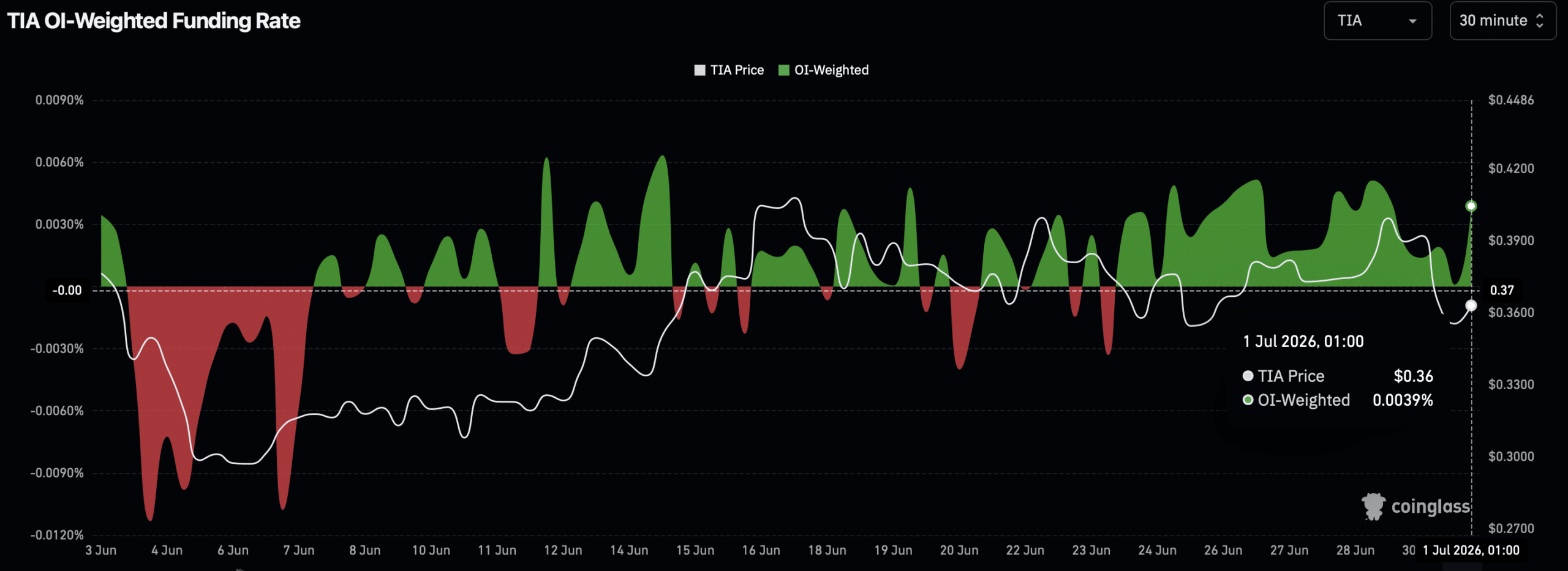
Dòng tiền ra trong vài ngày qua vẫn phản ánh tâm lý giảm giá đang tác động đến thị trường. Dữ liệu từ CoinGlass cho thấy Lãi mở - vốn cam kết vào các hợp đồng vĩnh cửu của một tài sản - đã giảm 2%, một sự rút lui trị giá 1,16 triệu USD, để lại lãi mở ròng ở mức 58 triệu USD.
Nguồn: CoinGlass

Tuy nhiên, dòng tiền ra này chưa làm thay đổi lập trường — Tỷ lệ Tài trợ Có trọng số theo Lãi mở, đo lường sự cân bằng giữa các hợp đồng vĩnh cửu của TIA và Tỷ lệ Tài trợ, vẫn ở mức dương là 0,0038%.

Tỷ lệ Tài trợ dương trong bối cảnh Lãi mở báo hiệu rằng phần lớn vốn trong thị trường vĩnh cửu đang nghiêng về lệnh mua, định vị cho TIA tăng giá trong các phiên sắp tới.

Chỉ số này chỉ hơi tích cực cho thấy các nhà giao dịch không tập trung quá mức vào phía tăng, điều này làm giảm nguy cơ một đợt bán tháo mạnh và hướng tới một lập trường ổn định, có chừng mực hơn.

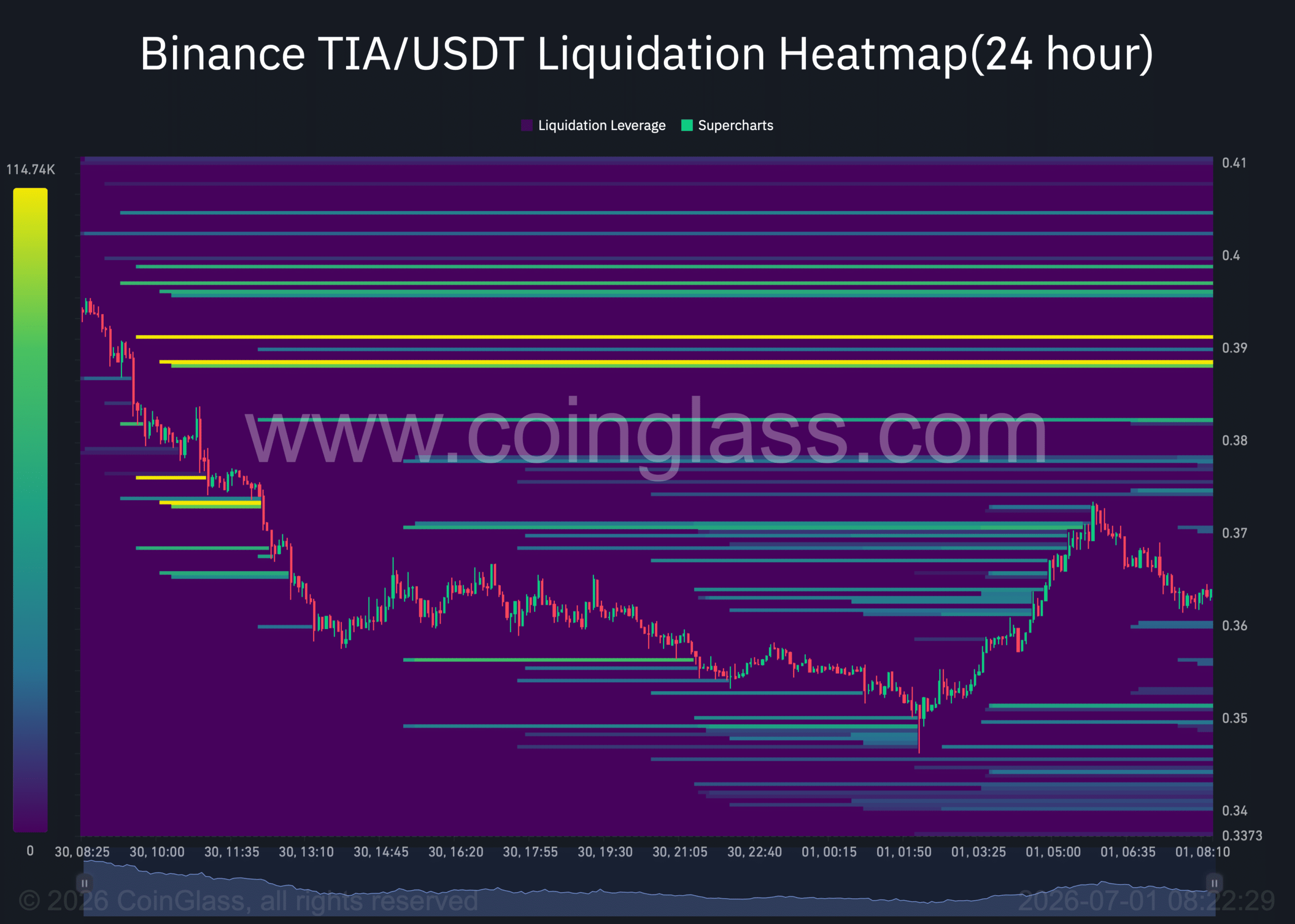
Bản đồ nhiệt thanh khoản TIA nghiêng về đà tăng

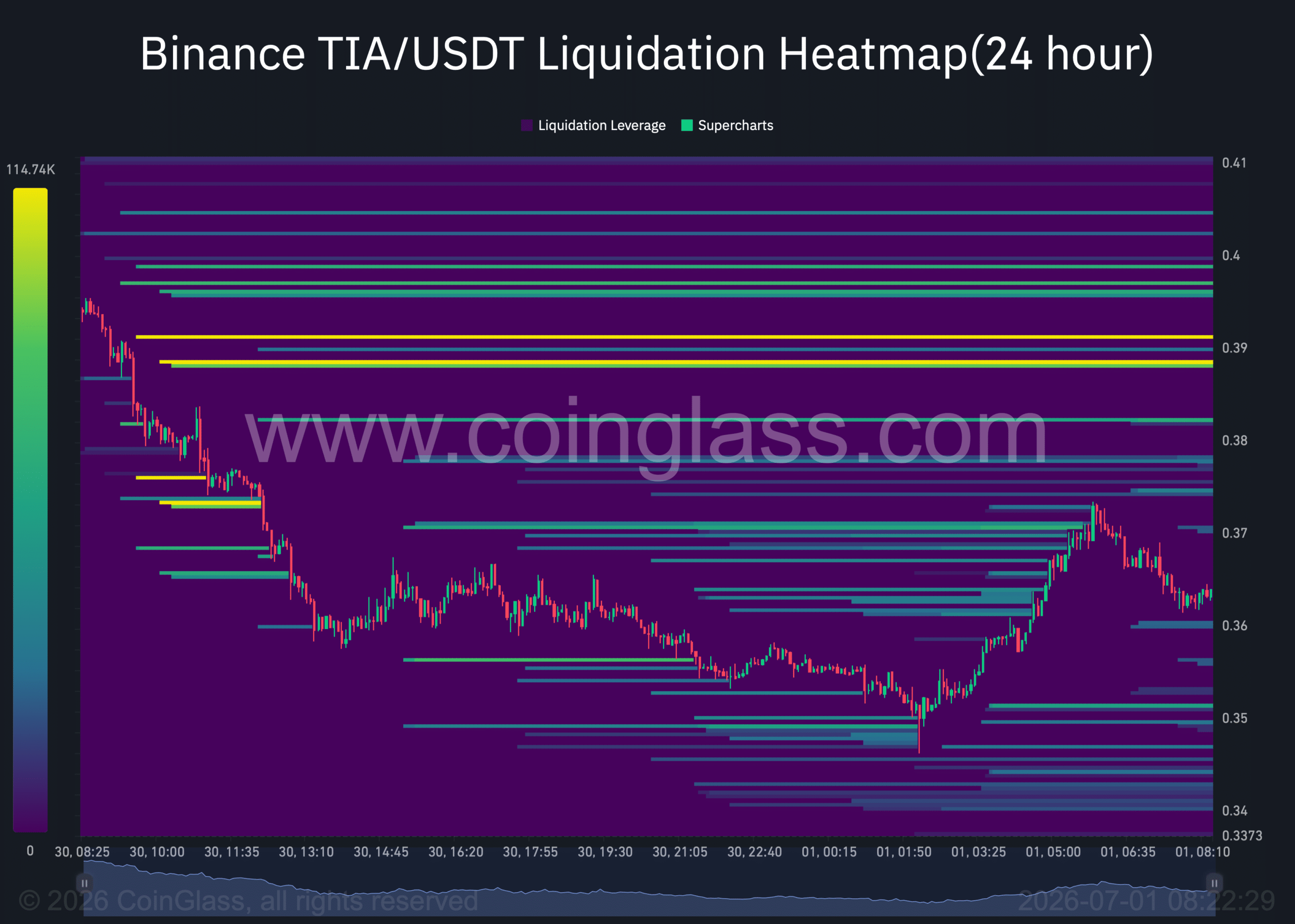
Bản đồ nhiệt thanh khoản chỉ ra khả năng TIA có đà tăng. Bản đồ này không khẳng định một hướng đi cụ thể, nhưng nó gợi ý hướng đi bằng cách lập bản đồ vị trí các lệnh mua và bán đang chờ.

Hiện tại, các cụm lệnh sâu hơn nằm trên mức giá hiện tại, gợi ý xác suất cao rằng TIA sẽ hồi phục hướng về những mức đó.
Nguồn: CoinGlass

Tuy nhiên, động lượng vẫn chống lại kịch bản đó, với TIA đã giảm hai con số trong ngày, và sự yếu kém đó có thể kéo giá xuống các cụm lệnh thấp hơn.

Những cụm lệnh thấp hơn đó chứa các lệnh mua đang chờ có thể là hạt giống cho một đợt tăng giá trung hạn và chuyển dịch cán cân trở lại ủng hộ TIA.


Tổng kết cuối cùng

  • Đội ngũ Celestia dự kiến sẽ bán khoảng 2,03 triệu USD TIA trong cả tháng, tạo thêm áp lực cơ cấu lên trên đà giảm của toàn thị trường.
  • Nhu cầu giao ngay và Tỷ lệ Tài trợ dương cho thấy người mua có thể hấp thụ nguồn cung sắp tới, giữ cho kịch bản tăng giá vẫn khả thi.


Criptos en tendencia

Preguntas relacionadas

QĐội ngũ Celestia dự kiến bán bao nhiêu TIA trong tháng 7?

AĐội ngũ Celestia dự kiến bán khoảng 2,03 triệu đô la trị giá TIA trong suốt tháng 7, tương đương với việc bán ra khoảng 67.000 đô la mỗi ngày.

QTại sao cấu trúc của TIA có thể khiến giá giảm thêm?

ACấu trúc của TIA được cho là sẵn sàng cho xu hướng giảm tiếp theo chủ yếu vì kế hoạch bán token theo lịch trình của đội ngũ sẽ bơm một lượng cung đáng kể (2,03 triệu đô la) vào thị trường trong tháng 7, tạo thêm áp lực bán.

QYếu tố nào cho thấy nhu cầu giao ngay có thể hấp thụ áp lực bán từ đội ngũ?

ADữ liệu giao dịch cho thấy tổng giá trị mua giao ngay (spot) đạt 106,68 triệu đô la trong tháng 6, với dòng tiền ròng khoảng 4,8 triệu đô la nghiêng về phía người mua. Điều này cho thấy nhu cầu giao ngay mạnh mẽ có khả năng hấp thụ lượng cung tăng thêm.

QTỷ lệ tài trợ (Funding Rate) và Open Interest của TIA tiết lộ điều gì?

ATỷ lệ tài trợ vẫn ở mức dương 0,0038% mặc dù Open Interest giảm. Điều này cho thấy phần lớn vốn trên thị trường hợp đồng vĩnh viễn đang đặt lệnh mua (long), kỳ vọng giá TIA tăng trong các phiên tới, dù với mức độ lạc quan thận trọng.

QBản đồ thanh khoản (liquidity heatmap) gợi ý điều gì về hướng đi của giá TIA?

ABản đồ thanh khoản chỉ ra rằng các cụm lệnh mua bán sâu hơn nằm ở phía trên mức giá hiện tại, gợi ý xác suất cao rằng TIA có thể hồi phục và tiến về các mức đó. Tuy nhiên, đà giảm hiện tại cũng có thể kéo giá xuống các cụm lệnh thấp hơn, nơi các lệnh mua chờ sẵn có thể tạo đà cho một đợt tăng giá trung hạn.

Lecturas Relacionadas

19 New Decacorns in Half a Year: Why is the Primary Market Chasing 'Certainty'?

In the first half of 2026, China’s primary market saw a notable increase in unicorns, adding 19 new companies each valued over 100 billion RMB, particularly in sectors like embodied AI and large language models (LLMs). Firms such as Galaxy General, Zibian, and ZhiPingFang even surpassed 200 billion RMB valuations within months. Moonshot AI's valuation surged from around $10 billion to $35 billion by July 2026, with a pre-IPO target of $50 billion. This concentration of capital into a few "certain" sectors highlights a market shift. The driving force is not a general abundance of capital but a chase for "certainty"—primarily clearer exit pathways like imminent IPOs. Companies with defined public listing timelines attract intense investment despite higher valuations, as they reduce exit uncertainty for investors. Secondary market valuations of listed peers also serve as new anchors, boosting the perceived value of private companies in similar fields, though this creates dependency on public market sentiment. Another form of certainty comes from the expectation of rising valuations in subsequent funding rounds. The investment logic has shifted in some cases from assessing long-term fundamental value to betting on the next round attracting higher prices. This dynamic is also seen in deep-tech areas like nuclear fusion, where firms like NeoFusion secured a 10.6 billion RMB valuation despite early commercial stages, driven by scarcity and strategic bets. However, this trend signals a risk transfer: technical uncertainties remain but are temporarily masked by valuation inflation. As valuations climb—50 billion to 200 billion or 500 billion RMB—companies face increasing pressure to demonstrate real revenue, profit, and sustainable business models. The danger lies not in the rise of unicorns itself, but if valuations become detached from value creation and rely merely on the expectation of future funding or exits. Ultimately, the surge reflects investors seeking perceived safety in shorter-term exit certainty and transactional momentum, rather than a renewed appetite for risk. The true test will come when the market inevitably refocuses on fundamentals, questioning how many of today’s high valuations are backed by genuine economic value.

marsbitHace 1 min(s)

19 New Decacorns in Half a Year: Why is the Primary Market Chasing 'Certainty'?

marsbitHace 1 min(s)

Just Now, Sam Altman Blasts Dario Amodei as 'Anti-Human', Secret Model Exposed the Same Day

Just now, Sam Altman strongly criticized Dario (Amodei, co-founder of Anthropic), denouncing his "doomsday marketing" as "anti-human dictator rhetoric." This came alongside the accidental exposure of OpenAI's next-generation model, codenamed "gpt-nathree," hinting at the imminent release of GPT-6 Astra. The leak occurred when an OpenAI employee's public GitHub commit mentioned the codename. Combined with previous leaks of "gpt-mewfour," it suggests these are iterative checkpoints for OpenAI's upcoming agent model, Astra. Astra is known for multi-agent collaboration and long-duration task handling, having reportedly solved previously unsolved mathematical problems. Meanwhile, two new Anthropic model codenames, "claude-marshmallow-eap" and "claude-melon-eap," were also exposed but are believed to be iterations of the Claude 5 series, not a new flagship. In a wide-ranging podcast interview, Altman admitted he was wrong about the speed of AI-driven disruption, acknowledging societal inertia slows adoption. He fiercely criticized rivals' marketing that simultaneously promises immense benefits (like curing cancer) and warns of existential risk, calling it a dangerous "benevolent dictator" narrative that seeks to concentrate power. He emphasized that people are the ultimate purpose of AI. Altman also revealed OpenAI's unconventional, consensus-defying path: spending four and a half years in the "dark" without a public product before ChatGPT's breakthrough, driven by scaling laws rather than early customer feedback. He concluded that even with superintelligent AI, genuine human connection will remain irreplaceably valuable.

marsbitHace 42 min(s)

Just Now, Sam Altman Blasts Dario Amodei as 'Anti-Human', Secret Model Exposed the Same Day

marsbitHace 42 min(s)

The 'Saving U.S. Treasuries' Baton Pass: Bessent Fumbled Last Week, This Week It's Wash's Turn

"Rescuing US Treasuries" Relay: After Bessent's Miss, All Eyes Are on Walsh Last week, US Treasury Secretary Bessent's announcement to at least double long-term Treasury buybacks failed to sustainably lower yields, which quickly rebounded. The market response saw a drop in the dollar alongside surges in gold and Bitcoin, interpreted as a "pressure release valve" for anxiety. The focus now shifts to Fed Chairman Walsh's upcoming Jackson Hole speech. Markets are highly sensitive to his message, seeking clarity on the Fed's policy response to stubborn inflation and worsening fiscal conditions. Analysts warn that a lack of new guidance could disappoint markets and worsen the sell-off in long-dated bonds. Analysts question the scale of Bessent's operations, noting they are too small relative to the overall debt market and do not constitute quantitative easing. A key issue is the Fed's massive holdings of long-term bonds, which distorts the market. With the Fed holding low-yielding short-term bonds that are losing money relative to its policy rate, discussion is growing around a potential Fed-led "Operation Twist." This would involve selling short-term bonds to buy long-term ones, aiming to lower long-end yields without expanding the balance sheet. The upcoming PCE inflation data will set the stage for Walsh's speech. However, the window for action is narrowing amid political pressures. A critical threshold is the 30-year yield at 5%; holding above it could increase stress on the dollar and leveraged sectors. Overall, the article suggests that without coordinated Fed action to anchor inflation expectations, Treasury interventions may ultimately fail, with investors increasingly looking to assets like gold as hedges.

marsbitHace 1 hora(s)

The 'Saving U.S. Treasuries' Baton Pass: Bessent Fumbled Last Week, This Week It's Wash's Turn

marsbitHace 1 hora(s)

Hyperliquid's Compliance Journey: From Permissionless to Permissioned via HIP-3

Hyperliquid’s Compliance Path: From Permissionless to Permissioned HIP-3 Hyperliquid currently blocks U.S. access because its permissionless, on-chain infrastructure conflicts with U.S. market structure laws, which restrict futures trading to registered exchanges, clearinghouses, and brokers. Through its Hyperliquid Policy Center (HPC), the project is advocating for regulatory modernization, proposing that regulated entities be allowed to build products on HyperCore (its exchange and clearing layer) while fulfilling their compliance obligations. The platform’s modular stack separates roles like a traditional exchange (DCM), clearinghouse (DCO), and broker (FCM), but reconstructs them on-chain with code. This enables permissionless access, self-custody, and 24/7 global trading, but clashes with U.S. rules requiring KYC, specific margin models, and custodial arrangements. To resolve this, HPC is engaging with U.S. regulators (CFTC, SEC) to seek clarity that deploying on-chain software does not itself trigger licensing, and to establish exemptions allowing non-custodial wallets to route users to regulated derivatives. Recent political signals suggest openness to this approach. On the technical side, Hyperliquid Labs has introduced permissioned HIP-3 deployers on testnet. These allow regulated entities to launch markets, perform KYC, and whitelist compliant users. While these create separate order books, whitelisted market makers can bridge liquidity between them, ensuring deep, shared liquidity across the same L1. Features like payload-based “PA” permissions enable DEX-level account controls (e.g., reduce-only orders), mirroring traditional broker authorities. The strategy is not to open the native, permissionless front-end to U.S. users, but to position Hyperliquid as neutral infrastructure that U.S. regulated firms can use while meeting their legal duties. This paves a compliant path for U.S. investor access while preserving the protocol’s core, permissionless nature.

marsbitHace 1 hora(s)

Hyperliquid's Compliance Journey: From Permissionless to Permissioned via HIP-3

marsbitHace 1 hora(s)

Trading

Spot

Artículos destacados

Cómo comprar TIA

¡Bienvenido a HTX.com! Hemos hecho que comprar Celestia (TIA) sea simple y conveniente. Sigue nuestra guía paso a paso para iniciar tu viaje de criptos.Paso 1: crea tu cuenta HTXUtiliza tu correo electrónico o número de teléfono para registrarte y obtener una cuenta gratuita en HTX. Experimenta un proceso de registro sin complicaciones y desbloquea todas las funciones.Obtener mi cuentaPaso 2: ve a Comprar cripto y elige tu método de pagoTarjeta de crédito/débito: usa tu Visa o Mastercard para comprar Celestia (TIA) al instante.Saldo: utiliza fondos del saldo de tu cuenta HTX para tradear sin problemas.Terceros: hemos agregado métodos de pago populares como Google Pay y Apple Pay para mejorar la comodidad.P2P: tradear directamente con otros usuarios en HTX.Over-the-Counter (OTC): ofrecemos servicios personalizados y tipos de cambio competitivos para los traders.Paso 3: guarda tu Celestia (TIA)Después de comprar tu Celestia (TIA), guárdalo en tu cuenta HTX. Alternativamente, puedes enviarlo a otro lugar mediante transferencia blockchain o utilizarlo para tradear otras criptomonedas.Paso 4: tradear Celestia (TIA)Tradear fácilmente con Celestia (TIA) en HTX's mercado spot. Simplemente accede a tu cuenta, selecciona tu par de trading, ejecuta tus trades y monitorea en tiempo real. Ofrecemos una experiencia fácil de usar tanto para principiantes como para traders experimentados.

240 Vistas totalesPublicado en 2024.12.10Actualizado en 2026.06.02

Cómo comprar TIA

Discusiones

Bienvenido a la comunidad de HTX. Aquí puedes mantenerte informado sobre los últimos desarrollos de la plataforma y acceder a análisis profesionales del mercado. A continuación se presentan las opiniones de los usuarios sobre el precio de TIA (TIA).

活动图片