Predicting Market True and False Gambling Gods: Debunking the 8300x Miracle; Price Manipulation Nets $230,000

Odaily星球日报Publicado a 2026-01-19Actualizado a 2026-01-19

Resumen

This article exposes two controversial cases on the prediction market platform Polymarket, highlighting issues of manipulation and deception. The first case involves a trader, ascetic, who claimed an 8,300x return—turning $12 into over $100,000 through 16 consecutive successful bets on Bitcoin's short-term volatility. However, he was accused by another trader, Moses, of operating a "Sybil farm"—using hundreds of accounts with small initial deposits to artificially create the illusion of a miraculous winning streak. Moses provided evidence of multiple accounts with similar trading patterns, suggesting the story was a fabricated marketing ploy. The second case details a more sophisticated manipulation: a trader known as a4385 exploited low liquidity during weekend trading to profit $233,000. He heavily bought "Yes" shares in a 15-minute XRP price prediction market, driving up the price of the shares. Then, just minutes before the market settled, he purchased $1 million worth of XRP on Binance, artificially inflating its price by 0.5% to ensure his Polymarket bet would win. After settlement, he quickly sold the XRP. This maneuver, with a minimal cost of around $6,200 in fees and slippage, effectively drained the liquidity from automated trading bots on Polymarket, one of which lost its entire annual profit of $160,000. The article concludes by warning users to be cautious and discerning, as not all spectacular gains are genuine, and platform rules can be exploited for manipu...

Original|Odaily Planet Daily(@OdailyChina)

Author|Wenser(@wenser 2010)

As a hot sector that has continued to rise since the beginning of the year, the prediction market is no stranger to wealth creation miracles.

But behind the miracles, is it a true spectacle achieved through careful timing and nimble maneuvering, or a false hype of artificial fraud and obfuscation? This requires onlookers to have a discerning eye. Recently, a Polymarket trader on X claimed to have achieved an "8300x miracle," betting from a $12 principal to over $100,000, but was quickly exposed for multi-account fraud and traffic炒作; another trader, through price manipulation of XRP, netted $230,000 in the "15-minute price prediction" section, executing a one-sided harvest against Polymarket's betting bots.

On the stage of betting for and against, some want to dance with lies, while others exploit rule loopholes for clever plunder. In the bet of right and wrong, there is no unbeatable strategy, only flexible tactics.

The 8300x Miracle from $12 to $100,000: Polymarket's Living Billboard VS Trader's Fraud Scheme

The story begins with a post "self-reporting a journey from a $12 principal to $100,000 in profit, achieving an 8300x return".

On January 16th, trader ascetic posted saying that through "all-in bets on short-term Bitcoin volatility", they doubled their principal 16 times consecutively, ultimately achieving the milestone of going from $12 to $100,000 in profit. Simultaneously, they emphasized that they "also specifically shared their betting strategy and the reasoning behind it" during the betting process.

Subsequently, they posted a link to their Polymarket account in the comments,直言 such wealth creation miracles can only happen on Polymarket (Odaily Planet Daily Note: Does it feel familiar? Platforms where traders previously used similar expressions include but are not limited to OpenSea, Blur, Pump.fun, Hyperliquid, Aster, etc.).

The comments section then上演 a "Polymarket community member's adrenaline-fueled狂欢", with countless people congratulating them,甚至 Polymarket Global Growth Lead LeGate commented: "Congrats bro! I think you deserve it! Congrats on the @PolymarketTrade badge!" (Odaily Planet Daily Note: This account is for the Polymarket active trader community.)

If you thought this would be a常规 "overnight wealth炫耀 post", then you might have underestimated the drama level of the situation.

Soon, the wind direction of this "Polymarket 8300x return miracle" event took a sharp turn for the worse.

From Betting Miracle to Fraud Scheme: 8300x Return Data Questioned

On January 16th itself, a trader named Moses, who自称 "ranked 515th in Polymarket trading for 2025", posted质疑 trader ascetic's account data, saying: "Did you ever wonder why his account balance was $3000 in the first post? The answer is simple: he operates a massive 'sybil farm'. He didn't start with $12, but with hundreds of accounts, each funded with $10 to $20. Once one account reached $2900, he started posting. Since then, he has made seven trades, all wins.

But note, he bets his entire stack every time. Real traders don't do this. He's just chasing clout, doing whatever it takes to get there.

Failing to get enough volume, he also seems to use other accounts to fake trade to get the price he wants.

Before blindly believing 'influencers', please do your own research. The attached image shows some of his failed sybil accounts that only made it to $1000 max."

Subsequently, Moses added in the comments that all accounts were created 7 months ago and consistently participated in random markets, all starting the same challenge on the same day 2 months ago. The entire "$10 to $100k" story is fake!

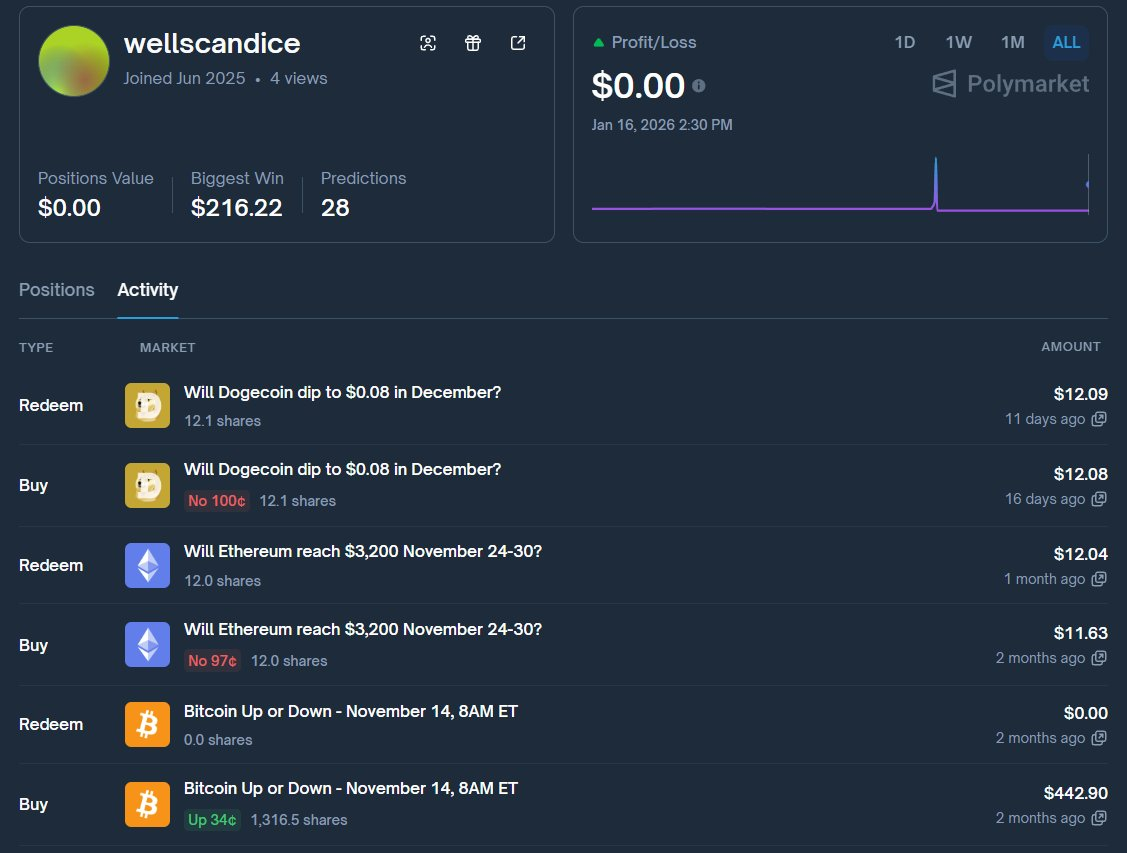
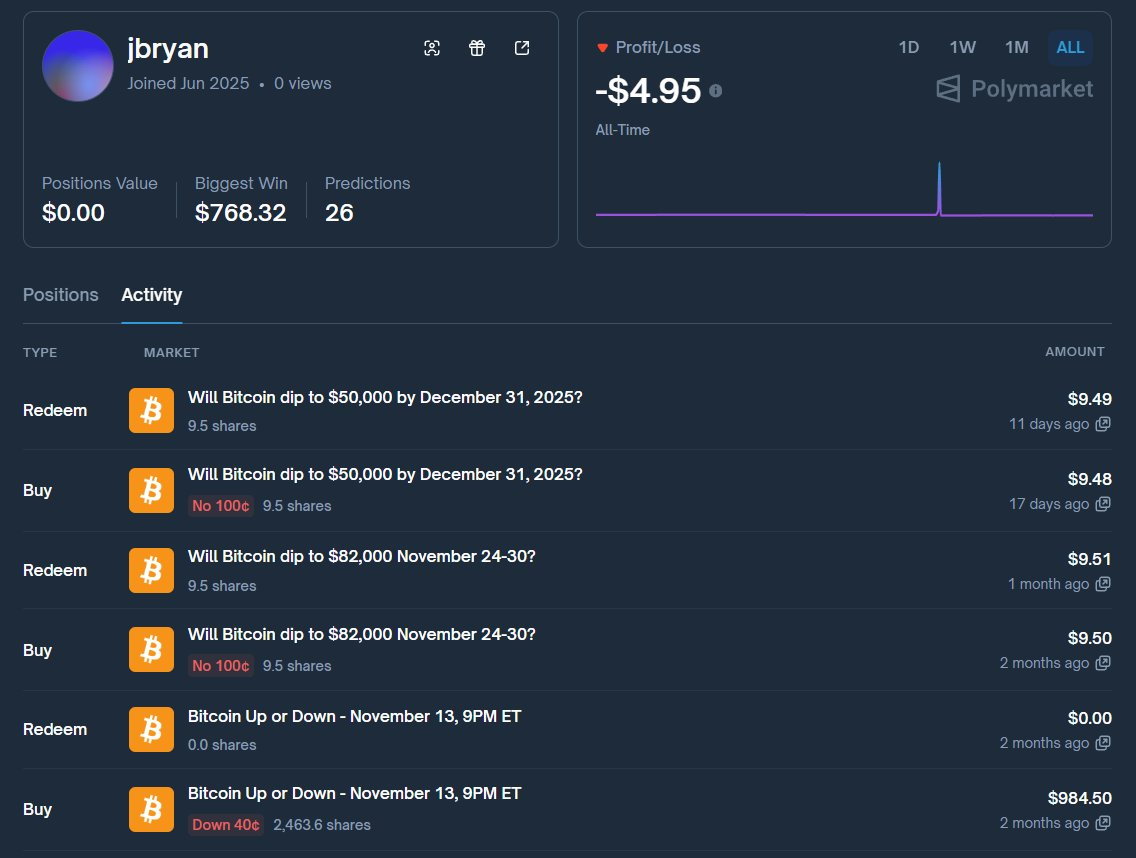
Not only that, he also posted screenshots and links to the corresponding sybil account homepages:

  • Account one: https://polymarket.com/@brockmatthew;
  • Account two: https://polymarket.com/@wellscandice;
  • Account three: https://polymarket.com/@jbryan.
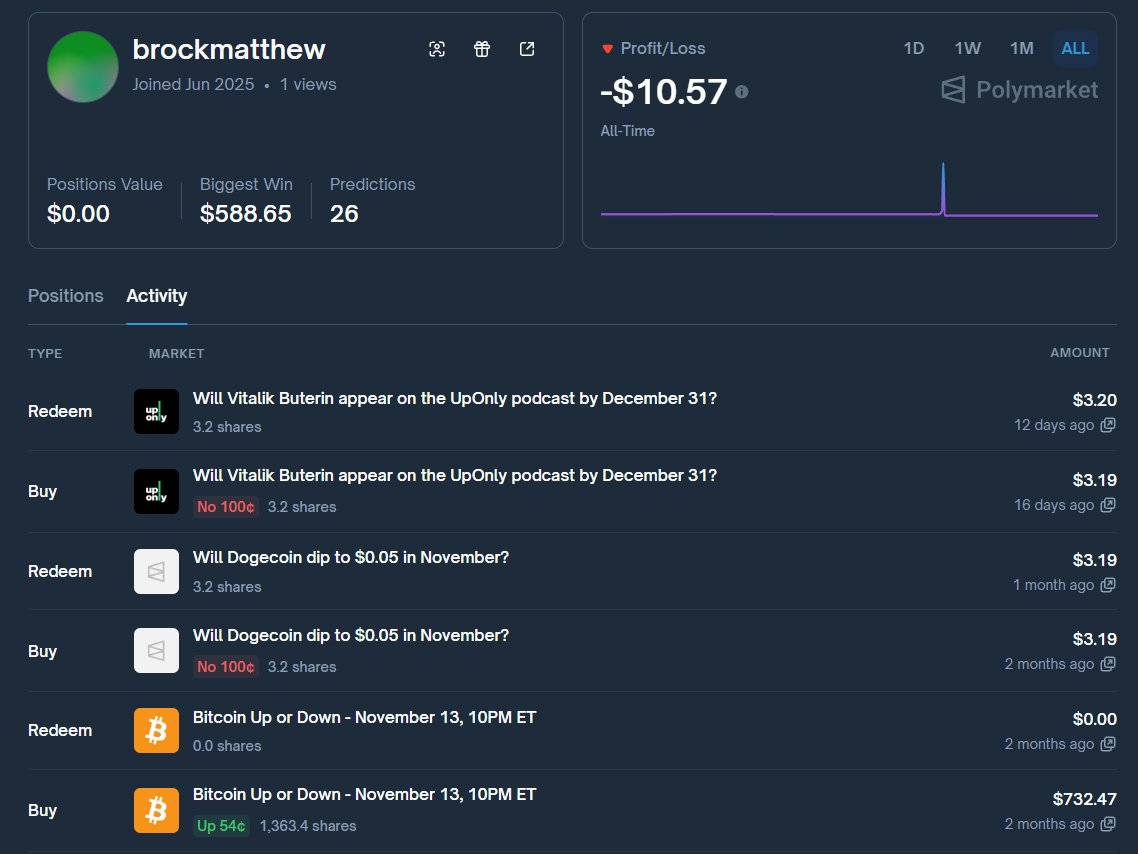
Although ascetic later responded in the comments that the wallets and accounts mentioned by Moses were unrelated to them, and some ZSC DAO (a Polymarket trader community) members also voiced support, calling Moses's actions a cyber attack, the association between the bot-like reply content on ascetic's previous tweet and their Polymarket account and numerous accounts with similar behavioral traces still greatly reduced the credibility of this "8300x return miracle".

Someone in the comments also mentioned it was hard to understand the reason for doing this, as "7 consecutive winning bets" itself is already impressive; but随后 someone pointed out this was still a game of "bot-style wide net".

Somewhat ironically, Moses's own bio also reads "The Road from $1 to $1M", whether it's a real record or a personal goal, we don't know.

Compared to the hard-to-judge ascetic, the following case of a trader who made $230,000 in profit through price manipulation in the XRP "15-minute price prediction market" might be more worthy of study by whale players.

Trader Uses Binance Spot to Counter-Harvest Prediction Market: $1M Principal Nets $230K Profit

On January 18th, Polymarket trader PredictTrader posted exposing a trader's操作 worthy of a "Wolf of Wall Street" drama—by harvesting liquidity from trading bots, he made $233,000 in just a few hours, and it hadn't even attracted大规模 market attention yet.

The timing chosen by this trader, a4385, was also extremely clever—it was Saturday evening, market liquidity was low, and Binance spot order book liquidity was also relatively thin.

In the "XRP Up/Down — Jan 17, 12:45-1:00 PM ET" market, he heavily bought "Yes" shares.

His counterparties were the more common "individual market makers" on Polymarket—various trading bots. (Odaily Planet Daily Note: Market making on Polymarket is relatively simple, with low entry barriers for individual developers, trading bots are very popular now). By 10 minutes into the event, XRP was down about 0.3% from the opening price, but he had pushed the "Yes" shares up to 70%. The trading bots saw a profit opportunity, unaware they were falling into the price trap set by this trader, and proceeded to sell him more "Yes" shares.

Ultimately, the trader bought $77,000 worth of "Yes" shares at an average price of 48%.

Then, just 2 minutes before the event settled, a wallet on Binance bought about $1 million worth of XRP spot, pushing its price up about 0.5%; seconds after the event settled, this $1 million spot was quickly sold off.

In other words, the cost of this price manipulation event was—approximately 0.25% one-way trade slippage + fees.

Using a Binance VIP Level 4 account (0.06%) (easy to obtain) and 0.25% two-way slippage, the total cost is approximately $6,200, the actual operating cost could be even lower. By repeating the same operation multiple times, exploiting the weekend liquidity loophole, this trader借此 emptied multiple bot wallets.

Some bots were shut down in time, while others weren't quick enough to react and lost all their funds—including @aleksandmoney, who lost their entire year's profit (about $160,000).

a4385 Polymarket account link: https://polymarket.com/profile/0x506bce138df20695c03cd5a59a937499fb00b0fe

At the end of the article, we hope that traders betting for and against, passionately battling on the prediction market, can distinguish fact from appearance. Sometimes, the truth is not always objective, while the standards and rules判定 by the platform are man-made.


Criptos en tendencia

Preguntas relacionadas

QWhat was the alleged 8300x return story on Polymarket, and what was the controversy surrounding it?

AA trader named ascetic claimed to have turned $12 into over $100,000 in profit through 16 consecutive successful bets on Bitcoin's short-term volatility, achieving an 8300x return. However, another trader, Moses, accused ascetic of running a 'Sybil farm' with hundreds of accounts, each starting with $10-$20, and only publicizing the one account that succeeded. Moses provided links to several accounts with similar creation dates and trading patterns to support the fraud allegation.

QHow did a trader allegedly manipulate the XRP price on Binance to profit on Polymarket?

AA trader, identified as a4385, manipulated the 'XRP Up/Down - 15-minute' market on Polymarket. They heavily bought 'Up' shares, pushing their price to 70% even though XRP was down 0.3%. Then, just two minutes before the market's resolution time, a wallet (likely controlled by them) bought ~$1 million of XRP spot on Binance, artificially pumping its price by ~0.5%. After the Polymarket market resolved in their favor, the XRP was quickly sold. The cost was minimal (estimated 0.25% slippage + fees), but the profit was $233,000, effectively draining liquidity from automated trading bots on Polymarket.

QWhat role did trading bots play in the XRP price manipulation scheme on Polymarket?

ATrading bots, which act as personal market makers on Polymarket, were the counterparties that sold the 'Up' shares to the manipulator, a4385. These bots, seeing a profitable opportunity to sell high-priced 'Up' shares against a falling XRP price, provided the liquidity that the manipulator needed. They failed to anticipate the upcoming artificial price pump on Binance and were consequently 'harvested' for their liquidity, with one bot, @aleksandmoney, reportedly losing its entire annual profit of ~$160,000.

QHow did the Polymarket community and officials initially react to the '8300x miracle' claim?

AInitially, the Polymarket community reacted with celebratory comments and congratulations. Polymarket's Global Head of Growth, LeGate, even congratulated the trader ascetic and awarded them a PolymarketTrade badge, seemingly endorsing the achievement as a legitimate success story for the platform before the fraud allegations surfaced.

QWhat is the core warning or lesson the article implies about prediction markets like Polymarket?

AThe article warns that not all spectacular gains are genuine. It highlights that these platforms can be susceptible to fraud, such as multi-account schemes (Sybil attacks), and sophisticated manipulation, where traders with significant capital can exploit market mechanics and liquidity providers (like bots) for profit. It advises participants to be discerning, conduct their own research, and understand that platform rules and judgments are ultimately man-made and can be gamed.

Lecturas Relacionadas

Is the 'Token Subsidy War' Among AI Giants Almost Over?

The article discusses the ongoing "token subsidy war" among AI giants like OpenAI and Anthropic, questioning whether it's nearing its end. It reveals that current AI subscription prices are heavily subsidized, with some plans offering tokens at up to 70 times the actual cost to attract and retain heavy users, especially developers and enterprises. This strategy mirrors past internet-era subsidy battles, but with a key difference: AI tokens lack "lock-in" effects. Unlike ride-hailing or food delivery apps, users can easily switch between AI providers as APIs become standardized, making it difficult for companies to raise prices post-subsidy. The piece highlights a structural asymmetry in the competition. Giants like Google, with massive advertising revenue, can afford to subsidize tokens indefinitely, akin to using "tokens as a weapon." In contrast, venture-backed companies like OpenAI and Anthropic face pressure to become profitable, especially as they approach IPO. The article cites Google Ventures founder Bill Maris, who suggests Google could slash token prices by 80%, putting immense pressure on competitors. Two potential endgames are presented: the "internet service" model (subsidize, monopolize, then raise prices) and the "utility" model (tokens become a standardized, low-margin commodity like electricity). Given the low switching costs, the latter seems more likely. The competition may not have a single winner but could instead accelerate AI's evolution into a foundational, infrastructure-level technology, akin to a public utility. For now, users continue to benefit from heavily subsidized token costs.

marsbitHace 19 min(s)

Is the 'Token Subsidy War' Among AI Giants Almost Over?

marsbitHace 19 min(s)

Beyond the Stadium: The Profitable Games Surrounding the World Cup

"Beyond the Pitch: The Profit Game Around the World Cup" The FIFA World Cup transcends being a sporting spectacle, evolving into a massive global arena for speculation and profit-seeking. The 2026 tournament has amplified this dynamic, creating a multi-layered ecosystem of financial opportunism alongside the football. **Prediction markets** have surged into the mainstream. Platforms like Polymarket and Kalshi saw trading volumes for World Cup contracts soar, attracting new users with their financial trading model and high-profile, chain-based wealth stories that overshadow traditional sports betting in terms of growth and narrative. However, **traditional sportsbooks** remain the dominant force, leveraging established user habits, legal markets, and comprehensive product offerings to handle the vast majority of speculative wagers, with projections suggesting record-breaking betting volumes. Capital markets also react. **"Concept stocks"** in countries like South Korea and Japan experience volatile price swings based on team performance and anticipated fan spending on items like chicken, beer, and viewing parties, effectively becoming a stock market reflecting fan sentiment. The **ticket resale market** has become a sophisticated arena for arbitrage. Prices fluctuate wildly based on team draws and star power, with sellers sometimes listing tickets they don't yet own in a practice akin to short-selling, while FIFA's own "Right to Buy" tokens add another layer of speculative trading. **Collectibles and merchandise** offer another avenue. Panini sticker albums, with their inherent scarcity and nostalgic value, can become high-value collectibles. Limited-edition or locally themed jerseys command significant premiums on secondary markets, and even counterfeit vendors profit from fans' desire for affordable match-day identity. The **cryptocurrency** space has seen a frenzy of speculative, unauthorized World Cup-themed meme coins on chains like Solana. These tokens, often exploiting team names and player imagery, experience extreme pump-and-dump cycles, creating stories of massive gains for a few early entrants and steep losses for many others. Finally, an entire industry thrives on **providing information and tools** to other speculators. Developers create platforms like SeatSidekick to track ticket inventory and prices, while paid Telegram groups and subscriptions sell betting tips and predictions, monetizing the widespread desire for an informational edge. In essence, the World Cup has become a compressed, global laboratory for speculation. While the games determine champions on the field, a parallel, complex network of financial transactions—spanning prediction contracts, bets, stocks, tickets, collectibles, crypto, and information services—settles its own scores in the global market.

marsbitHace 59 min(s)

Beyond the Stadium: The Profitable Games Surrounding the World Cup

marsbitHace 59 min(s)

How Does Codex Use a Computer? Three Entry Points and Permission Boundaries

This article explains the three primary methods for Codex to interact with a computer, each with distinct use cases, permission boundaries, and trust levels. **1. Computer Use:** This offers the broadest access, allowing Codex to visually control and interact with the graphical user interface of authorized macOS/Windows apps, system settings, and even iOS simulators. It's ideal for tasks lacking APIs or structured tools, such as operating legacy software or multi-app workflows. However, it's the slowest method and has the widest permission scope, requiring careful supervision for sensitive actions. **2. Chrome Extension:** This grants Codex access to the user's logged-in Chrome browser state, including cookies, profiles, and open tabs. It's best for tasks requiring user identity across websites like Gmail, LinkedIn, Salesforce, or internal dashboards. Its key advantage is multi-tab control for complex workflows. While more powerful for browser-based tasks than Computer Use, it carries higher sensitivity as actions are performed under the user's identity. **3. In-App Browser:** This is a browser isolated within the Codex thread, separate from the user's personal browsing data. It excels in web development and debugging scenarios—previewing local servers, testing responsive layouts, or annotating designs directly on the page. Its isolation is a strength for development but a limitation for tasks requiring login sessions. The core principle is to choose the narrowest, safest, and most structured interface for the task. Use plugins or MCPs first, resort to visual control (Computer Use) only for GUI-dependent tasks, employ the Chrome extension for identity-reliant browser work, and prefer the In-App Browser for isolated development. **Appshots** are clarified as a fourth, complementary tool for *inputting* context—capturing a screenshot of a window to point Codex to something—rather than a method for Codex to *act*. Together, this layered approach highlights a key to AI agent productization: not granting unlimited permissions, but constraining them within clear boundaries for specific tasks while preserving user oversight.

marsbitHace 2 hora(s)

How Does Codex Use a Computer? Three Entry Points and Permission Boundaries

marsbitHace 2 hora(s)

The "Iron Rule" of Chip Equipment Is Being Broken

For years, the semiconductor equipment industry followed an unwritten "iron rule": suppliers offered steep discounts for new tool introductions (Design-in) and faced consistent price pressure during repeat orders, especially during market downturns. This long-standing buyer's market dynamic is now being upended. Recently, SK Hynix's primary equipment suppliers have reportedly requested a 3-4% price *increase*, a nearly unprecedented move. This shift is driven by a severe supply-demand imbalance fueled by the AI compute boom. Securing equipment has become an urgent arms race as chipmakers' expansion speed dictates their ability to fulfill massive AI chip orders. Key areas feeling the strain include: **TCB (Thermal Compression Bonding) Equipment:** Demand is exploding, driven by the simultaneous needs of HBM4 memory stacking, AI chip Chip-on-Substrate (C2S), and logic Chiplet Chip-on-Wafer (C2W) packaging. Players like Hanmi Semiconductor, Hanwha Semitech, and ASMPT are receiving major orders. While hybrid bonding is seen as the future, TCB remains the pragmatic choice for HBM4 mass production, with its lifecycle extended by relaxed specifications and ongoing technological upgrades. **Test Equipment Bottlenecks:** Ironically, AI-driven shortages are now crippling test equipment manufacturing. Critical components like FPGAs, Driver ICs, and CPUs face severe shortages and extended lead times (up to 52 weeks for FPGAs), as AI data center and server vendors prioritize supply. This creates a paradoxical cycle: AI chip shortages drive fab expansion, which requires more test equipment, whose production is delayed because its key parts are diverted to make AI chips. The industry is entering a broad, AI-powered upcycle. SEMI forecasts global semiconductor equipment sales to hit a record $156 billion by 2027, fueled by investment in advanced logic/foundry, HBM-driven DRAM, and advanced packaging (like CoWoS). Major players like TSMC, SK Hynix, and Micron are aggressively ramping capital expenditure. In conclusion, leading equipment vendors are no longer just selling tools; they are selling the critical capability to deliver AI-era capacity. Pricing power is shifting decisively to those with indispensable technology in key process nodes like advanced logic, HBM, and advanced packaging, rewriting the industry's traditional power structure.

marsbitHace 2 hora(s)

The "Iron Rule" of Chip Equipment Is Being Broken

marsbitHace 2 hora(s)

Trading

Spot
Futuros

Artículos destacados

Cómo comprar GODS

¡Bienvenido a HTX.com! Hemos hecho que comprar Gods Unchained (GODS) sea simple y conveniente. Sigue nuestra guía paso a paso para iniciar tu viaje de criptos.Paso 1: crea tu cuenta HTXUtiliza tu correo electrónico o número de teléfono para registrarte y obtener una cuenta gratuita en HTX. Experimenta un proceso de registro sin complicaciones y desbloquea todas las funciones.Obtener mi cuentaPaso 2: ve a Comprar cripto y elige tu método de pagoTarjeta de crédito/débito: usa tu Visa o Mastercard para comprar Gods Unchained (GODS) al instante.Saldo: utiliza fondos del saldo de tu cuenta HTX para tradear sin problemas.Terceros: hemos agregado métodos de pago populares como Google Pay y Apple Pay para mejorar la comodidad.P2P: tradear directamente con otros usuarios en HTX.Over-the-Counter (OTC): ofrecemos servicios personalizados y tipos de cambio competitivos para los traders.Paso 3: guarda tu Gods Unchained (GODS)Después de comprar tu Gods Unchained (GODS), guárdalo en tu cuenta HTX. Alternativamente, puedes enviarlo a otro lugar mediante transferencia blockchain o utilizarlo para tradear otras criptomonedas.Paso 4: tradear Gods Unchained (GODS)Tradear fácilmente con Gods Unchained (GODS) en HTX's mercado spot. Simplemente accede a tu cuenta, selecciona tu par de trading, ejecuta tus trades y monitorea en tiempo real. Ofrecemos una experiencia fácil de usar tanto para principiantes como para traders experimentados.

123 Vistas totalesPublicado en 2024.12.13Actualizado en 2026.06.02

Cómo comprar GODS

Discusiones

Bienvenido a la comunidad de HTX. Aquí puedes mantenerte informado sobre los últimos desarrollos de la plataforma y acceder a análisis profesionales del mercado. A continuación se presentan las opiniones de los usuarios sobre el precio de GODS (GODS).

活动图片