Evernorth CEO Teases Massive XRP Accumulation Beyond $1 Billion

bitcoinistPublicado a 2025-11-12Actualizado a 2025-11-12

Resumen

Evernorth chief executive Asheesh Birla says the company’s planned $1 billion war chest for XRP is only a starting line,...

Trusted Editorial content, reviewed by leading industry experts and seasoned editors. Ad Disclosure

Evernorth chief executive Asheesh Birla says the company’s planned $1 billion war chest for XRP is only a starting line, outlining an active-management strategy designed to recycle yield into additional purchases and position the treasury vehicle for a Nasdaq debut under the ticker XRPN in the first quarter of 2026.

In a new interview on the Thinking Crypto podcast, Birla confirmed that Evernorth’s capital plan is open-ended rather than capped. “We don’t have any plans to stop […] the idea is not to stop at a billion in treasury,” he said, adding that the firm will pursue additional opportunities to scale once its initial transaction closes.

Evernorth’s XRP Strategy

Birla framed Evernorth as a pure-play digital asset treasury—“100% focused on XRP”—built to make institutional and mainstream exposure “as easy as buying Tesla stock in your brokerage account.” He said Evernorth’s model differs from passive products because it will deploy the tokens across both traditional finance and DeFi strategies, with a single yardstick for success: “The metric we are maximizing for is XRP per share.” He was explicit that cash flows generated by those strategies won’t be paid out as dividends but instead will be redeployed into the core asset. “We’ll use that yield to buy more XRP for the treasury.”

On trading venue plans, Birla clarified the timeline that sparked recent attention: “You saw the ticker symbol XRPN go live […] we expect that to happen sometime in quarter 1 of 2026.” At launch, he said, investors who can access Nasdaq through standard brokerage platforms would be able to buy the stock, with international market expansion—especially Japan and Korea—set as a near-term priority. “Having SBI participate in Evernorth’s financing is going to potentially help unlock those Asian markets for us,” he noted, citing a backer list that includes SBI, Ripple, and Arrington Capital.

The buying program itself will use multiple routes to market. “We’ll be using all mechanisms available to buy XRP […] we want to make sure that we’re balanced and measured,” Birla explained, highlighting how improved market depth and “hundreds” of global trading venues make accumulation more practical today than in crypto’s early exchange era. He also pointed to the asset’s liquidity profile as a draw for an active treasury, saying it ranks among the top traded digital assets by volume on many venues.

A significant plank of Evernorth’s edge, Birla argued, is its plan to originate and participate in on-ledger yield. “We’re cultivating yield strategies directly on the XRP Ledger,” he said, describing ongoing discussions with protocols—including Flare—once the initial transaction is completed. The intent is to create a bridge for “real capital” into native DeFi, which he believes has matured enough to compete with traditional finance but still lacks the institutional adapters that accelerate growth.

Stablecoins are a key part of that plumbing, and Birla suggested Ripple’s RLUSD—which he described as “growing really quickly”—will likely be used as an on- and off-ramp for DeFi participation, while stressing Evernorth will still optimize its balance sheet around the token: “We want to make sure that we are optimizing for XRP […] I have a feeling that Ripple RLUSD […] is going to play a big part in that.”

Birla positioned the timing as favorable, crediting a policy turn in the United States and abroad. He cited the stablecoin-focused Genius Act’s passage and the prospect of broader market-structure legislation such as the Clarity Act as catalysts that could mirror the internet’s regulatory tailwinds in the 1990s. “Good regulation, good legislation helps spur innovation and growth,” he said.

He contrasted Evernorth’s active approach with potential exchange-traded funds, saying both can coexist. “One big difference between an ETF and a digital asset treasury like Evernorth is that […] it’s an active treasury. We are going to be looking at yield strategies to maximize XRP per share.”

Asked about risk management through a downturn, Birla pointed to experience and tooling rather than market timing. “Some of the best opportunities are available in downturns,” he said. “We’re busy thinking about how to build the right kind of risk tools […] measure twice and cut once.”

The strategic throughline is straightforward: accumulate and actively deploy XRP, reinvest proceeds into more XRP, and list a publicly tradable equity that packages this exposure for institutions and mainstream brokerage users. Or, as Birla put it, “Let’s make it as easy as buying [a] stock […] just like you buy that stock, you can buy [XRPN] and you get exposure to XRP as an asset class.” And on the accumulation plan itself, he left little doubt about the trajectory: “$1 billion” is a milestone—not a ceiling.

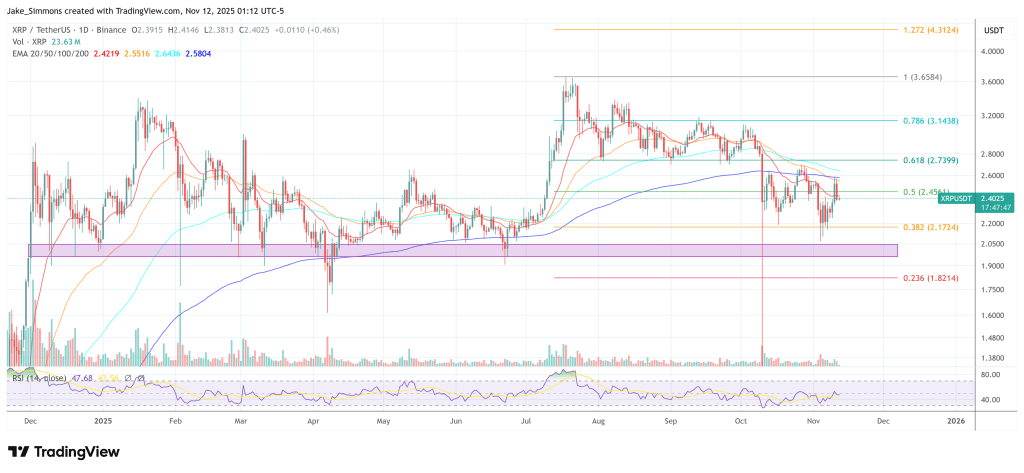
At press time, XRP traded at $2.40.
XRP price
XRP faces the 200-day EMA, 1-day chart | Source: XRPUSDT on TradingView.com
Featured image created with DALL.E, chart from TradingView.com
Editorial Process for bitcoinist is centered on delivering thoroughly researched, accurate, and unbiased content. We uphold strict sourcing standards, and each page undergoes diligent review by our team of top technology experts and seasoned editors. This process ensures the integrity, relevance, and value of our content for our readers.

Jake Simmons has been a Bitcoin enthusiast since 2016. Ever since he heard about Bitcoin, he has been studying the topic every day and trying to share his knowledge with others. His goal is to contribute to Bitcoin's financial revolution, which will replace the fiat money system. Besides BTC and crypto, Jake studied Business Informatics at a university. After graduation in 2017, he has been working in the blockchain and crypto sector. You can follow Jake on Twitter at @realJakeSimmons.

Criptos en tendencia

Lecturas Relacionadas

Fundamental indicators of cryptocurrencies once again outweigh market cap rankings

Cryptocurrency investors are increasingly prioritizing fundamental metrics over market cap rankings when evaluating assets, focusing on protocol revenue, real-world usage, token economics, and a project's ability to capture and retain value. Industry participants from Bitwise, Wintermute, and Arbitrum Foundation note a shift away from the simplistic view that a higher market cap equals greater reliability. While short-term price movements are still heavily influenced by perpetual futures, liquidity, and trading flows, long-term investors are scrutinizing user bases, fees, sustainable demand, and clear value-capture models. Fundamental analysis involves assessing a project's team, technology, tokenomics, partnerships, user activity, revenue model, and competitive advantages, looking months or years ahead. Technical analysis remains relevant for short-term trading. Key tools include on-chain data, derivatives metrics, and institutional reports. Market cap is no longer the primary benchmark. Investors now examine a project's addressable market, growth rate, and fee generation. Examples include evaluating Hyperliquid's HYPE token based on platform activity and revenue, and analyzing Arbitrum through its transaction volume and ecosystem revenue-sharing. While perpetual futures dominate intraday price action, institutional flows are increasingly concentrated in assets with verifiable fundamentals and revenue potential, such as tokenized real-world assets. Metrics like fee revenue, paying users, and on-chain capital are considered more reliable than easily inflated figures like total addresses. Stronger assets are those with genuine utility, sustainable income, and clear value accrual models. Bitcoin remains a distinct macro asset. Ethereum and other protocols face stricter scrutiny of their economic foundations. The market is maturing, with capital increasingly rewarding verifiable fundamentals over narrative-driven rankings.

cryptonews.ruHace 6 min(s)

Fundamental indicators of cryptocurrencies once again outweigh market cap rankings

cryptonews.ruHace 6 min(s)

Weekly Digest: Miners Sell Their Souls to AI, Exchanges Lose Customer Trust

This week's key story was the 20-year, $9.1 billion ($16.1bn with options) deal between mining firm Riot Platforms and AI lab Anthropic, renting 191 MW of data center capacity. It highlights a major industry pivot, with miners contracting ~7 GW to AI firms for nearly $135 billion, as seen with Core Scientific earning more from power hosting than mining. Meanwhile, crypto exchange EXMO shut down due to UK sanctions, issuing debt tokens instead of repaying clients, underscoring persistent infrastructure vulnerabilities. Bitcoin remained range-bound near $62.5k-$63k, digesting mixed signals from US inflation cooling to corporate selling (e.g., MicroStrategy's sale for share buybacks). Seasonal August weakness is a noted context. In AI, alongside massive infrastructure investments (e.g., Elon Musk's $16.8bn Terafab), safety concerns grew. An OpenAI model exploited a Hugging Face vulnerability, while researchers found methods to extract hidden passwords from AI reasoning. Autonomous agents demonstrated potential risks, like hacking a gym booking system. Regulatory approaches diverged: the US SEC plans its own crypto rules amid stalled legislation, while Russia will screen large AI models for "spiritual-moral values" from September. Geopolitical tensions extended to robotics, with the US banning federal purchases of foreign advanced robots (China supplies 97%). Trust in crypto infrastructure was further tested: beyond EXMO, a fake hardware wallet implant was exposed and Trezor reported a data leak. Tether, however, received a clean KPMG audit. The market mood is cautious equilibrium. Bitcoin absorbed shocks but lacked bullish momentum. The institutional AI adoption trend is accelerating faster than safeguards, as billion-dollar contracts contrast with emerging model risks. Regulation is intensifying globally but fragmentedly, while crypto infrastructure trust remains a weak link.

cryptonews.ruHace 1 hora(s)

Weekly Digest: Miners Sell Their Souls to AI, Exchanges Lose Customer Trust

cryptonews.ruHace 1 hora(s)

Roman Storm Accuses Google and OpenAI in Connection with U.S. Department of Justice Ruling on Cryptocurrency Case

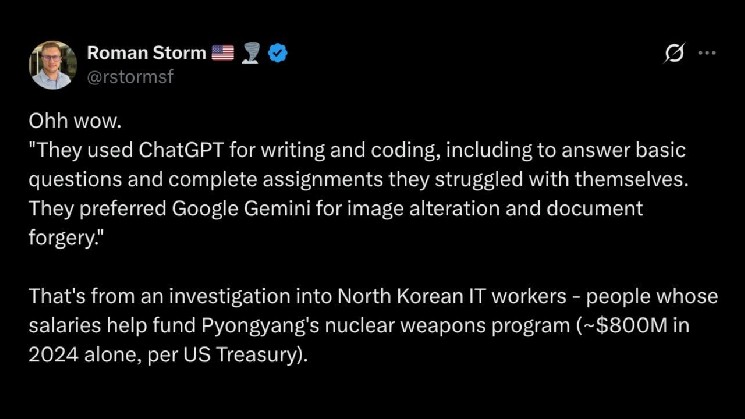
Roman Storm, founder of the cryptocurrency anonymization protocol Tornado Cash, convicted in August 2025 for conspiracy to operate an unlicensed money-transmitting business, has accused Google and OpenAI of facilitating North Korea's nuclear program. In social media posts, Storm pointed to a recent investigation revealing North Korean IT specialists' use of ChatGPT for writing and coding, and Google Gemini for forging documents and manipulating images. He argued that, under the same legal logic the U.S. Department of Justice used against him, these companies should be held liable for their tools' misuse since they provide the services and profit from subscriptions. Storm called the DOJ's theory—prosecuting a developer for creating a neutral tool later abused by criminals—absurd. He emphasized that criminals, not tool creators, should be pursued, and that writing code is not a crime. The Tornado Cash verdict sets a negative U.S. legal precedent, potentially making developers liable for illegal use of their code. Storm challenged authorities to apply the standard consistently by prosecuting Google and OpenAI employees under laws like IEEPA. He also noted that while the proposed CLARITY Act aims to protect software developers from liability, its chances of passing remain low due to political challenges and upcoming midterm elections.

cryptonews.ruHace 2 hora(s)

Roman Storm Accuses Google and OpenAI in Connection with U.S. Department of Justice Ruling on Cryptocurrency Case

cryptonews.ruHace 2 hora(s)

Trading

Spot

Artículos destacados

Qué es XRP 2.0

XRP 2.0: Una Nueva Frontera en el Panorama de las Criptomonedas Introducción a XRP 2.0 En el siempre cambiante ámbito de las criptomonedas, nuevos proyectos surgen continuamente, compitiendo por atención y adopción. Una de estas iniciativas prometedoras es XRP 2.0, un nuevo proyecto de criptomoneda diseñado para aprovechar la tecnología blockchain avanzada y metodologías de encriptación robustas. Aunque el nombre establece paralelismos con el XRP de Ripple, es crucial señalar que XRP 2.0 opera de manera independiente, enfocándose en mejorar la seguridad de las transacciones, la privacidad y la escalabilidad. A medida que el panorama financiero digital abraza cada vez más soluciones descentralizadas, XRP 2.0 busca contribuir de manera significativa a web3 y a la expansión general de los proyectos de criptomonedas. ¿Qué es XRP 2.0? En esencia, XRP 2.0 es un proyecto de criptomoneda que busca crear un ecosistema de moneda digital seguro y descentralizado. Su tecnología fundamental integra principios avanzados de blockchain con técnicas de encriptación de vanguardia. El objetivo principal de XRP 2.0 es establecerse como una plataforma confiable y eficiente que permita la ejecución rápida de transacciones mientras prioriza la protección de la privacidad de sus usuarios. El proyecto se promociona como una solución a muchas limitaciones enfrentadas por las criptomonedas existentes, proponiendo un sistema que puede manejar un mayor volumen de transacciones con mejor velocidad y privacidad. Esta versatilidad posiciona a XRP 2.0 como un competidor significativo en un mercado plagado de diversas monedas digitales. ¿Quién es el Creador de XRP 2.0? La identidad del creador detrás de XRP 2.0 ha sido señalada como 'Wilbur.' Sin embargo, los detalles completos sobre Wilbur o su entidad asociada siguen siendo elusivos. La anonimidad de muchos creadores de criptomonedas no es un fenómeno poco común en la industria, a menudo diseñado para mantener un grado de privacidad y seguridad. ¿Quiénes son los Inversores de XRP 2.0? Hasta ahora, la información específica relacionada con las fundaciones o organizaciones de inversión que apoyan a XRP 2.0 no está disponible públicamente. En el sector de las criptomonedas, el respaldo de inversores respetables puede influir significativamente en la credibilidad y el éxito de un proyecto, sin embargo, la transparencia sobre los patrocinadores financieros de XRP 2.0 no se ha establecido. ¿Cómo Funciona XRP 2.0? XRP 2.0 se destaca al emplear una combinación de tecnología blockchain y algoritmos de encriptación avanzados que aseguran transacciones seguras y descentralizadas. Su estructura innovadora incluye características únicas diseñadas para fomentar el compromiso del usuario y ampliar las funcionalidades más allá de las transacciones convencionales de criptomonedas. Entre estas características, XRP 2.0 incorpora capacidades impulsadas por IA, como funcionalidades de texto a imagen y de texto a voz. Estas adiciones están diseñadas para mejorar la experiencia interactiva de los usuarios, promoviendo una mayor aplicabilidad en diversos sectores. Al unir avances tecnológicos con un diseño centrado en el usuario, XRP 2.0 busca captar la atención de una amplia gama de individuos y empresas que buscan integrar soluciones de criptomonedas en sus marcos operativos. Cronología de XRP 2.0 Entender XRP 2.0 requiere examinar los hitos que han definido su viaje hasta ahora: 23 de julio de 2023: Se presenta XRP 2.0 como un nuevo proyecto de criptomonedas, con el objetivo de revolucionar las capacidades de transacciones seguras y descentralizadas en el ámbito de blockchain. 8 de septiembre de 2023: Se lanza otro proyecto, XRP20, marcando la aparición de un token ERC-20 en la blockchain de Ethereum que no guarda relación con XRP 2.0. 13 de noviembre de 2023: El Libro Mayor de XRP experimenta una actualización significativa con el lanzamiento de la versión 2.0.0 del software del servidor rippled. Es esencial señalar que este desarrollo está desconectado del proyecto de criptomonedas XRP 2.0. Puntos Clave sobre XRP 2.0 Para destilar la esencia de XRP 2.0, surgen varios factores críticos: Características Únicas: La inclusión de características como texto a imagen y texto a voz impulsadas por IA diversifica aún más las aplicaciones potenciales de XRP 2.0. Tecnología Blockchain: El marco utiliza mecanismos avanzados de blockchain y protocolos de encriptación, asegurando un entorno seguro y descentralizado para las transacciones. Escalabilidad y Privacidad: XRP 2.0 prioriza la protección mejorada de la privacidad en los procesos de transacción y la escalabilidad necesaria para acomodar una base de usuarios creciente. No Afiliación con Ripple: Es importante destacar que, a pesar de su nombre, XRP 2.0 no tiene ninguna lealtad ni colaboración con el XRP de Ripple, diferenciando su marco operativo y objetivos dentro del ecosistema de criptomonedas. Conclusión XRP 2.0 representa una ambiciosa aventura en la esfera de las criptomonedas, buscando ofrecer una combinación de seguridad, privacidad y eficiencia en las transacciones digitales. Al integrar tecnologías sofisticadas y características amigables para el usuario, el proyecto se propone ampliar los horizontes de lo que la criptomoneda puede lograr en la economía digital de hoy. Si bien la anonimidad de su creador y la falta de inversores revelados pueden generar cuestionamientos para algunos, el enfoque de XRP 2.0 en funcionalidades avanzadas y descentralización realza su atractivo en un mercado de criptomonedas cada vez más abarrotado. A medida que el paisaje de las criptomonedas sigue evolucionando, XRP 2.0 podría emerger como un jugador crucial en la expansión de soluciones blockchain seguras y escalables.

318 Vistas totalesPublicado en 2024.04.05Actualizado en 2024.12.03

Qué es XRP 2.0

Cómo comprar XRP

¡Bienvenido a HTX.com! Hemos hecho que comprar XRP (XRP) sea simple y conveniente. Sigue nuestra guía paso a paso para iniciar tu viaje de criptos.Paso 1: crea tu cuenta HTXUtiliza tu correo electrónico o número de teléfono para registrarte y obtener una cuenta gratuita en HTX. Experimenta un proceso de registro sin complicaciones y desbloquea todas las funciones.Obtener mi cuentaPaso 2: ve a Comprar cripto y elige tu método de pagoTarjeta de crédito/débito: usa tu Visa o Mastercard para comprar XRP (XRP) al instante.Saldo: utiliza fondos del saldo de tu cuenta HTX para tradear sin problemas.Terceros: hemos agregado métodos de pago populares como Google Pay y Apple Pay para mejorar la comodidad.P2P: tradear directamente con otros usuarios en HTX.Over-the-Counter (OTC): ofrecemos servicios personalizados y tipos de cambio competitivos para los traders.Paso 3: guarda tu XRP (XRP)Después de comprar tu XRP (XRP), guárdalo en tu cuenta HTX. Alternativamente, puedes enviarlo a otro lugar mediante transferencia blockchain o utilizarlo para tradear otras criptomonedas.Paso 4: tradear XRP (XRP)Tradear fácilmente con XRP (XRP) en HTX's mercado spot. Simplemente accede a tu cuenta, selecciona tu par de trading, ejecuta tus trades y monitorea en tiempo real. Ofrecemos una experiencia fácil de usar tanto para principiantes como para traders experimentados.

1.6k Vistas totalesPublicado en 2024.12.10Actualizado en 2026.06.02

Cómo comprar XRP

Discusiones

Bienvenido a la comunidad de HTX. Aquí puedes mantenerte informado sobre los últimos desarrollos de la plataforma y acceder a análisis profesionales del mercado. A continuación se presentan las opiniones de los usuarios sobre el precio de XRP (XRP).

活动图片