Прогноз цены Cardano (ADA) на 2 сентября

cryptonews.ruPublicado a 2025-04-30Actualizado a 2025-09-01

Сегодня цена Cardano составляет около $0,83, что на 1,2% ниже предыдущей сессии. Токен всё ещё находится под давлением в нисходящем канале, который определяет его динамику с середины августа.

Данные о денежных потоках показывают, что деньги продолжают уходить, а технические индикаторы говорят о том, что ADA необходимо преодолеть ключевой уровень сопротивления на $0,88, чтобы продемонстрировать возможность восстановления. Без этого общая структура продолжит склоняться к медвежьему тренду по мере приближения сентября.

Цена Кардано застряла внутри нисходящего канала
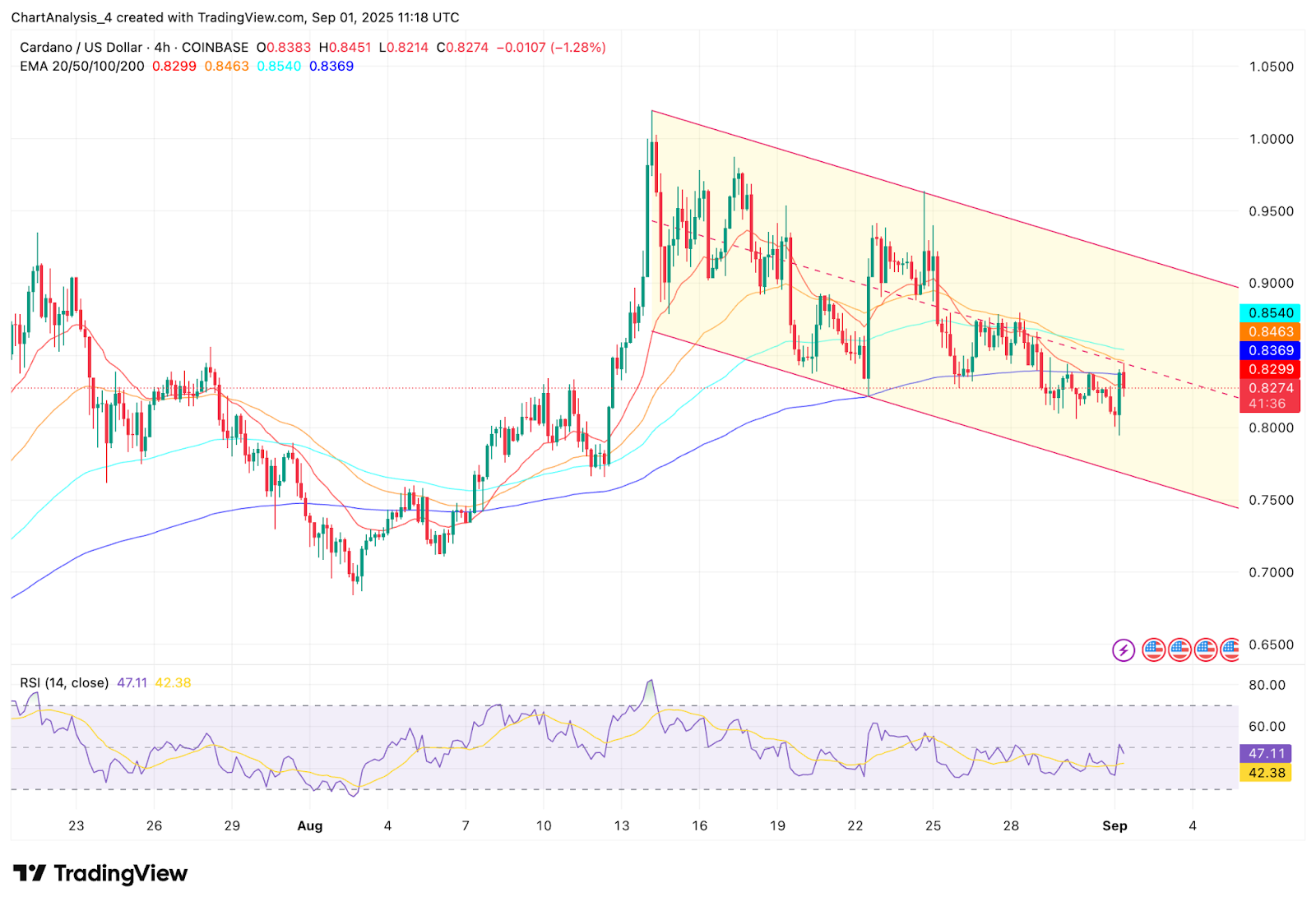
Динамика цен ADA (Источник: TradingView)

На 4-часовом графике ADA торгуется внутри чёткого нисходящего канала, ограниченного сопротивлением около $0,88 и уровнем поддержки около $0,81. 20- и 50-периодные EMA, на $0,83 и $0,84 соответственно, сходятся чуть выше спотовых уровней, усиливая влияние краткосрочного сопротивления.

Индекс относительной силы (RSI) колеблется около отметки 47, что указывает на нейтральный импульс, но на слабый тренд. Если покупатели не прорвут верхнюю границу канала, ADA рискует продолжить движение к $0,80 и, возможно, к $0,76, следующему уровню поддержки, совпадающему с уровнем коррекции Фибоначчи 0,618.

По теме: Прогноз цены XRP: XRP борется с нисходящим сопротивлением

Отток капитала усиливает давление на настроения
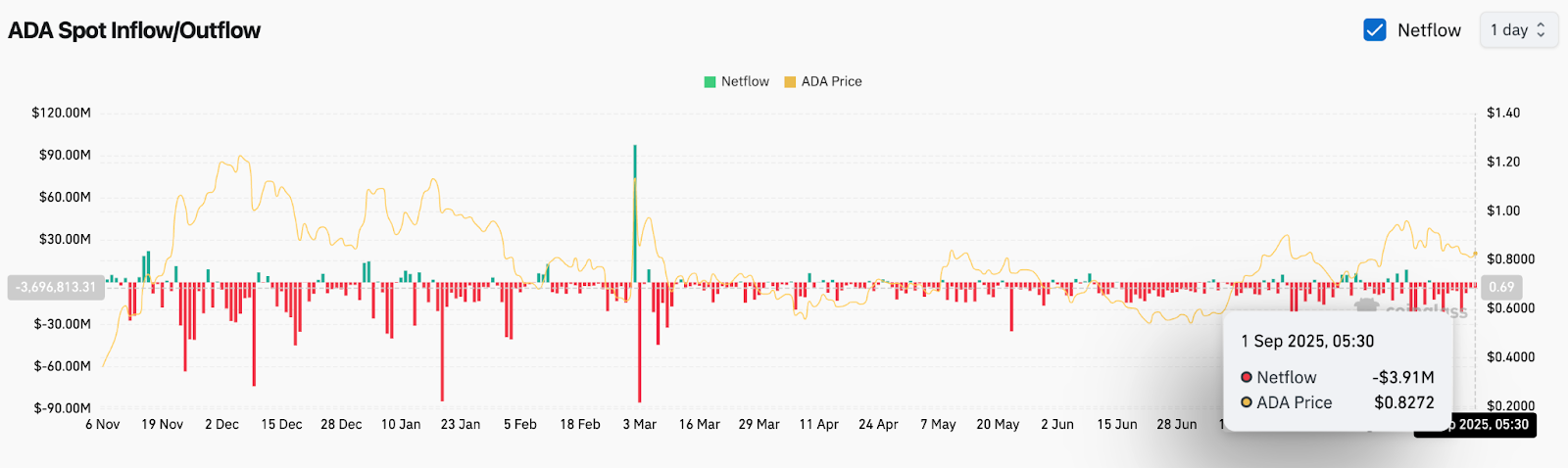
Данные о притоке/оттоке средств ADA Spot (Источник: Coinglass)

Спотовые потоки подтверждают сохраняющееся медвежье давление. 1 сентября ADA зафиксировала чистый отток в размере 3,91 млн долларов, продолжив негативную полосу, определившую август. Сокращение биржевой ликвидности указывает на продолжающиеся продажи со стороны крупных держателей.
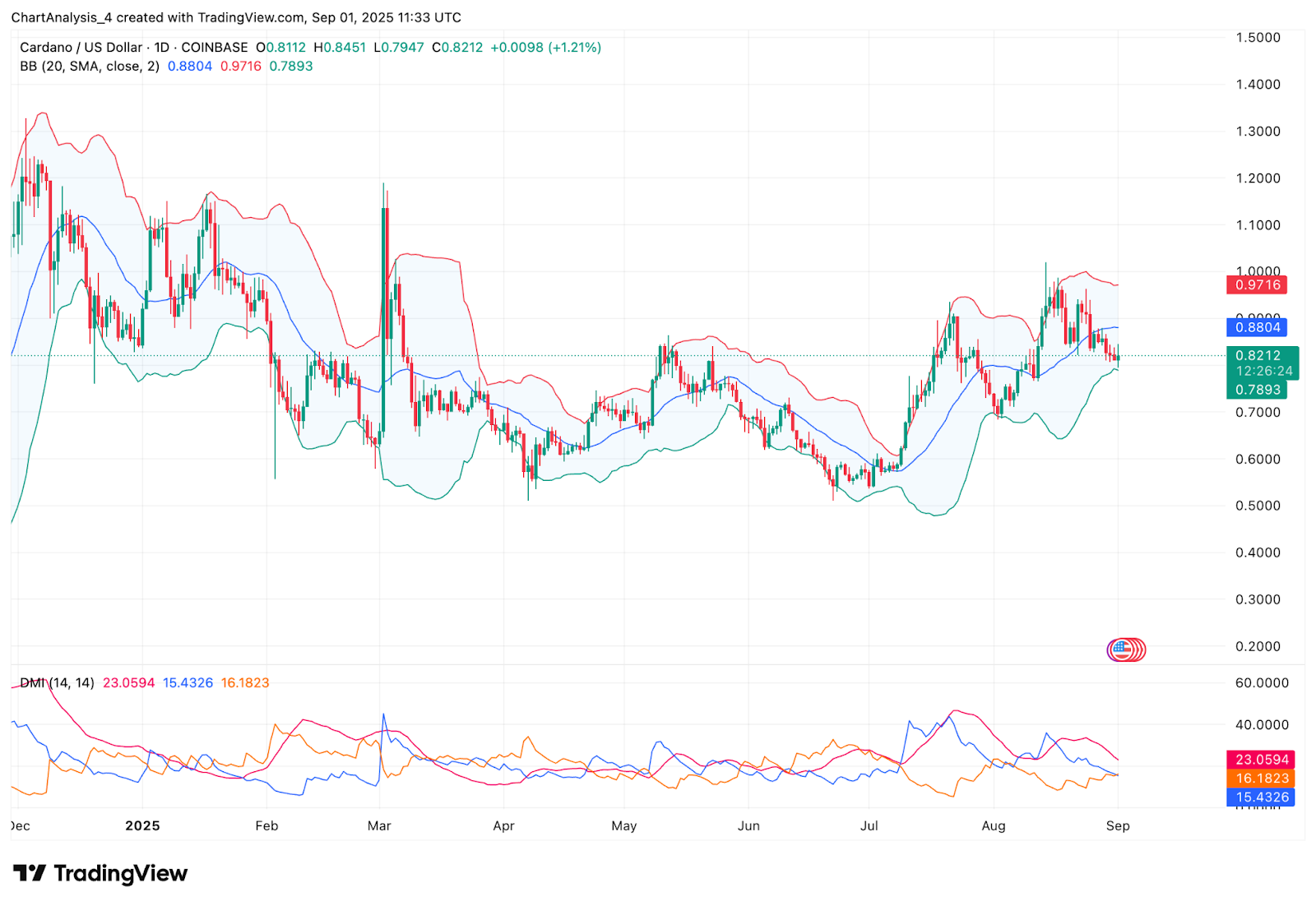
Динамика цен ADA (Источник: TradingView)

Дневные полосы Боллинджера показывают усиление волатильности: цена тестирует среднюю линию в районе $0,82. Верхняя полоса находится на уровне $0,97, что оставляет потенциал роста, если ADA сможет преодолеть сопротивление. Однако повторные закрытия ниже средней линии полосы Боллинджера подтверждают, что контроль сохраняется за продавцами.

По теме: Прогноз цены биткоина (BTC): следующий прорыв или падение?

Противоположные мнения: «Быки» возлагают надежды на $0,88, «медведи» предупреждают о падении

Аналитик Али Мартинес подчеркнул на сайте X, что Cardano должен преодолеть отметку $0,88, чтобы подтвердить ралли к $1,20. Его прогноз показывает потенциал роста, если покупатели восстановят критический уровень, что соответствует уровням расширения Фибоначчи, прогнозирующим целевые уровни $1,02 и $1,23.

Cardano $ADA must break $0.88 to confirm a rally toward $1.20! pic.twitter.com/BpCLzSor4B

— Ali (@ali_charts) September 1, 2025

Быки утверждают, что более широкая структура с июля по-прежнему демонстрирует более высокие минимумы на большем временном интервале, что говорит об устойчивости до тех пор, пока держится уровень $0,80.

Медведи возражают, что постоянный отток и повторяющиеся провалы вблизи $0,90 указывают на ослабление спроса. Если ADA не сможет удержать $0,81, следующая поддержка будет на $0,76, а более глубокая поддержка — вблизи $0,72, где скапливается 200-периодная экспоненциальная скользящая средняя. Пробой этой зоны может привести к увеличению падения до $0,66.

По теме: Прогноз и анализ цены Ethereum (ETH) на 2 сентября

Краткосрочный прогноз по Cardano: восстановление зависит от падения до $0,88

К 2 сентября краткосрочные перспективы ADA зависят от того, сможет ли она преодолеть отметку $0,88. Прорыв этого уровня развернёт бычий импульс, открывая путь к быстрому последовательному росту до $0,95 и $1,02. Однако отсутствие сопротивления грозит дальнейшим снижением до $0,80 и $0,76.

Прогноз цены Cardano на ближайшие сессии склоняется к медвежьему тренду ввиду отсутствия поддержки со стороны притока средств, хотя трейдеры по-прежнему сосредоточены на отметке $0,88 как на ключевом триггере восстановления.

Таблица прогнозов цен Cardano

Индикатор Сигнал Уровни/Примечания
Цена сегодня $0.83 Торговля внутри нисходящего канала
Поддерживать $0.81 / $0.76 База канала и 0,618 Фибоначчи
Сопротивление $0.88 / $0.95 / $1.02 Прорыв запускает рост
RSI 47 Нейтрально-слабый импульс
MACD Плоский уклон Нет сильного сдвига тренда
Шаблон Нисходящий канал Давление остается ниже $0,88
Потоки –Отток 3,91 млн долларов США Постоянное давление продавцов
Полосы Боллинджера Нейтрально-медвежий Цена ниже средней линии
Супертренд Медвежий уклон Необходим прорыв выше $0,88

Criptos en tendencia

Lecturas Relacionadas

Beyond the Stadium: The Profitable Games Surrounding the World Cup

"Beyond the Pitch: The Profit Game Around the World Cup" The FIFA World Cup transcends being a sporting spectacle, evolving into a massive global arena for speculation and profit-seeking. The 2026 tournament has amplified this dynamic, creating a multi-layered ecosystem of financial opportunism alongside the football. **Prediction markets** have surged into the mainstream. Platforms like Polymarket and Kalshi saw trading volumes for World Cup contracts soar, attracting new users with their financial trading model and high-profile, chain-based wealth stories that overshadow traditional sports betting in terms of growth and narrative. However, **traditional sportsbooks** remain the dominant force, leveraging established user habits, legal markets, and comprehensive product offerings to handle the vast majority of speculative wagers, with projections suggesting record-breaking betting volumes. Capital markets also react. **"Concept stocks"** in countries like South Korea and Japan experience volatile price swings based on team performance and anticipated fan spending on items like chicken, beer, and viewing parties, effectively becoming a stock market reflecting fan sentiment. The **ticket resale market** has become a sophisticated arena for arbitrage. Prices fluctuate wildly based on team draws and star power, with sellers sometimes listing tickets they don't yet own in a practice akin to short-selling, while FIFA's own "Right to Buy" tokens add another layer of speculative trading. **Collectibles and merchandise** offer another avenue. Panini sticker albums, with their inherent scarcity and nostalgic value, can become high-value collectibles. Limited-edition or locally themed jerseys command significant premiums on secondary markets, and even counterfeit vendors profit from fans' desire for affordable match-day identity. The **cryptocurrency** space has seen a frenzy of speculative, unauthorized World Cup-themed meme coins on chains like Solana. These tokens, often exploiting team names and player imagery, experience extreme pump-and-dump cycles, creating stories of massive gains for a few early entrants and steep losses for many others. Finally, an entire industry thrives on **providing information and tools** to other speculators. Developers create platforms like SeatSidekick to track ticket inventory and prices, while paid Telegram groups and subscriptions sell betting tips and predictions, monetizing the widespread desire for an informational edge. In essence, the World Cup has become a compressed, global laboratory for speculation. While the games determine champions on the field, a parallel, complex network of financial transactions—spanning prediction contracts, bets, stocks, tickets, collectibles, crypto, and information services—settles its own scores in the global market.

marsbitHace 10 min(s)

Beyond the Stadium: The Profitable Games Surrounding the World Cup

marsbitHace 10 min(s)

How Does Codex Use a Computer? Three Entry Points and Permission Boundaries

This article explains the three primary methods for Codex to interact with a computer, each with distinct use cases, permission boundaries, and trust levels. **1. Computer Use:** This offers the broadest access, allowing Codex to visually control and interact with the graphical user interface of authorized macOS/Windows apps, system settings, and even iOS simulators. It's ideal for tasks lacking APIs or structured tools, such as operating legacy software or multi-app workflows. However, it's the slowest method and has the widest permission scope, requiring careful supervision for sensitive actions. **2. Chrome Extension:** This grants Codex access to the user's logged-in Chrome browser state, including cookies, profiles, and open tabs. It's best for tasks requiring user identity across websites like Gmail, LinkedIn, Salesforce, or internal dashboards. Its key advantage is multi-tab control for complex workflows. While more powerful for browser-based tasks than Computer Use, it carries higher sensitivity as actions are performed under the user's identity. **3. In-App Browser:** This is a browser isolated within the Codex thread, separate from the user's personal browsing data. It excels in web development and debugging scenarios—previewing local servers, testing responsive layouts, or annotating designs directly on the page. Its isolation is a strength for development but a limitation for tasks requiring login sessions. The core principle is to choose the narrowest, safest, and most structured interface for the task. Use plugins or MCPs first, resort to visual control (Computer Use) only for GUI-dependent tasks, employ the Chrome extension for identity-reliant browser work, and prefer the In-App Browser for isolated development. **Appshots** are clarified as a fourth, complementary tool for *inputting* context—capturing a screenshot of a window to point Codex to something—rather than a method for Codex to *act*. Together, this layered approach highlights a key to AI agent productization: not granting unlimited permissions, but constraining them within clear boundaries for specific tasks while preserving user oversight.

marsbitHace 1 hora(s)

How Does Codex Use a Computer? Three Entry Points and Permission Boundaries

marsbitHace 1 hora(s)

The "Iron Rule" of Chip Equipment Is Being Broken

For years, the semiconductor equipment industry followed an unwritten "iron rule": suppliers offered steep discounts for new tool introductions (Design-in) and faced consistent price pressure during repeat orders, especially during market downturns. This long-standing buyer's market dynamic is now being upended. Recently, SK Hynix's primary equipment suppliers have reportedly requested a 3-4% price *increase*, a nearly unprecedented move. This shift is driven by a severe supply-demand imbalance fueled by the AI compute boom. Securing equipment has become an urgent arms race as chipmakers' expansion speed dictates their ability to fulfill massive AI chip orders. Key areas feeling the strain include: **TCB (Thermal Compression Bonding) Equipment:** Demand is exploding, driven by the simultaneous needs of HBM4 memory stacking, AI chip Chip-on-Substrate (C2S), and logic Chiplet Chip-on-Wafer (C2W) packaging. Players like Hanmi Semiconductor, Hanwha Semitech, and ASMPT are receiving major orders. While hybrid bonding is seen as the future, TCB remains the pragmatic choice for HBM4 mass production, with its lifecycle extended by relaxed specifications and ongoing technological upgrades. **Test Equipment Bottlenecks:** Ironically, AI-driven shortages are now crippling test equipment manufacturing. Critical components like FPGAs, Driver ICs, and CPUs face severe shortages and extended lead times (up to 52 weeks for FPGAs), as AI data center and server vendors prioritize supply. This creates a paradoxical cycle: AI chip shortages drive fab expansion, which requires more test equipment, whose production is delayed because its key parts are diverted to make AI chips. The industry is entering a broad, AI-powered upcycle. SEMI forecasts global semiconductor equipment sales to hit a record $156 billion by 2027, fueled by investment in advanced logic/foundry, HBM-driven DRAM, and advanced packaging (like CoWoS). Major players like TSMC, SK Hynix, and Micron are aggressively ramping capital expenditure. In conclusion, leading equipment vendors are no longer just selling tools; they are selling the critical capability to deliver AI-era capacity. Pricing power is shifting decisively to those with indispensable technology in key process nodes like advanced logic, HBM, and advanced packaging, rewriting the industry's traditional power structure.

marsbitHace 1 hora(s)

The "Iron Rule" of Chip Equipment Is Being Broken

marsbitHace 1 hora(s)

Trading

Spot
Futuros

Artículos destacados

Cómo comprar ADA

¡Bienvenido a HTX.com! Hemos hecho que comprar Cardano (ADA) sea simple y conveniente. Sigue nuestra guía paso a paso para iniciar tu viaje de criptos.Paso 1: crea tu cuenta HTXUtiliza tu correo electrónico o número de teléfono para registrarte y obtener una cuenta gratuita en HTX. Experimenta un proceso de registro sin complicaciones y desbloquea todas las funciones.Obtener mi cuentaPaso 2: ve a Comprar cripto y elige tu método de pagoTarjeta de crédito/débito: usa tu Visa o Mastercard para comprar Cardano (ADA) al instante.Saldo: utiliza fondos del saldo de tu cuenta HTX para tradear sin problemas.Terceros: hemos agregado métodos de pago populares como Google Pay y Apple Pay para mejorar la comodidad.P2P: tradear directamente con otros usuarios en HTX.Over-the-Counter (OTC): ofrecemos servicios personalizados y tipos de cambio competitivos para los traders.Paso 3: guarda tu Cardano (ADA)Después de comprar tu Cardano (ADA), guárdalo en tu cuenta HTX. Alternativamente, puedes enviarlo a otro lugar mediante transferencia blockchain o utilizarlo para tradear otras criptomonedas.Paso 4: tradear Cardano (ADA)Tradear fácilmente con Cardano (ADA) en HTX's mercado spot. Simplemente accede a tu cuenta, selecciona tu par de trading, ejecuta tus trades y monitorea en tiempo real. Ofrecemos una experiencia fácil de usar tanto para principiantes como para traders experimentados.

1.5k Vistas totalesPublicado en 2024.12.10Actualizado en 2026.06.02

Cómo comprar ADA

Discusiones

Bienvenido a la comunidad de HTX. Aquí puedes mantenerte informado sobre los últimos desarrollos de la plataforma y acceder a análisis profesionales del mercado. A continuación se presentan las opiniones de los usuarios sobre el precio de ADA (ADA).

活动图片