30-Year Treasury Yield Breaks 5% Again: The Era of 'Everything Is Cheap' Is Over

marsbitPublicado a 2026-06-01Actualizado a 2026-06-01

Resumen

The yield on the 30-year U.S. Treasury bond has again surpassed 5%, signaling a fundamental shift as markets begin to accept that high interest rates are here to stay. This reflects the simultaneous breakdown of three pillars that underpinned half a century of low inflation and low rates: cheap capital, cheap labor, and cheap energy. Global capital flows are shifting, energy security is strained, and labor costs are rising due to shortages and unionization, though partly offset by AI's impact. Long-term pressures like soaring government debt, geopolitical friction, and populism are also pushing up long-term borrowing costs. The role of AI remains the biggest uncertainty—it could boost productivity and lower debt or become a new source of inflation if it merely automates jobs while consuming vast resources. The core challenge for investors is adapting their models and expectations, calibrated during decades of cheap money, to this new, more persistent high-rate environment.

The yield on the 30-year Treasury bond has once again broken through 5%. This time, the market's reaction is markedly different from that in 2023—investors are beginning to truly accept the reality that high interest rates will persist for a long time.

Analysis points out that behind this lies a deeper structural shift: the three pillars supporting low inflation and low interest rates in the U.S. over the past 50 years—cheap capital, cheap labor, and cheap energy—are simultaneously eroding. And the direction of AI will be the biggest unknown determining future inflation trends.

The yield on the 30-year U.S. Treasury bond recently broke through 5% again. Writing in the Financial Times, columnist Rana Foroohar points out that, unlike the brief breach of 5% in 2023 followed by a rapid decline, this time the market's reaction is distinctly different—investors finally seem to be truly accepting the reality that the U.S. is bidding farewell to the era of low interest rates and entering a new phase with more persistent and diverse inflationary pressures.

The article cites a recent report to clients by Apollo chief economist Torsten Sløk, which states, "Investors should position their portfolios for a persistent high interest rate environment in the short, medium, and long term."

Behind this lies a larger structural story: the three cheap factors that drove U.S. economic growth over the past 50 years—cheap capital, cheap labor, and cheap energy—are simultaneously reversing.

How Did Half a Century of "Cheap Dividends" Come About?

The nearly half-century-long downward trend in the 30-year Treasury yield, falling from around double-digit percentages in the early 1980s to about 1% during the pandemic, was not an accident.

It was underpinned by a complete macro logic:

Cheap Capital: Decades of globalization and manufacturing technology advancements kept goods prices low; oil-exporting countries recycling massive petrodollars into the U.S. provided ample cheap funding; pension privatization reforms spurred enormous demand for various financial products; global investors vied to buy U.S. Treasuries, as no country was safer than America.

Cheap Labor: Outsourcing of industries, weakening of unions, automation waves, and the "shareholder primacy" corporate culture (emphasizing financial engineering over employee investment) collectively suppressed wages, especially for non-college-educated workers, persistently supporting corporate profit margins.

Cheap Energy: The petrodollar system helped curb inflation to some extent, and the global energy trade being settled in dollars also reinforced the dollar's global dominance.

These three pillars jointly supported half a century of low-inflation, low-interest-rate prosperity in the U.S.

The Three Pillars Are Simultaneously Loosening

In her article, Rana Foroohar notes that each of these supporting factors is now changing.

On the Capital Front: With each U.S. Treasury auction, international buyers are decreasing, not increasing. Deglobalization and supply chain reshoring will push up goods and services prices in the short term. Meanwhile, the foundation of the petrodollar system is being eroded.

On the Energy Front: Continued tensions in the Middle East directly impact Asian energy-importing countries. But in the longer term, this may accelerate the deployment of clean energy in major Asian nations—while the U.S. is retreating from climate commitments. This means long-term capital flows may shift from the U.S. to major Asian countries.

On the Labor Front: In recent years, labor shortages, large-scale strikes (including successful union action in the auto industry), tighter immigration restrictions, and growth in union membership in some sectors (especially white-collar industries) have all pushed wages higher. However, this trend is being partly offset by two factors: one is rising corporate healthcare insurance costs, leading companies to hedge by suppressing wages; the other is the impact of artificial intelligence.
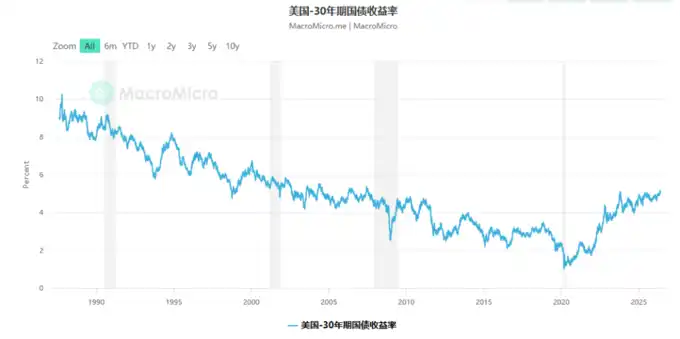
And Then There Are the Slow Variables: Debt, Geopolitics, and Populism

In addition to the explicit factors above, there are several "slow variables": rising government debt, intensifying geopolitical friction, and the spread of populism.

The combined effect of these risks is that lenders demand a higher risk premium to lend money out—especially for terms of several years.

This directly pushes up long-term interest rates, i.e., the yield on the 30-year Treasury bond.

AI: Savior or New Source of Inflation?

Of all the variables, the direction of artificial intelligence is the most difficult to judge, yet its impact could be the most far-reaching.

Rana Foroohar outlines two starkly different scenarios:

The Optimistic Scenario: The productivity benefits of AI diffuse widely across industries and individuals, creating new jobs and income sources. Models from Yale's Budget Lab show that in this scenario, U.S. national debt would fall significantly, and inflation would also recede.

The Pessimistic Scenario: AI serves merely as a tool for corporate layoffs, cost compression, and profit expansion, while the infrastructure construction of AI itself (consuming vast amounts of chips, land, water, and electricity) creates new inflationary pressures. The net effect is to raise, not lower, costs. Governments would also be forced to bail out displaced workers, increasing debt instead.

Currently, AI giants are voraciously consuming real estate, chips, water resources, and electricity, already pushing up the prices of these resources in the overall economy. The final outcome will likely take years to become clear.

The Real Challenge Facing Investors

The article's conclusion is direct and sobering: Most market participants have spent their entire careers in the "cheap era." Their intuition, models, and expectations were calibrated in a low-interest-rate environment.

And now, that environment is changing.

"Expectational inertia" is a powerful force—when the 30-year yield broke 5% in 2023, many thought it was just a brief anomaly that would soon recede. But this time, the market's reaction is already different.

Adjusting means abandoning old expectations. For investors accustomed to low interest rates, that is no easy task.


Criptos en tendencia

Preguntas relacionadas

QWhat is the main reason behind the recent sustained rise in the 30-year US Treasury yield above 5%, according to the article?

AThe main reason is a deeper structural shift where the three pillars supporting low inflation and low interest rates in the US for the past 50 years—cheap capital, cheap labor, and cheap energy—are simultaneously eroding, leading investors to accept that a high-rate environment is here to stay.

QWhat were the three 'cheap pillars' that drove US economic growth for half a century?

AThe three pillars were cheap capital (from globalization, petrodollar recycling, and high demand for safe US debt), cheap labor (due to outsourcing, weaker unions, automation, and a 'shareholder-first' culture), and cheap energy (supported by the petrodollar system).

QHow might Artificial Intelligence (AI) contribute to future inflation, based on the pessimistic scenario described in the article?

AIn the pessimistic scenario, AI does not boost broad productivity but is used mainly for cost-cutting and layoffs. Meanwhile, AI infrastructure itself (consuming chips, real estate, water, and electricity) creates new inflationary pressures. Governments may also need to bail out displaced workers, increasing debt.

QBesides the three main pillars, what other 'slow-moving' factors are contributing to higher long-term interest rates?

AOther factors include rising government debt, increasing geopolitical friction, and the spread of populism. These factors increase risk premiums, meaning lenders demand higher yields for long-term loans, which pushes up long-end rates like the 30-year Treasury yield.

QWhy is adjusting to the new high-rate environment particularly challenging for investors, as stated in the article's conclusion?

AAdjusting is challenging because most market participants have spent their entire careers in the 'cheap era' of low interest rates. Their instincts, models, and expectations are calibrated for that environment, creating a powerful 'expectational inertia' that makes it difficult to abandon old assumptions.

Lecturas Relacionadas

Podcast Notes | Conversation with GSR Asset Management Head: To Determine if This Crypto Rally is Real, Just Watch the Lending Rates on Aave

Podcast Summary: Dialogue with GSR's Head of Asset Management: To Determine if This Crypto Rally is Real, Just Check Lending Rates on Aave Andy Baehr, Managing Director of Asset Management at GSR, discusses the current crypto market, characterizing it as stuck in a state of "ambivalence" with short-lived, unsustainable rallies. He outlines a simple framework: the market moves between "ambivalence" and "conviction" (sustained upward momentum). Currently, every rally resembles a single-stage rocket booster that quickly fizzles out. Baehr identifies three key signals to watch: 1) DeFi lending rates, 2) the potential passage of the CLARITY Act, and 3) the market forming a consensus on the "Fed hawkish peak." He emphasizes that the most immediate indicator for the sustainability of the recent CPI-triggered rally is the USDC borrowing rate on Aave, currently around 3.75%—close to U.S. Treasury yields. The absence of a credit spread indicates low leverage demand and a lack of market energy. He explains that a healthy, sustained rally requires layered buying pressure. Last year's rally progressed from an ETH short squeeze to crypto-native trader influx and finally to ETF inflows. Currently, this structure is missing. Other potential structural buyers like Digital Asset Treasury (DAT) companies are absent, and ETF flows have proven transient. Baehr notes that while small-cap crypto tokens outperformed large caps in Q2—a potential sign of capitation in major assets—capital is also flowing to more exciting opportunities like AI stocks and tech IPOs, leaving crypto sidelined. Regarding DeFi, he highlights that platforms like Aave provide a clear, real-time signal of leverage demand through their supply/demand-driven interest rates. A significant, sustained rate increase would signal genuine market conviction. He also observes the quiet emergence of fixed-income-like products and vaults in DeFi. On regulation, the probability of the CLARITY Act passing before the August 7th deadline has dropped linearly from 75% to below 40% on Polymarket. Baehr suggests its passage would be treated as a bullish surprise, a potent driver for price movement. However, political hurdles, including ethical clause debates and disclosures about the First Family's crypto profits, remain significant obstacles. Ultimately, the market awaits clarity on the Fed's terminal rate under Chair Warsh. Until the "Fed Solstice"—the point where the market collectively understands the peak of hawkish policy—sustained conviction will be difficult to achieve.

marsbitHace 33 min(s)

Podcast Notes | Conversation with GSR Asset Management Head: To Determine if This Crypto Rally is Real, Just Watch the Lending Rates on Aave

marsbitHace 33 min(s)

7 Months After the Collapse of Huiwang, Southeast Asia's Escrow Platforms Undergo a Major Reshuffle

Following the collapse of Huione Pay—dubbed the "Alipay of Southeast Asia"—seven months ago, the region's underground financial guarantee platform sector is undergoing a significant reshuffle. This power vacuum has been swiftly filled by emerging platforms such as XinBi, Tiger/Navigator, JinBei (renamed JinBo), Dali/Tiancheng, and FullyLight. These platforms, operating largely via Telegram and offering services like escrow for illicit transactions, have absorbed the vast user base and markets left behind by Huione. While positioning themselves as "trust intermediaries," their primary clientele consists of networks involved in online scams, money laundering, illegal gambling, and even human trafficking. For instance, the Tiger/Navigator platform explicitly provides "escrow" services for kidnapping-for-ransom operations ("强押车交易"). Data underscores the immense scale: Huione alone processed over $103 billion in cryptocurrency payments and facilitated over $31 billion through its escrow market before its downfall, linking it to Cambodia's notorious Prince Group. Since its collapse, competitors have seen explosive growth. For example, the XinBi platform has accumulated over $1.6 billion in total USDT revenue, while platforms like NewPay, OkPay (under Dali), and FullyLight Wallet collectively processed over $4.8 billion in USDT in a single year. This ecosystem thrives in regions like Cambodia and Myanmar, where regulatory gaps allow these platforms to act as critical financial infrastructure for sprawling cybercrime industries, from scam compounds to online casinos. The article concludes that the moniker "Southeast Asian Alipay" is a misnomer, obscuring the platforms' fundamental role in enabling serious criminal enterprises rather than representing legitimate financial innovation.

Odaily星球日报Hace 1 hora(s)

7 Months After the Collapse of Huiwang, Southeast Asia's Escrow Platforms Undergo a Major Reshuffle

Odaily星球日报Hace 1 hora(s)

Trading

Spot

Artículos destacados

Cómo comprar ERA

¡Bienvenido a HTX.com! Hemos hecho que comprar Caldera (ERA) sea simple y conveniente. Sigue nuestra guía paso a paso para iniciar tu viaje de criptos.Paso 1: crea tu cuenta HTXUtiliza tu correo electrónico o número de teléfono para registrarte y obtener una cuenta gratuita en HTX. Experimenta un proceso de registro sin complicaciones y desbloquea todas las funciones.Obtener mi cuentaPaso 2: ve a Comprar cripto y elige tu método de pagoTarjeta de crédito/débito: usa tu Visa o Mastercard para comprar Caldera (ERA) al instante.Saldo: utiliza fondos del saldo de tu cuenta HTX para tradear sin problemas.Terceros: hemos agregado métodos de pago populares como Google Pay y Apple Pay para mejorar la comodidad.P2P: tradear directamente con otros usuarios en HTX.Over-the-Counter (OTC): ofrecemos servicios personalizados y tipos de cambio competitivos para los traders.Paso 3: guarda tu Caldera (ERA)Después de comprar tu Caldera (ERA), guárdalo en tu cuenta HTX. Alternativamente, puedes enviarlo a otro lugar mediante transferencia blockchain o utilizarlo para tradear otras criptomonedas.Paso 4: tradear Caldera (ERA)Tradear fácilmente con Caldera (ERA) en HTX's mercado spot. Simplemente accede a tu cuenta, selecciona tu par de trading, ejecuta tus trades y monitorea en tiempo real. Ofrecemos una experiencia fácil de usar tanto para principiantes como para traders experimentados.

421 Vistas totalesPublicado en 2025.07.17Actualizado en 2026.06.02

Cómo comprar ERA

Discusiones

Bienvenido a la comunidad de HTX. Aquí puedes mantenerte informado sobre los últimos desarrollos de la plataforma y acceder a análisis profesionales del mercado. A continuación se presentan las opiniones de los usuarios sobre el precio de ERA (ERA).

活动图片












