Трамп освободил ключевые технологии от пошлин: выиграет ли криптовалютный рынок?

cryptonews.ruPublicado a 2025-01-13Actualizado a 2025-04-13

Кремниевая долина выдохнула с облегчением после решения президента США исключить ключевые технологические продукты из списка товаров, подлежащих «ответным» торговым пошлинам. Это освобождение касается смартфонов, компьютеров, чипов и других важных электронных компонентов.

По данным Таможенно-пограничной службы США, карты памяти, модемы, диоды, полупроводники и другая электроника также не будут облагаться дополнительными сборами при импорте.

«Технологические компании с крупной капитализацией в конечном итоге выйдут победителями, когда все это закончится», — отметили аналитики The Kobeissi Letter в соцсети X от 12 апреля.

Биткоин реагирует на макроэкономические новости

Облегчение тарифной нагрузки снимет давление с технологических акций, которые стали одними из главных жертв торговой войны. Учитывая корреляцию криптовалютного рынка с технологическим сектором, положительные новости о торговой войне могут привести к росту и на крипторынке благодаря увеличению аппетита к риску.

После известий об освобождении от пошлин цена биткоина преодолела отметку в $85 000 12 апреля, что демонстрирует реакцию криптовалютного рынка на последние макроэкономические события.

Рынки зависят от каждого слова Трампа

Президент Трамп смягчил свою жесткую тарифную политику 9 апреля, объявив 90-дневную паузу для «ответных» пошлин и снизив тарифные ставки до 10% для стран, которые не ввели ответных пошлин на американские товары.

В тот же день биткоин вырос на 9%, а индекс S&P 500 подскочил более чем на 10%.

Макроэкономический трейдер Рауль Пал (Raoul Pal) считает, что тарифная политика является инструментом переговоров для заключения торгового соглашения между США и Китаем, и охарактеризовал торговую риторику администрации США как «позерство».

А вот сторонник биткоина Макс Кайзер (Max Keiser) утверждает, что освобождение некоторых технологических продуктов от импортных пошлин не снизит доходность облигаций и не поможет администрации Трампа в достижении цели по снижению процентных ставок.

Доходность 10-летних казначейских облигаций США выросла до локального максимума примерно в 4,5% 11 апреля, поскольку инвесторы отреагировали на макроэкономическую неопределенность, связанную с затяжной торговой войной, и на перспективу продажи облигаций Китаем.
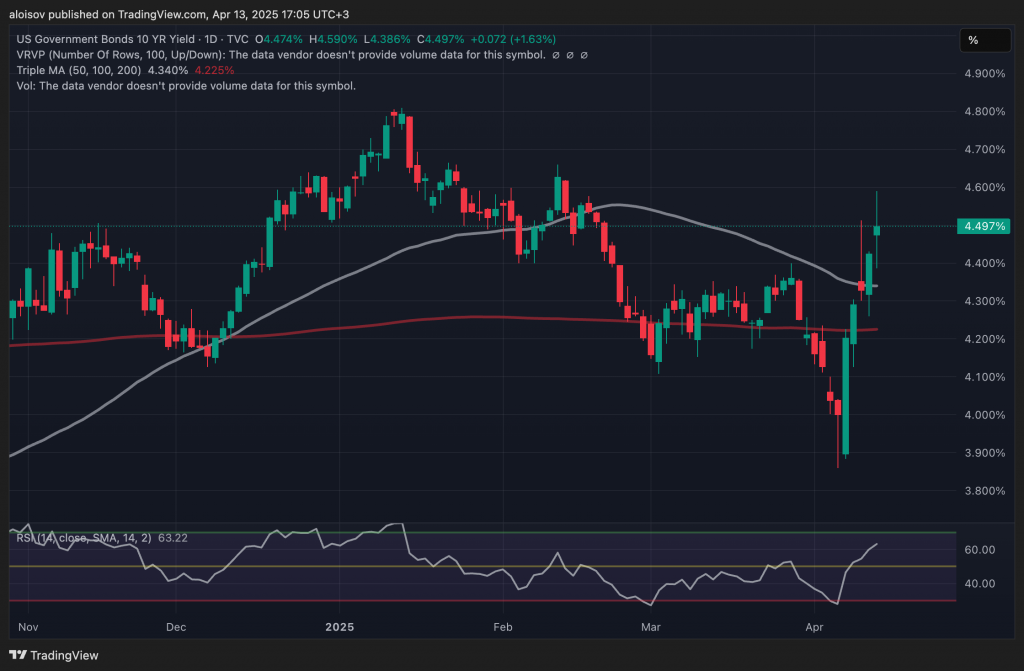
Доходность 10-летних казначейских облигаций США растет на фоне торговой войны Трампа

«Уступка, только что сделанная Китаю в отношении технологического экспорта, не изменит тенденцию повышения тарифных ставок. Доверие к облигациям США и доллару США разрушается годами и сейчас не остановится», — написал Кайзер 12 апреля.

Теперь экономисты внимательно следят за тем, как новая тарифная политика США повлияет на глобальные рынки в долгосрочной перспективе. Технологический сектор получил временную передышку, но фундаментальные проблемы в мировой торговле остаются нерешенными.
Lecturas Relacionadas

Bitwise CIO: STRC Plunge is a Bottom Signal, Bull Market to Begin in Autumn

Matt Hougan, Chief Investment Officer at Bitwise, explains the recent Bitcoin price drop below $60,000 and its connection to the steep decline in MicroStrategy's STRC (Strategy's Perpetual Preferred Stock). STRC, designed as a high-yield, stable-price instrument, fell from its $100 target to $75 due to market fears over MicroStrategy's ability to sustain its dividend amid Bitcoin's price weakness. Hougan clarifies that while MicroStrategy's overall financial position remains strong, with significant Bitcoin holdings and cash, the core market anxiety centered on the optional nature of the dividend payments. In response, MicroStrategy announced a new operational framework: it will sell some Bitcoin as needed to fund dividends, will no longer actively defend the $100 share price through dividend hikes, and may repurchase STRC on the open market. This shift marks a change in MicroStrategy's role from a consistent, one-way buyer of Bitcoin to a more dynamic participant that may both buy and sell. According to Hougan, the STRC volatility is a classic late-cycle event, signaling the painful but necessary process of flushing out excessive leverage from the market. He draws parallels to the unwinding of the GBTC premium in the previous cycle. He identifies key potential bottoming signals: MSTR trading at a discount to its net asset value (NAV), extreme readings on the Crypto Fear & Greed Index, and persistently negative Bitcoin funding rates. Hougan concludes that while the exact timing of the market bottom is unpredictable, the current deleveraging phase suggests it is near. He expresses confidence that a new bull market will begin in the fall of this year, with the next major wave of buying expected to come from institutional investors like banks, asset managers, and pension funds.

Foresight NewsHace 19 min(s)

Bitwise CIO: STRC Plunge is a Bottom Signal, Bull Market to Begin in Autumn

Foresight NewsHace 19 min(s)

ENS Founder Seeks to 'Seize Power' from DAO

On June 29th, the ENS community entered the on-chain voting phase for a proposal to renew the ENS DAO Security Council's veto power for two more years. Shortly after voting began, ENS founder Nick Johnson used his substantial ENS holdings to cast over 3.55 million votes against the proposal, swinging the outcome despite initial strong support. The Security Council was established in July 2024 with a 4/8 multisig veto power to protect the DAO's treasury (valued over $350 million) from malicious proposals during a period of low voter participation. Its powers were limited to vetoing only harmful proposals, not normal ones. Nick Johnson's opposition stems from broader concerns about ENS DAO's governance. In late 2025, he and others expressed frustration that the DAO had become mired in political gamesmanship, with capable contributors leaving and leadership falling to less experienced or misaligned parties. This context set the stage for a major restructuring proposal by ENS COO Katherine Wu on June 19th, titled "Next Era of ENS DAO: Empowering the ENS Foundation." The controversial proposal aims to transfer daily operations, treasury management, and long-term strategy to a restructured ENS Foundation with a professional board, while the DAO would retain core protocol governance powers. Critics, including original ENS constitution author Brantly Millegan, argue this effectively transfers treasury control from token holders to ENS Labs (the core development team), undermining the DAO's original decentralized design. Nick's massive "no" vote on the Security Council renewal is seen as the first move in this power struggle. He explained his vote was due to concerns about insufficient checks on the Council's power and the potential for its veto to be used politically. In response, Katherine Wu submitted a revised proposal with higher execution thresholds (5/8 instead of 4/8) and stricter limits. The push for change comes as ENS's annual revenue has declined significantly, from over $10 million in 2023 to under $2 million in 2025, increasing pressure to manage the treasury more effectively. Nick Johnson now faces the challenge of proving that a more structured foundation can steer ENS better than the current DAO model.

Foresight NewsHace 49 min(s)

ENS Founder Seeks to 'Seize Power' from DAO

Foresight NewsHace 49 min(s)

Predicting World Cup Knockout Matches: Why Are Different AI Models So Far Apart?

AI performance in predicting the 2026 FIFA World Cup knockout matches varied significantly, according to an analysis of models including ChatGPT, Grok, DeepSeek, Gemini, and Claude. The standout predictions came from DeepSeek and Gemini for the Netherlands vs. Morocco match. Gemini precisely forecasted a 1-1 draw and a penalty shootout win for Morocco, while DeepSeek correctly identified the high probability of a draw and Morocco's potential to advance via a defensive and counter-attacking strategy. Grok and Tongyi Qianwen (千问) demonstrated strength in predicting accurate scores for matches with clearer favorites. They correctly called the narrow 1-0 win for Canada over South Africa and Brazil's 2-1 victory over Japan, as well as Norway's 2-1 win over Ivory Coast. ChatGPT and Claude excelled more in match process analysis than in predicting exact scores or upsets. They frequently identified potential challenges for favorites, such as Japan's pressing against Brazil or DR Congo's defensive tactics against England, even when predicting the favorite's ultimate victory. A notable failure was the unanimous misjudgment of Germany vs. Paraguay. All models incorrectly favored Germany, underestimating Paraguay's ability to force a penalty shootout and cause an upset. In summary, Gemini and DeepSeek showed the most insight for high-stakes, unpredictable matches. Grok and Qianwen were reliable "score predictors" for less volatile games. ChatGPT and Claude were strong "analytical models," adept at outlining match dynamics but often hesitant to predict upsets.

Odaily星球日报Hace 1 hora(s)

Predicting World Cup Knockout Matches: Why Are Different AI Models So Far Apart?

Odaily星球日报Hace 1 hora(s)

Trading

Spot
活动图片