Opinion: The AI Bubble in Stocks Has Arrived. Why I'm Turning to Bet on Bitcoin?

marsbitPublicado a 2026-07-02Actualizado a 2026-07-02

Resumen

This article argues that the AI-driven stock market surge shows clear signs of a bubble. The author, citing Howard Marks' cycle theory, presents a checklist of behaviors signaling a market top—excessive optimism, easy capital, and the belief "no price is too high"—and finds the current AI stock mania matches most criteria. Consequently, the author has sold AI-related ETFs and shifted focus to accumulating Bitcoin within a $50k-$60k range, viewing it as a scarcer asset with a wider margin of safety amid high equity valuations. The piece contrasts the narrow, frothy AI rally with what it sees as a more rational long-term opportunity in Bitcoin, especially given indicators like high CAPE ratios and selective risk appetite. The author's personal strategy involves holding significant cash, with capital allocated across trading, long-term accumulation (primarily BTC), and illiquid investments.

Author:Investing Beanstock

Translation:Deep Tide TechFlow

Deep Tide's Guide: AI stocks are soaring, but this trader is actually selling tech stocks and turning to bottom-fish Bitcoin. He used Howard Marks's cycle theory to examine the current market point by point and found that AI already meets almost all the characteristics of a "bubble top." For investors, this article provides a calm framework for cycle positioning, helping you judge whether it's time to be greedy or fearful now.

The stock market is experiencing an AI-driven, frenzied bull market, which should come as a surprise to no one.

Not being positioned feels downright stupid—because capital expenditure (CAPEX) will only continue to rise, and the forward valuations of all these stocks will only become crazier.

I won't comment on specific stocks or indices; banks and financial media worldwide are already providing blanket coverage. I'm more interested in figuring out—or at least trying to decipher—what stage of the market we're in. Not just in cryptocurrency, but across the entire financial markets.

To do this, I drew heavy inspiration from one of my favorite books: Howard Marks's *Mastering the Market Cycle*.

Most people understand cycles as a series of events. Most also understand that these events typically follow each other in a regular sequence: an upswing is followed by a downswing, and then eventually a new upswing. But to fully understand cycles, this isn't enough. Events in a cycle shouldn't just be seen as one following another; more importantly, each event *causes* the next to happen.
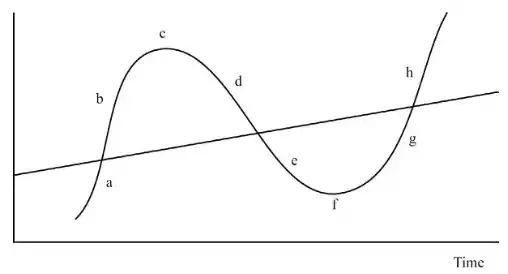
The straight line = the midpoint. The market's pendulum is the wavy line oscillating around the midpoint. Together they form the market cycle, driven by various market forces that cause it to deviate from the midpoint from time to time.

The movement of cyclical phenomena can be easily recognized in several stages:

a: Recovery from an overly depressed low extreme or "trough" towards the midpoint.

b: Continuing past the midpoint to swing towards the high extreme or "peak."

c: Reaching the peak.

d: Correcting downward from the peak back to the midpoint or mean.

e: Continuing the downward movement past the midpoint towards a new low.

f: Reaching the trough.

g: Recovering from the trough back to the midpoint.

h: The cycle repeats.

So Where Are We Now?
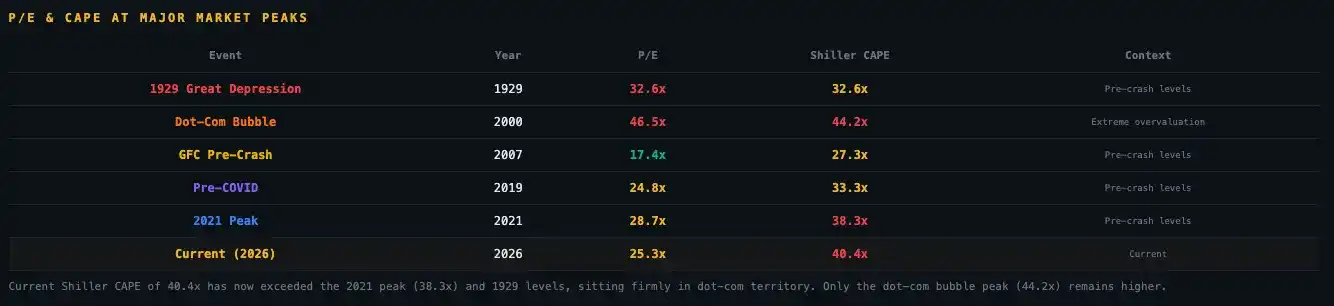
Is this a bubble? I think it's quite evident at this point that AI indeed *is* a bubble. According to Marks, a bubble is signaled when the sentiment that "price doesn't matter" is strong.

In a bubble, investors often conclude that you can make money by borrowing (using leverage) to buy the frenzied asset. No matter what your borrowing rate or funding fee is, the asset will surely appreciate faster than that.

"No price is too high" is the ultimate ingredient of a bubble, a fairly obvious signal that the market has gone too far.

There are actually conflicting schools of thought, believing the market can stay far above its intrinsic value and still reward multiples due to the frenzy.

What to Do?

Since we can't be sure when the bubble will burst, in my view, we have two clear approaches to portfolio allocation.

Dollar-Cost Averaging (I mean real DCA, no timing, you just buy in boring, mechanical dribs and drabs. The more batches you split into, the smoother your final cost basis, that's the whole point.)

Heavy cash allocation, but still allowing yourself to participate in the market through tactical/satellite positions, like active trading.

I personally prefer the second method. But that's because I actively monitor the markets day in and day out; I rely on my own market experience and intuition to navigate all this.

DCA isn't a bad method either. But it does require one to truly extend their time horizon. Not 1 or 3 years, but at least 5 years to really see results. Most people DCA for a few weeks, or try to DCA while also timing, and it backfires. If you plan to DCA into a particular investment, make sure you fully understand that business/industry, and then just stick to it in a super boring, repetitive way and go on with your life.

In my 2025 review and reflection post, I mentioned allocating 25% of my portfolio to passive ETFs, including QQQ, SOXQ, XAR, URA, and UFO. I think a large part of the gains came from QQQ and SOXQ, but I sold all of it in May because I believe the market had swung far past the midpoint.

I also said I was overall bearish on crypto until early 2026 (which turned out right), I managed to keep a lot of cash, and am now patiently deploying a portion into BTC. The target accumulation range is $50k–$60k, so I've already started allocating as of writing this.

"Crypto Is Dead, Pivot to AI"

Honestly, my only regret is not allocating more to speculative private market exposure in Anthropic and xAI. I think frontier models still offer the purest AI exposure, compared to public market "picks and shovels" types, like the GPU/semiconductor/storage narrative. Since those are already consensus, I don't think chasing them now offers asymmetric upside. That ship sailed a long time ago. Stocks like MU are up almost 10x in a year, and stocks like SNDK basically move like memecoins. Upside might still be there, but downside risk looks worse.

But the CAPEX! Yes, this might translate into real incremental value in the future, but it's still speculative. Overly speculative, excess money all funneling into the same thing, I've seen this movie before.

Is it disappointing to miss a big chunk of the AI bull run? Sure, it stings a bit. But I still have exposure, and it's doubled. I really don't think it's responsible to tell someone AI stocks are truly worth buying at today's valuations, unless they *really* know what they're doing and are in it for the long term (most aren't, they're here for quick money).

Market Sanity Checklist

Now, let's go back to how Marks judges if we are near/approaching a market top:

The economy is growing; economic reports are positive.

Corporate profits are rising and beating expectations.

The media only reports good news.

The securities markets are strong.

Investors are becoming increasingly confident and optimistic.

Risk is perceived as scarce and mild.

Investors believe taking risks is the necessary path to profits.

Greed drives behavior.

Demand for investment opportunities exceeds supply.

Asset prices exceed intrinsic value.

Capital markets are wide open; raising money or rolling over debt is easy.

Defaults are rare.

Skepticism is low, confidence is high, meaning risky trades can be made.

No one can imagine things going wrong. No favorable development seems impossible.

Everyone assumes things will get better forever.

Investors ignore the possibility of loss, only worry about missing out.

No one can think of a reason to sell, and no one is forced to sell.

There are more buyers than sellers.

If the market dips, investors are happy to buy.

Prices reach new highs.

The media celebrates this exciting event.

Investors become euphoric and carefree.

Equity holders marvel at their own cleverness; perhaps they'll buy more.

Those who stayed on the sidelines feel regret; therefore, they capitulate and buy.

^ This means:

Future returns are low (or negative).

Risk is high.

Investors should forget about missed opportunities, only worry about losing money.

This is a time for caution!

So, how many of these do you think the current stock market is exhibiting?

On the flip side of the "market top" checklist, the opposite scenario can also manifest:

The economy slows; reports are negative.

Corporate profits are flat or falling, missing expectations.

The media only reports bad news.

The market is weak.

Investors become worried and despondent.

Risk is perceived as everywhere.

Investors believe taking risks is just a way to lose money.

Fear dominates investor psychology.

Demand for securities is less than supply.

Asset prices are below intrinsic value.

Capital markets are closed; it's hard to issue securities or refinance debt.

Defaults surge.

Skepticism is high, confidence is low, meaning only safe trades can be made, or none at all.

No one thinks improvement is possible. No outcome seems too negative to happen.

Everyone assumes things will get worse forever.

Investors ignore the possibility of missing opportunities, only worry about losing money.

No one can think of a reason to buy.

There are more sellers than buyers.

"Don't try to catch a falling knife" replaces "buy the dip."

Prices reach new lows.

The media focuses on this depressing trend.

Investors become despondent and panicked.

Equity holders feel stupid and disillusioned. They realize they don't really understand the reasons behind their investments.

Those who didn't buy (or who sold) feel vindicated and are praised for their cleverness.

Those who held capitulate and sell at depressed prices, furthering the downward spiral.

^ This means:

Implied future returns are sky-high.

Risk is low.

Investors should forget about the risk of losing money, only worry about missing opportunities.

This is a time to be aggressive!

Based on the checklist above, I do think BTC is exhibiting many of these (especially in the Saylor/MSTR situation). So I do feel BTC presents a more attractive investment prospect compared to today's high-flying AI stocks.

However, note that the above progressions are simplified, they may not even appear in the same order, nor necessarily appear in every market cycle, but these behaviors are real, they are indeed elements that rhyme in markets over decades.
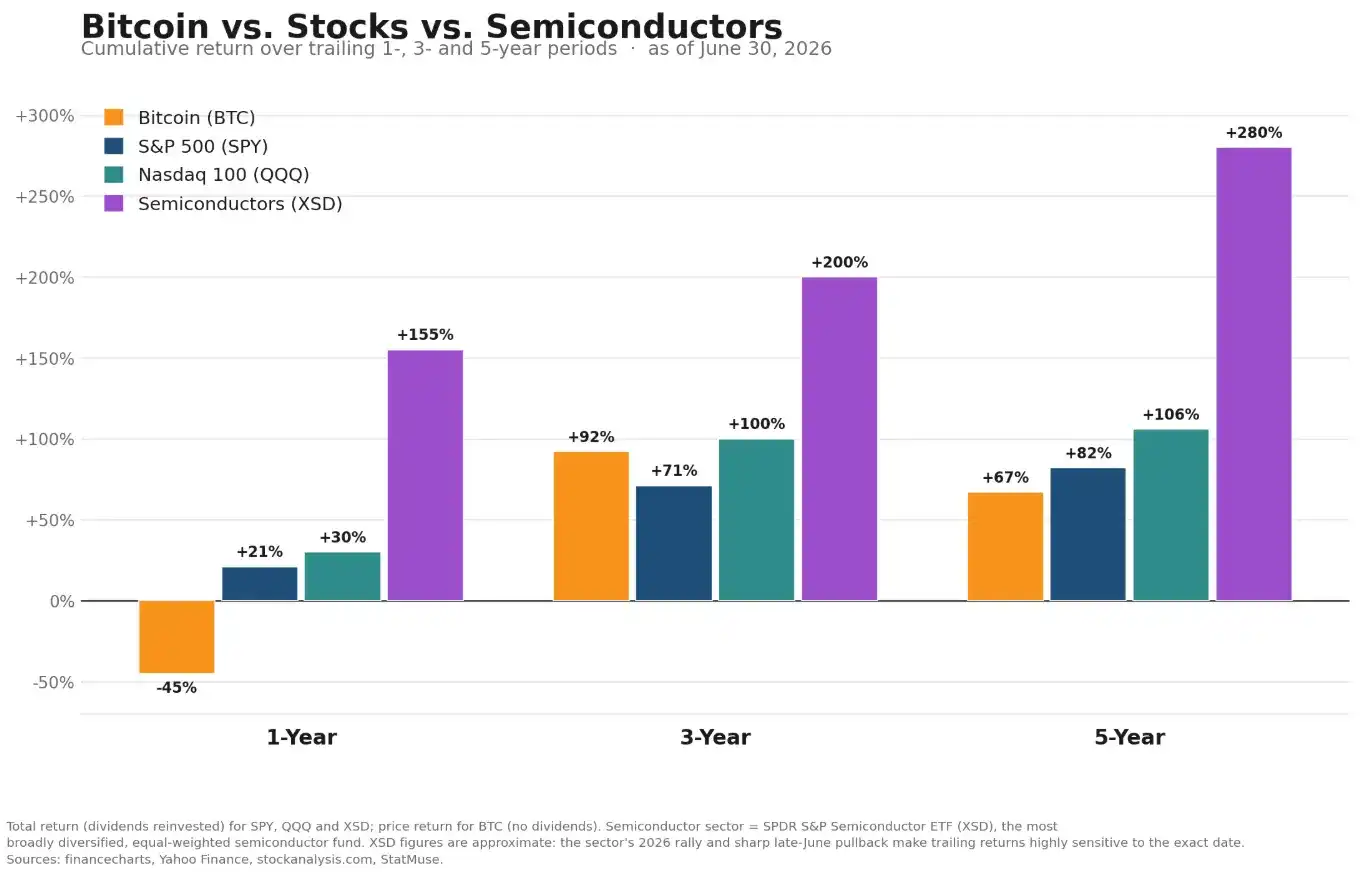
The AI revolution has clearly benefited tech stocks, especially semiconductors over 1/3/5 year periods.

But investing is never done by looking in the rearview mirror (unfortunately, most people do and take reference from the past), advantage emerges where people ignore/dismiss it. We need to look at "what happens 1 to 10 years from now," not what today's environment is.

Looking at the chart above, saying you're a crypto investor and you should have invested in stocks would look silly.

Based on the above chart, if you chose stocks, statistically speaking, the likelihood of future underperformance is high.

Also, reading this in 2026 might sound like a joke now, but based on past lessons from cycles and an understanding of forward return/valuation fundamentals, I do think BTC will outperform stocks over the next few years.

The Most Dislocated Macro Environment Ever

We are also in one of the most dislocated, irrational market environments ever.

Under new Fed Chair Wash, interest rates are currently at 3.5–3.75%, and he's also publicly struck a hawkish tone. But rates aren't compressing; stocks instead keep rising, all because AI will cure cancer and everyone will make infinite money forever, right?

The Shiller CAPE ratio for stocks has broken above 40 for the first time, the first time since the peak of the dot-com bubble era. US stock market capitalization is now near 2x its GDP, valuations are higher than during the 2000 bubble.

Multiple expansions during a tightening cycle, this is textbook definition of dislocation.

This dislocation is primarily driven by a three-engine narrative/liquidity machine.

AI CAPEX supercycle: Large hyperscale cloud providers spending up to $725 billion in 2026, nearing $1 trillion, now accounting for over 30% of the entire S&P 500.

Late-cycle fiscal stimulus: Lower corporate and personal taxes/tariff rebates boosting nominal earnings, even as the Fed tightens.

Passive index fund flows: Index funds mechanically funnel every 401(k) dollar into the largest market cap companies, regardless of price. Boomers are now forced to buy these hyperscale cloud provider stocks at all-time highs, and they continue.

Risk Appetite Is Selective

Today capital is rushing into AI/semiconductors, while everything else including Bitcoin (last cycle's darling) is barely growing or bleeding. This is not a universally greedy market, but one funneling all capital into a single narrative (AI and its related verticals).

In 2025, AI-related stocks accounted for roughly 80% of the entire US stock market gains. Behind these all-time highs, market breadth is extremely narrow, most stocks aren't even contributing to the rally (unless you're AI-related).

Cracks Are Forming

The entire edifice assumes AI CAPEX can be met with real demand, and that energy-driven inflationary shocks will subside/not matter. Core PCE rose from 3% to 3.3%, oil prices surged from $57 to $113 during the Iran war then fell to $76, this is exactly why rate cuts were ruled out.

Cracks have already shown.

In the last full week of June, South Korea's KOSPI halted trading twice, Samsung and SK Hynix fell 12% in a single day, a warning of seller count versus remaining buyers.

Dalio also said his bubble gauge is near 1929 and 2000 levels, Buffett... still holds a record $381 billion in cash. Prices have become dependent on narrative, positioning, and leverage, there really isn't much margin of safety left.

My Personal Plan

Considering all of the above, here's how I, as a capital allocator, think about the whole picture.

Please note this is highly tailored to my own life situation, investment goals, and personality. Please do your own research, none of this constitutes financial advice.

I currently split my capital into 3 distinct buckets and manage accordingly based on a specific bucket.

Trading capital (highest risk, highest volatility, highest variance)

Long-term accumulation capital (buy-and-hold type I don't intend to sell)

Illiquid capital (private equity – SPVs, alternative investments)

How to allocate capital to which bucket is highly dependent on market environment and liquidity.

Right now, I keep most cash for Bucket 2. I've drastically reduced allocation to Bucket 1 due to deteriorating market edge. In crypto, I currently only deem BTC, HYPE, and LIT worth holding. Looking at stocks is playing musical chairs. Given current valuations, long-term allocation to stocks also doesn't make sense.

For Bucket 3, the amount is mostly fixed, about 20% of my net worth. Given its illiquidity and years needed to realize full returns, this bucket remains largely unchanged for the foreseeable future.

As of writing, I'm mostly cash (>80%), with allocation weights across the 3 buckets at 10%, 70%, 20% respectively.

Under Bucket 2, I've made 4 buys of spot BTC so far, average price around $59k. I'm also interested in certain ETFs, which I'll disclose when I decide on a long-term allocation.

In summary, nothing too fancy. More like fishing, waiting for that big fish. I don't mind catching a few small ones before the big one comes, but the point is to keep fishing, stay focused, and not give up.

Perpetual DEX Airdrop Farming Still an Edge

Although my trading decreased in June, I think one massively undervalued edge in crypto is perpetual DEX farming, especially Variational.
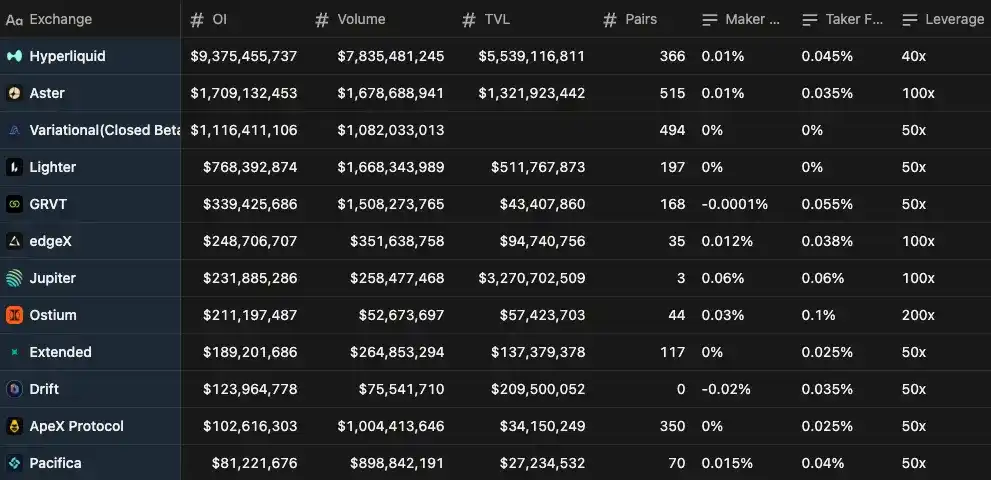
Though primarily driven by airdrop incentives, it's still ranked top 3 among perpetual DEXs, excluding the clear market leader Hyperliquid.

Variational is still in private beta, meaning you need an invite to use. What's special? It's an RFQ-based perpetual DEX, theoretically meaning they can list all sorts of pairs (even the most obscure) and still have deep liquidity, unlike order books that need crazy bootstrapping.

I mainly use it to trade commodities like crude oil, gold, silver, copper, and some other pairs. Focusing on open interest and holding long-term gets the most efficient points.
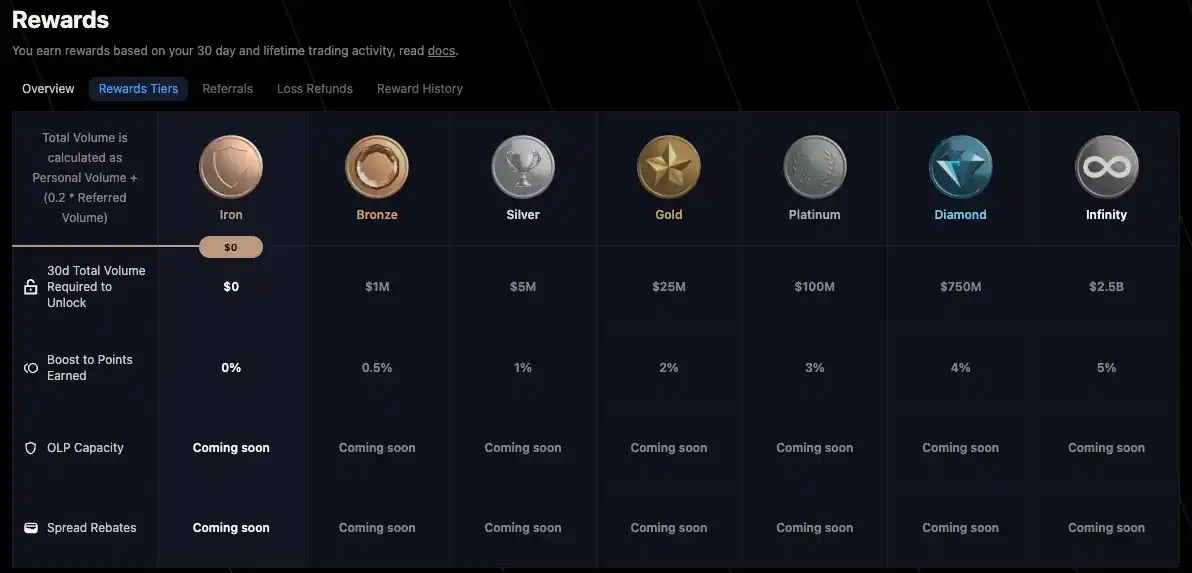
Referrals get a 15% points boost, my code automatically grants you SILVER tier for 90 days upon sign-up.

Other platforms I'm still farming with significant point allocation are:

The TGE target for all mentioned perpetual DEXs is Q3 2026.

I think the fear around STRC is overdone. But this financial engineering does alter investor behavior around it. Unwillingness to allocate until Saylor finishes selling $1B of BTC is now a key "bottom signal."

At $58k BTC price, I think valuations are reasonable. It's even below the 200-day moving average now.

This means H2 2026 could be a significant period for long-term accumulators. I do think there will be one last capitulation and heavy forced selling (including Saylor), likely coinciding with stocks starting to weaken.

While this isn't a pure BTC bullish post, I think among all assets that exist today, BTC offers one of the widest margins of safety, even if the ultimate low is about 15–20% down from here.

Think about it, in a long-term stagflation environment, scarce assets perform best. It was gold in the past, an asset outside the monetary system that existed for millennia.

I think ten years from now, accumulating BTC today will be seen as one of the most rewarding moments in a long time.

While stocks will indeed rise over time in the future, at this moment, I can't justify buying at such high valuations and am happy to watch from the sidelines until it comes back to earth.

What do you think? How are you thinking about capital allocation now?

Criptos en tendencia

Preguntas relacionadas

QAccording to the author, what are the two main portfolio allocation methods suggested for dealing with the current market, which one does he prefer, and why?

AThe author suggests two methods: 1) DCA (Dollar-Cost Averaging) in a true, non-timing, mechanical way. 2) Being heavy on cash while allowing participation through tactical/satellite positions like active trading. He personally prefers the second method. The reason is that he actively monitors the market daily and relies on his market experience and intuition to navigate it. He finds DCA requires a genuine long-term horizon (at least 5 years) and strict discipline, which most people lack as they often try to time the market within it.

QBased on Howard Marks' framework from 'The Cycle', what key characteristics does the author believe the current AI-driven stock market is exhibiting that signal a potential bubble top?

AThe author believes the AI-driven market exhibits many characteristics from Howard Marks' 'market top' checklist. Key ones include: prices seeming irrelevant ('no price is too high'), the belief that leverage is a sure path to profit, widespread investor confidence and optimism, greed driving behavior, asset prices exceeding intrinsic value, easy capital raising, low skepticism, high confidence enabling risky trades, and investors worrying more about missing out (FOMO) than losing money. He argues the market shows 'price doesn't matter' sentiment, a hallmark of a bubble.

QWhy does the author view Bitcoin as a more attractive investment prospect compared to high-flying AI stocks at this moment?

AThe author views Bitcoin as more attractive because he believes it is exhibiting many characteristics from the *opposite* side of Howard Marks' checklist—the one indicating a market bottom or undervalued state. He implies BTC shows signs like fear dominating investor psychology, prices potentially below intrinsic value, high skepticism, low confidence, and investors worrying about losing money rather than missing gains. He also cites BTC trading below its 200-day moving average around $58,000, offering a wider 'margin of safety' and reasonable valuation, especially in a potential long-term stagflation environment where scarce assets historically perform well.

QWhat are the three main drivers the author identifies as creating the current 'dislocated' and 'irrational' macro market environment?

AThe author identifies three main drivers: 1) The AI Capital Expenditure Supercycle, with hyperscalers spending massively (projected $725B in 2026), now representing over 30% of the S&P 500. 2) Late-cycle fiscal stimulus, including tax and tariff rebates boosting nominal profits even as the Fed tightens policy. 3) Passive index fund flows, where funds mechanically funnel retirement savings (like 401(k)s) into the largest market-cap companies regardless of price, forcing buying at historic highs.

QHow has the author personally allocated his capital across different 'buckets' based on the current market outlook, and what is he specifically accumulating in his 'long-term accumulation' bucket?

AThe author has allocated his capital into three buckets: 1) Trading capital (highest risk), 2) Long-term accumulation capital (buy-and-hold), and 3) Illiquid capital (private equity/SPVs). Given the current market, he has significantly reduced allocation to bucket 1 due to poor market edge. He holds most of his cash for bucket 2 (>80% cash overall). His current weightings are approximately 10% for bucket 1, 70% for bucket 2, and 20% for bucket 3. Within bucket 2 (long-term accumulation), he is specifically accumulating spot Bitcoin, having made four buys at an average price of around $59,000.

Lecturas Relacionadas

Bitwise CIO: STRC Plunge is a Bottom Signal, Bull Market to Begin in Autumn

Matt Hougan, Chief Investment Officer at Bitwise, explains the recent Bitcoin price drop below $60,000 and its connection to the steep decline in MicroStrategy's STRC (Strategy's Perpetual Preferred Stock). STRC, designed as a high-yield, stable-price instrument, fell from its $100 target to $75 due to market fears over MicroStrategy's ability to sustain its dividend amid Bitcoin's price weakness. Hougan clarifies that while MicroStrategy's overall financial position remains strong, with significant Bitcoin holdings and cash, the core market anxiety centered on the optional nature of the dividend payments. In response, MicroStrategy announced a new operational framework: it will sell some Bitcoin as needed to fund dividends, will no longer actively defend the $100 share price through dividend hikes, and may repurchase STRC on the open market. This shift marks a change in MicroStrategy's role from a consistent, one-way buyer of Bitcoin to a more dynamic participant that may both buy and sell. According to Hougan, the STRC volatility is a classic late-cycle event, signaling the painful but necessary process of flushing out excessive leverage from the market. He draws parallels to the unwinding of the GBTC premium in the previous cycle. He identifies key potential bottoming signals: MSTR trading at a discount to its net asset value (NAV), extreme readings on the Crypto Fear & Greed Index, and persistently negative Bitcoin funding rates. Hougan concludes that while the exact timing of the market bottom is unpredictable, the current deleveraging phase suggests it is near. He expresses confidence that a new bull market will begin in the fall of this year, with the next major wave of buying expected to come from institutional investors like banks, asset managers, and pension funds.

Foresight NewsHace 1 hora(s)

Bitwise CIO: STRC Plunge is a Bottom Signal, Bull Market to Begin in Autumn

Foresight NewsHace 1 hora(s)

Trading

Spot

Artículos destacados

Qué es DOGE M

Doge Matrix ($doge m): La Nueva Raza de Criptomonedas Impulsadas por la Comunidad Introducción En el paisaje en constante evolución de las criptomonedas, nuevos proyectos emergen constantemente, cada uno con el objetivo de captar el interés de inversores y entusiastas por igual. Uno de los últimos en entrar en este dominio es Doge Matrix, representado por el símbolo de ticker $doge m. Este proyecto ha atraído atención gracias a sus raíces en la popular cultura de memes que rodea a Dogecoin, estableciendo su lugar dentro del espacio web3. Este artículo tiene como objetivo proporcionar un análisis integral de Doge Matrix, cubriendo su visión general, creador, inversores, funcionalidad, cronología y aspectos notables. ¿Qué es Doge Matrix ($doge m)? Doge Matrix es un proyecto de criptomoneda impulsado por la comunidad que aparentemente se basa en el atractivo generalizado de Dogecoin, una moneda digital conocida por su mascota Shiba Inu y sus orígenes en memes. Si bien los objetivos generales de Doge Matrix no están ampliamente definidos, se caracteriza por un compromiso con la participación y el apoyo de la comunidad. A diferencia de las criptomonedas tradicionales que a menudo enfatizan la utilidad o el valor intrínseco a través de tecnologías subyacentes, Doge Matrix se posiciona dentro de un espacio que abraza el fenómeno cultural de las criptomonedas, apelando particularmente a aquellos que resuenan con la ética de los activos basados en memes. Aprovechando las fortalezas de la comunidad de Dogecoin, Doge Matrix opera como parte de un ecosistema más amplio, invitando a la participación y el compromiso de usuarios que comparten un interés en la criptomoneda y el paisaje digital. ¿Quién es el Creador de Doge Matrix ($doge m)? La identidad del creador de Doge Matrix sigue siendo desconocida. Esta falta de transparencia no es un acontecimiento poco común en el espacio de las criptomonedas, donde algunos proyectos se lanzan sin revelar las identidades de sus fundadores. La ausencia de información sobre el equipo fundador puede generar preguntas entre los posibles inversores sobre la responsabilidad y dirección del proyecto. ¿Quiénes son los Inversores de Doge Matrix ($doge m)? Hasta el momento, no hay información disponible públicamente que detalle los inversores o fundaciones de inversión que respaldan a Doge Matrix. El proyecto parece depender principalmente del apoyo de la comunidad en lugar de inversiones institucionales. Este modelo se alinea con la naturaleza impulsada por la comunidad de la iniciativa, fomentando un entorno donde la dirección del proyecto es moldeada por sus participantes en lugar de ser dictada por unos pocos patrocinadores financieros seleccionados. ¿Cómo Funciona Doge Matrix ($doge m)? Los detalles sobre los mecanismos operativos de Doge Matrix son algo vagos, reflejando una tendencia más amplia de proyectos en el espacio de las monedas meme donde las funcionalidades innovadoras no siempre están claramente articuladas. No obstante, Doge Matrix parece estar diseñado para aprovechar el ecosistema existente de criptomonedas alentar la participación de los usuarios mientras se conecta con las referencias culturales familiares asociadas a Dogecoin. Sus características potencialmente únicas derivan de las interacciones comunitarias en lugar de avances tecnológicos, enfatizando experiencias compartidas y colaboración entre los poseedores de tokens. Si bien las innovaciones exactas no se han delineado explícitamente, el proyecto parece crear un espacio donde los miembros de la comunidad pueden interactuar, compartir ideas y propulsar el potencial del proyecto hacia adelante. Cronología de Doge Matrix ($doge m) Reflexionar sobre la cronología del proyecto revela eventos notables que han definido su trayectoria hasta ahora: 25 de noviembre de 2024: Doge Matrix alcanzó su valor máximo histórico, marcando un hito significativo en su historia temprana. 1 de enero de 2025: Por el contrario, Doge Matrix alcanzó su valor mínimo histórico, ilustrando la volatilidad a menudo asociada con las criptomonedas, especialmente en las primeras etapas del ciclo de vida de un proyecto. En curso: El proyecto continúa siendo activamente negociado y respaldado por su comunidad, aunque aún no se han divulgado hitos u objetivos futuros específicos. Puntos Clave Sobre Doge Matrix ($doge m) Enfoque Comunitario En el corazón de Doge Matrix hay un compromiso con la participación de la comunidad. El proyecto prospera sobre la premisa de colaboración y objetivos compartidos entre sus miembros, enfatizando la importancia del esfuerzo colectivo. A diferencia de los proyectos centralizados que a menudo tienen una estructura de liderazgo definida, Doge Matrix actualmente muestra un enfoque más fluido hacia la gobernanza, donde la voz de cada miembro de la comunidad importa. Volatilidad El mercado de criptomonedas es notorio por su volatilidad, y Doge Matrix no es una excepción. Su historial de precios refleja fluctuaciones significativas entre valores altos y bajos, lo cual es típico de muchas nuevas criptomonedas, pero subraya los riesgos asociados con la inversión en tokens emergentes. Falta de Información Detallada Una de las características más llamativas de Doge Matrix es la escasez de información detallada sobre sus fundamentos tecnológicos y mecanismos operativos. Esta ambigüedad requiere que los posibles inversores realicen una diligencia debida exhaustiva antes de involucrarse con el proyecto. Conclusión En resumen, Doge Matrix ($doge m) ilustra una nueva ola de proyectos de criptomonedas que se apoyan en gran medida en la participación de la comunidad y la relevancia cultural. Si bien carece de ciertos detalles, como liderazgo claro, objetivos definidos y funcionalidad detallada, el proyecto ha logrado generar interés dentro de la comunidad cripto, aprovechando el atractivo establecido de la cultura de memes. Al igual que con cualquier inversión en el espacio de las criptomonedas, comprender los riesgos inherentes y realizar una investigación exhaustiva es esencial para los participantes potenciales. Doge Matrix se erige como un recordatorio de la naturaleza dinámica y, a veces, impredecible de la industria cripto, marcada por una evolución constante y entusiasmo por iniciativas impulsadas por la comunidad.

432 Vistas totalesPublicado en 2025.02.03Actualizado en 2025.02.03

Qué es DOGE M

Qué es $M

Entendiendo Mantis ($M): Una Nueva Era en la Interoperabilidad entre Cadenas En el paisaje en constante evolución de Web3 y las criptomonedas, nuevos proyectos se esfuerzan por ofrecer soluciones innovadoras destinadas a mejorar la experiencia del usuario y expandir las posibilidades funcionales dentro del ecosistema financiero descentralizado. Uno de estos proyectos que está ganando atención es Mantis ($M), un protocolo pionero fundado en los principios de interoperabilidad entre cadenas y liquidaciones basadas en intenciones. Este artículo profundiza en los aspectos esenciales de Mantis, incluyendo su funcionalidad central, creadores, respaldo de inversión, características innovadoras y hitos críticos. ¿Qué es Mantis ($M)? Mantis se describe como un protocolo de liquidación de intenciones multi-dominio que simplifica las interacciones entre cadenas, permitiendo a los usuarios ejecutar transacciones financieras complejas a través de varias plataformas de blockchain sin problemas. El protocolo opera a través de tres capas principales: Expresión de Intenciones: Los usuarios pueden articular sus objetivos de transacción utilizando un lenguaje natural facilitado por el DISE LLM, un modelo de lenguaje de IA avanzado. Por ejemplo, un usuario podría expresar el deseo de intercambiar Ethereum (ETH) por Solana (SOL) con una tolerancia de deslizamiento específica del 1%. Ejecución: Esta capa emplea una red de solucionadores que compiten para cumplir con las intenciones de los usuarios. Las transacciones se ejecutan utilizando mecanismos como Coincidencia de Deseos (CoWs) y Subastas de Flujo de Órdenes (OFAs), que aseguran que las demandas de los usuarios se satisfagan de manera óptima. Liquidación: Aprovechando el protocolo de Comunicación Inter-Blockchain (IBC), Mantis permite transacciones atómicas entre cadenas, permitiendo a los usuarios operar a través de varias cadenas soportadas, incluyendo Ethereum, Solana y Cosmos. Mantis está diseñado para introducir generación de rendimiento nativa para activos inactivos, utilizando pruebas criptográficas para mantener la integridad de las transacciones a lo largo de todo el proceso. Creadores y Equipo de Desarrollo Mantis fue concebido por la Composable Foundation, una organización impulsada por la investigación notable por su énfasis en soluciones de interoperabilidad de blockchain. Esta fundación colabora con instituciones académicas de renombre, incluyendo la Universidad de Harvard y la Universidad de Lisboa, contribuyendo a extensos esfuerzos de investigación y desarrollo que informan la arquitectura y funcionalidad de Mantis. El compromiso de la Composable Foundation de fomentar la innovación en el espacio de blockchain posiciona a Mantis como una solución robusta para la creciente demanda de interoperabilidad entre múltiples redes de blockchain. Inversores y Respaldo Si bien los detalles específicos sobre inversores individuales no se han divulgado públicamente, Mantis disfruta de un respaldo sustancial de varias entidades, incluyendo: Subvenciones del ecosistema de cadenas habilitadas por IBC, que apoyan el crecimiento del protocolo y su integración dentro de ecosistemas de finanzas descentralizadas. Asociaciones estratégicas con proveedores de infraestructura que mejoran las capacidades de la red de Mantis y sus estrategias de implementación. Financiamiento a través del tesoro de la Composable Foundation, asegurando un apoyo financiero sostenido para el desarrollo continuo y los costos operativos. Estos esfuerzos colaborativos reflejan un consenso entre las partes interesadas sobre la importancia de mejorar la funcionalidad entre cadenas y la utilidad potencial de las innovaciones infraestructurales de Mantis. Innovaciones Clave Mantis se distingue por varias innovaciones pioneras que mejoran su funcionalidad y utilidad: Intenciones Agnósticas a la Cadena: Los usuarios pueden iniciar transacciones desde cualquier cadena soportada mientras liquidan en otra. Esta flexibilidad empodera a los usuarios, impulsando una mayor interacción entre diferentes plataformas. Interfaz Potenciada por IA: La integración del DISE LLM permite a los usuarios realizar operaciones complejas de DeFi utilizando lenguaje natural, simplificando así las interacciones y haciendo que la tecnología blockchain sea accesible a un público más amplio. Captura de MEV Inter-Dominio: Mantis crea un mercado interno para el valor máximo extraíble (MEV) a través de competencias entre solucionadores. Este enfoque innovador permite una mayor eficiencia y extracción de valor en transacciones complejas. Capa de Liquidación Modular: El protocolo soporta varios métodos de verificación, incluyendo pruebas de conocimiento cero y rollups optimistas, proporcionando un marco versátil que puede adaptarse a las tecnologías de blockchain emergentes. Línea de Tiempo Histórica El desarrollo de Mantis está marcado por varios hitos críticos que trazan su trayectoria y crecimiento: | Año | Hito | |————|———————————————————————–| | 2022 | Desarrollo del concepto inicial dentro de la división de investigación de la Composable Foundation. | | Q3 2024 | Lanzamiento de la testnet con capacidades de puenteo entre Solana y Ethereum. | | Q1 2025 | Evento de Generación de Token (TGE) anticipado junto con el lanzamiento de la mainnet. | | Q2 2025 | Integración esperada del DISE LLM y expansión de las capacidades entre cadenas. | | 2025 H2 | Soporte planeado para más de 15 cadenas a través de futuras actualizaciones de IBC. | Esta línea de tiempo describe la evolución de Mantis, desde discusiones conceptuales hasta la implementación activa y fases de crecimiento futuro. Estrategia de Crecimiento del Ecosistema La estrategia de Mantis para el crecimiento del ecosistema incluye varias iniciativas diseñadas para fomentar la participación de los usuarios y el compromiso de los desarrolladores: Sistema de Créditos: Los usuarios pueden ganar créditos del protocolo al proporcionar liquidez y participar en programas de referidos. Estos créditos son canjeables por incentivos en el futuro, fomentando una comunidad de usuarios robusta. Kit de Desarrollo de Software Modular (SDK): Este conjunto de herramientas empodera a los desarrolladores para crear aplicaciones basadas en modelos impulsados por intenciones utilizando la infraestructura de Mantis, promoviendo así la innovación dentro de su ecosistema. Modelo de Gobernanza: A medida que el protocolo madura, los poseedores de tokens $M tendrán voz en la gobernanza del protocolo, permitiéndoles votar sobre actualizaciones y cambios propuestos, mejorando así el compromiso de la comunidad y la descentralización. Mantis representa un avance significativo en el ámbito de la arquitectura entre cadenas. Al integrar sin problemas algoritmos avanzados de IA con un marco de liquidación robusto, Mantis busca abordar los problemas de fragmentación dentro de los ecosistemas multi-cadena. Su enfoque innovador prioriza la mejora de la experiencia del usuario mientras se adhiere a los principios fundamentales de descentralización y seguridad, estableciendo un nuevo estándar para la futura interoperabilidad de las tecnologías blockchain. A medida que Mantis continúa su camino de crecimiento e implementación, promete ser un proyecto a seguir de cerca en el competitivo paisaje de Web3 y las finanzas descentralizadas. Con su enfoque en cruzar fronteras y elevar la participación del usuario, Mantis está preparado para ser una parte integral de los futuros desarrollos en el espacio de las criptomonedas.

47 Vistas totalesPublicado en 2025.03.18Actualizado en 2025.03.18

Qué es $M

Cómo comprar M

¡Bienvenido a HTX.com! Hemos hecho que comprar MemeCore (M) sea simple y conveniente. Sigue nuestra guía paso a paso para iniciar tu viaje de criptos.Paso 1: crea tu cuenta HTXUtiliza tu correo electrónico o número de teléfono para registrarte y obtener una cuenta gratuita en HTX. Experimenta un proceso de registro sin complicaciones y desbloquea todas las funciones.Obtener mi cuentaPaso 2: ve a Comprar cripto y elige tu método de pagoTarjeta de crédito/débito: usa tu Visa o Mastercard para comprar MemeCore (M) al instante.Saldo: utiliza fondos del saldo de tu cuenta HTX para tradear sin problemas.Terceros: hemos agregado métodos de pago populares como Google Pay y Apple Pay para mejorar la comodidad.P2P: tradear directamente con otros usuarios en HTX.Over-the-Counter (OTC): ofrecemos servicios personalizados y tipos de cambio competitivos para los traders.Paso 3: guarda tu MemeCore (M)Después de comprar tu MemeCore (M), guárdalo en tu cuenta HTX. Alternativamente, puedes enviarlo a otro lugar mediante transferencia blockchain o utilizarlo para tradear otras criptomonedas.Paso 4: tradear MemeCore (M)Tradear fácilmente con MemeCore (M) en HTX's mercado spot. Simplemente accede a tu cuenta, selecciona tu par de trading, ejecuta tus trades y monitorea en tiempo real. Ofrecemos una experiencia fácil de usar tanto para principiantes como para traders experimentados.

849 Vistas totalesPublicado en 2025.07.02Actualizado en 2026.06.02

Cómo comprar M

Discusiones

Bienvenido a la comunidad de HTX. Aquí puedes mantenerte informado sobre los últimos desarrollos de la plataforma y acceder a análisis profesionales del mercado. A continuación se presentan las opiniones de los usuarios sobre el precio de M (M).

活动图片