Falling Tides

insights.glassnodePublicado a 2025-02-18Actualizado a 2025-02-26

Executive Summary

  • After Bitcoin’s second attempt to break above $105k in late January, the market has entered a contraction phase, with monthly price momentum sharply declining across major assets.
  • Bitcoin has held relatively steady, while Ethereum, Solana, and Memecoins have faced much deeper corrections, reflecting a shifting appetite for risk.
  • Solana has emerged as a market leader in capital inflows over the past two years, in contrast to Ethereum, which has comparatively struggled to attract sustained demand.
  • However, this week, all digital assets aside from Bitcoin have seen a dramatic decline in capital flows, with Solana, and its associated memecoin ecosystem taking a relatively large hit.
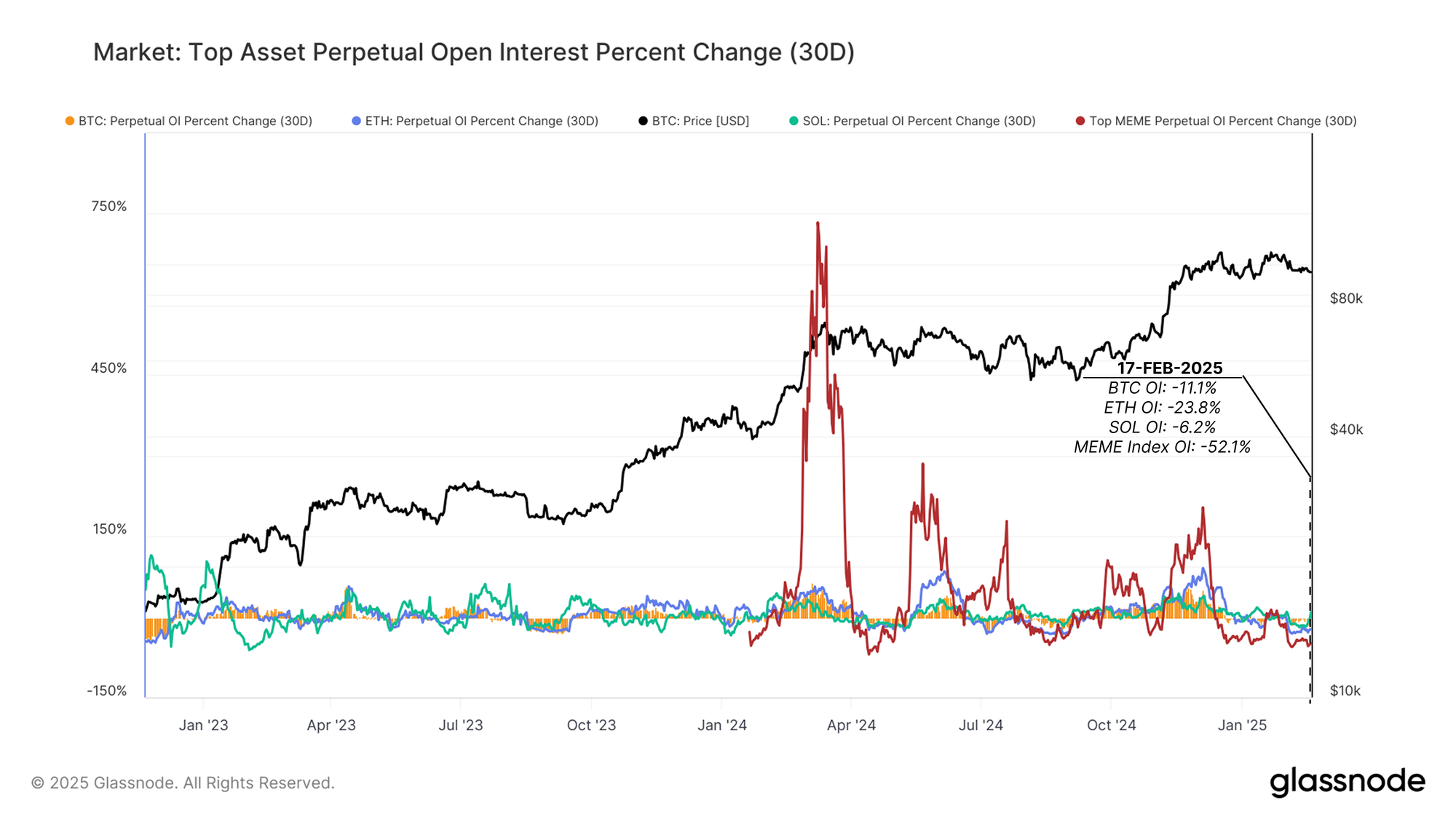
  • Perpetual futures open interest has declined across Bitcoin (-11.1%), Ethereum (-23.8%), Solana (-6.2%), and Memecoins Index (-52.1%), reflecting a diminished appetite for leveraged speculation.
💡
View all charts in this edition in The Week On-chain Dashboard.

Market Momentum Takes a Breather

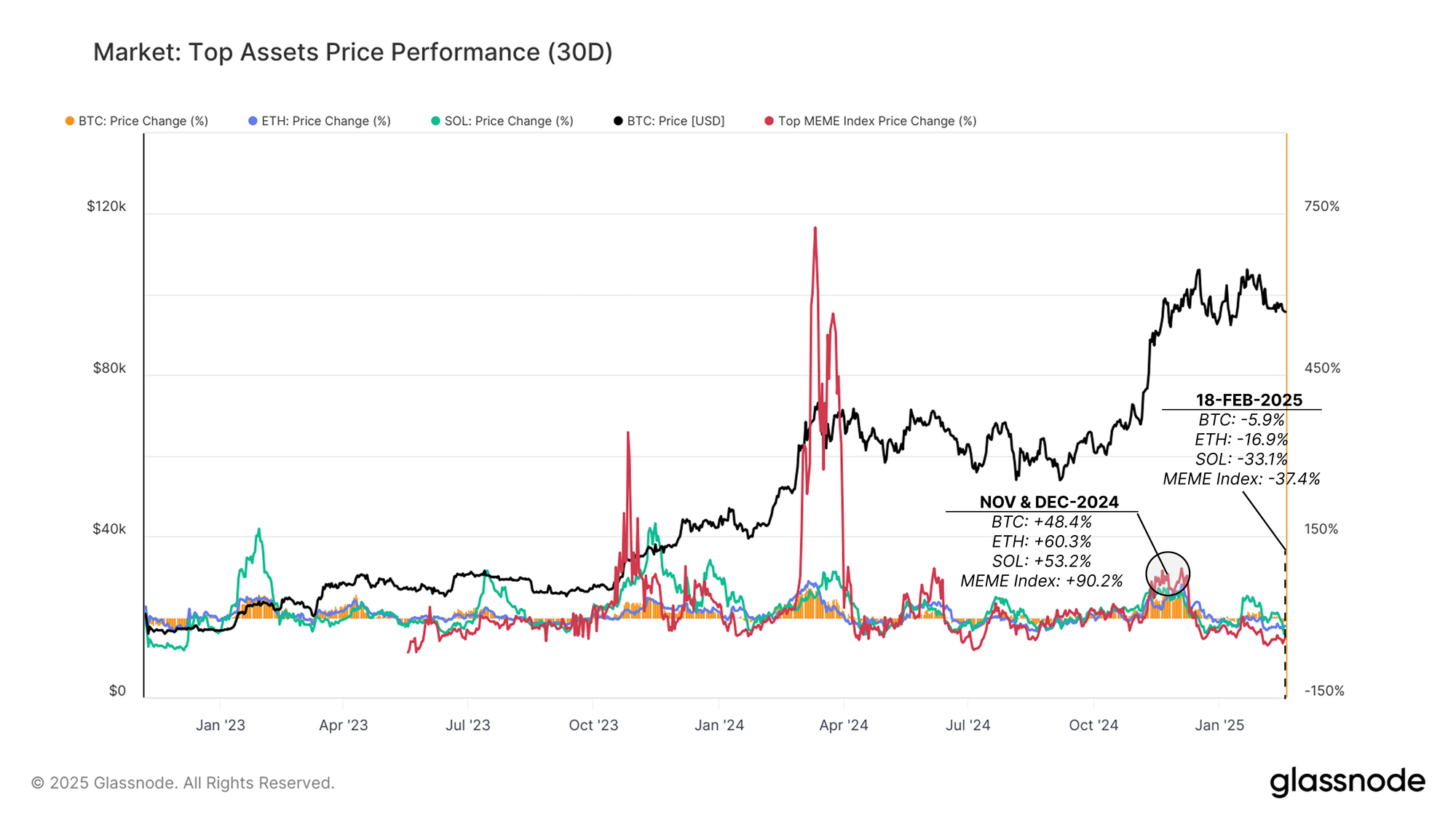
The Bitcoin market attempted to rally above the ATH, and back into price discovery in late January 2025. This rally, however, could not achieve the necessary momentum, and the market has entered into a period of contraction and consolidation since then, with price momentum sharply declining across major assets.

  • Bitcoin: +48.4% (Nov 2024) → -5.9% (Feb 2025)
  • Ethereum: +60.3% (Dec 2024) → -16.9% (Feb 2025)
  • Solana: +53.2% (Nov 2024) → -33.1% (Feb 2025)
  • Meme Coins Index: +90.2% (Dec 2024) → -37.4% (Feb 2025)

Notably, Memecoins and Solana have thrived during strongly trending market conditions but also tend to correct sharply during downturns. Ethereum has remained one of the weakest performers throughout this cycle, and whilst it has outperformed Solana this week, a robust trend of out-performance has not yet been established.
Live Chart

Assessing Performance So Far

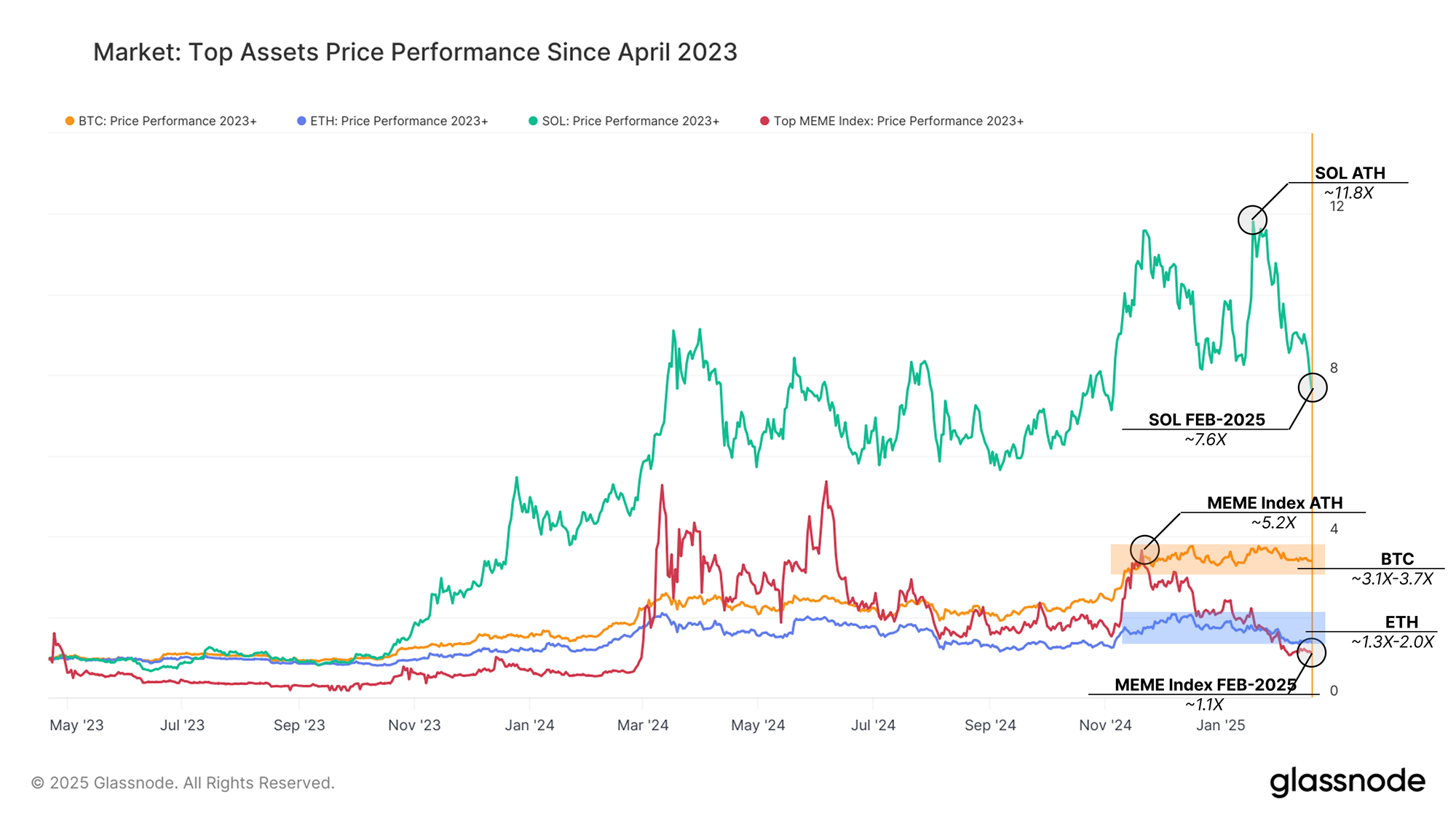
The recent slowdown comes after an extended period of strong gains across the major digital assets. Looking at the performance since early 2023, we can see clear differentiation in how each asset has navigated the cycle so far:

  • Bitcoin is trading within a range approximately 3.4x higher than April 2023, providing a benchmark return profile.
  • Ethereum has struggled compared to its peers, ranging between 1.3X and 2.0X relative to April 2023.
  • Solana's returns since 2023 peaked at 11.8x in early January 2025, but have since dropped sharply to around 7.6x as the current correction took hold.
  • Memecoins Index: Saw an explosive uptick in prices in mid-2024, largely aligned with Solana’s out-performance, and peaking 5.2X since 2023. However, recent weeks have seen this sector get hit quite severely, with total performance now being the worst out of the four assets.

This provides a view of Solana’s high-beta nature, where it has experienced both the strongest upside and also the sharpest corrections. Bitcoin’s steadier trajectory highlights its resilience as a benchmark return profile for the digital asset space. Memecoins, in particular, have seen a marked decline in investor demand of late, suggesting there has been a change in risk appetite.
Live Chart

Capital Flows Drive Markets

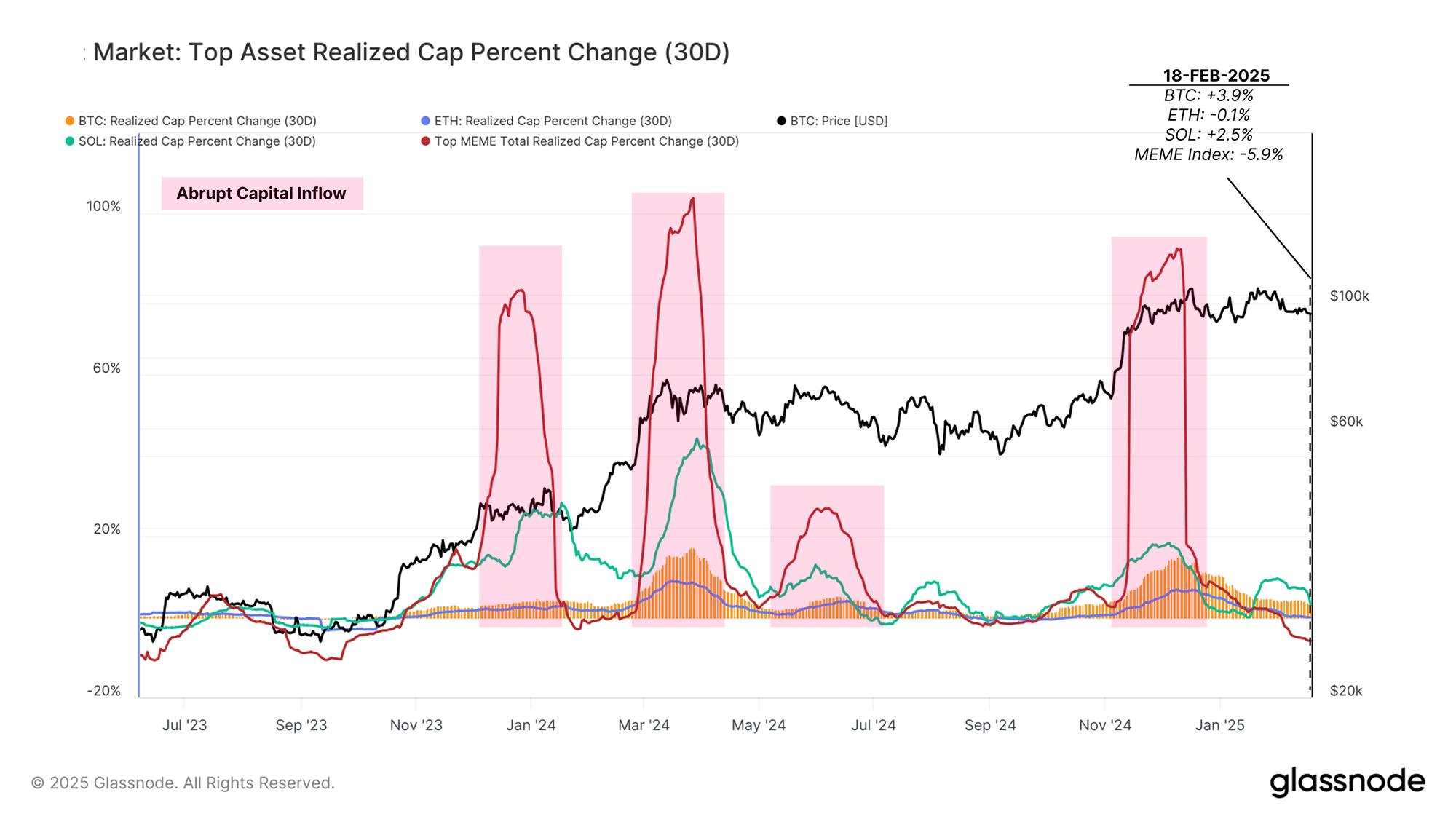
The strong out-performance of Solana over the last two years aligns with a persistent capital inflow from investor demand. Looking at the monthly change in the realized cap, we can see clear patterns in capital movement across various digital assets:

  • Solana: Has consistently attracted higher relative capital inflows, supporting its strong price appreciation.
  • Ethereum: Has seen the weakest capital net inflow out of the majors, explaining its relative underperformance.
  • Memecoins: Experienced several abrupt but unsustainable surges in capital inflow, reflecting speculative bursts, but without sustained momentum.

However, in recent weeks, the momentum of capital inflows has declined for all digital assets. Notably, Ethereum and Top Memecoins have now flipped negative (capital outflows), with Ethereum facing a -0.1% net outflow from the Realized Cap and Memecoins Index seeing an even sharper -5.9% outflow.

This signals a meaningful cooling down in speculative appetite and alludes to a potential for capital rotation out of riskier assets on the road ahead.
Live Chart

Weakness In Futures Markets

As momentum starts to fade in spot markets, we can also see a decline in capital inflows within the perpetual futures market. The cooling of demand on the spot side has led to a sharp drop in perpetual open interest (OI) across all major assets, signalling a reduction in speculative activity and lower cash and carry yields.

Over the last 30 days, the rate of change in open interest highlights a widespread retreat of capital:

  • Bitcoin OI: -11.1%
  • Ethereum OI: -23.8%
  • Solana OI: -6.2%
  • Memecoins OI: -52.1%

This trend of declining open interest across the board suggests that speculators are reducing their leveraged exposure, likely in response to weaker market momentum and increasing market uncertainty. The most extreme decline is seen in Memecoins, which tend to attract more short-term leveraged bets but lose traction quickly whenever sentiment weakens.
Live Chart

Funding Rates Signal Bearish Sentiment

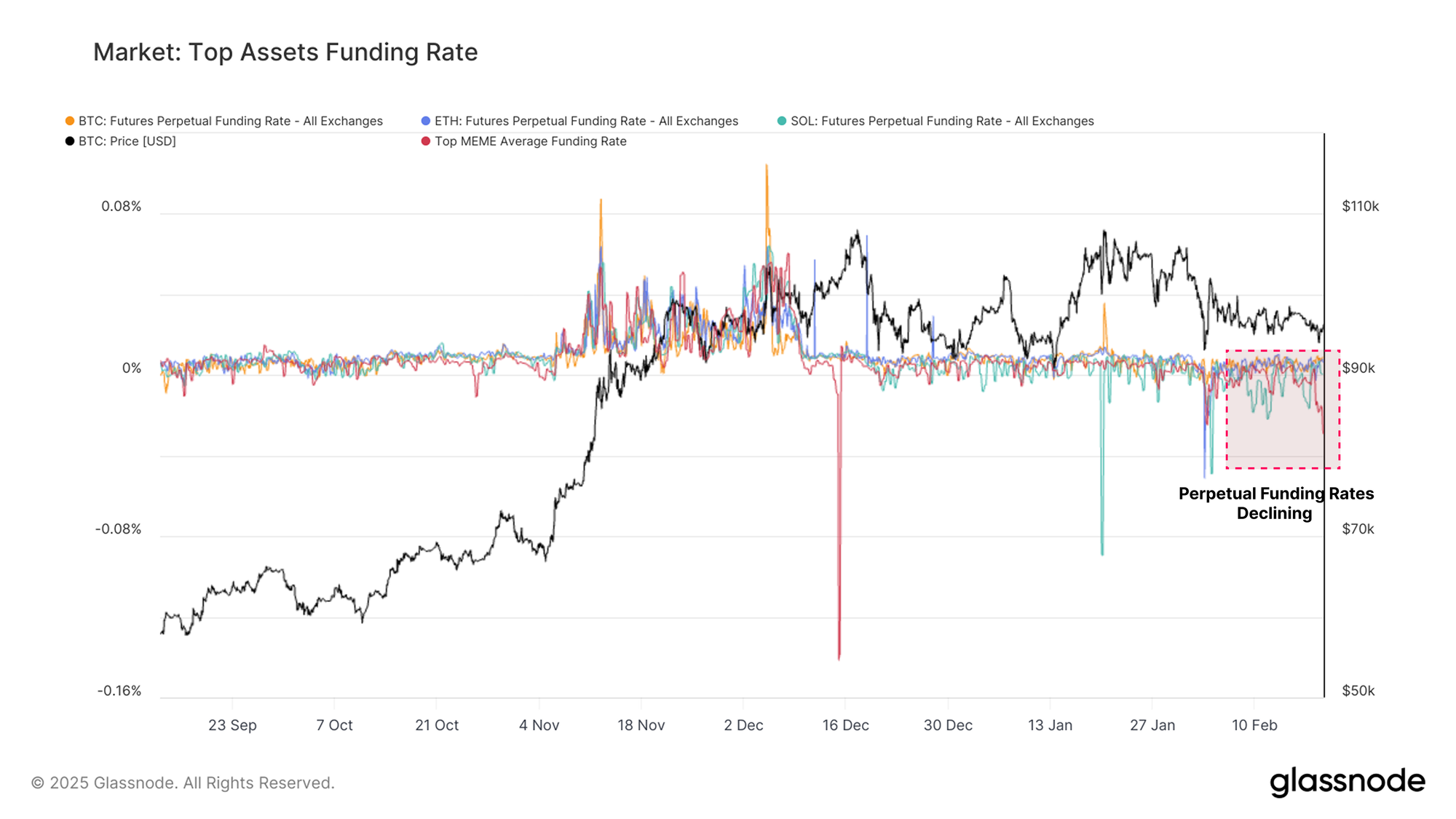
The weakening in open interest is further reinforced by a decline in perpetual futures funding rates. This reflects a shift toward more bearish sentiment and an unwinding of leveraged positions, particularly in riskier assets.

  • Bitcoin and Ethereum funding rates remain slightly positive, and their deeper liquidity profile tends to see positive funding rates except during sharp leverage wash-out events.
  • Solana funding rate have edged lower and have traded negative in recent weeks, signalling a cooling off of demand for long speculative positions.
  • Memecoins have seen funding rates turn very negative, indicating that shorts now dominate in these highly speculative assets, and many traders are closing their positions (or being liquidated).

Negative funding rates for Solana and Memecoins suggest a net shift towards bearish sentiment in higher-risk assets and a closing out of excessive long-sided leverage.
Live Chart

ETF Flows and Market Impact

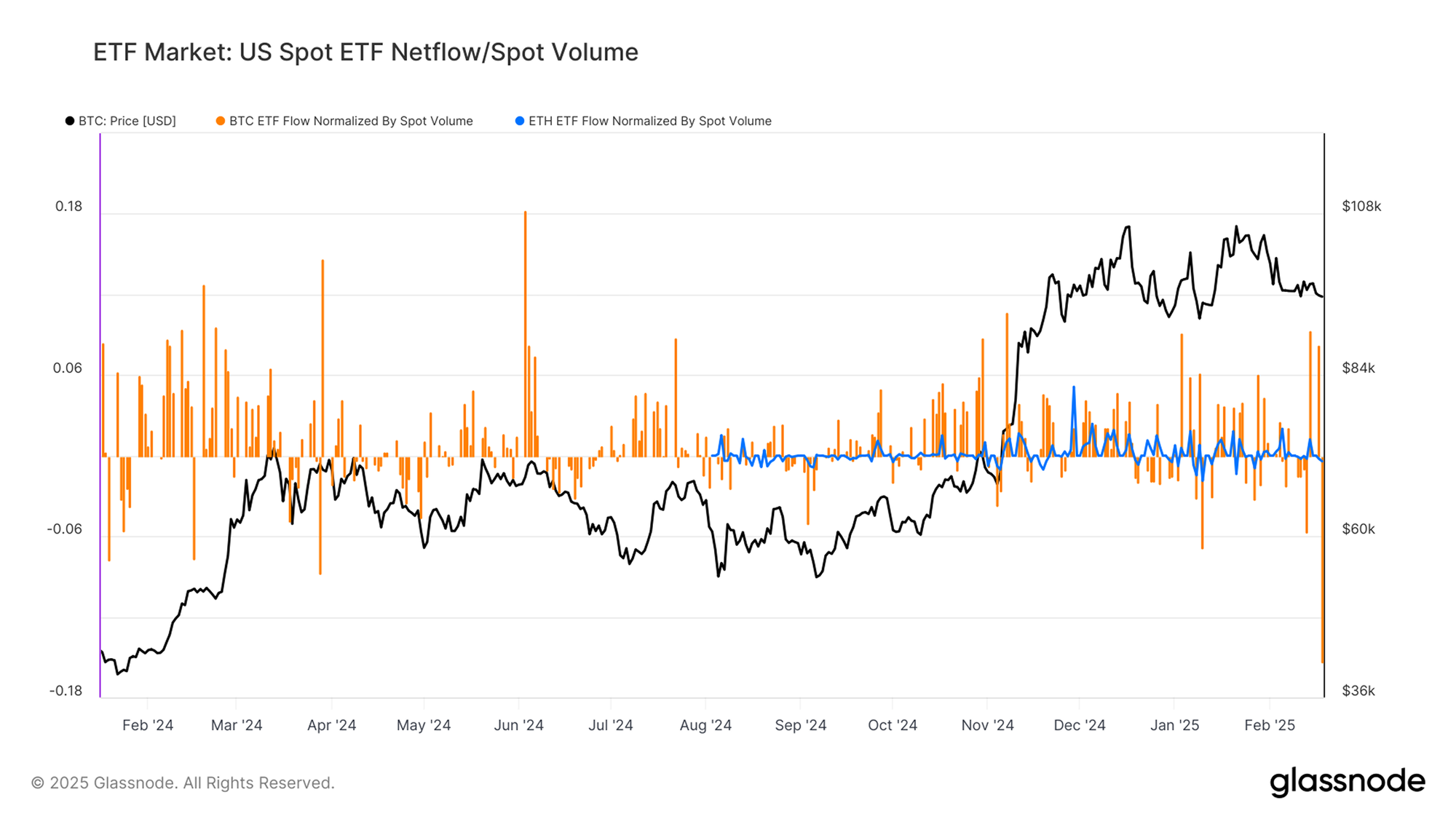
With the market in a contraction phase, institutional interest in Bitcoin and Ethereum has slowed based on spot ETF flows. By normalizing net inflows against each asset’s native spot volume, we can gauge the weight and influence of the ETFs on market dynamics.

  • Bitcoin ETFs saw several outflows exceeding $200M/day last week, however this was followed by a strong rebound in buy-side activity, exceeding 8% of global spot volume, and highlighting institutional demand (akin to ‘buy the dip’ behavior).
  • Ethereum ETF demand has cooled significantly and remains much smaller in scale compared to Bitcoin. ETF activity for ETH is hovering close to zero in terms of net flows in and out, suggesting a lack of strong traditional investor demand and participation.

This divergence has been a theme of this market cycle thus far and reinforces Bitcoin’s dominant role within the institutional asset mix. Ethereum continues to struggle to attract large, sustained inflows, which further explains its relative underperformance in recent years.
Live Chart

A Key Bull-Bear Threshold

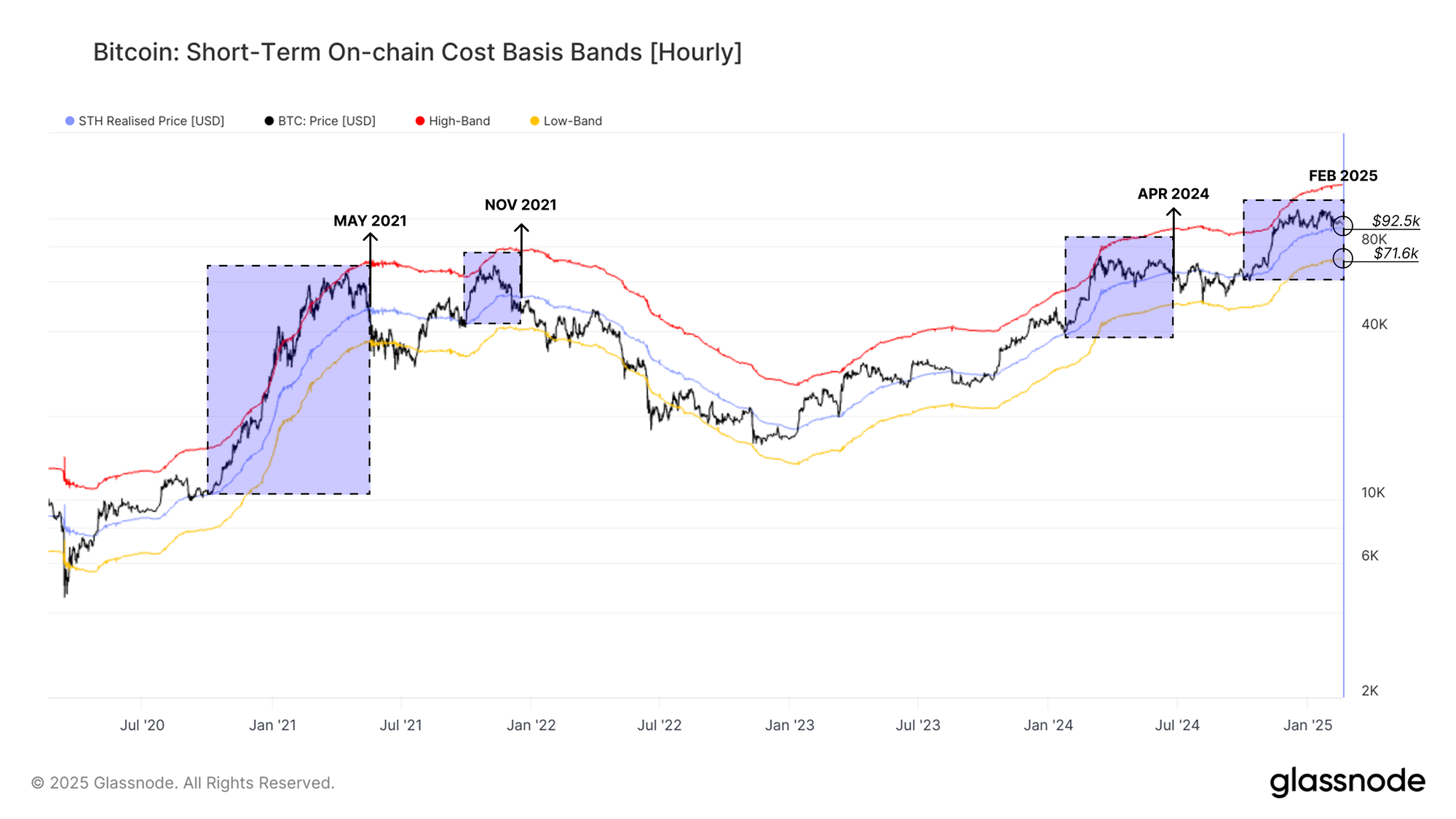
Bitcoin is currently trading $1k-$5k above the Short-Term Holder (STH) cost basis, located at $92.5k. Historically, this level has served as a key pivot point between local scale bull and bear phases, being the pivot point where the average recent buyer moves between a state of unrealized profit and loss.

Reviewing previous instances where Bitcoin reached a new ATH and then corrected lower, we can see a similar pattern in May 2021, Nov 2021, April 2024, and Feb 2024.

In each of these cases, the downtrend extended toward the lower band of the STH cost basis model, specifically -1 standard deviation (σ) below the cost basis. Currently, this lower band sits at $71.6K, helping frame up the potential downside risks should these historical patterns repeat.
Live Chart

Post ATH Consolidation

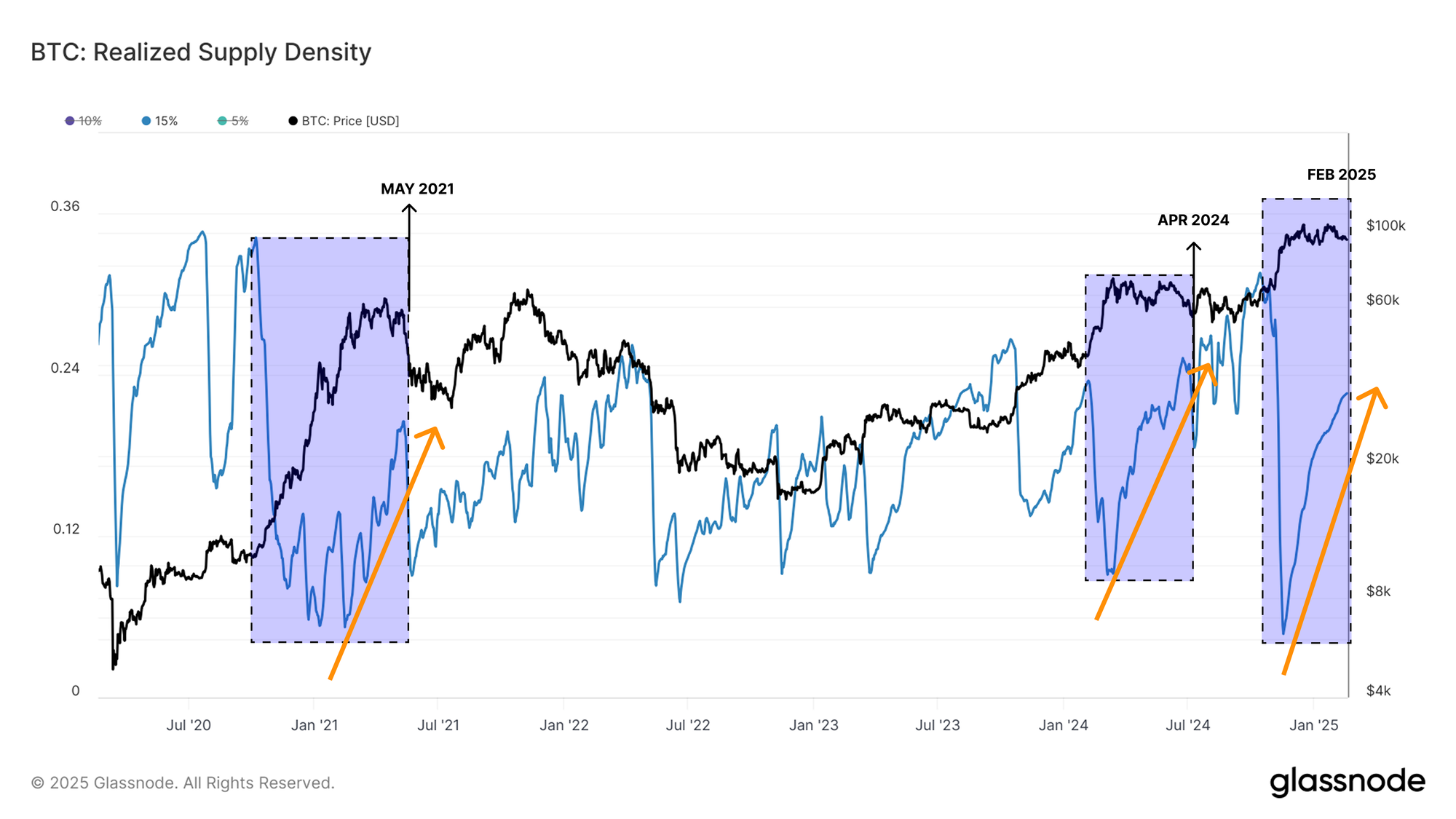
In prior instances where Bitcoin has reached a new ATH, we observe a consistent post-rally pattern, where a surge in realized supply density occurs within ±15% of the spot price. This results from the market transitioning from an aggressive uptrend into price consolidation, as the market trades within a relatively narrow range.

This behaviour is evident in previous cycle tops, where:

  • As the market rallies within price discovery, the realized supply density crashes lower all the way up to the price peak.
  • Market participants then begin redistributing coins as the market enters a correction or consolidation phase.
  • This often occurs close to the STH cost basis, as the conviction and demand profile of new investors is tested.

The current realized supply density aligns with a typical post-ATH consolidation phase, where buyers and sellers try to establish a new equilibrium before the next major trend unfolds.
Live Chart

Approaching a Decisive Market Moment

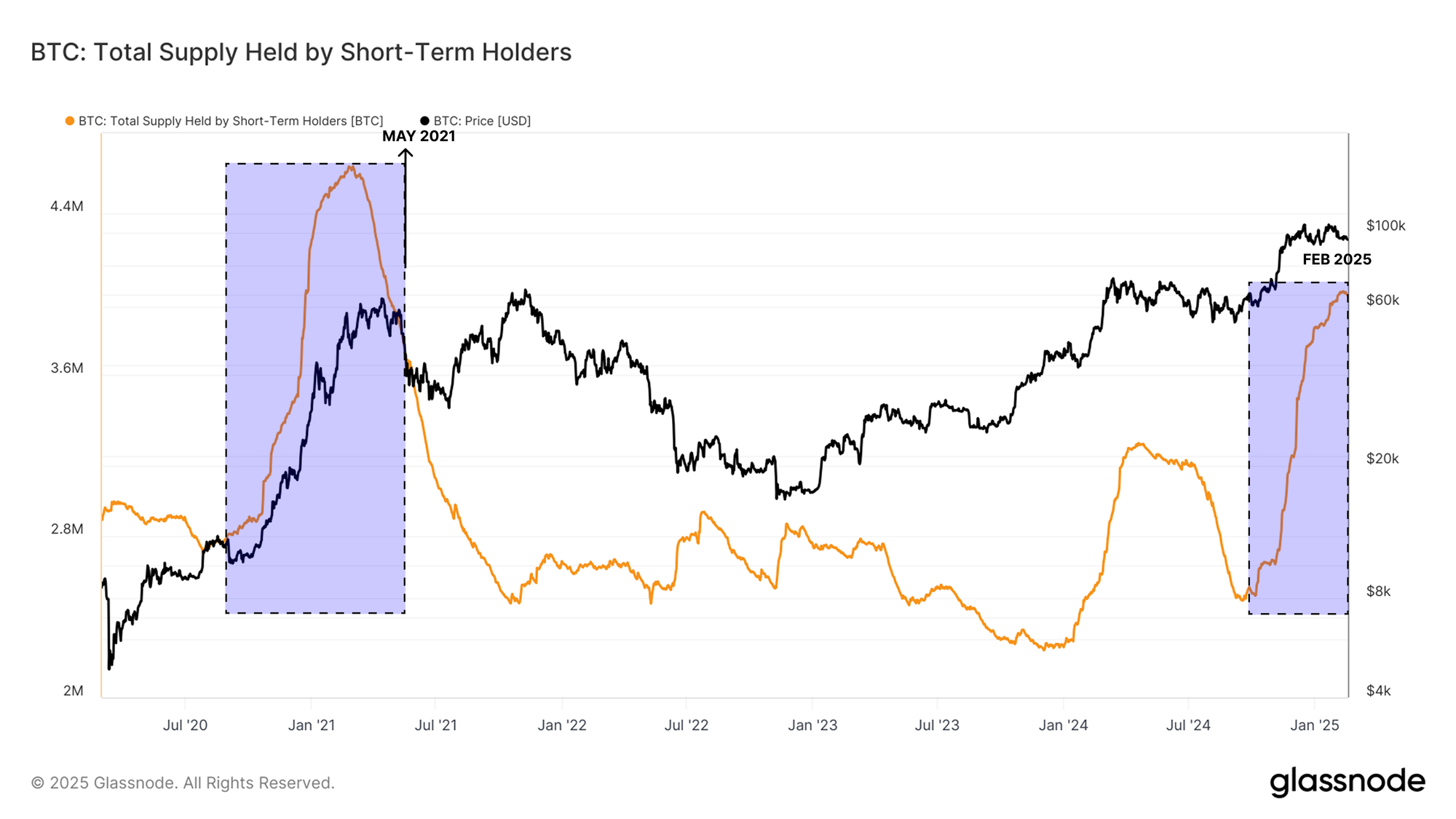
To better understand how sensitive the market is due to this supply density, we can analyze the supply held by short-term holders (STH) in recent post-ATH distribution phases. This helps gauge the patterns of new investor accumulation and whether current conditions resemble past cycle peaks.

When comparing STH supply changes, we observe:

  • The recent accumulation phase closely mirrors May 2021, suggesting a similarly large amount of supply, and investors will be sensitive to a price decline below $92.5k.
  • In April 2024, new investors also accumulated aggressively, but the magnitude of the STH supply uptrend in the current cycle structurally aligns more with May 2021 rather than 2024.

Given these similarities, we are now very close to a decisive moment in the market—a phase where price action is primed for uncoiling. If demand remains strong, Bitcoin could establish a new range above ATHs. However, a lack of sustained buy pressure could lead to a deeper distribution-driven correction, similar to prior post-ATH phases. This would likely be driven by panic amongst recent buyers who see their recently acquired coins move from being in profit to holding an unrealized loss.
Live Chart

Conclusion & Summary

Bitcoin has been consolidating around $95k for several weeks and is trading within a relatively stable range. The same cannot be said for the wider digital asset landscape, with Ethereum, Solana, and Memecoins all seeing significant drawdowns from their cyclical highs. In particular, Memecoins have seen a significant cool-off of demand, as evidenced by capital outflows, sharp price declines, and bearish sentiment in futures markets.

For Bitcoin, the key level to watch is the Short-Term Holder cost basis around $92.5k. This is a pivot point where a large proportion of recent buyers will see their holdings move into an unrealized loss. This could precipitate more downside as panic sets in. In either case, the current consolidation phase appears to be nearing its later stages, and the market looks ready to trend in one direction once again.


Disclaimer: This report does not provide any investment advice. All data is provided for information and educational purposes only. No investment decision shall be based on the information provided here and you are solely responsible for your own investment decisions.

Exchange balances presented are derived from Glassnode’s comprehensive database of address labels, which are amassed through both officially published exchange information and proprietary clustering algorithms. While we strive to ensure the utmost accuracy in representing exchange balances, it is important to note that these figures might not always encapsulate the entirety of an exchange’s reserves, particularly when exchanges refrain from disclosing their official addresses. We urge users to exercise caution and discretion when utilizing these metrics. Glassnode shall not be held responsible for any discrepancies or potential inaccuracies. Please read our Transparency Notice when using exchange data.


Lecturas Relacionadas

Google Cracks Down on 'AI Poisoning'

Google has taken a strong stance against "AI poisoning," a new form of manipulation where advertisers subtly feed information to influence AI-generated answers like those in Google's AI Overview. Unlike traditional SEO, which aims for higher website rankings, Generative Engine Optimization (GEO) seeks to have a brand or product recommended within the AI's response itself. This is particularly valuable as AI summaries, often perceived as neutral and comprehensive, can shorten the consumer decision path and directly influence purchases. The article illustrates the issue with a "hot dog experiment," where fabricated content was quickly picked up and presented as fact by AI. GEO exploitation is potent because AI models aggregate information from various sources—reviews, articles, forums—and can mistake coordinated marketing campaigns for genuine consensus. This threatens the core credibility of search engines. While Google's updated spam policy now explicitly covers attempts to manipulate AI-generated content, enforcement faces challenges. Google can leverage its long experience fighting SEO spam, using penalties like ranking demotion. However, sophisticated "gray area" tactics, such as sponsored third-party reviews or industry reports, are harder to distinguish from legitimate promotion. Other AI players, like Microsoft, have taken a more open approach to GEO, viewing it as a new channel for brands. Ultimately, as AI becomes a primary information source, maintaining the trustworthiness of its answers is a critical challenge for all platforms.

marsbitHace 8 min(s)

Google Cracks Down on 'AI Poisoning'

marsbitHace 8 min(s)

When Futu Turns into a Matchmaking Corner: Overseas Identity Becomes the Hard Currency for the Middle Class

When Futu Becomes a Matchmaking Corner: Overseas Status as the New Hard Currency for China's Middle Class Following a severe penalty announcement from Chinese regulators on May 22nd targeting offshore brokerages like Futu, its app community unexpectedly transformed into an impromptu matchmaking platform. Users posted相亲 (matchmaking) requests, explicitly seeking partners with overseas residency or citizenship, revealing a stark new reality: for China's middle class, an overseas identity has become a crucial asset. The regulatory crackdown, which restricts mainland Chinese residents from opening new accounts to buy overseas securities like US stocks, has sharply escalated the value of a foreign passport or permanent residency. This status now acts as a gateway to global asset allocation—including US equities, offshore property, and foreign currency deposits—effectively becoming a new form of "hard currency." Its scarcity, non-transferability (except through marriage, inheritance, etc.), and role as a hedge against domestic uncertainty have driven its premium. The article traces the evolution of how China's middle class views overseas resources: from an investment for opportunity (2000s), to risk diversification (2010s), and now to a mandatory "insurance policy" for financial access. With the regulatory window closing for many, the demand is shifting towards securing such status for the next generation through international education. The surreal scene of high-performing investors posting dating resumes underscores a 2026 where financial talent can be secondary to the right passport.

marsbitHace 59 min(s)

When Futu Turns into a Matchmaking Corner: Overseas Identity Becomes the Hard Currency for the Middle Class

marsbitHace 59 min(s)

Understanding Bound in One Article: The "Multi-signature + Timelock" Escape Mechanism and the Off-Chain Matching Black Box

**Title**: Understanding Bound: The Escape Mechanism of "Multi-Sig + Time Lock" and the Off-Chain Matching Black Box **Summary**: Bound Exchange, evolved from the earlier radFi platform, introduces a novel approach to Bitcoin trading by combining self-custody security with exchange-like speed. Its core mechanism relies on a 2-of-2 multi-signature (multi-sig) address for user deposits. One private key is held by the user via a passkey, and the other is held by Bound. This setup requires both keys to sign any transaction, preventing Bound from unilaterally accessing user funds (non-custodial). To address the risk of Bound becoming unavailable, a 3-month timelock is integrated into the Bitcoin script. After this period, users can withdraw their assets with just their single signature, ensuring an escape hatch. For trading, Bound operates a concentrated liquidity AMM. However, as Bitcoin L1 lacks smart contracts, the AMM curve, liquidity management, and trade price calculations occur off-chain in Bound's backend database. On-chain Bitcoin transactions serve only as final settlement receipts for pre-determined amounts. This creates a centralization point: the critical sequence of trade execution—which determines the exact price along the curve for each order—is managed off-chain by Bound in a non-transparent "black box." While the 2-of-2 setup protects user本金 (principal), the pricing and ordering of trades introduce potential operational MEV risks, as the order processing is invisible and unverifiable on-chain. In practice, users can also connect external wallets (like Unisat) for fully self-custodied trading, but this requires manually signing every transaction. The platform currently supports deposits of BTC and Runes only.

marsbitHace 1 hora(s)

Understanding Bound in One Article: The "Multi-signature + Timelock" Escape Mechanism and the Off-Chain Matching Black Box

marsbitHace 1 hora(s)

Amid Internal and External Challenges, Is Ethereum's Neutral Route Still Viable?

"Ethereum is facing a dual crisis of market pressure and internal challenges. Its native token ETH is in a mid-term downtrend, with negative sentiment prevailing, weak price action, and significant outflows from ETFs. The ETH/BTC ratio has hit a ten-month low, and institutional holdings have shrunk. Concurrently, the Ethereum Foundation has seen a major exodus of core personnel following its commitment to a neutral, non-commercial development roadmap focused on censorship resistance, openness, privacy, and security (CROPS). This stance has sparked debate. Critics, including former members, argue that the ecosystem lacks a dedicated, well-funded entity to promote ETH's commercial value and compete with rival chains. Proposals suggest creating a new, independent body to drive adoption and token value, forming a dual-model with the Foundation. While some investors view the personnel changes as normal turnover and remain bullish on Ethereum's long-term fundamentals, the immediate path forward is unclear. Analysts believe Ethereum must execute its technical roadmap (like upcoming upgrades), clarify governance, and focus on high-value sectors like DeFi and tokenization to convert its technological edge into a compelling investment thesis. The current downturn tests whether its decentralized model can adapt to balance core principles with commercial competitiveness."

marsbitHace 1 hora(s)

Amid Internal and External Challenges, Is Ethereum's Neutral Route Still Viable?

marsbitHace 1 hora(s)

Technology Has No Barriers, 24/7 Trading is the Key to Hyperliquid's Success

The article argues that Hyperliquid's competitive edge lies not in technological superiority but in its 24/7 trading model, which fundamentally challenges traditional finance's fixed market hours. Based in Singapore with an 11-person team, Hyperliquid has generated significant revenue and trading volume. Its core advantage is the ability to facilitate trading continuously, including during weekends when major exchanges like the CME are closed. This was demonstrated when Hyperliquid listed a SpaceX pre-IPO perpetual contract on a Sunday, allowing the market to price the company hours before traditional institutions opened. This disruption has drawn regulatory scrutiny from traditional giants like CME and ICE, who cite risks like lack of KYC and market manipulation. However, the article suggests their concern stems from Hyperliquid eroding the "time monopoly" of established markets. The piece contrasts Hyperliquid's synthetic derivatives—pure price-betting contracts with no underlying asset or centralized issuer—with other models like PreStocks (dependent on real股权) and Ondo (licensed but targetable). Hyperliquid's code-based, decentralized structure makes it resilient to takedowns, even if founders face legal action. Ultimately, the author concludes that while it raises legitimate regulatory questions, Hyperliquid's "unforgeable" competitive barrier is the time advantage of non-stop trading, a feature legacy systems cannot replicate.

marsbitHace 1 hora(s)

Technology Has No Barriers, 24/7 Trading is the Key to Hyperliquid's Success

marsbitHace 1 hora(s)

Trading

Spot
Futuros

Artículos destacados

Qué es BITCOIN

Entendiendo HarryPotterObamaSonic10Inu (ERC-20) y Su Posición en el Espacio Cripto En los últimos años, el mercado de criptomonedas ha sido testigo de un aumento en la popularidad de las monedas meme, capturando el interés no solo de los comerciantes, sino también de aquellos que buscan compromiso comunitario y valor de entretenimiento. Entre estos tokens únicos se encuentra HarryPotterObamaSonic10Inu (ERC-20), un proyecto intrigante que mezcla referencias culturales en el tejido de las criptomonedas. Este artículo profundiza en los aspectos clave de HarryPotterObamaSonic10Inu, explorando sus mecanismos, ethos impulsado por la comunidad y su relación con el paisaje cripto más amplio. ¿Qué es HarryPotterObamaSonic10Inu (ERC-20)? Como su nombre sugiere, HarryPotterObamaSonic10Inu es una moneda meme construida sobre la blockchain de Ethereum, clasificada bajo el estándar ERC-20. A diferencia de las criptomonedas tradicionales que pueden enfatizar la utilidad práctica o el potencial de inversión, este token prospera en el valor de entretenimiento y la fuerza de su comunidad. El proyecto tiene como objetivo fomentar un entorno donde los usuarios comprometidos puedan reunirse, compartir ideas y participar en actividades inspiradas por diversos fenómenos culturales. Una característica notable de HarryPotterObamaSonic10Inu es su cero impuestos en las transacciones. Este atractivo elemento tiene como objetivo incentivar el comercio y la participación comunitaria, sin cargos adicionales que puedan disuadir a los comerciantes de pequeña escala. El suministro total de la moneda está establecido en mil millones de tokens, una cifra que marca su intención de mantener una circulación sustancial dentro de la comunidad. Creador de HarryPotterObamaSonic10Inu (ERC-20) Los orígenes de HarryPotterObamaSonic10Inu están algo envueltos en misterio; los detalles sobre el creador siguen siendo desconocidos. El desarrollo de este token carece de un equipo identificable o de un plan explícito, lo cual no es inusual dentro del sector de monedas meme. En cambio, el proyecto ha surgido de manera orgánica, con su progreso muy dependiente del entusiasmo y la participación de su comunidad. Inversores de HarryPotterObamaSonic10Inu (ERC-20) En cuanto a inversiones externas y respaldo, HarryPotterObamaSonic10Inu también sigue siendo ambiguo. El token no lista ninguna fundación de inversión conocida o apoyo organizacional significativo. En cambio, la savia del proyecto es su comunidad de base, que informa su crecimiento y sostenibilidad a través de la acción colectiva y el compromiso en el espacio cripto. ¿Cómo Funciona HarryPotterObamaSonic10Inu (ERC-20)? Como una moneda meme, HarryPotterObamaSonic10Inu opera principalmente fuera de los marcos tradicionales que a menudo rigen el valor de los activos. Hay varios aspectos distintivos que definen cómo funciona el proyecto: Transacciones Sin Impuestos: Sin tarifas impositivas en las transacciones, los usuarios pueden comprar y vender el token libremente sin preocuparse por costos ocultos. Compromiso Comunitario: El proyecto prospera en la interacción comunitaria, aprovechando plataformas de redes sociales para crear entusiasmo y facilitar la participación. Las discusiones, el intercambio de contenido y el compromiso son elementos cruciales que ayudan a expandir su alcance y fomentar la lealtad entre los seguidores. Sin Utilidad Práctica: Cabe señalar que HarryPotterObamaSonic10Inu no ofrece utilidad concreta dentro del ecosistema financiero. Más bien, se clasifica como un token principalmente para actividades de entretenimiento y comunitarias. Referencia Cultural: El token incorpora astutamente elementos de la cultura popular para atraer interés, conectando con entusiastas de los memes y seguidores de las criptomonedas por igual. HarryPotterObamaSonic10Inu ejemplifica cómo las monedas meme operan de manera diferente a los proyectos de criptomonedas más tradicionales, ingresando al mercado como construcciones sociales innovadoras en lugar de activos utilitarios. Cronología de HarryPotterObamaSonic10Inu (ERC-20) La historia de HarryPotterObamaSonic10Inu está marcada por varios hitos notables: Creación: El token surgió de un meme viral, capturando la imaginación de muchos entusiastas de las criptomonedas. Las fechas específicas de creación no están disponibles, subrayando su ascenso orgánico. Listado en Exchanges: HarryPotterObamaSonic10Inu ha llegado a varios exchanges, permitiendo un acceso y comercio más fácil por parte de la comunidad. Iniciativas de Compromiso Comunitario: Actividades continuas destinadas a mejorar la interacción comunitaria, incluyendo concursos, campañas en redes sociales y generación de contenido por parte de fanáticos y defensores. Planes de Expansión Futuros: La hoja de ruta del proyecto incluye el lanzamiento de una colección de NFT, mercancía y un sitio de comercio electrónico relacionado con sus temas culturales, involucrando aún más a la comunidad e intentando añadir más dimensiones a su ecosistema. Puntos Clave Sobre HarryPotterObamaSonic10Inu (ERC-20) Naturaleza Impulsada por la Comunidad: El proyecto prioriza la participación colectiva y la creatividad, asegurando que la involucración de los usuarios esté a la vanguardia de su desarrollo. Clasificación como Moneda Meme: Representa la epítome de las criptomonedas basadas en el entretenimiento, diferenciándose de los vehículos de inversión tradicionales. Sin Afiliación Directa con Bitcoin: A pesar de la similitud en el nombre del ticker, HarryPotterObamaSonic10Inu es distinto y no tiene relación con Bitcoin u otras criptomonedas establecidas. Enfoque en la Colaboración: HarryPotterObamaSonic10Inu está diseñado para crear un espacio para la colaboración y el intercambio de historias entre sus poseedores, proporcionando una vía para la creatividad y el vínculo comunitario. Perspectivas Futuras: La ambición de expandirse más allá de su premisa inicial hacia NFTs y mercancías describe un camino para que el proyecto potencialmente ingrese a avenidas más tradicionales dentro de la cultura digital. A medida que las monedas meme continúan capturando la imaginación de la comunidad de criptomonedas, HarryPotterObamaSonic10Inu (ERC-20) se destaca debido a sus lazos culturales y su enfoque centrado en la comunidad. Si bien puede no encajar en el molde típico de un token impulsado por la utilidad, su esencia radica en la alegría y la camaradería fomentadas entre sus seguidores, destacando la naturaleza en evolución de las criptomonedas en una era cada vez más digital. A medida que el proyecto continúa desarrollándose, será importante observar cómo las dinámicas comunitarias influyen en su trayectoria en el cambiante paisaje de la tecnología blockchain.

1.5k Vistas totalesPublicado en 2024.04.01Actualizado en 2024.12.03

Qué es BITCOIN

Cómo comprar BTC

¡Bienvenido a HTX.com! Hemos hecho que comprar Bitcoin (BTC) sea simple y conveniente. Sigue nuestra guía paso a paso para iniciar tu viaje de criptos.Paso 1: crea tu cuenta HTXUtiliza tu correo electrónico o número de teléfono para registrarte y obtener una cuenta gratuita en HTX. Experimenta un proceso de registro sin complicaciones y desbloquea todas las funciones.Obtener mi cuentaPaso 2: ve a Comprar cripto y elige tu método de pagoTarjeta de crédito/débito: usa tu Visa o Mastercard para comprar Bitcoin (BTC) al instante.Saldo: utiliza fondos del saldo de tu cuenta HTX para tradear sin problemas.Terceros: hemos agregado métodos de pago populares como Google Pay y Apple Pay para mejorar la comodidad.P2P: tradear directamente con otros usuarios en HTX.Over-the-Counter (OTC): ofrecemos servicios personalizados y tipos de cambio competitivos para los traders.Paso 3: guarda tu Bitcoin (BTC)Después de comprar tu Bitcoin (BTC), guárdalo en tu cuenta HTX. Alternativamente, puedes enviarlo a otro lugar mediante transferencia blockchain o utilizarlo para tradear otras criptomonedas.Paso 4: tradear Bitcoin (BTC)Tradear fácilmente con Bitcoin (BTC) en HTX's mercado spot. Simplemente accede a tu cuenta, selecciona tu par de trading, ejecuta tus trades y monitorea en tiempo real. Ofrecemos una experiencia fácil de usar tanto para principiantes como para traders experimentados.

4.9k Vistas totalesPublicado en 2024.12.12Actualizado en 2025.03.21

Cómo comprar BTC

Qué es $BITCOIN

ORO DIGITAL ($BITCOIN): Un Análisis Integral Introducción al ORO DIGITAL ($BITCOIN) ORO DIGITAL ($BITCOIN) es un proyecto basado en blockchain que opera en la red Solana, cuyo objetivo es combinar las características de los metales preciosos tradicionales con la innovación de las tecnologías descentralizadas. Aunque comparte un nombre con Bitcoin, a menudo referido como “oro digital” debido a su percepción como un refugio de valor, ORO DIGITAL es un token separado diseñado para crear un ecosistema único dentro del paisaje Web3. Su meta es posicionarse como un activo digital alternativo viable, aunque los detalles sobre sus aplicaciones y funcionalidades aún están en desarrollo. ¿Qué es ORO DIGITAL ($BITCOIN)? ORO DIGITAL ($BITCOIN) es un token de criptomoneda diseñado explícitamente para su uso en la blockchain de Solana. A diferencia de Bitcoin, que proporciona un papel de almacenamiento de valor ampliamente reconocido, este token parece centrarse en aplicaciones y características más amplias. Aspectos notables incluyen: Infraestructura Blockchain: El token está construido sobre la blockchain de Solana, conocida por su capacidad para manejar transacciones de alta velocidad y bajo costo. Dinámicas de Suministro: ORO DIGITAL tiene un suministro máximo limitado a 100 cuatrillones de tokens (100P $BITCOIN), aunque los detalles sobre su suministro circulante no se han divulgado actualmente. Utilidad: Si bien las funcionalidades precisas no están delineadas explícitamente, hay indicios de que el token podría ser utilizado para diversas aplicaciones, potencialmente involucrando aplicaciones descentralizadas (dApps) o estrategias de tokenización de activos. ¿Quién es el Creador de ORO DIGITAL ($BITCOIN)? En la actualidad, la identidad de los creadores y el equipo de desarrollo detrás de ORO DIGITAL ($BITCOIN) sigue siendo desconocida. Esta situación es típica entre muchos proyectos innovadores dentro del espacio blockchain, particularmente aquellos alineados con las finanzas descentralizadas y fenómenos de monedas meme. Si bien tal anonimato puede fomentar una cultura impulsada por la comunidad, intensifica las preocupaciones sobre la gobernanza y la responsabilidad. ¿Quiénes son los Inversores de ORO DIGITAL ($BITCOIN)? La información disponible indica que ORO DIGITAL ($BITCOIN) no tiene patrocinadores institucionales conocidos ni inversiones destacadas de capital de riesgo. El proyecto parece operar en un modelo de peer-to-peer centrado en el apoyo y la adopción de la comunidad en lugar de rutas de financiamiento tradicionales. Su actividad y liquidez se sitúan principalmente en intercambios descentralizados (DEX), como PumpSwap, en lugar de plataformas de trading centralizadas establecidas, lo que resalta aún más su enfoque de base. Cómo Funciona ORO DIGITAL ($BITCOIN) Los mecanismos operativos de ORO DIGITAL ($BITCOIN) pueden elaborarse en función de su diseño blockchain y atributos de red: Mecanismo de Consenso: Al aprovechar el único proof-of-history (PoH) de Solana combinado con un modelo de proof-of-stake (PoS), el proyecto asegura una validación de transacciones eficiente que contribuye al alto rendimiento de la red. Tokenómica: Si bien los mecanismos deflacionarios específicos no se han detallado extensamente, el vasto suministro máximo de tokens implica que podría atender microtransacciones o casos de uso nicho que aún están por definirse. Interoperabilidad: Existe el potencial de integración con el ecosistema más amplio de Solana, incluyendo varias plataformas de finanzas descentralizadas (DeFi). Sin embargo, los detalles sobre integraciones específicas permanecen no especificados. Cronología de Eventos Clave Aquí hay una cronología que destaca hitos significativos relacionados con ORO DIGITAL ($BITCOIN): 2023: El despliegue inicial del token ocurre en la blockchain de Solana, marcado por su dirección de contrato. 2024: ORO DIGITAL gana visibilidad al estar disponible para trading en intercambios descentralizados como PumpSwap, permitiendo a los usuarios comerciar contra SOL. 2025: El proyecto presencia actividad de trading esporádica y potencial interés en compromisos liderados por la comunidad, aunque no se han documentado asociaciones notables o avances técnicos hasta el momento. Análisis Crítico Fortalezas Escalabilidad: La infraestructura subyacente de Solana soporta altos volúmenes de transacciones, lo que podría mejorar la utilidad de $BITCOIN en varios escenarios de transacción. Accesibilidad: El potencial bajo precio de trading por token podría atraer a inversores minoristas, facilitando una participación más amplia debido a oportunidades de propiedad fraccionada. Riesgos Falta de Transparencia: La ausencia de patrocinadores, desarrolladores o un proceso de auditoría conocidos públicamente puede generar escepticismo sobre la sostenibilidad y confiabilidad del proyecto. Volatilidad del Mercado: La actividad de trading depende en gran medida del comportamiento especulativo, lo que puede resultar en una volatilidad de precios significativa y en incertidumbre para los inversores. Conclusión ORO DIGITAL ($BITCOIN) surge como un proyecto intrigante pero ambiguo dentro del ecosistema de Solana en rápida evolución. Si bien intenta aprovechar la narrativa del “oro digital”, su alejamiento del papel establecido de Bitcoin como refugio de valor subraya la necesidad de una diferenciación más clara de su utilidad y estructura de gobernanza previstas. La aceptación y adopción futura dependerán probablemente de abordar la actual opacidad y de definir sus estrategias operativas y económicas de manera más explícita. Nota: Este informe abarca información sintetizada disponible hasta octubre de 2023, y pueden haber ocurrido desarrollos más allá del período de investigación.

83 Vistas totalesPublicado en 2025.05.13Actualizado en 2025.05.13

Qué es $BITCOIN

Discusiones

Bienvenido a la comunidad de HTX. Aquí puedes mantenerte informado sobre los últimos desarrollos de la plataforma y acceder a análisis profesionales del mercado. A continuación se presentan las opiniones de los usuarios sobre el precio de BTC (BTC).

活动图片