When Futu Turns into a Matchmaking Corner: Overseas Identity Becomes the Hard Currency for the Middle Class

marsbitPublicado a 2026-05-25Actualizado a 2026-05-25

Resumen

When Futu Becomes a Matchmaking Corner: Overseas Status as the New Hard Currency for China's Middle Class Following a severe penalty announcement from Chinese regulators on May 22nd targeting offshore brokerages like Futu, its app community unexpectedly transformed into an impromptu matchmaking platform. Users posted相亲 (matchmaking) requests, explicitly seeking partners with overseas residency or citizenship, revealing a stark new reality: for China's middle class, an overseas identity has become a crucial asset. The regulatory crackdown, which restricts mainland Chinese residents from opening new accounts to buy overseas securities like US stocks, has sharply escalated the value of a foreign passport or permanent residency. This status now acts as a gateway to global asset allocation—including US equities, offshore property, and foreign currency deposits—effectively becoming a new form of "hard currency." Its scarcity, non-transferability (except through marriage, inheritance, etc.), and role as a hedge against domestic uncertainty have driven its premium. The article traces the evolution of how China's middle class views overseas resources: from an investment for opportunity (2000s), to risk diversification (2010s), and now to a mandatory "insurance policy" for financial access. With the regulatory window closing for many, the demand is shifting towards securing such status for the next generation through international education. The surreal scene of high-performing inve...

Author: Xiao Bing, Deep Tide TechFlow

On May 22nd, after China Securities Regulatory Commission (CSRC) announced plans to impose severe penalties on three overseas brokerages—Futu, Tiger Brokers, and Longbridge—their stock prices plummeted sharply.

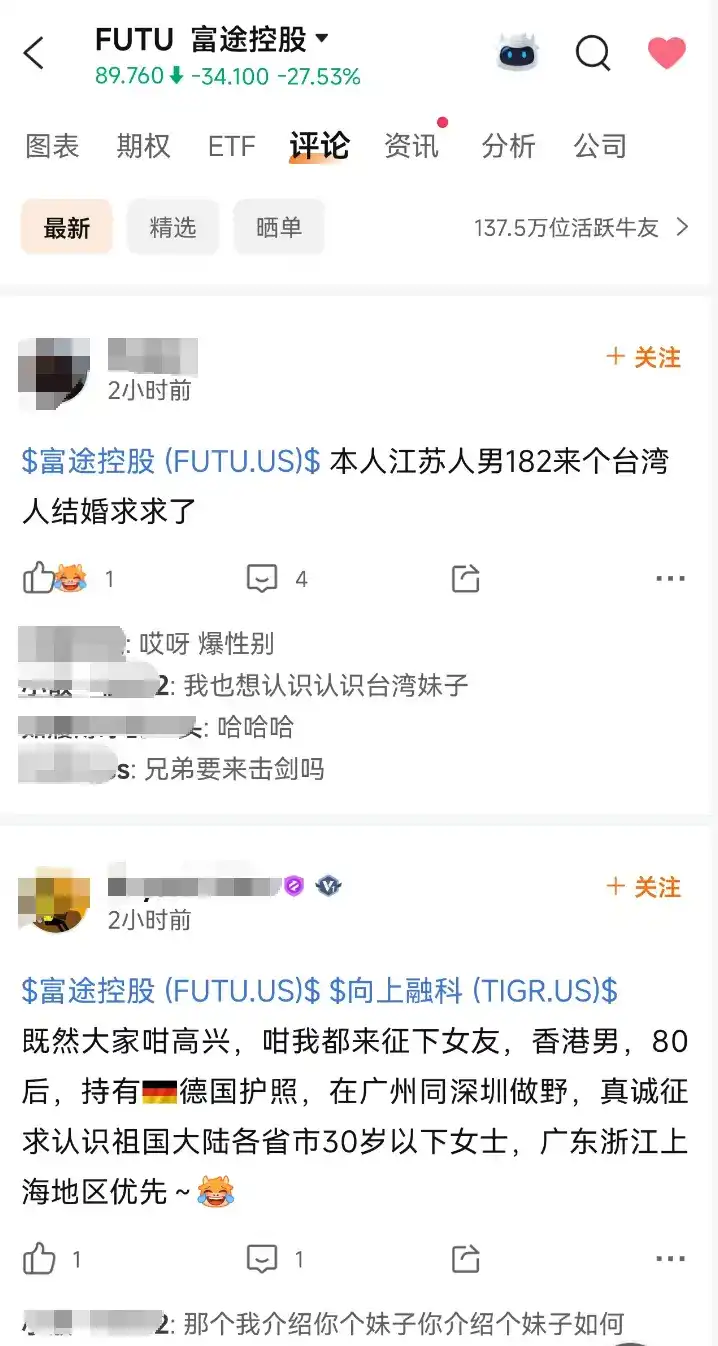
However, in the community of Futu's own app, the tone took a sudden turn. Beyond discussing stocks, it became a matchmaking platform for investors overnight.
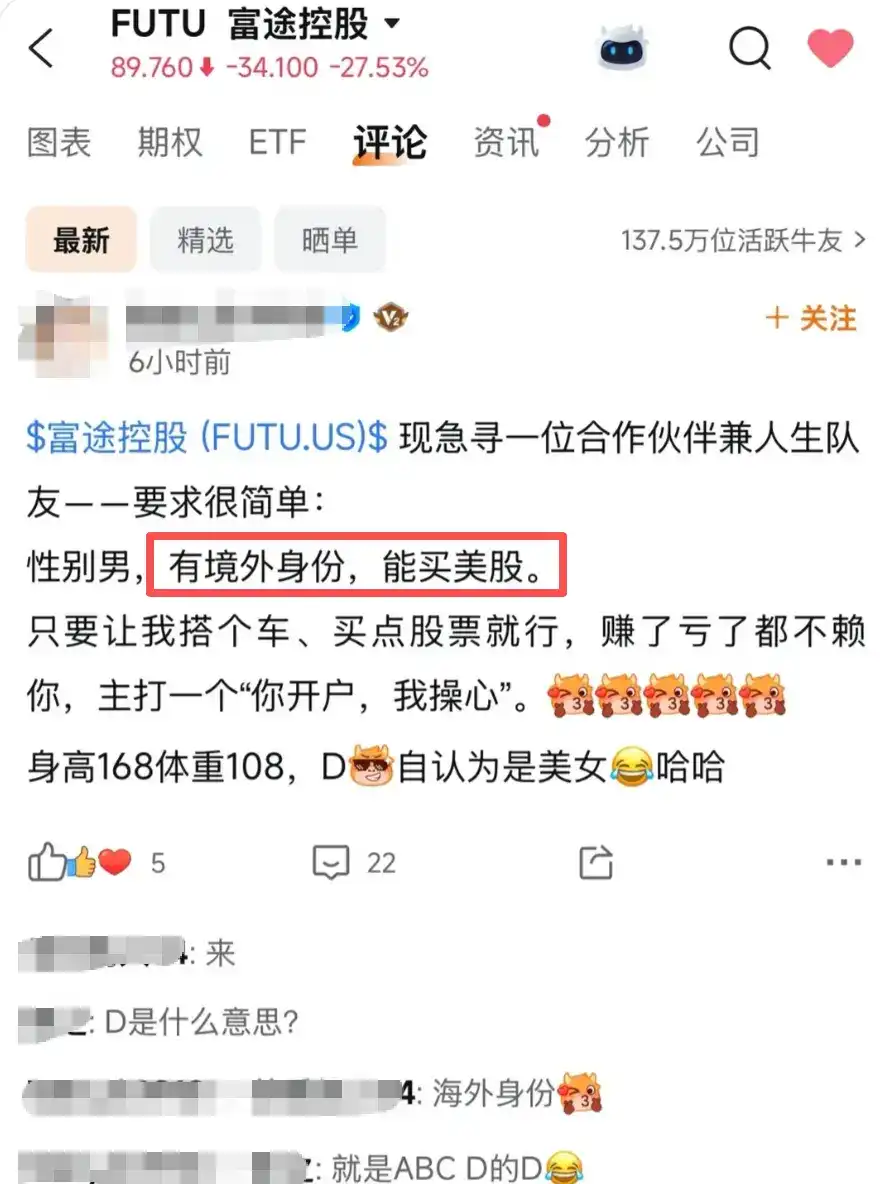
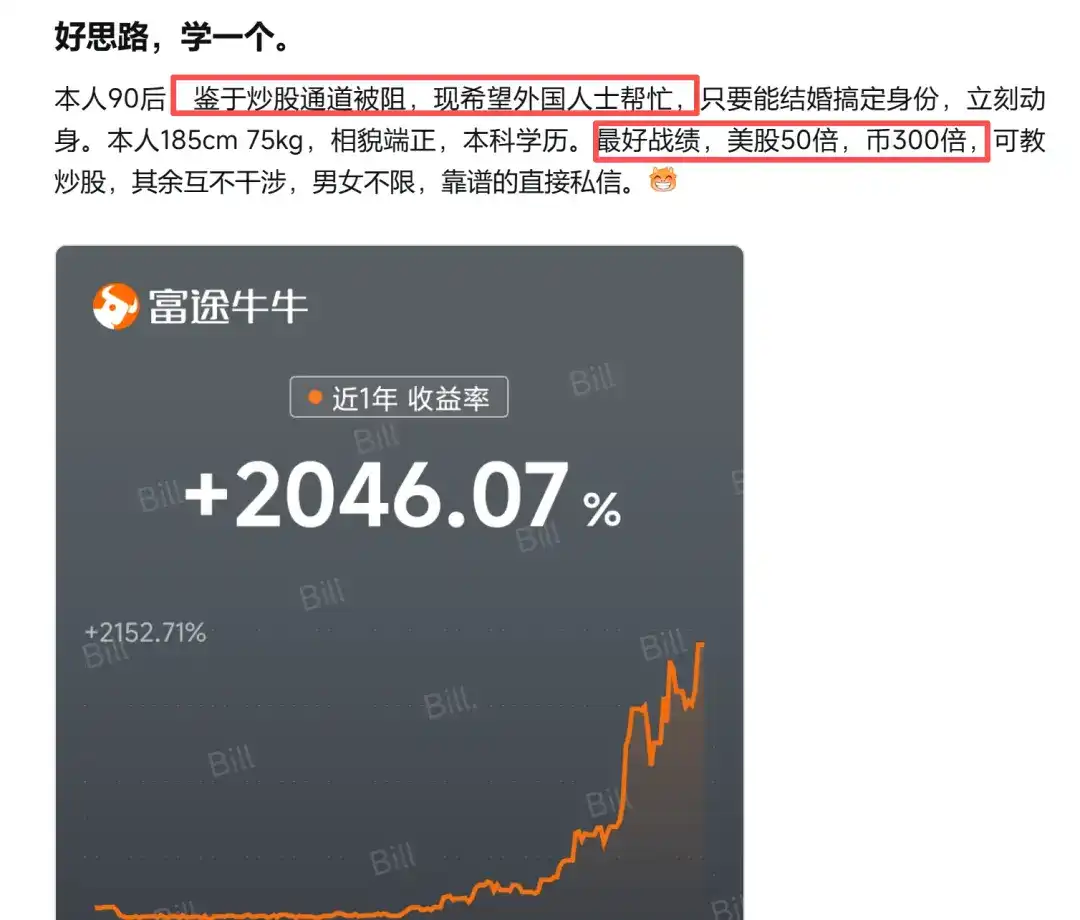
A self-proclaimed D-cup beauty from mainland China is seeking an overseas man; a mainland-born '90s generation individual with a 2046% return is willing to consider "any gender" for an identity swap; a Hong Kong man holding a German passport is inverting the selection criteria, preferring "Guangdong, Zhejiang, or Shanghai natives"......

This isn't just anecdotal. You're witnessing a latent, securitized marriage market taking shape in real time within the Futu community. Demand side, supply side, price preferences, geographical screening conditions... all spontaneously forming. This is the most honest natural language leak of the mindset among China's middle-class investor group in 2026.

The Regulatory Hammer Falls

On May 22nd, China's Securities Regulatory Commission, along with seven other departments, jointly issued the "Implementation Plan for Comprehensive Rectification of Illegal Cross-border Securities, Futures, and Fund Business Activities." On the same day, they announced plans to impose severe penalties on three overseas brokerages: Futu Holdings is slated to be fined approximately 1.85 billion RMB; Tiger Brokers faces a fine of 411.2 million RMB; Longbridge is also on the list. Both Futu and Tiger's US-listed shares plunged over 30% in pre-market trading.

The brokerages' responses were measured in their wording. Futu stated that as of the end of Q1 2026, funded accounts from mainland China accounted for about 13% of the company's total funded accounts; Tiger Brokers said client assets from mainland China constituted roughly 10% of the group's global total assets. Both emphasized that "business operations in all regions outside mainland China remain normal."

But for mainland users who already hold US stocks in their Futu or Tiger accounts, the truly stinging piece of information boils down to one phrase:

Sell only, no buying.

This means that for the foreseeable future, if you want to open a new US stock account to buy NVIDIA, Tesla, or an S&P 500 ETF, you must first possess identification proving you are a non-mainland Chinese resident.

Looking back over the past three years, the account opening threshold for mainland users by overseas brokerages has been raised step by step:

  • Late 2022, the CSRC named them for the first time;
  • May 2023, their apps were removed from mainland app stores;
  • Starting 2024, only mainland residents who "actually work or live overseas" were accepted, requiring proof like overseas utility bills, credit card statements, tax documents;
  • September 2025, the threshold was raised to requiring "proof of overseas permanent residence";
  • Late 2025, only "non-mainland Chinese ID documents" were accepted;
  • May 2026, fines were directly imposed on the brokerage entities.

The threshold for opening an account escalated from a utility bill all the way to an overseas passport or permanent residence card. The other side of this curve is precisely the process by which identity is being repeatedly repriced in the investment market.

Overseas Identity, the New Hard Currency for the Middle Class

For China's domestic middle class in 2026, overseas identity has become a latent asset class. It cannot be bought and sold like real estate, nor does it have a public quote like stocks, yet it possesses all the basic attributes of "hard currency."

First is scarcity. Hong Kong's various talent admission schemes approved around 140,000 applicants in 2024, with the vast majority coming from the mainland. It sounds like a lot, but against a population base of 1.4 billion, the penetration rate is less than one in ten thousand.

Unlike real estate, overseas identity doesn't depreciate due to population outflows, policy adjustments, or rising interest rates. At any given point in time, it corresponds to the same set of clear-cut rights and offers an extremely high rate of return. What it unlocks isn't just a single stock, but an entire dimension of asset allocation: US stocks, overseas real estate, offshore insurance, foreign currency deposits, compliant channels for crypto assets.

Most tempting is its non-transferability. Identity as an asset cannot be arbitraged in a secondary market like stocks. It can only be held by the individual, or transferred through three ancient methods: marriage, childbirth, and inheritance.

School district housing once spawned a complete gray industry chain: agents, transfer companies, fake household registrations, sham marriages, sham divorces. The overseas identity industry chain is now replicating all this: Hong Kong Quality Migrant Admission Scheme agencies, Portugal's Golden Visa, Singapore's Employment Pass, Malta citizenship, rapid Caribbean citizenship programs. Each product comes with a clear price list and processing timeline.

The form of the asset has shifted from a "property deed" to a "residence card," from a "school place" to an "account opening qualification."

The past two decades saw the middle class using school district housing to lock in social status; the next decade will see them using overseas identity to lock in assets.

Is Studying Abroad Equivalent to Buying Insurance?

Stepping back for a broader view, the logic behind the Chinese middle class purchasing overseas resources has been redefined three times over the past twenty years.

2000 to 2010 was about betting on overseas development potential. Sending children abroad for studies or families moving overseas was underpinned by an offensive judgment: opportunities were greater abroad. This was an investment, with the goal of returns.

2010 to 2020 was about diversification. After rapid domestic wealth accumulation, overseas real estate, insurance, and education were incorporated into the family asset framework for geographical dispersion. This was a defensive move, aiming for risk control.

2020 to the present is about "buying insurance." An overseas identity is no longer just part of the portfolio; it has become the entry ticket itself. Even if it generates no returns, without it, you lack the qualification to even enter certain investment markets. It is a premium paid to hedge against uncertainty, its price rising as uncertainty increases.

The regulatory hammer on May 22nd is yet another jump point on this "insurance price curve."

When a generation realizes they have missed the window to obtain an overseas identity themselves, they will transfer their hopes to the next generation. What will truly see price increases next might not be talent scheme agents, but rather spots in international schools, overseas university preparatory courses, and services for accompanying young children studying abroad. This "identity insurance" will be passed down through family generations.

I don't know which path that '90s individual with the 2046% return ultimately chose.

The evidence left behind after a year spent proving they are among the top 1% of the top 1% in the US stock and crypto markets should have been a highlight on a resume.

But after May 22nd, it became an attachment to a matchmaking profile.

A curve that could make a fund manager's eyes turn red is finally being used this way.

This is 2026.

Preguntas relacionadas

QAccording to the article, what unexpected phenomenon occurred in the Futu community following the regulatory crackdown?

AFollowing the regulatory crackdown, the Futu community unexpectedly transformed into an informal matchmaking platform, where users started posting personal ads seeking relationships, often with a focus on connecting with individuals possessing overseas residency or citizenship.

QWhat key restriction did the 2026 Chinese regulatory action impose on mainland users of overseas brokerages like Futu and Tiger?

AThe key restriction imposed was that mainland Chinese users could only sell, not buy, securities. To open new accounts for buying assets like U.S. stocks, users were required to provide proof of non-mainland Chinese residency.

QHow does the article describe the evolution of the value of an overseas identity for the Chinese middle class over time?

AThe article describes it as evolving from an investment for greater opportunities (2000-2010), to a tool for risk diversification (2010-2020), and finally to a mandatory 'insurance policy' or 'admission ticket' (2020 onwards) that is essential for accessing certain investment markets, thus becoming a hard currency for the middle class.

QWhat does the article suggest might be the next area to see price increases as a consequence of the growing demand for 'identity insurance'?

AThe article suggests that the next areas to see price increases are international school placements, overseas university preparatory courses, and services for accompanying young children studying abroad, as families shift their focus to securing overseas identity opportunities for the next generation.

QWhat ironic contrast does the article highlight using the example of the 90s investor with a 2046% return?

AThe article highlights the ironic contrast between an extraordinary investment track record (a 2046% return) that would typically be a career highlight for a financial professional, and its new, diminished utility as merely an 'attachment' to a personal相亲简历(resume) in the quest for a partner with overseas status.

Lecturas Relacionadas

Understanding Bound in One Article: The "Multi-signature + Timelock" Escape Mechanism and the Off-Chain Matching Black Box

**Title**: Understanding Bound: The Escape Mechanism of "Multi-Sig + Time Lock" and the Off-Chain Matching Black Box **Summary**: Bound Exchange, evolved from the earlier radFi platform, introduces a novel approach to Bitcoin trading by combining self-custody security with exchange-like speed. Its core mechanism relies on a 2-of-2 multi-signature (multi-sig) address for user deposits. One private key is held by the user via a passkey, and the other is held by Bound. This setup requires both keys to sign any transaction, preventing Bound from unilaterally accessing user funds (non-custodial). To address the risk of Bound becoming unavailable, a 3-month timelock is integrated into the Bitcoin script. After this period, users can withdraw their assets with just their single signature, ensuring an escape hatch. For trading, Bound operates a concentrated liquidity AMM. However, as Bitcoin L1 lacks smart contracts, the AMM curve, liquidity management, and trade price calculations occur off-chain in Bound's backend database. On-chain Bitcoin transactions serve only as final settlement receipts for pre-determined amounts. This creates a centralization point: the critical sequence of trade execution—which determines the exact price along the curve for each order—is managed off-chain by Bound in a non-transparent "black box." While the 2-of-2 setup protects user本金 (principal), the pricing and ordering of trades introduce potential operational MEV risks, as the order processing is invisible and unverifiable on-chain. In practice, users can also connect external wallets (like Unisat) for fully self-custodied trading, but this requires manually signing every transaction. The platform currently supports deposits of BTC and Runes only.

marsbitHace 52 min(s)

Understanding Bound in One Article: The "Multi-signature + Timelock" Escape Mechanism and the Off-Chain Matching Black Box

marsbitHace 52 min(s)

Amid Internal and External Challenges, Is Ethereum's Neutral Route Still Viable?

"Ethereum is facing a dual crisis of market pressure and internal challenges. Its native token ETH is in a mid-term downtrend, with negative sentiment prevailing, weak price action, and significant outflows from ETFs. The ETH/BTC ratio has hit a ten-month low, and institutional holdings have shrunk. Concurrently, the Ethereum Foundation has seen a major exodus of core personnel following its commitment to a neutral, non-commercial development roadmap focused on censorship resistance, openness, privacy, and security (CROPS). This stance has sparked debate. Critics, including former members, argue that the ecosystem lacks a dedicated, well-funded entity to promote ETH's commercial value and compete with rival chains. Proposals suggest creating a new, independent body to drive adoption and token value, forming a dual-model with the Foundation. While some investors view the personnel changes as normal turnover and remain bullish on Ethereum's long-term fundamentals, the immediate path forward is unclear. Analysts believe Ethereum must execute its technical roadmap (like upcoming upgrades), clarify governance, and focus on high-value sectors like DeFi and tokenization to convert its technological edge into a compelling investment thesis. The current downturn tests whether its decentralized model can adapt to balance core principles with commercial competitiveness."

marsbitHace 58 min(s)

Amid Internal and External Challenges, Is Ethereum's Neutral Route Still Viable?

marsbitHace 58 min(s)

Technology Has No Barriers, 24/7 Trading is the Key to Hyperliquid's Success

The article argues that Hyperliquid's competitive edge lies not in technological superiority but in its 24/7 trading model, which fundamentally challenges traditional finance's fixed market hours. Based in Singapore with an 11-person team, Hyperliquid has generated significant revenue and trading volume. Its core advantage is the ability to facilitate trading continuously, including during weekends when major exchanges like the CME are closed. This was demonstrated when Hyperliquid listed a SpaceX pre-IPO perpetual contract on a Sunday, allowing the market to price the company hours before traditional institutions opened. This disruption has drawn regulatory scrutiny from traditional giants like CME and ICE, who cite risks like lack of KYC and market manipulation. However, the article suggests their concern stems from Hyperliquid eroding the "time monopoly" of established markets. The piece contrasts Hyperliquid's synthetic derivatives—pure price-betting contracts with no underlying asset or centralized issuer—with other models like PreStocks (dependent on real股权) and Ondo (licensed but targetable). Hyperliquid's code-based, decentralized structure makes it resilient to takedowns, even if founders face legal action. Ultimately, the author concludes that while it raises legitimate regulatory questions, Hyperliquid's "unforgeable" competitive barrier is the time advantage of non-stop trading, a feature legacy systems cannot replicate.

marsbitHace 58 min(s)

Technology Has No Barriers, 24/7 Trading is the Key to Hyperliquid's Success

marsbitHace 58 min(s)

New Information Laundering in Prediction Markets: How Secrets Blend into Investment Signals

"The New Information Laundering in Prediction Markets: How Secrets Infiltrate Investment Signals In late February 2026, nine linked anonymous wallets on Polymarket placed over 80 bets on specific details of a US-Iran war, winning over $2.4 million with a 98% win rate. This exemplifies 'information laundering'—a destructive flaw inherent to prediction markets. These markets function by aggregating trader supply and demand on an order book to set prices, which represent collective probability estimates. This makes them valuable real-time sentiment indicators for institutions. However, the system cannot distinguish between public information and stolen secrets. Confidential information enters one end, and 'clean' market prices—bearing no trace of their illicit origin—emerge from the other. For example, an insider knowing of an imminent strike can buy contracts at low odds, pushing the price up and disguising the secret as a savvy market signal, then profit massively when the event occurs. Analysts can sometimes uncover these schemes due to the blockchain's transparency, as seen with Bubblemaps. Paradoxically, this same transparency can inadvertently broadcast secrets to adversarial observers, providing them with low-cost intelligence. Current laws, like insider trading regulations focused on corporate information, fail to address this issue, especially concerning events like military actions with no 'issuer.' Jurisdictional challenges are amplified as platforms operate offshore, easily bypassing national bans with VPNs. Recent US congressional investigations and proposed bills aim to ban war betting and trading on non-public information by officials. The core issue is that information laundering is not a bug but a feature: a market that perfectly converts knowledge into price will inherently reward those with the best information, including those who obtained it illicitly. As prediction markets grow, potentially reaching hundreds of billions in volume, society must confront whether it can tolerate a machine that profitably transforms its most guarded secrets into public, tradable numbers."

链捕手Hace 1 hora(s)

New Information Laundering in Prediction Markets: How Secrets Blend into Investment Signals

链捕手Hace 1 hora(s)

Trump’s Dual Pressure: When the Iran Deal Meets the Midterm Elections

U.S. President Donald Trump’s efforts to negotiate a deal with Iran are triggering a political backlash within his own Republican Party, as the approach of midterm elections intensifies internal divisions. Reports of a potential agreement—involving a temporary ceasefire, phased sanctions relief, and the unfreezing of Iranian assets in exchange for discussions on Tehran diluting or transferring its stockpile of highly enriched uranium—have drawn sharp criticism from GOP hawks. Key allies like Senators Lindsey Graham and Ted Cruz warned that such concessions could allow Iran to recuperate, undermine recent U.S. military gains, and ultimately strengthen a hostile regime. The dispute highlights a broader political struggle for Trump, who must reconcile his "America First" posture with diplomatic compromise while facing a tough electoral landscape. With Republicans fighting to maintain control of Congress and Trump’s approval ratings declining, the Iran deal has quickly become a test of party loyalty and perceived toughness. Public sparring between Trump aides and critics—including former Secretary of State Mike Pompeo—underscores the internal pressure. While Secretary of State Marco Rubio defended Trump’s historically hardline stance, skeptics like Senator Thom Tillis questioned the logic of any deal that leaves nuclear materials in Iran. The outcome now hinges on whether Trump can persuade his party’s hardliners to accept a negotiated exit.

marsbitHace 1 hora(s)

Trump’s Dual Pressure: When the Iran Deal Meets the Midterm Elections

marsbitHace 1 hora(s)

Trading

Spot
Futuros
活动图片