Amid Internal and External Challenges, Is Ethereum's Neutral Route Still Viable?

marsbitPublicado a 2026-05-25Actualizado a 2026-05-25

Resumen

"Ethereum is facing a dual crisis of market pressure and internal challenges. Its native token ETH is in a mid-term downtrend, with negative sentiment prevailing, weak price action, and significant outflows from ETFs. The ETH/BTC ratio has hit a ten-month low, and institutional holdings have shrunk. Concurrently, the Ethereum Foundation has seen a major exodus of core personnel following its commitment to a neutral, non-commercial development roadmap focused on censorship resistance, openness, privacy, and security (CROPS). This stance has sparked debate. Critics, including former members, argue that the ecosystem lacks a dedicated, well-funded entity to promote ETH's commercial value and compete with rival chains. Proposals suggest creating a new, independent body to drive adoption and token value, forming a dual-model with the Foundation. While some investors view the personnel changes as normal turnover and remain bullish on Ethereum's long-term fundamentals, the immediate path forward is unclear. Analysts believe Ethereum must execute its technical roadmap (like upcoming upgrades), clarify governance, and focus on high-value sectors like DeFi and tokenization to convert its technological edge into a compelling investment thesis. The current downturn tests whether its decentralized model can adapt to balance core principles with commercial competitiveness."

Author: Oluwapelumi Adejumo

Compiled by: Saoirse, Foresight News

As Ethereum's native token ETH enters a mid-term downtrend, overall market sentiment has significantly weakened. Data from blockchain analytics platform Santiment shows that discussions about ETH surged across networks in May, but the prevailing sentiment was overwhelmingly negative, with investors widely concerned about further price declines.
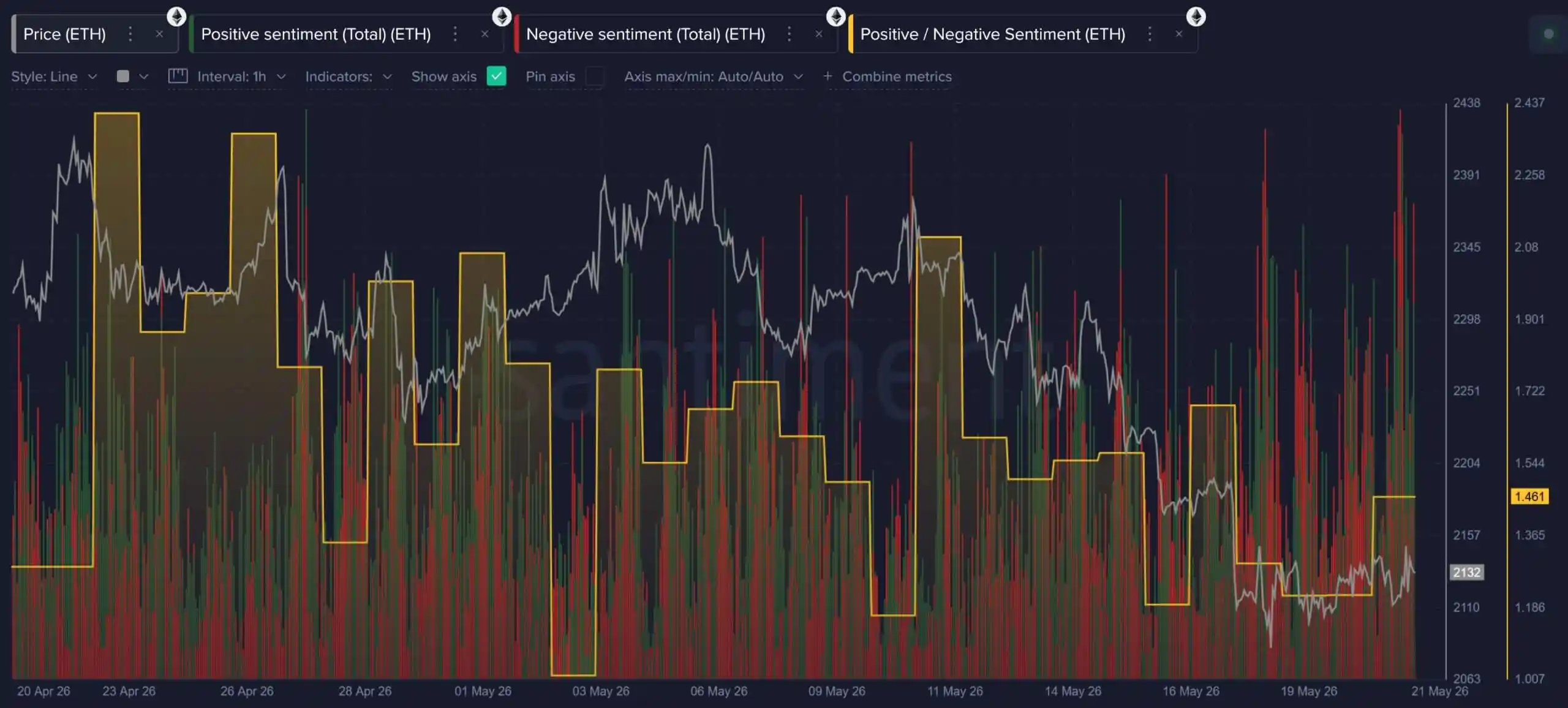
Ethereum Market Sentiment (Source: Santiment)

Analysts indicate that multiple bearish factors have converged, collectively dragging down the market: weak spot price performance, continuous outflows from ETFs, the departure of key personnel from the Ethereum Foundation, public questioning from veteran community supporters, and the growing competitiveness of peer public chains such as Hyperliquid, Zcash, and Solana.

Data from CryptoQuant also confirms a significant cooling in institutional investment interest. Currently, ETH price is approaching the critical $2,000 support level, with both spot market and fundamental indicators showing clear signs of weakness.

Ethereum's performance relative to the broader market appears particularly sluggish. The ETH/Bitcoin exchange rate has fallen to around 0.02758, hitting a ten-month low, indicating that Ethereum has significantly underperformed Bitcoin in this cycle. Spot investors continue to reduce their holdings, market liquidity keeps shrinking, and major institutions have largely ceased buying.

Persistent Spot Selling, Ethereum Lacks Effective Buying Support

Over the past two quarters, institutional holdings have consistently decreased. In October 2025, institutional holdings once exceeded 7 million ETH but have now retreated to around 5.5 million. During the prolonged price correction, large investment institutions have been scaling back their core positions.

The regulated ETF market is also under pressure. Current Ethereum ETF assets under management are approximately $12.14 billion, a 23% decrease from the peak in January. Data from SoSoValue shows severe market performance in May, with ETFs experiencing net outflows for two consecutive weeks, totaling around $470 million in cumulative outflows, marking one of the most concentrated periods of capital flight this year.
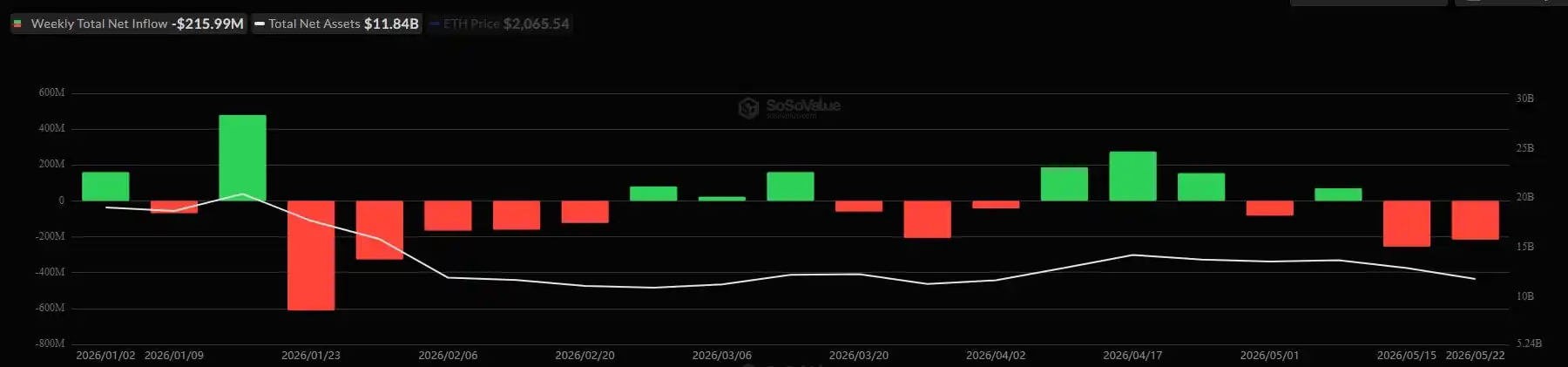
Weekly Ethereum ETF Fund Outflows (Source: SoSoValue)

The Coinbase Premium Index has remained in negative territory throughout, reflecting a lack of spot buying interest among U.S. institutional investors. As institutional holdings decrease, ETH market liquidity has tightened in tandem. Since February 2026, daily average institutional trading volume has continued to decline, falling well below the one-year average. Recent daily trading volume has only ranged between $17 million and $42 million.

Market bottom-fishing willingness has faded, and spot market activity is sluggish. Any negative news could easily trigger sharp price volatility.

Derivatives Market Hedging Heats Up, Contract Longs Remain Determined

As spot market selling pressure intensifies, the derivatives market shows significant divergence regarding future trends. Industry opinions are split on whether ETH is entering a long-term downtrend or is about to bottom out and rebound.

Professional traders are actively buying put options to hedge risks, while the perpetual contract market still retains substantial long positions, reflecting starkly opposing views. Block Scholes data shows that the seven-day ETH 25-delta risk reversal skew is close to -7%, indicating traders are willing to pay a premium for put options to hedge against downside risk.

Data from Deribit exchange shows that the total open interest for put options with strike prices of $2,000 and $2,100 exceeds $380 million, making these two price levels the core battleground for short-term institutional speculation.
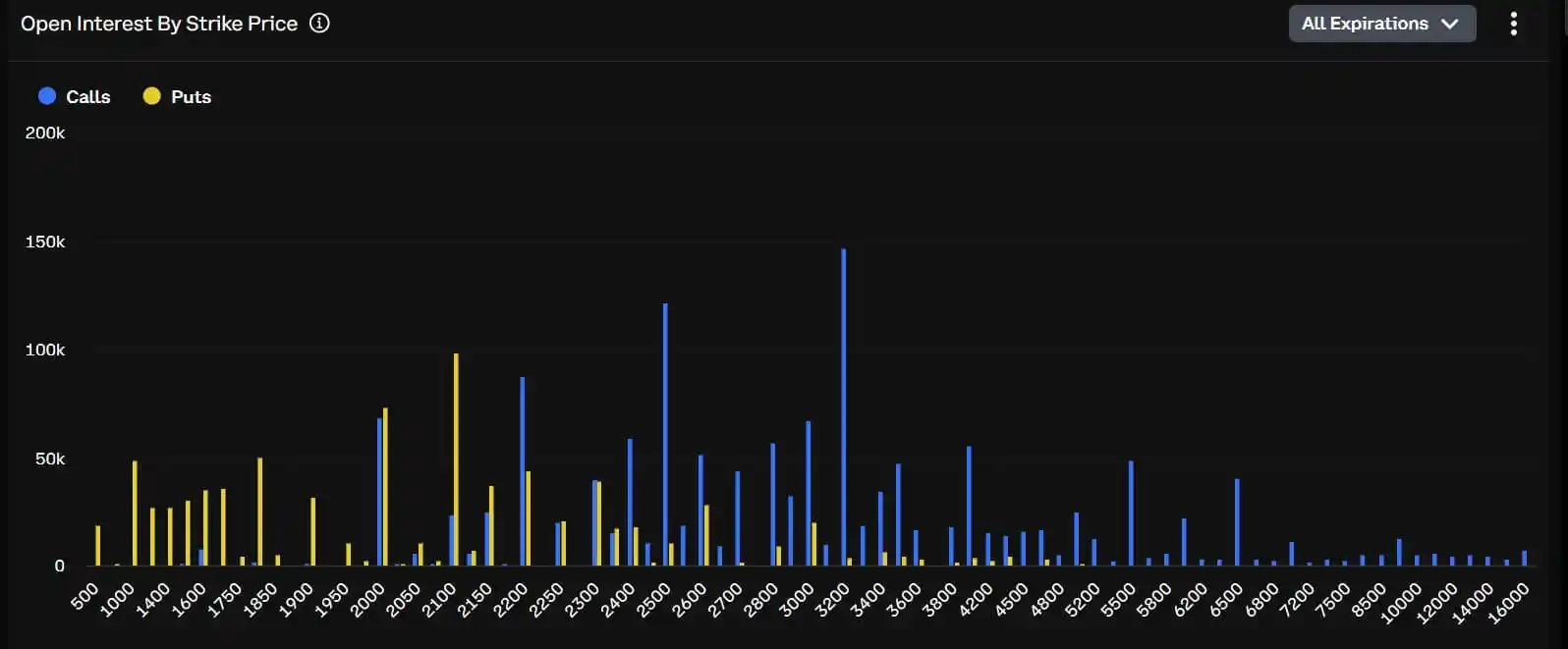
Ethereum Options Trader Positions (Source: Deribit)

Market Interpretation: The large-scale deployment of put options suggests a widespread market expectation of continued weakness. The price has already broken below the $2,100 support level, and market risk appetite keeps declining. In the absence of spot capital to absorb selling pressure, the market can only rely on hedging operations to mitigate risks.

Signals from the perpetual contract market are more complex. According to CryptoQuant statistics, Ethereum's funding rate has remained stable in positive territory, reaching 0.0082 on May 21st. Even as market capitalization, institutional holdings, and spot trading volume decline across the board, speculative bullish sentiment has not completely dissipated.
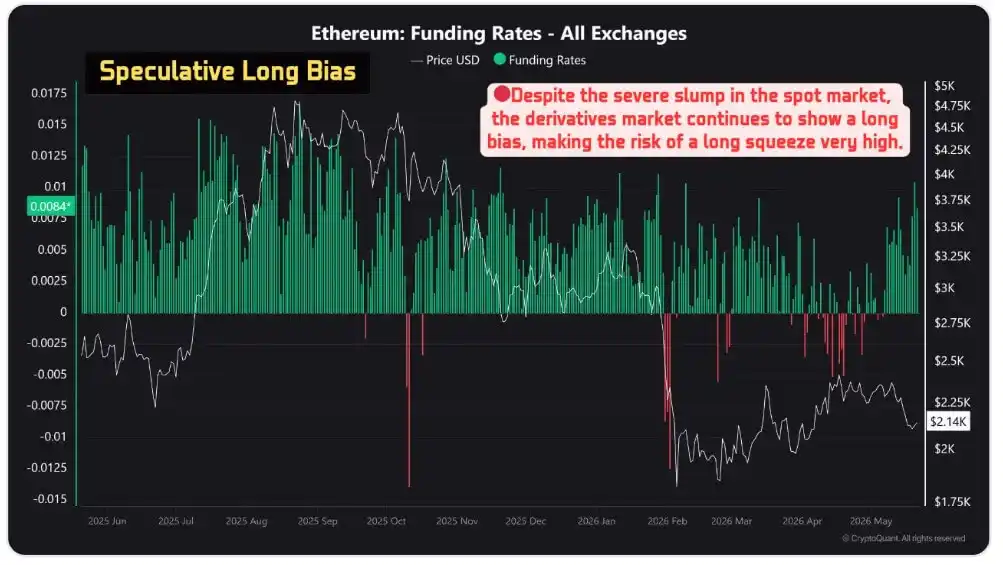
Ethereum Funding Rate (Source: CryptoQuant)

The opposing long and short stances introduce significant uncertainty into the price action. If spot buying suddenly recovers, it is likely to trigger a short squeeze and rebound. Conversely, if the price breaks below the critical $2,000 support level, the massive open interest could trigger a cascade of liquidations, exacerbating market volatility.

Key Talent Departures, Ethereum's Value Debate Intensifies

Amid the poor price performance, the Swiss non-profit Ethereum Foundation, responsible for Ethereum's underlying R&D, is undergoing large-scale senior personnel changes.

Senior R&D personnel Carl Beek and Julian Ma have formally resigned, triggering internal personnel turbulence. Carl Beek, with seven years of experience, was primarily responsible for Beacon Chain design. Julian Ma led the development of the lab oversight incentive framework.

Since February, at least nine senior personnel have left or stepped back from core roles at the Foundation. In May alone, five individuals departed, including former Co-Executive Director Tomasz Stańczak, Board Co-Chair Josh Stark, protocol R&D contributor Trent Van Epps, protocol team lead Barnabé Monnot, and Tim Beiko. Senior researcher Alex Stokes has also begun a three-month leave. The reduction in core technical team members during a market downturn has created a leadership vacuum.

Industry analysis suggests the trigger for this personnel change was a foundational document released by the Foundation in mid-March. This 38-page document established the CROPS principles: Censorship Resistance, Open Source, Privacy, and Security.

The document clearly defines the Foundation's role as an ecosystem guardian, not a commercial operator. Its core duty is to maintain network neutrality, not to pursue goals like raising token prices, boosting investor returns, or advancing commercial expansion.

Now, as other public chains continue to capture market share, the Foundation's adherence to a neutral development philosophy is increasingly difficult for the market to accept. Tommy Shaughnessy, co-founder of venture firm Delphi Ventures, stated that the negative impact of this talent drain far exceeds surface appearances. With reform-minded members gone, internal voices questioning the current development direction are unlikely to emerge again.

Calls for Reform Grow Louder, Neutral Development Model Faces Severe Test

Many departing core members believe the Foundation has been insufficiently proactive in commercialization and have called for adjustments to the governance structure. Prominent researcher Dankrad Feist, who left the Foundation last year to join a new public chain project, publicly proposed forming a new, independent institution to ensure the network's economic competitiveness.

He suggested the new institution should have initial capital of at least $1 billion, partially sourced from network staking rewards. This institution would be directly accountable to token holders, with the core mission of expanding ETH's commercial application scenarios and driving token market capitalization growth.

Dankrad Feist pointed out that the Ethereum Foundation currently holds less than 0.1% of the total circulating supply, cannot access underlying staking rewards or on-chain transaction fees, and the entire ecosystem lacks a professional body actively promoting the token in capital markets.

Ryan Sean Adams, co-founder of media outlet Bankless, expressed agreement with this view. He argued that Ethereum's development cannot rely solely on the Foundation. The ecosystem needs well-funded, competitive professional institutions focused on improving capital efficiency, communicating development value externally, and implementing commercial projects—tasks that fall outside the Foundation's mandate.

These reform proposals do not call for abolishing the original Foundation but advocate for a dual-agency collaborative model: one side remains true to its original purpose, safeguarding the underlying network's neutrality and building public infrastructure; the other focuses on token promotion and competing for institutional capital resources.

Bullish investors, however, believe the market is over-interpreting short-term volatility, viewing the personnel changes as a normal generational transition. Investor Ryan Berckmans stated that talent flow is a normal phenomenon for team renewal. Ethereum has successfully navigated regulatory storms and management changes in the past, completed major technical upgrades like The Merge and blobs transactions, and its on-chain application assets remain industry-leading. Global enterprises continue to deploy stablecoins and asset tokenization businesses, which can still support long-term network development.

Major institutional holders also maintain an optimistic outlook. Thomas Lee, Chairman of BitMine, the public company with the largest ETH holdings, believes the current market panic is just a normal correction within the cycle. The company holds 5.2 million ETH, with assets worth over $10 billion in staking.
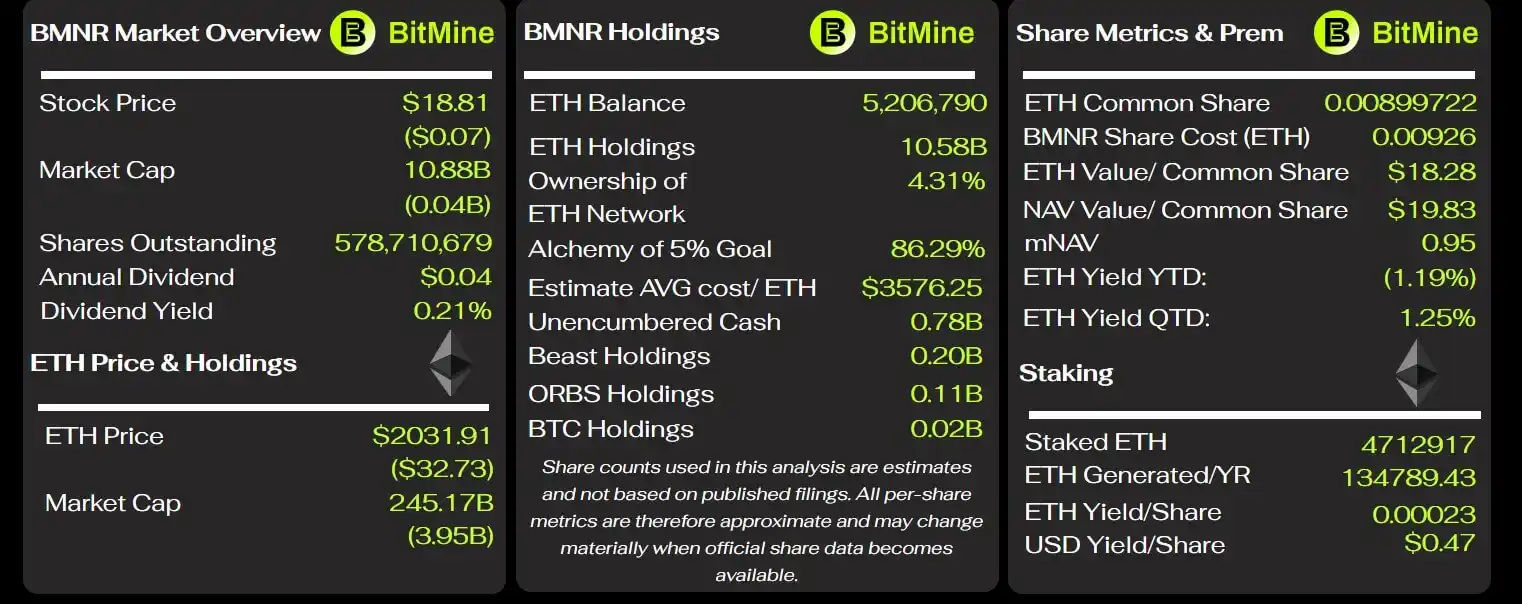
BitMine Key Metrics (Source: BitMine Tracker)

Thomas Lee stated that blockchain serves as the underlying infrastructure for AI commercial systems and institutional financial settlements. With its mature security system, ample market liquidity, and broad institutional recognition, Ethereum still possesses irreplaceable industry advantages.

Shaking Off Negative Sentiment, How Can Ethereum Regain Its Upward Trajectory?

Industry insiders believe Ethereum's future trajectory depends on whether its technical roadmap and commercial moats can translate into an attractive investment thesis. Analysis from investment firm Galaxy Digital suggests that to stem the tide of capital outflows, Ethereum must steadily execute its various operational plans.

The short-term priority is to successfully launch the Glamsterdam upgrade, steadily advance subsequent Hegotá version iterations, clarify internal authority and responsibility divisions within the Foundation, and concentrate resources on core commercial sectors. Key focus areas include high-value decentralized finance (DeFi), institutional asset issuance, real-world asset tokenization, stablecoin settlement, and privacy financial infrastructure. Ethereum's neutrality and security capabilities will become core advantages in these sectors.

Simultaneously, Ethereum needs to accelerate its layout in the next wave of industry hotspots, including public chain scaling technology, on-chain privacy protection, post-quantum security, and AI-native economic systems. Relevant technical frameworks are already included in the open-source R&D roadmap. The current biggest challenge is coordinating synergistic development between commercial entities and institutional resources.

The Foundation's charter clearly outlines principles for underlying technology R&D but does not specify a token value growth logic or establish dedicated operational entities to address competitor challenges.

This price decline is no longer merely a simple market correction; it is a profound test: Can a decentralized system rationally allocate commercial functions and complete institutional division of labor adjustments while maintaining operational stability?

If the ecosystem can leverage this personnel transition to streamline authority and responsibility, transforming technical plans into clear investment value, this downturn may become an opportunity for governance model optimization. Conversely, if adjustments cannot be made, persistently weak spot market performance, frequent talent departures, and shifting competitive landscapes will lead the market to question whether Ethereum's network strength can no longer support stable token value.


Lecturas Relacionadas

When Futu Turns into a Matchmaking Corner: Overseas Identity Becomes the Hard Currency for the Middle Class

When Futu Becomes a Matchmaking Corner: Overseas Status as the New Hard Currency for China's Middle Class Following a severe penalty announcement from Chinese regulators on May 22nd targeting offshore brokerages like Futu, its app community unexpectedly transformed into an impromptu matchmaking platform. Users posted相亲 (matchmaking) requests, explicitly seeking partners with overseas residency or citizenship, revealing a stark new reality: for China's middle class, an overseas identity has become a crucial asset. The regulatory crackdown, which restricts mainland Chinese residents from opening new accounts to buy overseas securities like US stocks, has sharply escalated the value of a foreign passport or permanent residency. This status now acts as a gateway to global asset allocation—including US equities, offshore property, and foreign currency deposits—effectively becoming a new form of "hard currency." Its scarcity, non-transferability (except through marriage, inheritance, etc.), and role as a hedge against domestic uncertainty have driven its premium. The article traces the evolution of how China's middle class views overseas resources: from an investment for opportunity (2000s), to risk diversification (2010s), and now to a mandatory "insurance policy" for financial access. With the regulatory window closing for many, the demand is shifting towards securing such status for the next generation through international education. The surreal scene of high-performing investors posting dating resumes underscores a 2026 where financial talent can be secondary to the right passport.

marsbitHace 47 min(s)

When Futu Turns into a Matchmaking Corner: Overseas Identity Becomes the Hard Currency for the Middle Class

marsbitHace 47 min(s)

Understanding Bound in One Article: The "Multi-signature + Timelock" Escape Mechanism and the Off-Chain Matching Black Box

**Title**: Understanding Bound: The Escape Mechanism of "Multi-Sig + Time Lock" and the Off-Chain Matching Black Box **Summary**: Bound Exchange, evolved from the earlier radFi platform, introduces a novel approach to Bitcoin trading by combining self-custody security with exchange-like speed. Its core mechanism relies on a 2-of-2 multi-signature (multi-sig) address for user deposits. One private key is held by the user via a passkey, and the other is held by Bound. This setup requires both keys to sign any transaction, preventing Bound from unilaterally accessing user funds (non-custodial). To address the risk of Bound becoming unavailable, a 3-month timelock is integrated into the Bitcoin script. After this period, users can withdraw their assets with just their single signature, ensuring an escape hatch. For trading, Bound operates a concentrated liquidity AMM. However, as Bitcoin L1 lacks smart contracts, the AMM curve, liquidity management, and trade price calculations occur off-chain in Bound's backend database. On-chain Bitcoin transactions serve only as final settlement receipts for pre-determined amounts. This creates a centralization point: the critical sequence of trade execution—which determines the exact price along the curve for each order—is managed off-chain by Bound in a non-transparent "black box." While the 2-of-2 setup protects user本金 (principal), the pricing and ordering of trades introduce potential operational MEV risks, as the order processing is invisible and unverifiable on-chain. In practice, users can also connect external wallets (like Unisat) for fully self-custodied trading, but this requires manually signing every transaction. The platform currently supports deposits of BTC and Runes only.

marsbitHace 52 min(s)

Understanding Bound in One Article: The "Multi-signature + Timelock" Escape Mechanism and the Off-Chain Matching Black Box

marsbitHace 52 min(s)

Technology Has No Barriers, 24/7 Trading is the Key to Hyperliquid's Success

The article argues that Hyperliquid's competitive edge lies not in technological superiority but in its 24/7 trading model, which fundamentally challenges traditional finance's fixed market hours. Based in Singapore with an 11-person team, Hyperliquid has generated significant revenue and trading volume. Its core advantage is the ability to facilitate trading continuously, including during weekends when major exchanges like the CME are closed. This was demonstrated when Hyperliquid listed a SpaceX pre-IPO perpetual contract on a Sunday, allowing the market to price the company hours before traditional institutions opened. This disruption has drawn regulatory scrutiny from traditional giants like CME and ICE, who cite risks like lack of KYC and market manipulation. However, the article suggests their concern stems from Hyperliquid eroding the "time monopoly" of established markets. The piece contrasts Hyperliquid's synthetic derivatives—pure price-betting contracts with no underlying asset or centralized issuer—with other models like PreStocks (dependent on real股权) and Ondo (licensed but targetable). Hyperliquid's code-based, decentralized structure makes it resilient to takedowns, even if founders face legal action. Ultimately, the author concludes that while it raises legitimate regulatory questions, Hyperliquid's "unforgeable" competitive barrier is the time advantage of non-stop trading, a feature legacy systems cannot replicate.

marsbitHace 58 min(s)

Technology Has No Barriers, 24/7 Trading is the Key to Hyperliquid's Success

marsbitHace 58 min(s)

New Information Laundering in Prediction Markets: How Secrets Blend into Investment Signals

"The New Information Laundering in Prediction Markets: How Secrets Infiltrate Investment Signals In late February 2026, nine linked anonymous wallets on Polymarket placed over 80 bets on specific details of a US-Iran war, winning over $2.4 million with a 98% win rate. This exemplifies 'information laundering'—a destructive flaw inherent to prediction markets. These markets function by aggregating trader supply and demand on an order book to set prices, which represent collective probability estimates. This makes them valuable real-time sentiment indicators for institutions. However, the system cannot distinguish between public information and stolen secrets. Confidential information enters one end, and 'clean' market prices—bearing no trace of their illicit origin—emerge from the other. For example, an insider knowing of an imminent strike can buy contracts at low odds, pushing the price up and disguising the secret as a savvy market signal, then profit massively when the event occurs. Analysts can sometimes uncover these schemes due to the blockchain's transparency, as seen with Bubblemaps. Paradoxically, this same transparency can inadvertently broadcast secrets to adversarial observers, providing them with low-cost intelligence. Current laws, like insider trading regulations focused on corporate information, fail to address this issue, especially concerning events like military actions with no 'issuer.' Jurisdictional challenges are amplified as platforms operate offshore, easily bypassing national bans with VPNs. Recent US congressional investigations and proposed bills aim to ban war betting and trading on non-public information by officials. The core issue is that information laundering is not a bug but a feature: a market that perfectly converts knowledge into price will inherently reward those with the best information, including those who obtained it illicitly. As prediction markets grow, potentially reaching hundreds of billions in volume, society must confront whether it can tolerate a machine that profitably transforms its most guarded secrets into public, tradable numbers."

链捕手Hace 1 hora(s)

New Information Laundering in Prediction Markets: How Secrets Blend into Investment Signals

链捕手Hace 1 hora(s)

Trump’s Dual Pressure: When the Iran Deal Meets the Midterm Elections

U.S. President Donald Trump’s efforts to negotiate a deal with Iran are triggering a political backlash within his own Republican Party, as the approach of midterm elections intensifies internal divisions. Reports of a potential agreement—involving a temporary ceasefire, phased sanctions relief, and the unfreezing of Iranian assets in exchange for discussions on Tehran diluting or transferring its stockpile of highly enriched uranium—have drawn sharp criticism from GOP hawks. Key allies like Senators Lindsey Graham and Ted Cruz warned that such concessions could allow Iran to recuperate, undermine recent U.S. military gains, and ultimately strengthen a hostile regime. The dispute highlights a broader political struggle for Trump, who must reconcile his "America First" posture with diplomatic compromise while facing a tough electoral landscape. With Republicans fighting to maintain control of Congress and Trump’s approval ratings declining, the Iran deal has quickly become a test of party loyalty and perceived toughness. Public sparring between Trump aides and critics—including former Secretary of State Mike Pompeo—underscores the internal pressure. While Secretary of State Marco Rubio defended Trump’s historically hardline stance, skeptics like Senator Thom Tillis questioned the logic of any deal that leaves nuclear materials in Iran. The outcome now hinges on whether Trump can persuade his party’s hardliners to accept a negotiated exit.

marsbitHace 1 hora(s)

Trump’s Dual Pressure: When the Iran Deal Meets the Midterm Elections

marsbitHace 1 hora(s)

Trading

Spot
Futuros

Artículos destacados

Cómo comprar ROUTE

¡Bienvenido a HTX.com! Hemos hecho que comprar Router Protocol (ROUTE) sea simple y conveniente. Sigue nuestra guía paso a paso para iniciar tu viaje de criptos.Paso 1: crea tu cuenta HTXUtiliza tu correo electrónico o número de teléfono para registrarte y obtener una cuenta gratuita en HTX. Experimenta un proceso de registro sin complicaciones y desbloquea todas las funciones.Obtener mi cuentaPaso 2: ve a Comprar cripto y elige tu método de pagoTarjeta de crédito/débito: usa tu Visa o Mastercard para comprar Router Protocol (ROUTE) al instante.Saldo: utiliza fondos del saldo de tu cuenta HTX para tradear sin problemas.Terceros: hemos agregado métodos de pago populares como Google Pay y Apple Pay para mejorar la comodidad.P2P: tradear directamente con otros usuarios en HTX.Over-the-Counter (OTC): ofrecemos servicios personalizados y tipos de cambio competitivos para los traders.Paso 3: guarda tu Router Protocol (ROUTE)Después de comprar tu Router Protocol (ROUTE), guárdalo en tu cuenta HTX. Alternativamente, puedes enviarlo a otro lugar mediante transferencia blockchain o utilizarlo para tradear otras criptomonedas.Paso 4: tradear Router Protocol (ROUTE)Tradear fácilmente con Router Protocol (ROUTE) en HTX's mercado spot. Simplemente accede a tu cuenta, selecciona tu par de trading, ejecuta tus trades y monitorea en tiempo real. Ofrecemos una experiencia fácil de usar tanto para principiantes como para traders experimentados.

130 Vistas totalesPublicado en 2024.12.11Actualizado en 2025.03.21

Cómo comprar ROUTE

Discusiones

Bienvenido a la comunidad de HTX. Aquí puedes mantenerte informado sobre los últimos desarrollos de la plataforma y acceder a análisis profesionales del mercado. A continuación se presentan las opiniones de los usuarios sobre el precio de ROUTE (ROUTE).

活动图片



