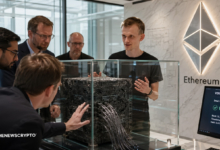
Conflux与中国移动咪咕推出全球首款基于区块链的视频铃声

币界网Publicado a 2024-08-21Actualizado a 2024-08-21

币界网报道:

[2024年8月21日,美国纽约]

Conflux Network是中国唯一一家符合监管要求的公共区块链,正在与中国移动合作,中国移动是中国最大的电信提供商,每月拥有超过10亿用户。这一战略联盟旨在通过中国移动的数字内容部门Migu彻底改变数字收藏。Conflux Network和中国移动将推出尖端的数字收藏品,如视频彩铃(Ringback Tones)、数字身份(DID)和区块链通信硬件,所有这些都由Conflux TreeGraph公共区块链驱动。

此次合作的第一个版本将成为世界上第一个基于公共区块链的数字收藏视频铃声,创造历史。该系列名为“MIGO和他的朋友ConFi”,将于2024年8月23日北京时间上午10:00推出,可通过Migu音乐应用程序的“数字收藏品”部分购买。

该系列以Conflux的吉祥物“ConFi”和中国移动咪咕的开创性NFT产品“MIGO”为特色。该剧融合了香港的现实地标,通过引人入胜的视觉故事讲述了一个友谊故事。“MIGO和他的朋友ConFi”视频铃声将作为神秘盒子出售,每盒售价13.9元人民币(约2美元),有5000个。其中,500个是罕见版本,仅占总数的1%。这些视频铃声神秘盒子提供了一种尖端的5G体验,结合了个性化、社交互动和交互性。用户在通话过程中可以直接在手机屏幕上查看相应的视频铃声,而无需安装额外的软件。

自2021年以来,咪咕一直是中国移动增长最快的垂直行业之一,是沉浸式媒体技术的领导者。Migu推动了数字内容创新,战略重点是超高清视频、视频铃声、云游戏、云VR和云AR,所有这些都是其Metaverse进化战略的一部分。与Conflux的合作标志着Migu首次在公共区块链网络上涉足Metaverse和数字收藏应用程序,将这项技术带给Migu的1.2亿月活跃客户。

关于Conflux

Conflux Network是一个无需许可的第1层区块链,它跨越国界和协议连接去中心化的经济体。它利用混合PoW/PoS共识机制来确保快速、安全和可扩展的区块链环境。有了Conflux,拥塞得以消除,费用保持在较低水平,网络安全得到了增强。

作为中国领先的合规公共区块链,Conflux为寻求进入亚洲市场的项目提供了明显的优势。该平台与该地区的知名全球品牌和政府实体合作,推动区块链和元宇宙倡议。值得注意的合作伙伴包括上海市、中国电信、小红书(中国的“Instagram”)、麦当劳中国和奥利奥。用户可以了解更多:https://confluxnetwork.org/

关于中国移动咪咕

中国移动咪咕是中国移动旗下专注于移动互联网领域的专业子公司。该公司致力于“数字内容平台”的核心原则,融合了电信运营商和互联网公司的特点。在先进技术的支持下,Migu继续构建其在内容技术、平台技术和云网络技术方面的核心能力。咪咕正积极探索创新的“互联网+数字内容”运营,将内容孵化与渠道合作相结合,并致力于开发新媒体整合、数字内容聚合、版权交易和内容创业平台。Migu致力于改变用户体验娱乐和文化的方式。咪咕拥有4亿视频铃声用户、2500万数字智能用户、6000多万电子书和130多本出版书籍。Migu还提供2300款云游戏,拥有1.2亿活跃用户,使其成为顶级文化科技品牌和新媒体平台。


Lecturas Relacionadas

Why is China's AI Developing So Fast? The Answer Lies Inside the Labs

A US researcher's visit to China's top AI labs reveals distinct cultural and organizational factors driving China's rapid AI development. While talent, data, and compute are similar to the West, Chinese labs excel through a pragmatic, execution-focused culture: less emphasis on individual stardom and conceptual debate, and more on teamwork, engineering optimization, and mastering the full tech stack. A key advantage is the integration of young students and researchers who approach model-building with fresh perspectives and low ego, prioritizing collective progress over personal credit. This contrasts with the US culture of self-promotion and "star scientist" narratives. Chinese labs also exhibit a strong "build, don't buy" mentality, preferring to develop core capabilities—like data pipelines and environments—in-house rather than relying on external services. The ecosystem feels more collaborative than tribal, with mutual respect among labs. While government support exists, its scale is unclear, and technical decisions appear driven by labs, not state mandates. Chinese companies across sectors, from platforms to consumer tech, are building their own foundational models to control their tech destiny, reflecting a broader cultural drive for technological sovereignty. Demand for AI is emerging, with spending patterns potentially mirroring cloud infrastructure more than traditional SaaS. Despite challenges like a less mature data industry and GPU shortages, Chinese labs are propelled by vast talent, rapid iteration, and deep integration with the open-source community. The competition is evolving beyond a pure model race into a contest of organizational execution, developer ecosystems, and industrial pragmatism.

marsbitHace 1 hora(s)

Why is China's AI Developing So Fast? The Answer Lies Inside the Labs

marsbitHace 1 hora(s)

3 Years, 5 Times: The Rebirth of a Century-Old Glass Factory

Corning, a 175-year-old glass company, is experiencing a dramatic revival as a key player in AI infrastructure, driven by surging demand for high-performance optical fiber in data centers. AI data centers require vastly more fiber than traditional ones—5 to 10 times as much per rack—to handle high-speed data transmission between GPUs. This structural demand shift, coupled with supply constraints from the lengthy expansion cycle for fiber preforms, has created a significant supply-demand gap. Nvidia has invested in Corning, along with Lumentum and Coherent, in a $4.5 billion total commitment to secure the optical supply chain for AI. Corning's competitive edge lies in its expertise in producing ultra-low-loss, high-density, and bend-resistant specialty fiber, which is critical for 800G+ and future 1.6T data rates. Its deep involvement in co-packaged optics (CPO) with partners like Nvidia further solidifies its position. While not the largest fiber manufacturer globally, Corning's revenue from enterprise/data center clients now exceeds 40% of its optical communications sales, and it has secured multi-year supply agreements with major hyperscalers including Meta and Nvidia. Financially, Corning's optical communications revenue has surged, doubling from $1.3 billion in 2023 to over $3 billion in 2025. Its stock price has risen nearly 6-fold since late 2023. Key future catalysts include the rollout of Nvidia's CPO products and the scale of undisclosed customer agreements. However, risks include high current valuations and potential disruption from next-generation technologies like hollow-core fiber. The company's long-term bet on light over electricity, maintained even through the telecom bubble crash, is now being validated by the AI boom.

marsbitHace 1 hora(s)

3 Years, 5 Times: The Rebirth of a Century-Old Glass Factory

marsbitHace 1 hora(s)

In the Age of AI, the Organization Itself Is the Moat

In the AI era, where products, interfaces, and narratives are easily replicated, a company's true moat is its organizational structure. The article argues that exceptional companies like OpenAI, Anthropic, and Palantir differentiate themselves not merely through technology but by inventing new organizational forms that allow a specific type of talent to thrive and become a version of themselves they couldn't elsewhere. These companies compete on identity, offering ambitious individuals a sense of being special, chosen, close to power, and part of a historic mission. However, this emotional commitment must be matched by structural commitment—real power, ownership, status, and economic participation. For founders, the key question is not how to tell a better story, but what kind of person can only truly realize their potential within their specific company structure. For individuals evaluating opportunities, the distinction between "being chosen" (an emotional feeling) and "being seen" (a structural reality of tangible power and rewards) is crucial. The most dangerous promises are those priced in future time. While AI makes copying visible elements easy, it does not make building a great, novel organization any easier. The next frontier of competition is creating organizational vessels that attract, structure, and compound the judgment of the right people—those whom traditional boxes cannot contain. The company itself becomes the moat.

marsbitHace 2 hora(s)

In the Age of AI, the Organization Itself Is the Moat

marsbitHace 2 hora(s)

I've Been a Divorce Lawyer for 26 Years: How Has Cryptocurrency Become a New Tool for the Wealthy to Hide Assets?

Natalie Brunell reports on insights from divorce lawyer James Sexton, who has 26 years of experience. He argues that money itself is not the root of marital breakdown; rather, emotional disconnection is the core issue. While financial hardship increases divorce risk, excessive wealth can also make divorce easier by reducing the incentive to work on the relationship. Sexton discusses financial management in marriages, advocating for transparency and a "yours, mine, and ours" system that balances shared finances with individual autonomy and privacy. He notes the growing normalization of prenuptial agreements, especially among younger generations. A significant portion focuses on cryptocurrency's role in divorce. Sexton explains that crypto became a new tool for hiding assets due to its early anonymity and complexity. He highlights that many lawyers and spouses lack understanding, allowing knowledgeable parties to gain advantages. He cites a New York legal form that only added a specific crypto disclosure field in 2026. On saving relationships, Sexton emphasizes small, consistent acts of reconnection, affirmation, and expressing appreciation, which he finds more effective than criticism. He concludes that fostering warmth and kindness is a simple yet powerful way to strengthen bonds and, in his words, "put divorce lawyers out of business."

marsbitHace 2 hora(s)

I've Been a Divorce Lawyer for 26 Years: How Has Cryptocurrency Become a New Tool for the Wealthy to Hide Assets?

marsbitHace 2 hora(s)

Turing Award Laureate Sutton's New Work: Using a Formula from 1967 to Solve a Major Flaw in Streaming Reinforcement Learning

New research titled "Intentional Updates for Streaming Reinforcement Learning" (arXiv:2604.19033v1), involving Turing Award laureate Richard Sutton, addresses a core challenge in deep reinforcement learning (RL): the "stream barrier." Current deep RL methods typically rely on replay buffers and batch training for stability, failing catastrophically when learning online from single data points (streaming). The authors propose a fundamental shift: instead of prescribing how far to move parameters (a fixed step size), their "Intentional Updates" method specifies the desired change in the function's output (e.g., a 5% reduction in value prediction error). It then calculates the step size needed to achieve that intent. This idea is inspired by the Normalized Least Mean Squares (NLMS) algorithm from 1967. Applied to value and policy learning, this yields algorithms like Intentional TD(λ) and Intentional AC. The method inherently stabilizes learning by adapting the step size based on the local gradient landscape, preventing overshooting/undershooting. In experiments on MuJoCo continuous control and Atari discrete tasks, Intentional AC achieved performance rivaling batch-based algorithms like SAC in a streaming setting (batch size=1, no replay buffer), while being ~140x more computationally efficient per update. The work demonstrates significant robustness, reducing reliance on numerous stabilization tricks. A remaining challenge is bias in policy updates due to action-dependent step sizes. Overall, this approach advances efficient, online, "learn-as-you-go" RL, enabling adaptive systems without massive data buffers or compute clusters.

marsbitHace 3 hora(s)

Turing Award Laureate Sutton's New Work: Using a Formula from 1967 to Solve a Major Flaw in Streaming Reinforcement Learning

marsbitHace 3 hora(s)

Trading

Spot
Futuros
活动图片