2026 Altcoin Season Guide: Is It Time to Welcome the Altcoin Season?

marsbitPublicado a 2026-07-19Actualizado a 2026-07-19

Resumen

The Altcoin Season Guide for 2026 examines the phenomenon where alternative cryptocurrencies outperform Bitcoin. Defined by the Altseason Index, an altcoin season occurs when over 75% of the top 50 altcoins beat Bitcoin's returns over a rolling 90-day period, typically lasting 2-6 months. This cycle differs due to the "ETF wall," where institutional capital in Bitcoin ETFs may limit immediate flows into altcoins. A genuine season requires Bitcoin's dominance to fall below 50-55%, coupled with strength in key pairs like ETH/BTC. Historical patterns show capital rotation through distinct phases: accumulation, early narrative-driven breakouts (e.g., AI, RWA, DePIN), and a peak phase marked by high volatility and retail frenzy. Successful strategies involve portfolio diversification, sector rotation, and strict risk management. The next major altcoin season is anticipated 18-30 months post the 2024 Bitcoin halving, potentially in 2026-2027, driven by macroeconomic conditions, institutional adoption, and strong narratives in emerging sectors. Preparation involves building a watchlist of projects with solid fundamentals and active ecosystems.

Written by: Maciej Zerelik

Compiled by: AididiaoJP, Foresight News

The altcoin season kicks off when alternative cryptocurrencies start outperforming Bitcoin. However, accurately pinpointing its exact start is not easy. This guide will provide a detailed explanation of the cyclical patterns of altcoin seasons, the impact of the ETF Wall, narrative-driven sector rotations, and potential cross-chain strategies for 2026.

Understanding Altcoin Season

Definition of Altcoin Season

Many newcomers wonder, what exactly is an altcoin season, and why does it attract so much attention from crypto investors.

Altcoin season refers to a phase where at least 75% of the top 50 cryptocurrencies outperform Bitcoin over a rolling 90-day period. Analysts use this benchmark to gauge whether capital is flowing from BTC into other digital assets.

This concept became widely known during the 2017-2018 bull market. At that time, countless investors shifted Bitcoin profits into Ethereum and other smaller tokens, resulting in many altcoins delivering returns far exceeding BTC within months.

Historically, a complete altcoin season typically lasts 2 to 6 months, though the rhythm varies each cycle.

"Outperform" means that an altcoin has a higher return than Bitcoin over the same period. For example, if Bitcoin rises 25% over 90 days, and Solana rises 80%, then Solana has significantly outperformed BTC. When most leading cryptocurrencies exhibit similar performance, the market is usually considered to be in an altcoin season.

Bitcoin vs. Altcoin Dynamics: The ETF Wall

Bitcoin Dominance represents Bitcoin's share of the total cryptocurrency market capitalization. When this indicator begins to decline, investors often interpret it as a signal that capital is flowing into altcoins.

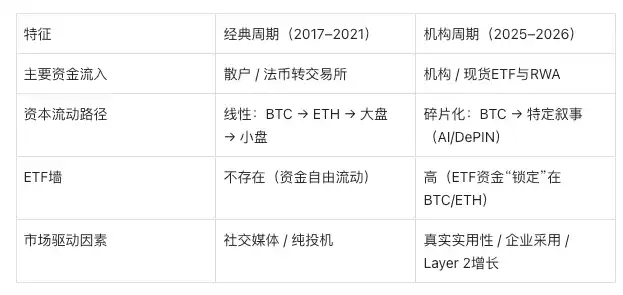
However, this market cycle is different from previous ones due to the existence of the so-called "ETF Wall."

Spot Bitcoin ETFs launched by asset managers like BlackRock and Fidelity have attracted tens of billions of dollars from institutional investors. These investors typically only gain Bitcoin exposure through regulated financial products, effectively locking this portion of capital within the BTC ecosystem.

In the 2017 bull market, retail capital could flow more freely into thousands of altcoins. In 2026, for a broad altcoin season to occur, it may require Bitcoin profit-taking alongside a new wave of retail and on-chain liquidity injection before capital can diffuse into the broader market.

Comparison between classic cycles (2017–2021) and institutional cycles (2025–2026):
How to Identify Altcoin Season

Identifying an altcoin season early can make a huge difference, as entering after the biggest gains often carries higher risks and less upside potential.

Altcoin Season Index and New 2026 Indicators

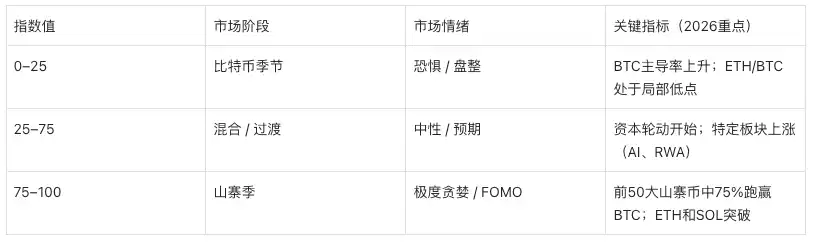
The Altcoin Season Index is one of the most popular tools for tracking market rotation. Developed by Blockchaincenter, it measures the performance of major cryptocurrencies against Bitcoin over the past 90 days on a scale of 0-100.

An index below 25 indicates Bitcoin season, 25-75 indicates a mixed market, and when the index rises above 75, the market is usually considered to be in an altcoin season, as most leading altcoins are outperforming BTC.
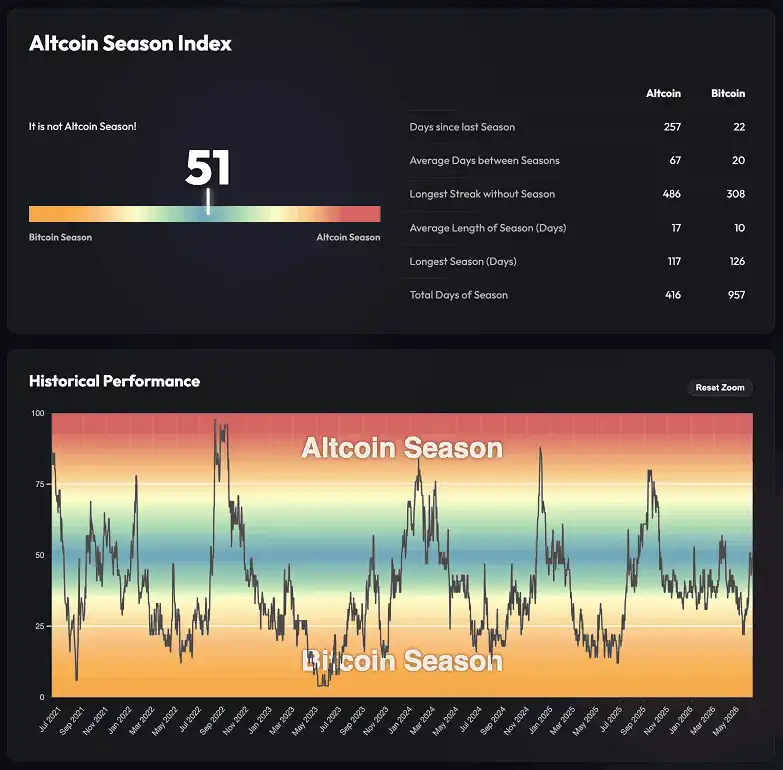
(Chart: Altcoin Season Index, BlockchainCenter, June 10, 2026)

However, the 2026 market requires additional confirmation. Many analysts now also observe the ETH/BTC and SOL/BTC trading pairs. If Ethereum and Solana fail to strengthen against Bitcoin, even if the index exceeds 75, it might only be short-term speculation rather than a sustainable rotation. Strong performance in benchmark pairs often confirms that capital has flowed from Bitcoin into the broader ecosystem.

Table of index values corresponding to market phases:
Key Metrics and Indicators

No single metric can perfectly predict the market. Experienced investors combine multiple signals to judge whether a new rotation is genuinely starting.

One of the strongest indicators is Bitcoin Dominance. When it retreats from above 50% to 40% or lower, it typically means capital is moving away from BTC into altcoins. Simultaneously, the total altcoin market cap growth rate should significantly outpace Bitcoin's, ideally by 2-3 times.

Trading activity also provides important clues. A week-over-week increase in altcoin/BTC trading volume exceeding 50% often indicates growing investor interest. Social media engagement and Google Trends can corroborate this, especially when search terms like "best altcoins" or "altcoin season" grow 30-50% within a few weeks.

When multiple indicators align, the probability of a genuine altcoin season is much higher than relying on the Altcoin Season Index alone.

Historical Altcoin Bull Run Patterns

Each major altcoin rally leaves valuable lessons, helping investors identify recurring trends and avoid emotional decisions in future cycles.

2017-2018 and 2020-2021 Bull Markets

Although both cycles produced astonishing returns, the driving forces behind them were entirely different.

The 2017-2018 altcoin season was driven by the ICO frenzy. Hundreds of new blockchain projects raised funds directly from retail investors, with speculation often outweighing fundamentals. As Bitcoin hit new highs and slowed down, capital quickly shifted to smaller tokens, with many coins surging hundreds of percent within months.

The 2020-2021 cycle followed a different path. Market focus shifted to DeFi protocols, NFT platforms, Layer 1 blockchains, and later, meme coins. Meanwhile, institutional investors entered the crypto space through companies, funds, and regulated products, bringing in capital far exceeding previous levels.

Retail investors still played a significant role in the NFT and meme coin mania, but institutional participation made the market larger and more mature. This shift also changed the way capital rotated, making the leadership role of Ethereum and key sectors more important than broad speculation. Therefore, future altcoin seasons may become increasingly selective rather than lifting all projects simultaneously.

Phases of an Altcoin Season: From BTC to Narrative-Driven

Modern altcoin cycles are no longer about all tokens rising in sync. Capital now rotates among different narratives, rewarding those sectors with the strongest adoption and momentum. Understanding these phases helps investors see where money is flowing, rather than chasing projects that have already peaked.

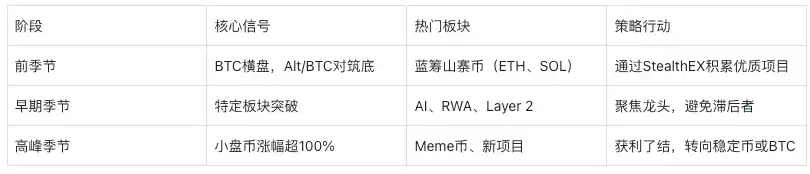
Phase comparison table:
Pre-Season (Accumulation Phase)

The accumulation phase typically begins when Bitcoin is range-bound or corrects by 10-20%. During this time, many altcoins may fall another 20-40% from their local highs, leading to disappearing retail interest.

Trading volume remains low, social media activity declines, and discussions are filled with negative sentiment. Behind the scenes, experienced investors are gradually accumulating fundamentally strong projects at discounted prices.

This phase often ends when Bitcoin stabilizes, Ethereum starts outperforming BTC, and trading volume slowly recovers. For long-term investors, this is the best time to research projects, build watchlists, and establish positions before widespread market attention returns.

Early Season: Narrative-Led Breakouts

Many investors ask, when does the altcoin season start? In today's market, the answer is often linked to narratives rather than market cap.

Not all top-ten cryptocurrencies will rise simultaneously; capital first flows into the most talked-about sectors. AI agents, Real-World Assets (RWA), and DePIN projects have recently become typical examples of this trend.

The traditional strategy of buying the largest altcoins simply because they are in the top ten is much less effective. Early winners are increasingly those projects with clear use cases, growing ecosystems, and the ability to attract fresh liquidity.

Peak Season (Maximum Activity)

When mid- and small-cap coins achieve 100-500% gains within weeks, does that mean we are in the common altcoin season? In this phase, optimism reaches extremes, and the Fear & Greed Index often exceeds 80.

Retail investors aggressively buy every dip, while experienced traders begin gradually reducing positions and locking in profits. New token launches surge, leverage amplifies, and social media is flooded with unrealistic price predictions.

These conditions are often warning signs rather than buying opportunities. Rising volatility, excessive leverage, and parabolic moves typically indicate the market is approaching exhaustion. Historically, this peak phase lasts 2 to 6 weeks, followed by significant corrections or broader market rotations.

Trading Strategies for Altcoin Season

Successful altcoin investing depends on a clear plan. A structured strategy helps investors manage risk, protect profits, and avoid emotional decisions during extreme volatility.

Portfolio Allocation and Sector Rotation

A balanced portfolio should match your risk tolerance and market environment. Conservative investors allocate more capital to Bitcoin, Ethereum, and stablecoins, while aggressive traders increase exposure to high-growth sectors during strong trends.

Sector rotation is equally important. Capital rarely stays in one narrative for the entire cycle. For example, profits taken from AI-related projects may later rotate into RWA, DePIN, gaming, or other emerging sectors. Following liquidity rather than chasing past winners often yields better long-term results.

Risk Management and Stop-Loss Discipline

Even the strongest altcoin seasons eventually end, so risk management is one of the most crucial parts of any strategy.

Many experienced investors limit single positions to 5-10% of their portfolio to minimize the impact of any one trade failing. Diversifying across 8-12 carefully selected projects further reduces overall risk while maintaining exposure to multiple narratives.

Keeping a portion of the portfolio in stablecoins also provides flexibility. A stablecoin reserve allows you to buy quality assets during pullbacks and protect profits when the market overheats. Combined with preset stop-losses and profit targets, this disciplined approach often leads to more consistent outcomes than trying to maximize gains on every trade.

Altcoin Season vs. Bitcoin Season

Understanding the transition between Bitcoin season and altcoin season helps investors identify market rotations and adjust strategies before capital shifts.

Key Differences and Rotation Signals

The difference between altcoin season and Bitcoin season lies in capital flow. During Bitcoin season, BTC dominance typically rises above 50-60%, showing investor preference for the market's largest, most mature asset. Simultaneously, many altcoins underperform or decline against BTC even if their USD price is stable.

Altcoin season is the opposite story. Bitcoin dominance tends to fall back to 40% or lower, and Ethereum and other major cryptocurrencies begin to attract more liquidity. This rotation eventually spreads to mid-cap and small-cap projects, creating the cycle's strongest gains.

Investor profiles also change. Bitcoin season attracts more conservative investors and institutions seeking lower volatility and long-term exposure. Altcoin season brings more speculative capital, with traders accepting higher risk in pursuit of significantly higher returns.

Historically, Bitcoin dominant phases can last for months, while intense altcoin seasons may only last 2-6 weeks before momentum fades. Therefore, watching BTC dominance is critical. If dominance begins rising again, stablecoin inflows increase, and leading altcoins start weakening against Bitcoin, these are often early signals that capital is flowing back to BTC or defensive positions, signaling the altcoin season is about to end.

Expert Predictions and Future Outlook for Altcoin Season

While all predictions involve uncertainty, understanding altcoin season forecasts and their key catalysts can help investors build smarter long-term strategies.

When Will the Next Altcoin Season Start

Many investors ask when the altcoin season will start, but no indicator can give an exact date. Successful prediction relies on a combination of macroeconomic conditions, Bitcoin market cycles, and capital rotation.

Historically, the strongest altcoin rallies have occurred 18 to 30 months after a Bitcoin market bottom, often following a halving event. Given the most recent Bitcoin halving occurred in April 2024, many analysts believe 2026-2027 could still offer favorable conditions if liquidity continues to improve.

Macroeconomic factors will play a significant role. Lower interest rates, global liquidity expansion, and stronger investor risk appetite may encourage capital flow into high-risk digital assets. Institutional adoption will also support the market, though much investment remains concentrated in Bitcoin ETFs rather than altcoins.

Technological progress will likely shape the next cycle alongside macroeconomics. Narratives like AI infrastructure, real-world asset tokenization, DePIN, next-gen DeFi, and blockchain gaming may become the primary destinations for fresh capital. Investors should not expect all cryptocurrencies to rise in unison but should focus on sectors attracting real users, active developer engagement, and institutional attention.

When Will the 2026 Altcoin Season Start

The official confirmation of a 2026 altcoin season has not yet begun, as Bitcoin currently represents about 56-60% of the total market cap. Analysts predict that a sustained shift to altcoins will only occur when Bitcoin dominance falls below 50-55% and the Altcoin Season Index reaches the 75 threshold.

How to Prepare for the Next Altcoin Season

Preparing during calm market periods often creates better opportunities than reacting after prices have already skyrocketed. A solid plan allows you to act confidently when momentum returns.

Building a Watchlist

The best watchlists focus on quality over quantity. Before adding a project, investors should confirm it has a real product, active users, an experienced and public development team, reasonable valuation, and a strong community supporting long-term growth.

A practical research checklist should include: token utility, ecosystem activity, developer updates, partnerships, liquidity, tokenomics, and competitive advantages. Regularly reviewing these factors makes it easier to distinguish lasting projects from short-term hype.

Frequently Asked Questions

What is the current Altcoin Season Index value?

You can view the Altcoin Season Index in real-time on Blockchaincenter. A score of 0-25 indicates Bitcoin season, 25-75 indicates a mixed market, and 75-100 suggests an altcoin season. Although the index updates daily, checking weekly often provides clearer signals and avoids overtrading due to short-term noise.

When is the altcoin season coming?

Many investors ask when the altcoin season is coming, but there is no fixed date. Historically, major altcoin rallies have often occurred 12-18 months after a Bitcoin halving. While the most recent halving was in April 2024, market conditions, Bitcoin dominance, liquidity, and ETH/BTC strength are more important than the calendar.

If Bitcoin crashes, can an altcoin season still happen?

No. A broad altcoin season requires Bitcoin to remain stable or rise moderately. When Bitcoin drops more than 20% in a short period, capital typically leaves the entire crypto market rather than rotating into altcoins. Historically, significant altcoin rallies have occurred during Bitcoin consolidation or moderate uptrends, with only a few exceptions during minor BTC pullbacks.

When will altcoins surge?

The answer to when altcoins will surge usually depends on market rotation. Altcoins tend to accelerate after Bitcoin dominance peaks above 50-55% and begins to decline, while the ETH/BTC ratio strengthens. A 15-30% rise in ETH/BTC often heralds a broader rally, with capital gradually flowing from Ethereum to large-cap, then mid-cap, and finally small-cap altcoins.

Criptos en tendencia

Preguntas relacionadas

QWhat is the key metric used by analysts to define an 'alt season', and what does it measure?

AThe key metric used to define an 'alt season' is the Altseason Index, which measures the percentage of the top 50 cryptocurrencies that have outperformed Bitcoin over a rolling 90-day period. An index value above 75 typically indicates an alt season is underway, signaling a capital rotation from BTC into other digital assets.

QWhat is the 'ETF wall' mentioned in the article, and how does it differ from previous market cycles?

AThe 'ETF wall' refers to the massive capital inflows into spot Bitcoin ETFs from institutional investors via firms like BlackRock and Fidelity. Unlike the 2017 cycle where retail capital flowed freely into altcoins, a significant portion of institutional capital in the current cycle is locked into regulated BTC products. This creates a structural difference, potentially making a broad alt season reliant on bitcoin profit-taking and a new wave of retail or on-chain liquidity to spread to the wider market.

QAccording to the article, what additional confirmation is needed in 2026 beyond the Altseason Index to signal a sustainable alt season?

AIn 2026, analysts look for additional confirmation beyond the Altseason Index reaching above 75. Specifically, they monitor the strength of key trading pairs like ETH/BTC and SOL/BTC. If major cryptocurrencies like Ethereum and Solana are not strengthening against Bitcoin, a high index score might indicate short-term speculation rather than a sustained, broad-based capital rotation.

QWhat are the typical stages of a modern altcoin cycle as described in the guide, and what characterizes the 'Early Season'?

AThe typical stages of a modern altcoin cycle are: Accumulation Phase (Pre-Season), Early Season, and Peak Season (Maximum Activity). The 'Early Season' is characterized by narrative-led breakouts, where capital flows first into the most compelling thematic sectors (like AI agents, RWA, or DePIN projects) rather than all top altcoins rising simultaneously. Winners are increasingly projects with clear use cases and growing ecosystems.

QUnder what market condition is a broad alt season unlikely to occur, and why?

AA broad alt season is unlikely to occur if Bitcoin experiences a sharp crash. Historically, when Bitcoin drops more than 20% in a short period, capital tends to exit the entire crypto market rather than rotate into altcoins. Significant altcoin rallies usually happen during periods of Bitcoin consolidation or moderate uptrends, with only minor exceptions during slight BTC pullbacks.

Lecturas Relacionadas

Should Developers Build on Corporate Chains Like Base and Robinhood? Five Key Risks to Consider

Should developers build on enterprise chains like Base and Robinhood? While offering enticing initial benefits like user access, these chains pose significant risks due to the inherent conflict of interest when the operator controls both the platform and a leading on-chain application. The primary lure is the promise of traffic and user distribution (e.g., through a parent company's app). However, five key risks emerge: 1. **Direct Competition**: The platform can use its exclusive data and positioning to launch competing products against third-party developers, mirroring cases like Amazon and Microsoft. 2. **Wallet Multi-Chain Reality**: Associated wallets (like Coinbase Wallet) must support multiple chains to remain competitive, diluting the promised exclusive traffic advantage for the enterprise chain. 3. **Exclusion by Platform Rivals**: Competing platforms (e.g., Coinbase vs. Robinhood) have no incentive to promote applications built on each other's chains, limiting growth avenues. 4. **Profit Squeeze**: The party controlling the end-user interface holds superior bargaining power and can capture a disproportionate share of value, squeezing developer profits. 5. **Unfulfilled Promises**: Promised traffic support can fail to materialize due to shifting platform priorities or strategic changes. In contrast, neutral blockchains like Ethereum and Solana avoid these platform risks. To mitigate risks on enterprise chains, developers should consider strategies like securing substantial onboarding grants, obtaining formal commitments (though these have weak historical enforceability), or, most effectively, pursuing a multi-chain deployment strategy while building independent user acquisition channels. Enterprise chains may be useful for initial cold-start user acquisition, but the core goal should be cultivating an independent user base rather than long-term dependence.

Foresight NewsHace 9 min(s)

Should Developers Build on Corporate Chains Like Base and Robinhood? Five Key Risks to Consider

Foresight NewsHace 9 min(s)

Crypto Watch This Week: Uniswap Fee Switch Vote Starts Today, CLARITY Act Could Face Senate Vote This Week

**Weekly Crypto Watch: Key Events & Catalysts** This week’s crypto focus is on pivotal governance votes, potential regulatory progress, and major protocol upgrades. **Uniswap** takes center stage with two crucial on-chain proposals going to vote from July 19-26. The first aims to activate protocol fees for Uniswap V2/V3 on the new Robinhood Chain and direct them to a UNI token burn mechanism. The second seeks to activate V4 fees across seven major chains, including Ethereum and Base. Robinhood Chain has already seen over $60B in Uniswap volume since its launch 18 days ago. The proposals build on last year's UNIfication plan, which transformed UNI into a fee-generating asset. On the **U.S. regulatory front**, the **CLARITY Act** could face a Senate floor vote this week. While some lawmakers are optimistic, the bill faces hurdles, needing at least 60 votes to overcome a filibuster. Prediction market Polymarket currently gives it only a 34% chance of being signed into law this year. Other notable catalysts include: * **Morpho's** fixed-rate lending protocol, **Morpho Midnight**, is set for its public launch, starting with a single market (cbBTC/USDC) on Base. * **Derive** (formerly Lyra) is preparing for its largest-ever upgrade, **V3**, which will reportedly introduce 0DTE options and a more retail-friendly UX. * **Pendle** will hold a community call on July 22 to share its roadmap, with a focus on expanding its RWA (Real World Assets) capabilities. * An undisclosed privacy-focused application for **Polymarket**, built on **Starknet**, is reportedly launching on July 20.

marsbitHace 1 hora(s)

Crypto Watch This Week: Uniswap Fee Switch Vote Starts Today, CLARITY Act Could Face Senate Vote This Week

marsbitHace 1 hora(s)

Citi's Interpretation: Upgrading China, Downgrading South Korea, Is the Emerging Markets Rally Beginning to Broaden?

In its latest emerging markets strategy report, Citi has upgraded China to overweight from neutral, while downgrading South Korea to neutral from overweight. It maintains an overweight rating for China-Taiwan markets. The report sets MSCI EM index targets of 1870 by end-2026 and 2050 by mid-2027, implying further upside of approximately 12% and over 20% respectively from current levels. Citi's move reflects a search for "broadening" opportunities beyond the concentrated rally in AI hardware and tech, which has driven EM gains year-to-date, led by South Korea and China-Taiwan markets. The upgrade for China is based on factors including light investor positioning, potential benefits from lower oil prices, and relative attractiveness in a recovering global growth cycle. While maintaining a strong long-term view on South Korea, Citi notes its recent outperformance and elevated volatility prompted a tactical downgrade. The report highlights that EM earnings revisions remain narrow, with the IT sector contributing about 85% of 2026 EPS estimate upgrades. For a sustained rally, Citi argues that market gains need to broaden to other sectors and regions. China, South Africa, and Mexico rank highly as potential "broadening candidates" based on factors like sensitivity to a weaker dollar, lower bond yields, and oil prices. Key uncertainties include the sustainability of AI capital expenditure returns, geopolitical risks, and Federal Reserve policy. Citi's stance is cautiously optimistic, suggesting the rally has room to broaden rather than signaling a confirmed broad-based EM bull market. The path to higher index targets depends on whether non-tech earnings revisions improve and if capital rotates from concentrated winners into a wider set of markets.

marsbitHace 1 hora(s)

Citi's Interpretation: Upgrading China, Downgrading South Korea, Is the Emerging Markets Rally Beginning to Broaden?

marsbitHace 1 hora(s)

Trading

Spot

Artículos destacados

Qué es $S$

Entendiendo SPERO: Una Visión General Completa Introducción a SPERO A medida que el panorama de la innovación continúa evolucionando, la aparición de tecnologías web3 y proyectos de criptomonedas juega un papel fundamental en la configuración del futuro digital. Un proyecto que ha atraído la atención en este campo dinámico es SPERO, denotado como SPERO,$$s$. Este artículo tiene como objetivo reunir y presentar información detallada sobre SPERO, para ayudar a entusiastas e inversores a comprender sus fundamentos, objetivos e innovaciones dentro de los dominios web3 y cripto. ¿Qué es SPERO,$$s$? SPERO,$$s$ es un proyecto único dentro del espacio cripto que busca aprovechar los principios de descentralización y tecnología blockchain para crear un ecosistema que promueva la participación, la utilidad y la inclusión financiera. El proyecto está diseñado para facilitar interacciones de igual a igual de nuevas maneras, proporcionando a los usuarios soluciones y servicios financieros innovadores. En su esencia, SPERO,$$s$ tiene como objetivo empoderar a los individuos al proporcionar herramientas y plataformas que mejoren la experiencia del usuario en el espacio de las criptomonedas. Esto incluye habilitar métodos de transacción más flexibles, fomentar iniciativas impulsadas por la comunidad y crear caminos para oportunidades financieras a través de aplicaciones descentralizadas (dApps). La visión subyacente de SPERO,$$s$ gira en torno a la inclusividad, buscando cerrar brechas dentro de las finanzas tradicionales mientras aprovecha los beneficios de la tecnología blockchain. ¿Quién es el Creador de SPERO,$$s$? La identidad del creador de SPERO,$$s$ sigue siendo algo oscura, ya que hay recursos públicos limitados que proporcionan información de fondo detallada sobre su(s) fundador(es). Esta falta de transparencia puede derivarse del compromiso del proyecto con la descentralización, una ética que muchos proyectos web3 comparten, priorizando las contribuciones colectivas sobre el reconocimiento individual. Al centrar las discusiones en torno a la comunidad y sus objetivos colectivos, SPERO,$$s$ encarna la esencia del empoderamiento sin señalar a individuos específicos. Como tal, comprender la ética y la misión de SPERO sigue siendo más importante que identificar a un creador singular. ¿Quiénes son los Inversores de SPERO,$$s$? SPERO,$$s$ cuenta con el apoyo de una diversa gama de inversores que van desde capitalistas de riesgo hasta inversores ángeles dedicados a fomentar la innovación en el sector cripto. El enfoque de estos inversores generalmente se alinea con la misión de SPERO, priorizando proyectos que prometen avances tecnológicos sociales, inclusión financiera y gobernanza descentralizada. Estas fundaciones de inversores suelen estar interesadas en proyectos que no solo ofrecen productos innovadores, sino que también contribuyen positivamente a la comunidad blockchain y sus ecosistemas. El respaldo de estos inversores refuerza a SPERO,$$s$ como un contendiente notable en el dominio de proyectos cripto que evoluciona rápidamente. ¿Cómo Funciona SPERO,$$s$? SPERO,$$s$ emplea un marco multifacético que lo distingue de los proyectos de criptomonedas convencionales. Aquí hay algunas de las características clave que subrayan su singularidad e innovación: Gobernanza Descentralizada: SPERO,$$s$ integra modelos de gobernanza descentralizada, empoderando a los usuarios para participar activamente en los procesos de toma de decisiones sobre el futuro del proyecto. Este enfoque fomenta un sentido de propiedad y responsabilidad entre los miembros de la comunidad. Utilidad del Token: SPERO,$$s$ utiliza su propio token de criptomoneda, diseñado para servir diversas funciones dentro del ecosistema. Estos tokens permiten transacciones, recompensas y la facilitación de servicios ofrecidos en la plataforma, mejorando la participación y la utilidad general. Arquitectura en Capas: La arquitectura técnica de SPERO,$$s$ apoya la modularidad y escalabilidad, permitiendo la integración fluida de características y aplicaciones adicionales a medida que el proyecto evoluciona. Esta adaptabilidad es fundamental para mantener la relevancia en el cambiante paisaje cripto. Participación de la Comunidad: El proyecto enfatiza iniciativas impulsadas por la comunidad, empleando mecanismos que incentivan la colaboración y la retroalimentación. Al nutrir una comunidad sólida, SPERO,$$s$ puede abordar mejor las necesidades de los usuarios y adaptarse a las tendencias del mercado. Enfoque en la Inclusión: Al ofrecer tarifas de transacción bajas e interfaces amigables para el usuario, SPERO,$$s$ busca atraer a una base de usuarios diversa, incluyendo a individuos que anteriormente pueden no haber participado en el espacio cripto. Este compromiso con la inclusión se alinea con su misión general de empoderamiento a través de la accesibilidad. Cronología de SPERO,$$s$ Entender la historia de un proyecto proporciona información crucial sobre su trayectoria de desarrollo y hitos. A continuación se presenta una cronología sugerida que mapea eventos significativos en la evolución de SPERO,$$s$: Fase de Conceptualización e Ideación: Las ideas iniciales que forman la base de SPERO,$$s$ fueron concebidas, alineándose estrechamente con los principios de descentralización y enfoque comunitario dentro de la industria blockchain. Lanzamiento del Whitepaper del Proyecto: Tras la fase conceptual, se lanzó un whitepaper completo que detalla la visión, los objetivos y la infraestructura tecnológica de SPERO,$$s$ para generar interés y retroalimentación de la comunidad. Construcción de Comunidad y Primeras Interacciones: Se realizaron esfuerzos de divulgación activa para construir una comunidad de primeros adoptantes y posibles inversores, facilitando discusiones en torno a los objetivos del proyecto y obteniendo apoyo. Evento de Generación de Tokens: SPERO,$$s$ llevó a cabo un evento de generación de tokens (TGE) para distribuir sus tokens nativos a los primeros seguidores y establecer liquidez inicial dentro del ecosistema. Lanzamiento de la dApp Inicial: La primera aplicación descentralizada (dApp) asociada con SPERO,$$s$ se puso en marcha, permitiendo a los usuarios interactuar con las funcionalidades centrales de la plataforma. Desarrollo Continuo y Alianzas: Actualizaciones y mejoras continuas a las ofertas del proyecto, incluyendo alianzas estratégicas con otros actores en el espacio blockchain, han moldeado a SPERO,$$s$ en un jugador competitivo y en evolución en el mercado cripto. Conclusión SPERO,$$s$ se erige como un testimonio del potencial de web3 y las criptomonedas para revolucionar los sistemas financieros y empoderar a los individuos. Con un compromiso con la gobernanza descentralizada, la participación comunitaria y funcionalidades diseñadas de manera innovadora, allana el camino hacia un paisaje financiero más inclusivo. Como con cualquier inversión en el espacio cripto que evoluciona rápidamente, se anima a los posibles inversores y usuarios a investigar a fondo y participar de manera reflexiva con los desarrollos en curso dentro de SPERO,$$s$. El proyecto muestra el espíritu innovador de la industria cripto, invitando a una mayor exploración de sus innumerables posibilidades. Mientras el viaje de SPERO,$$s$ aún se desarrolla, sus principios fundamentales pueden, de hecho, influir en el futuro de cómo interactuamos con la tecnología, las finanzas y entre nosotros en ecosistemas digitales interconectados.

150 Vistas totalesPublicado en 2024.12.17Actualizado en 2024.12.17

Qué es $S$

Qué es AGENT S

Agent S: El Futuro de la Interacción Autónoma en Web3 Introducción En el paisaje en constante evolución de Web3 y las criptomonedas, las innovaciones están redefiniendo constantemente cómo los individuos interactúan con las plataformas digitales. Uno de estos proyectos pioneros, Agent S, promete revolucionar la interacción humano-computadora a través de su marco agente abierto. Al allanar el camino para interacciones autónomas, Agent S busca simplificar tareas complejas, ofreciendo aplicaciones transformadoras en inteligencia artificial (IA). Esta exploración detallada profundizará en las complejidades del proyecto, sus características únicas y las implicaciones para el dominio de las criptomonedas. ¿Qué es Agent S? Agent S se presenta como un marco agente abierto innovador, diseñado específicamente para abordar tres desafíos fundamentales en la automatización de tareas informáticas: Adquisición de Conocimiento Específico del Dominio: El marco aprende inteligentemente de diversas fuentes de conocimiento externas y experiencias internas. Este enfoque dual le permite construir un rico repositorio de conocimiento específico del dominio, mejorando su rendimiento en la ejecución de tareas. Planificación a Largo Plazo de Tareas: Agent S emplea planificación jerárquica aumentada por la experiencia, un enfoque estratégico que facilita la descomposición y ejecución eficiente de tareas complejas. Esta característica mejora significativamente su capacidad para gestionar múltiples subtareas de manera eficiente y efectiva. Manejo de Interfaces Dinámicas y No Uniformes: El proyecto introduce la Interfaz Agente-Computadora (ACI), una solución innovadora que mejora la interacción entre agentes y usuarios. Utilizando Modelos de Lenguaje Multimodal de Gran Escala (MLLMs), Agent S puede navegar y manipular diversas interfaces gráficas de usuario sin problemas. A través de estas características pioneras, Agent S proporciona un marco robusto que aborda las complejidades involucradas en la automatización de la interacción humana con las máquinas, preparando el terreno para una multitud de aplicaciones en IA y más allá. ¿Quién es el Creador de Agent S? Si bien el concepto de Agent S es fundamentalmente innovador, la información específica sobre su creador sigue siendo elusiva. El creador es actualmente desconocido, lo que resalta ya sea la etapa incipiente del proyecto o la elección estratégica de mantener a los miembros fundadores en el anonimato. Independientemente de la anonimidad, el enfoque sigue siendo en las capacidades y el potencial del marco. ¿Quiénes son los Inversores de Agent S? Dado que Agent S es relativamente nuevo en el ecosistema criptográfico, la información detallada sobre sus inversores y patrocinadores financieros no está documentada explícitamente. La falta de información disponible públicamente sobre las bases de inversión u organizaciones que apoyan el proyecto plantea preguntas sobre su estructura de financiamiento y hoja de ruta de desarrollo. Comprender el respaldo es crucial para evaluar la sostenibilidad del proyecto y su posible impacto en el mercado. ¿Cómo Funciona Agent S? En el núcleo de Agent S se encuentra una tecnología de vanguardia que le permite funcionar de manera efectiva en diversos entornos. Su modelo operativo se basa en varias características clave: Interacción Humano-Computadora Similar a la Humana: El marco ofrece planificación avanzada de IA, esforzándose por hacer que las interacciones con las computadoras sean más intuitivas. Al imitar el comportamiento humano en la ejecución de tareas, promete elevar las experiencias de los usuarios. Memoria Narrativa: Empleada para aprovechar experiencias de alto nivel, Agent S utiliza memoria narrativa para hacer un seguimiento de las historias de tareas, mejorando así sus procesos de toma de decisiones. Memoria Episódica: Esta característica proporciona a los usuarios una guía paso a paso, permitiendo que el marco ofrezca apoyo contextual a medida que se desarrollan las tareas. Soporte para OpenACI: Con la capacidad de ejecutarse localmente, Agent S permite a los usuarios mantener el control sobre sus interacciones y flujos de trabajo, alineándose con la ética descentralizada de Web3. Fácil Integración con APIs Externas: Su versatilidad y compatibilidad con varias plataformas de IA aseguran que Agent S pueda encajar sin problemas en ecosistemas tecnológicos existentes, convirtiéndolo en una opción atractiva para desarrolladores y organizaciones. Estas funcionalidades contribuyen colectivamente a la posición única de Agent S dentro del espacio cripto, ya que automatiza tareas complejas y de múltiples pasos con una intervención humana mínima. A medida que el proyecto evoluciona, sus posibles aplicaciones en Web3 podrían redefinir cómo se desarrollan las interacciones digitales. Cronología de Agent S El desarrollo y los hitos de Agent S pueden encapsularse en una cronología que resalta sus eventos significativos: 27 de septiembre de 2024: El concepto de Agent S fue lanzado en un documento de investigación integral titulado “Un Marco Agente Abierto que Usa Computadoras Como un Humano”, mostrando las bases del proyecto. 10 de octubre de 2024: El documento de investigación fue puesto a disposición del público en arXiv, ofreciendo una exploración profunda del marco y su evaluación de rendimiento basada en el benchmark OSWorld. 12 de octubre de 2024: Se lanzó una presentación en video, proporcionando una visión visual de las capacidades y características de Agent S, involucrando aún más a posibles usuarios e inversores. Estos marcadores en la cronología no solo ilustran el progreso de Agent S, sino que también indican su compromiso con la transparencia y la participación comunitaria. Puntos Clave Sobre Agent S A medida que el marco Agent S continúa evolucionando, varios atributos clave destacan, subrayando su naturaleza innovadora y potencial: Marco Innovador: Diseñado para proporcionar un uso intuitivo de las computadoras similar a la interacción humana, Agent S aporta un enfoque novedoso a la automatización de tareas. Interacción Autónoma: La capacidad de interactuar de manera autónoma con las computadoras a través de GUI significa un salto hacia soluciones informáticas más inteligentes y eficientes. Automatización de Tareas Complejas: Con su metodología robusta, puede automatizar tareas complejas y de múltiples pasos, haciendo que los procesos sean más rápidos y menos propensos a errores. Mejora Continua: Los mecanismos de aprendizaje permiten a Agent S mejorar a partir de experiencias pasadas, mejorando continuamente su rendimiento y eficacia. Versatilidad: Su adaptabilidad en diferentes entornos operativos como OSWorld y WindowsAgentArena asegura que pueda servir a una amplia gama de aplicaciones. A medida que Agent S se posiciona en el paisaje de Web3 y criptomonedas, su potencial para mejorar las capacidades de interacción y automatizar procesos significa un avance significativo en las tecnologías de IA. A través de su marco innovador, Agent S ejemplifica el futuro de las interacciones digitales, prometiendo una experiencia más fluida y eficiente para los usuarios en diversas industrias. Conclusión Agent S representa un audaz avance en la unión de la IA y Web3, con la capacidad de redefinir cómo interactuamos con la tecnología. Aunque aún se encuentra en sus primeras etapas, las posibilidades para su aplicación son vastas y atractivas. A través de su marco integral que aborda desafíos críticos, Agent S busca llevar las interacciones autónomas al primer plano de la experiencia digital. A medida que nos adentramos más en los reinos de las criptomonedas y la descentralización, proyectos como Agent S sin duda desempeñarán un papel crucial en la configuración del futuro de la tecnología y la colaboración humano-computadora.

561 Vistas totalesPublicado en 2025.01.14Actualizado en 2025.01.14

Qué es AGENT S

Cómo comprar S

¡Bienvenido a HTX.com! Hemos hecho que comprar Sonic (S) sea simple y conveniente. Sigue nuestra guía paso a paso para iniciar tu viaje de criptos.Paso 1: crea tu cuenta HTXUtiliza tu correo electrónico o número de teléfono para registrarte y obtener una cuenta gratuita en HTX. Experimenta un proceso de registro sin complicaciones y desbloquea todas las funciones.Obtener mi cuentaPaso 2: ve a Comprar cripto y elige tu método de pagoTarjeta de crédito/débito: usa tu Visa o Mastercard para comprar Sonic (S) al instante.Saldo: utiliza fondos del saldo de tu cuenta HTX para tradear sin problemas.Terceros: hemos agregado métodos de pago populares como Google Pay y Apple Pay para mejorar la comodidad.P2P: tradear directamente con otros usuarios en HTX.Over-the-Counter (OTC): ofrecemos servicios personalizados y tipos de cambio competitivos para los traders.Paso 3: guarda tu Sonic (S)Después de comprar tu Sonic (S), guárdalo en tu cuenta HTX. Alternativamente, puedes enviarlo a otro lugar mediante transferencia blockchain o utilizarlo para tradear otras criptomonedas.Paso 4: tradear Sonic (S)Tradear fácilmente con Sonic (S) en HTX's mercado spot. Simplemente accede a tu cuenta, selecciona tu par de trading, ejecuta tus trades y monitorea en tiempo real. Ofrecemos una experiencia fácil de usar tanto para principiantes como para traders experimentados.

1.1k Vistas totalesPublicado en 2025.01.15Actualizado en 2026.06.02

Cómo comprar S

Discusiones

Bienvenido a la comunidad de HTX. Aquí puedes mantenerte informado sobre los últimos desarrollos de la plataforma y acceder a análisis profesionales del mercado. A continuación se presentan las opiniones de los usuarios sobre el precio de S (S).

活动图片