Crypto Watch This Week: Uniswap Fee Switch Vote Starts Today, CLARITY Act Could Face Senate Vote This Week

marsbitPublicado a 2026-07-20Actualizado a 2026-07-20

Resumen

**Weekly Crypto Watch: Key Events & Catalysts** This week’s crypto focus is on pivotal governance votes, potential regulatory progress, and major protocol upgrades. **Uniswap** takes center stage with two crucial on-chain proposals going to vote from July 19-26. The first aims to activate protocol fees for Uniswap V2/V3 on the new Robinhood Chain and direct them to a UNI token burn mechanism. The second seeks to activate V4 fees across seven major chains, including Ethereum and Base. Robinhood Chain has already seen over $60B in Uniswap volume since its launch 18 days ago. The proposals build on last year's UNIfication plan, which transformed UNI into a fee-generating asset. On the **U.S. regulatory front**, the **CLARITY Act** could face a Senate floor vote this week. While some lawmakers are optimistic, the bill faces hurdles, needing at least 60 votes to overcome a filibuster. Prediction market Polymarket currently gives it only a 34% chance of being signed into law this year. Other notable catalysts include: * **Morpho's** fixed-rate lending protocol, **Morpho Midnight**, is set for its public launch, starting with a single market (cbBTC/USDC) on Base. * **Derive** (formerly Lyra) is preparing for its largest-ever upgrade, **V3**, which will reportedly introduce 0DTE options and a more retail-friendly UX. * **Pendle** will hold a community call on July 22 to share its roadmap, with a focus on expanding its RWA (Real World Assets) capabilities. * An undisclosed...

Author: Claude, Shenchao TechFlow

Shenchao TechFlow: Crypto KOL @TheDeFiInvestor listed this week's catalyst rundown, with 6 projects releasing positive news intensively, but the main theme of this week is regulation and revenue. Uniswap initiates on-chain voting today, proposing to channel V2/V3 protocol fees on Robinhood Chain into the UNI burn mechanism, while simultaneously activating V4 protocol fees on 7 chains. Robinhood Chain, live for only 18 days, has already seen cumulative Uniswap trading volume exceed $60 billion. On the macro front, Representative Bryan Steil expressed optimism about the CLARITY Act passing the Senate next week, but Polymarket gives it only a 34% probability of being signed into law this year. The Morpho Midnight fixed-rate lending protocol is set to go live publicly, Derive's V3 upgrade is imminent, and Pendle's community call on July 22 will disclose its roadmap.
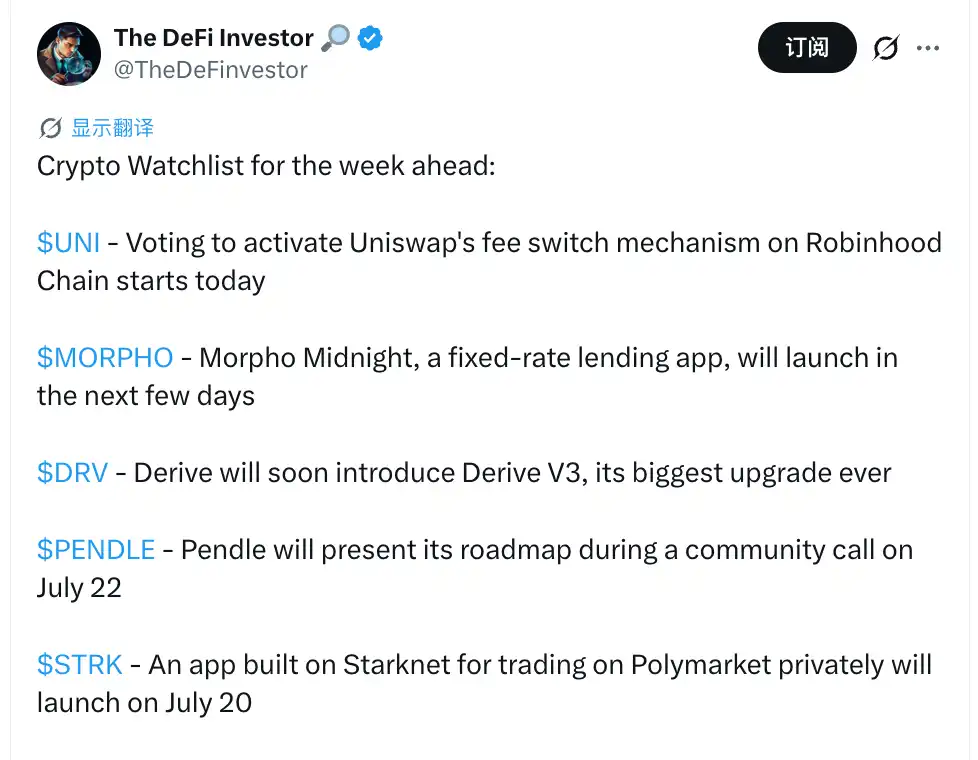
UNI: Fee Switch Vote Starts Today, Robinhood Chain's $60B Trading Volume to Enter Burn Mechanism

The most significant catalyst this week is Uniswap.

According to Crypto News on July 19, Uniswap founder Hayden Adams submitted two governance proposals on July 17, entering the final on-chain voting phase: the first to activate V2 and V3 protocol fees on Robinhood Chain, the second to activate V4 protocol fees on 7 chains including Ethereum, Base, Arbitrum, Robinhood Chain, BNB Chain, Polygon, and Optimism. The voting window is from July 19 to July 26, requiring a quorum of 40 million UNI to pass.

According to Crypto Times, Uniswap, deployed on Robinhood Chain for only 18 days, has seen cumulative trading volume surpass $60 billion. Robinhood Chain even briefly surpassed Hyperliquid in daily DEX volume, breaking $375 million in a single day. If the proposals pass, protocol fees collected on Robinhood Chain will flow into the TokenJar contract and eventually be bridged back to the Ethereum mainnet to burn UNI.

The backdrop of these proposals is the UNIfication proposal passed in December 2025. UNIfication passed with 125 million UNI votes in favor (only 742 against), first linking protocol fees to UNI burning, transforming UNI from a pure governance token into a cash-flow asset. According to Crypto News, Adams revealed on July 12 that Uniswap's daily average fee revenue had reached $5.2 million, surpassing all crypto protocols except the top two stablecoin issuers.

Risk reminder for holders: Voting is not yet concluded; after passing, there is a 2-day timelock. V4 fee structure is more complex due to hooks mechanism, with actual rates varying significantly by pool type. UNI has rebounded about 30% from the $2.70 low in July. Standard Chartered analyst Geoff Kendrick gave a year-end 2026 target price of $6.50, but this represents a single analyst view. Short-term sentiment appears relatively fully priced.

Macro Event: CLARITY Act Could Face Full Senate Vote This Week, But Polymarket Gives Only 34% Odds

The US crypto market structure bill, the CLARITY Act, is in its final sprint.

According to Benzinga on July 18, House Financial Services Committee Digital Assets Subcommittee Chairman Bryan Steil stated at a hearing in New York's Federal Hall that he is optimistic the Senate will pass the bill next week. Senator Cynthia Lummis is also reported to expect a full Senate vote during the week of July 20. Senate Republicans released an updated bill text following talks with the Trump White House.
According to CoinDesk on July 9, the bill needs to merge versions from the Senate Banking and Agriculture Committees and secure 60 votes to overcome the filibuster threshold. Republicans currently hold 53 seats, but Senators Josh Hawley and Rand Paul are expected to vote no, meaning at least 7 to 9 Democratic votes are needed. Currently, only two Democrats, Ruben Gallego and Angela Alsobrooks, voted in favor at the committee stage. According to Yahoo Finance, Stifel's chief Washington policy strategist Brian Gardner believes the bill "likely needs to pass the Senate by the end of July," or its prospects will "materially deteriorate."

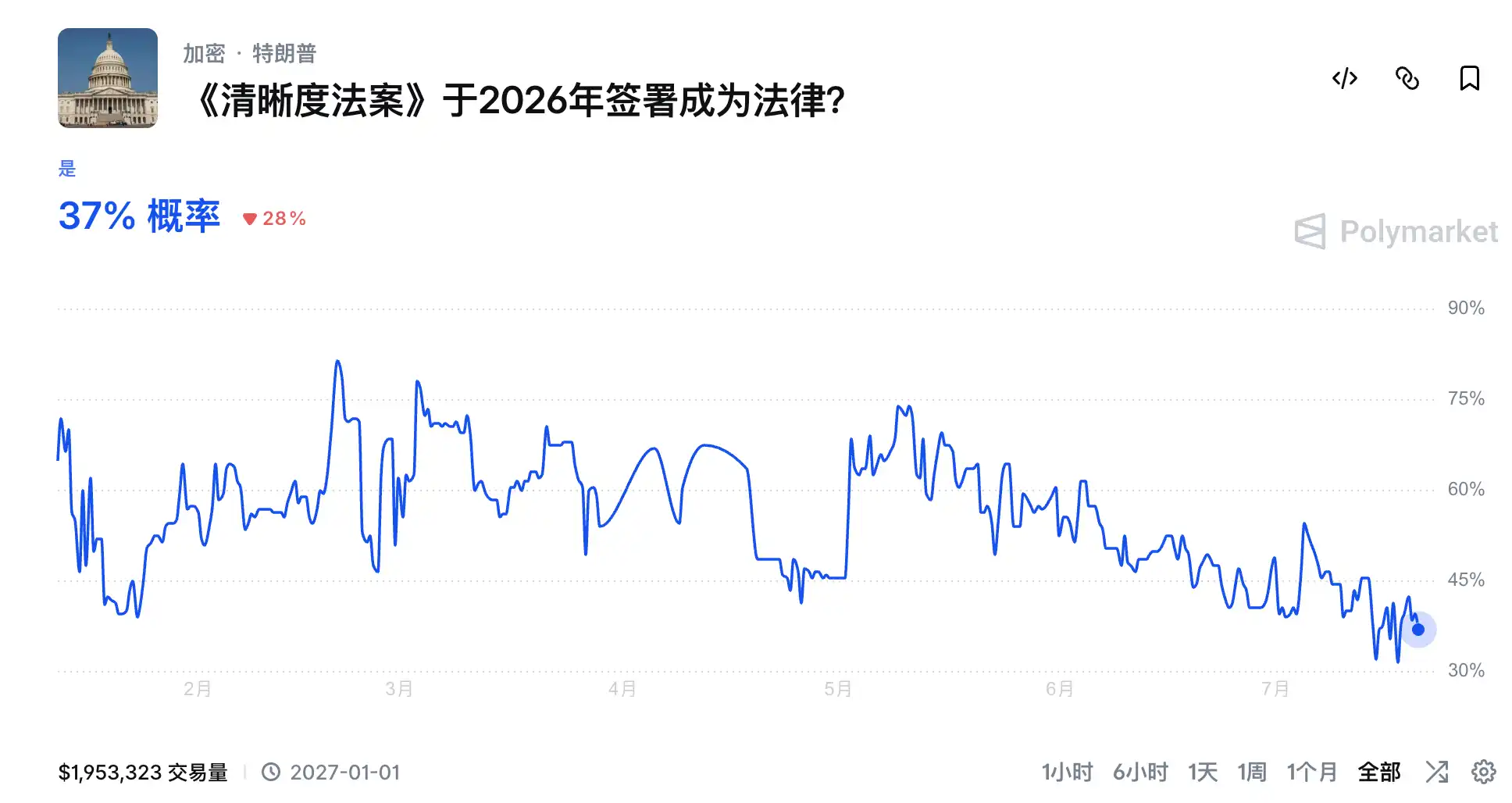
On Polymarket, the odds for the CLARITY Act being signed into law this year stand at 34%, having previously touched 44% before quickly retreating.

For the crypto market, the bill would delineate digital asset regulatory boundaries between the SEC and CFTC, the most anticipated legislation in years for the industry. However, Democratic concerns over Trump's crypto conflicts of interest remain the biggest obstacle.

MORPHO: Morpho Midnight Fixed-Rate Lending Protocol Set for Public Launch

According to Bankless on July 17, Morpho CEO Paul Frambot announced that Morpho Midnight will end its months-long testing period and officially launch publicly "in the coming days." According to CoinMarketCap, the mainnet launch date for Midnight is July 18.

Morpho Midnight is the third-generation paradigm for DeFi lending. Frambot describes it as: first-gen protocols (like Compound) set risk, rates, and maturity by the protocol; Morpho Blue delegated risk management to vault curators; Midnight further delegates rate and maturity to the market. Lenders and borrowers trade around fixed rates and real maturity dates set by the market, introducing the long-missing duration dimension to DeFi.

The initial release is deliberately restrained: launching only one market on Base chain (cbBTC/USDC, also the largest market on Morpho Blue), offering multiple maturities, no vault adapter integration, no auto-rolling, and no cross-chain functionality. The subsequent roadmap includes vault adapters (connecting tens of billions in Morpho Vaults liquidity), more chains and collateral types, compliance gating, APIs, etc.

Morpho's current TVL is approximately $7.7 billion, second only to Aave, ranking second among DeFi lending protocols. According to CoinMarketCap data, Galaxy Curator integrated with Fireblocks Earn on July 17, directly connecting Morpho vault yields to over 2,400 institutions.

Risk reminder for holders: Fixed-rate lending has been attempted multiple times in DeFi but never truly scaled. Attracting sustained liquidity is the core challenge. The initial launch features only a single market on a single chain, limiting short-term impact on protocol revenue.

DRV: Derive to Launch V3 Soon, Its Largest Upgrade Ever

@TheDeFiInvestor states that Derive will launch V3 "soon," defining it as its largest upgrade ever.

Derive (formerly Lyra) is an on-chain options and derivatives protocol built on Derive L2 (an Ethereum Rollup based on OP Stack). According to CoinMarketCap, V3 will introduce 0DTE (Zero Days to Expiry) options and a more retail-oriented user experience.

Recent developments: DRV began trading on Coinbase on May 27, its largest centralized exchange listing. On April 23, the DAO passed a proposal to increase the proportion of protocol fees used for DRV buybacks from 25% to 35%, while cutting weekly staking emissions from 250k to 100k tokens. The DAO has cumulatively repurchased over 23 million DRV.

Risk reminder for holders: DRV market cap is approximately $116 million, with daily trading volume only about $170k, indicating relatively thin liquidity. The specific launch date and full feature list for V3 have not been officially released. The phrasing "soon" is akin to Aave App's "soon"—don't treat vague expectations as definite catalysts.

PENDLE: Community Call on July 22 to Disclose Roadmap, RWA Momentum is Focus

According to an official Pendle X post (published July 16), Pendle will hold a community call on Discord on July 22 at 1 PM UTC. Pendle previewed in the post that it will share "new updates" covering the next steps for RWA momentum and the roadmap to make Pendle "the greatest yield trading platform in global finance."

According to CoinMarketCap analysis, Pendle's recent expansion directions include distributing 470k MON tokens on Monad as incentives for YT holders (starting July 23), and expanding into commodity and stock perps (WTI Crude, Brent Crude, Gold, Silver, NVDA, TSLA, etc.) via Boros. Sierra integrated with Pendle in early July, offering structured yield products.

Risk reminder for holders: Community calls are inherently informational events. If the roadmap lacks substantive content beyond known expectations, it could trigger a "buy the rumor, sell the news" reaction. PENDLE's current price is approximately $1.52, market cap around $260 million, with 7-day price change nearly flat.

STRK: Starknet-Based Polymarket Privacy Trading App to Launch Privately on July 20

Public information indicates an application built on Starknet will launch privately on July 20, enabling users to trade on Polymarket in a privacy-preserving manner.

The specific project name and detailed information for this catalyst have not been publicly disclosed; it's a single-source report. However, the context is plausible: Starknet just rolled out a suite of privacy features (Private Yield, Private Swaps, Private Transfers) on July 3, and released the STRK20 private token standard on July 15, providing native support for protected ERC-20 transfers. A Polymarket frontend leveraging Starknet's ZK privacy capabilities is technically feasible.

Risk reminder for holders: The app's name, team, and functional scope have not been confirmed by independent sources. STRK faced approximately 127 million early investor token unlocks in mid-July, presenting supply-side pressure independent of the app launch. STRK's current price is around $0.029, down about 5.5% over 7 days, trading in its historical low range.


Preguntas relacionadas

QWhat are the two key Uniswap governance proposals currently under on-chain voting, and what is the main purpose of them?

AThe two proposals are: 1) Activating protocol fees for V2 and V3 on Robinhood Chain. 2) Activating V4 protocol fees on Ethereum, Base, Arbitrum, Robinhood Chain, BNB Chain, Polygon, and Optimism. Their main purpose is to direct a portion of the protocol fees collected on these chains into a mechanism to buy back and burn UNI tokens, effectively turning UNI into a cash-flow generating asset.

QAccording to the article, what is the current probability for the CLARITY Act to be signed into law this year on Polymarket, and what is a major obstacle to its passage in the Senate?

AThe current probability for the CLARITY Act to be signed into law this year on Polymarket is 34%. A major obstacle to its passage in the Senate is securing enough Democratic votes, as concerns about potential crypto-related conflicts of interest for former President Trump have caused hesitation among some Democratic senators.

QWhat is Morpho Midnight, and how does it represent a 'third paradigm' for DeFi lending according to its CEO?

AMorpho Midnight is a fixed-rate lending protocol. According to Morpho CEO Paul Frambot, it represents a 'third paradigm' for DeFi lending: the first generation (e.g., Compound) had the protocol set risk, rates, and maturity; Morpho Blue delegated risk management to vault curators; Midnight further delegates both interest rates and maturity terms to the market, allowing borrowers and lenders to trade based on fixed rates and specific maturities.

QWhat major upgrade is the Derive (DRV) protocol expected to release soon, and what are two key features mentioned for this V3 upgrade?

ADerive (DRV) is expected to soon release its V3 upgrade, described as its biggest ever. Two key features mentioned for V3 are the introduction of 0DTE (Zero Days to Expiry) options and a more retail-focused user experience.

QWhat event is scheduled for Pendle on July 22nd, and what are the two main topics expected to be covered according to the announcement?

APendle has scheduled a community call on Discord for July 22nd. According to the announcement, the call is expected to cover 'new updates,' specifically focusing on the next steps for its Real World Assets (RWA) momentum and the roadmap to make Pendle 'the greatest yield trading platform in global finance.'

Lecturas Relacionadas

Zhongji Innolight Leads Investment in a Tsinghua '90s Postgraduate

Shihe Robotics, a Chinese intelligent high-altitude robotics company, has completed a Series C financing round worth hundreds of millions of RMB. The round was jointly led by Qianggang Capital and Zhongji InnoLight, with participation from Guangxi Investment Capital, Guohai Securities, Junton Capital, and existing investor Fosun RuiZheng. Founded around 2015 by Xu Huayang, a Tsinghua University Ph.D. graduate, the company has spent nearly a decade focusing on robotics for high-risk, high-altitude maintenance work. Starting from a specific application in ship hull derusting, which has achieved a dominant market share in China, Shihe has expanded into a wider product matrix serving scenarios in petrochemical storage tank maintenance, energy facility inspection, bridge infrastructure, and building façade cleaning. CEO Xu Huayang emphasizes a hardware-first, commercialization-focused philosophy for the robotics industry. The company's strategy revolves around "one machine, multiple uses; complete process closure," aiming to deliver reliable value in real industrial settings rather than pursuing demos. It has served major domestic clients like COSCO, China State Shipbuilding Corporation, Sinopec, and Saudi Aramco. Shihe is building its technological edge by leveraging vast, high-fidelity industrial data collected during operations. It is developing a vertical "Industrial World Model" in collaboration with top university labs. This model is tailored for complex, hazardous industrial environments, enabling robots to progress towards greater autonomy in perception, decision-making, and task execution. In the context of the booming "embodied AI" field, Shihe positions its path as starting from structured, specialized industrial scenarios before moving to more complex environments. Concurrently, the company is accelerating its global expansion, with overseas revenue growing tenfold over two years. Xu aims for international markets to contribute half of the company's revenue within five years. The latest funding will support further technological development, product matrix expansion, and global market penetration.

marsbitHace 8 min(s)

Zhongji Innolight Leads Investment in a Tsinghua '90s Postgraduate

marsbitHace 8 min(s)

NFTs That Can Earn Stock Tokens? What Exactly is StonkBrokers?

Title: How StonkBrokers Connects NFTs to Stock Token Earnings StonkBrokers is an NFT project from the Web3 development team Clutch Labs (CLUTCH) built on Robinhood Chain. It consists of 4,444 "pixel broker" NFTs. Unlike typical NFTs, each one is linked to an ERC-6551 token-bound account, meaning it functions as its own wallet capable of holding assets like stock tokens. The project's ecosystem includes: 1. **STONKBROKER (ERC-20 Token)**: The fungible token connected to the NFTs via the Anvil AMM. Users can trade tokens for NFTs at a base rate of 666,666 STONKBROKER (plus ETH fees). 2. **NFT Activation & Rewards**: NFT holders must spend STONKBROKER tokens to "activate" their NFT into one of five tiers, which determines their weight in receiving stock token rewards. These rewards are funded by 70% of the ETH trading fees generated on the Anvil AMM. 3. **Lending**: NFTs can be used as collateral to borrow STONKBROKER tokens. 4. **Future Products**: The roadmap includes the Stonk Launcher (a token launchpad) and the Stonk Exchange (a "vote-directed DEX" based on Uniswap V3), scheduled for late July and August 2026, respectively. The project aims to provide NFTs with ongoing utility as active financial agents rather than static collectibles. Its token (STONKBROKER) and NFT collection have seen significant price increases recently. However, the project's long-term viability depends on successful product delivery, sustainable protocol revenue, and navigating risks like market volatility, smart contract security, and the nascent Robinhood Chain ecosystem.

Foresight NewsHace 29 min(s)

NFTs That Can Earn Stock Tokens? What Exactly is StonkBrokers?

Foresight NewsHace 29 min(s)

The Most Difficult Thing to Predict on Polymarket Is... When the POLY Airdrop Will Happen

During the recent World Cup, Polymarket saw record-breaking activity, with its "World Cup winner" market reaching $4.32 billion in volume, making it the platform's highest-volume single prediction event ever. Over the six-week tournament, football markets amassed $85 billion in nominal trading volume, cementing sports as a major growth driver. Capitalizing on this surge in traffic, Polymarket quietly increased fees for its sports markets in early July. The taker fee multiplier was raised from 0.03 to 0.05, effectively raising maximum costs per trade by nearly 70% and moving sports out of its lowest fee tier. This follows a broader trend of the platform gradually expanding fee structures across various market categories since the start of the year to boost revenue. However, community focus is increasingly shifting from trading volumes to the long-awaited POLY token airdrop. Despite a senior executive confirming in late 2025 that a token and airdrop were planned for after U.S. market re-entry, no timeline has been provided. Recent actions, like an affiliated account deleting a potentially suggestive tweet and official help pages stating "no airdrop or token generation event has been announced," have fueled speculation and frustration. The community is divided on the reasons for the delay. Some believe Polymarket is waiting for a more favorable regulatory window in the U.S., while others speculate that the platform's strong organic growth and rising fee revenue have reduced the urgency to issue a token, potentially following a path similar to OpenSea. The prolonged uncertainty has led users to question not the *if*, but the *when*, of the POLY airdrop, turning it into one of the platform's most unpredictable events.

Odaily星球日报Hace 39 min(s)

The Most Difficult Thing to Predict on Polymarket Is... When the POLY Airdrop Will Happen

Odaily星球日报Hace 39 min(s)

Trading

Spot
活动图片