Ripple Claims $11 Million In FTX Bankruptcy Case, Bolstering Legal Position

BitcoinistPublicado a 2023-12-26Actualizado a 2023-12-26

Resumen

In a significant legal development within the ongoing bankruptcy case of defunct crypto exchange FTX, Ripple, the blockchain payment company,...

In a significant legal development within the ongoing bankruptcy case of defunct crypto exchange FTX, Ripple, the blockchain payment company, has emerged victorious with a claim on FTX assets. Notably, Ripple Singapore is the party making the claim against Alameda assets in the legal battle.
Ripple Singapore Asserts Rights To FTX Assets
The filing with the United States Bankruptcy Court for the District of Delaware reveals that the debtors involved in the case have revised the proposed form of order to address the informal comments submitted by Ripple Labs. 
The revised order, which has received no objections from Ripple Labs, the Office of the United States Trustee, or the Official Committee of Unsecured Creditors, is now awaiting the court’s approval.
Ripple

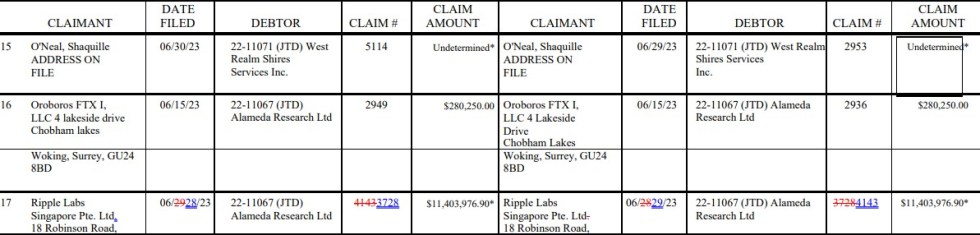
Ripple’s court claim against Alameda Research. Source: FTX court filing
Related Reading: ADA Price Set To Explode: Analyst Identifies Indicators That Predict A Massive Rally
It is important to note that the filing emphasizes that the order and any subsequent actions or payments made by the debtors should not be interpreted as an admission of the validity, amount, or basis of any claim against them under bankruptcy or non-bankruptcy law. 
Furthermore, the order should not be seen as a waiver of the debtors’ or any other party’s right to dispute claims, a promise or requirement to pay specific claims, or an admission regarding the nature of any particular claim.
The filing also includes a list of claims to be disallowed, alongside surviving claims, which provides insight into the parties and amounts involved in the bankruptcy case. 
Singapore Arm Secures $11.4 Million Claim On FTX Assets
Of particular interest is the claim made by Ripple Labs Singapore Pte. Ltd., with an impressive amount of $11,403,976.90. 
Ripple’s successful claim to FTX’s assets is a significant milestone for the company and represents a victory in addition to its ongoing dispute with the Securities and Exchange Commission (SEC).
By asserting their rights in the bankruptcy case, Ripple Singapore has positioned itself as a relevant party in the matter and stands to potentially benefit from the allocation of FTX’s assets.
As the court reviews the revised order and deliberates on the various claims, stakeholders will be closely monitoring the proceedings to assess the potential impact on Ripple’s financial position and future operations.

Ripple

XPR’s price uptrend on the daily chart. Source: XRPUSDT on TradingView.com According to data provided by CoinGecko, XRP is currently valued at $0.638416, marking a 2.40% increase over the past 24 hours. This positive momentum has also contributed to a 6.10% price rise over the past week.
The cryptocurrency’s trading volume has reflected strong investor interest, with a 24-hour trading volume of $1,792,104,137.87. 
XRP’s market capitalization stands at an impressive $34,549,510,806, reaffirming its position as one of the most valued cryptocurrencies in the market. 

Criptos en tendencia

Lecturas Relacionadas

One Vote Could Make SOL's Daily Burn Rate Soar 14 Times

Solana's first formal on-chain governance vote concluded on August 27th, coinciding with SOL hitting a yearly high. Three key proposals aimed at reshaping the network's tokenomics were decided. Solana's core challenge is a massive usage-to-value capture gap. Despite processing 120x more transactions than Ethereum and leading in DEX volume, its fee revenue is significantly lower due to its fee structure. Currently, most fees (priority fees) go to validators, with only a small base fee partially burned. This results in high net inflation (approx. 6k SOL issued vs. ~650 burned daily). The three proposals seek to address this: **SGP-0001** establishes the formal governance framework. **SGP-0002** (Double Deflation Acceleration) proposes doubling the annual reduction rate of new SOL issuance from 15% to 30%, aiming to reach the terminal inflation rate by 2029 instead of 2032, reducing issuance by an estimated 18.9 million SOL. **SGP-0003** (Resource & Entry Fee Restructuring) would split the base fee into a fixed "entry fee" for block producers and a variable, fully burned "resource fee." This could increase daily SOL burns by ~14x to 7,500-9,000. Major stakeholders like Helius, Jupiter, and Jito support the changes. However, opposition exists, notably from Solana Company (HSDT), whose revenue is 99.4% from staking. They argue rapid changes could disrupt institutional adoption. Critics also highlight a potential conflict where validators can vote against reduced staking yields using delegated SOL without explicit voter consent. The outcome of these votes provides a directional mandate. If passed, they represent a significant step towards aligning Solana's immense network activity with tangible economic value for SOL holders.

marsbitHace 5 min(s)

One Vote Could Make SOL's Daily Burn Rate Soar 14 Times

marsbitHace 5 min(s)

Chinese Venture Capital Is Shifting from 'Selecting People' to 'Selecting Cities'

Chinese Venture Capital: Shifting from "Picking Founders" to "Picking Cities" The article discusses a significant shift in China's venture capital (VC) landscape. Historically, VC investments heavily focused on the individual founder's vision, track record, and capability, as seen in early internet-era successes like Wang Xing (Meituan), Li Bin (Nio), and Li Xiang (Li Auto). The belief was that betting on exceptional people was the key to success. However, the rise of hard tech startups—in fields like semiconductors, robotics, AI, and biotech—has changed this calculus. These industries depend heavily on deep, localized ecosystems: specialized talent pools, established supply chains, manufacturing bases, and application scenarios. A city's industrial "resume" now significantly impacts a startup's chances. Examples include Shenzhen's dominance in robotics, Beijing's concentration of AI firms, Suzhou's biotech cluster, and Hefei's successful bet on semiconductor giant ChangXin. This shift is further driven by changes in funding sources. Government-guided funds and state-owned capital now dominate VC limited partners (LPs). These "patient capital" investors prioritize local economic development, job creation, and industrial chain growth alongside financial returns. Their early bets signal viability to other investors. Ultimately, the VC logic remains about managing risk and increasing the odds of success. In the hard tech era, a supportive city ecosystem provides crucial resources—talent, suppliers, R&D, and policy stability—that a single founder cannot easily assemble. The investment due diligence process has thus expanded from evaluating just the founder to also evaluating the founder's city. Consequently, capital is concentrating in a few regions with strong, focused industrial foundations, challenging other cities to build compelling, credible ecosystems to attract investment.

marsbitHace 59 min(s)

Chinese Venture Capital Is Shifting from 'Selecting People' to 'Selecting Cities'

marsbitHace 59 min(s)

Trading

Spot

Artículos destacados

Cómo comprar ADA

¡Bienvenido a HTX.com! Hemos hecho que comprar Cardano (ADA) sea simple y conveniente. Sigue nuestra guía paso a paso para iniciar tu viaje de criptos.Paso 1: crea tu cuenta HTXUtiliza tu correo electrónico o número de teléfono para registrarte y obtener una cuenta gratuita en HTX. Experimenta un proceso de registro sin complicaciones y desbloquea todas las funciones.Obtener mi cuentaPaso 2: ve a Comprar cripto y elige tu método de pagoTarjeta de crédito/débito: usa tu Visa o Mastercard para comprar Cardano (ADA) al instante.Saldo: utiliza fondos del saldo de tu cuenta HTX para tradear sin problemas.Terceros: hemos agregado métodos de pago populares como Google Pay y Apple Pay para mejorar la comodidad.P2P: tradear directamente con otros usuarios en HTX.Over-the-Counter (OTC): ofrecemos servicios personalizados y tipos de cambio competitivos para los traders.Paso 3: guarda tu Cardano (ADA)Después de comprar tu Cardano (ADA), guárdalo en tu cuenta HTX. Alternativamente, puedes enviarlo a otro lugar mediante transferencia blockchain o utilizarlo para tradear otras criptomonedas.Paso 4: tradear Cardano (ADA)Tradear fácilmente con Cardano (ADA) en HTX's mercado spot. Simplemente accede a tu cuenta, selecciona tu par de trading, ejecuta tus trades y monitorea en tiempo real. Ofrecemos una experiencia fácil de usar tanto para principiantes como para traders experimentados.

1.7k Vistas totalesPublicado en 2024.12.10Actualizado en 2026.06.02

Cómo comprar ADA

Discusiones

Bienvenido a la comunidad de HTX. Aquí puedes mantenerte informado sobre los últimos desarrollos de la plataforma y acceder a análisis profesionales del mercado. A continuación se presentan las opiniones de los usuarios sobre el precio de ADA (ADA).

活动图片