$6.44 Billion Worth of Bitcoin Options Set to Expire Friday: Will the Market See a Volatile Move?

marsbitPublicado a 2026-08-28Actualizado a 2026-08-28

Resumen

A significant $6.44 billion in Bitcoin options, comprising 81,700 contracts, is set to expire on Friday on the Deribit exchange. The put/call ratio of 0.83 indicates a bullish bias among holders. The "max pain" price, where most contracts expire worthless, is around $70,000, well below Bitcoin's current price. Notably, approximately 62% of these contracts are deeply out-of-the-money and are expected to expire without value. Historically, large-scale option expiries like a $15 billion event in June 2025 and a $13.3 billion expiry in December 2024 have not significantly moved Bitcoin's price. Analysts suggest such expiries often sound more impactful than they prove to be. However, this event coincides with other market catalysts, including Federal Reserve Chair Kevin Warsh's speech at the Jackson Hole symposium. While option sellers' hedging activities can create independent market flows, the consensus is that this expiry alone is unlikely to cause major volatility. Attention is shifting to the even larger options expiration scheduled for September. Key price levels to watch include Bitcoin's 200-day moving average near $69,000 if a recent market pullback continues.

Author:Jose Antonio Lanz

Compiled by:Deep Chao TechFlow

Deep Chao Guide: Bitcoin options worth $6.44 billion are set to expire in a concentrated batch on Friday on Deribit, corresponding to 81,700 contracts, with a put/call ratio of 0.83, indicating an overall bullish bias. The max pain point is around $70,000, significantly below the current price. However, the majority of contracts are out-of-the-money and will expire worthless. Historically, expiries of similar scale have often failed to significantly impact the price.

Bitcoin options worth $6.44 billion are set to expire on Friday on cryptocurrency derivatives exchange Deribit. This is a substantial figure, coinciding with renewed momentum in the Bitcoin market and a shift in sentiment following a quiet crypto winter. But will this expiry genuinely affect Bitcoin's price?

The Bitcoin options expiry event is one of many catalysts closely watched by crypto traders. It coincides with the second day of the Jackson Hole Economic Policy Symposium—where the new Federal Reserve Chair, Kevin Warsh, is scheduled to deliver his first keynote address as the central bank's chief—while Bitcoin's rally also faces its first real price resistance test above $80,000.
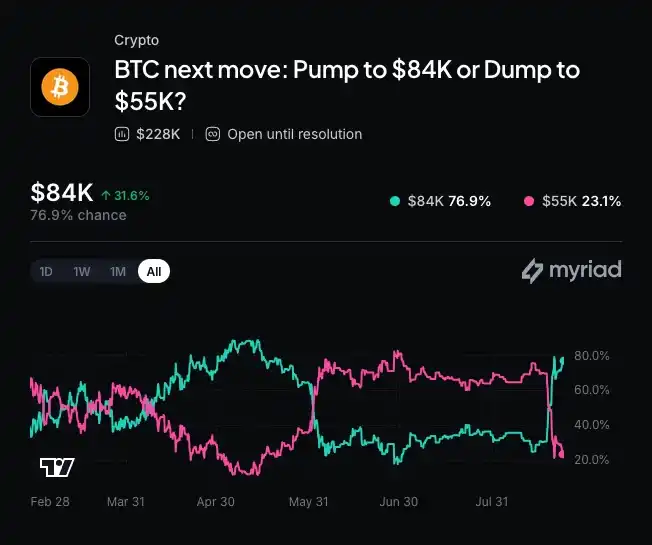
An expiry of this scale is significant because the institutions that sold these options must hedge their exposure by buying or selling actual Bitcoin as prices move. A book valued at $6.44 billion is capable of generating its own independent hedging flows, which can stir the market on their own, irrespective of any news.

This $6.44 billion corresponds to 81,700 contracts—44,639 call contracts versus 37,061 put contracts—resulting in a put/call ratio of 0.83, a distribution skewed bullish. This figure represents nearly one-fifth of Deribit's total Bitcoin open interest expiring in a single trading session.

The $6.44 billion is a notional value figure, not the actual amount of money changing hands. The majority of Friday's contracts are deep out-of-the-money and will expire completely without triggering any settlement. The strike prices with the heaviest open interest—$75,000 and $80,000—mark where option sellers hold their largest positions, not where the market is destined to settle.

Traders focus on a price level known as the "max pain" point, which is the strike price at which the largest volume of contracts would expire worthless. Deribit indicates the max pain for the August 28 expiry is around $70,000, approximately $9,000 to $11,000 below Bitcoin's price today.

Not everyone is bracing for chaos. Frank Hepworth, CEO of New Market Trading, told TheStreet that expiry weeks "always sound scarier than they are." He pointed out that 62% of Friday's contracts are headed for a worthless expiry, and the size of the September expiry is already shaping up to be nearly double that of this week's.

Hepworth noted that if the pullback triggered by this week's hot PCE data continues into Friday, a level worth watching is Bitcoin's 200-day moving average (around $69,000).
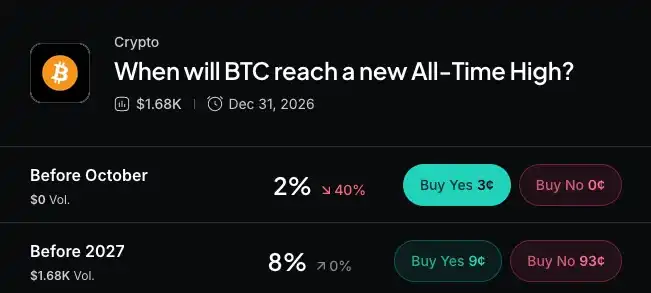
Large-scale expiries do not automatically push Bitcoin prices. The $15 billion expiry in June 2025, with a max pain point of $102,000 and implied volatility at its lowest since October 2023, saw Bitcoin barely budge.

Similarly, the $13.3 billion Deribit expiry in December elicited a muted market response, despite the max pain point being around $100,000 to $102,000.

The difference in Friday's setup lies in the location of pressure, not how far the max pain is from the spot price. Bitcoin is trading close enough to the $75,000 and $80,000 strike prices to keep market makers' hedging active. Furthermore, this expiry aligns with other catalysts this week, including Wednesday's inflows into spot Bitcoin and Ethereum ETFs, and Warsh's speech at Jackson Hole on Friday.

Deribit's contracts will settle on Friday at 08:00 UTC, roughly coinciding with the time window for Warsh's speech at Jackson Hole. According to Hepworth, the September options book is already accumulating towards a size nearly double that of Friday's, setting the stage for a potentially larger test three weeks from now.


Criptos en tendencia

Preguntas relacionadas

QWhat is the total nominal value of Bitcoin options expiring on Deribit this Friday, and how does the put/call ratio indicate market sentiment?

AThe total nominal value of Bitcoin options expiring on Deribit this Friday is $64.4 billion. The put/call ratio is 0.83, which indicates a bias towards bullish sentiment as there are more call options (44,639) than put options (37,061) set to expire.

QWhat is the 'max pain' price for the upcoming Bitcoin options expiration, and how does it compare to the current spot price?

AThe 'max pain' price for the upcoming expiration is approximately $70,000. This is significantly lower than the current spot price, which was about $9,000 to $11,000 higher at the time of the article's writing, suggesting many contracts are out-of-the-money.

QAccording to the article, why might a large options expiration not automatically lead to significant Bitcoin price volatility?

AA large options expiration might not automatically lead to significant price volatility because a majority of the contracts are deeply out-of-the-money and will expire worthless without triggering settlements. Historical examples, like the $150 billion expiration in June 2025 and the $133 billion expiration in December, showed minimal market impact despite their large nominal size.

QWhat two key price levels (strike prices) hold the heaviest concentration of contracts for this expiration, according to the article?

AThe two key strike prices with the heaviest concentration of contracts for this expiration are $75,000 and $80,000.

QWhat other market events are mentioned as coinciding with this options expiration, potentially adding to market catalysts?

AThe options expiration coincides with other market events, including the second day of the Jackson Hole Economic Policy Symposium (where new Fed Chair Kevin Warsh is scheduled to speak) and Wednesday's inflows into spot Bitcoin and Ethereum ETFs.

Lecturas Relacionadas

One Vote Could Make SOL's Daily Burn Rate Soar 14 Times

Solana's first formal on-chain governance vote concluded on August 27th, coinciding with SOL hitting a yearly high. Three key proposals aimed at reshaping the network's tokenomics were decided. Solana's core challenge is a massive usage-to-value capture gap. Despite processing 120x more transactions than Ethereum and leading in DEX volume, its fee revenue is significantly lower due to its fee structure. Currently, most fees (priority fees) go to validators, with only a small base fee partially burned. This results in high net inflation (approx. 6k SOL issued vs. ~650 burned daily). The three proposals seek to address this: **SGP-0001** establishes the formal governance framework. **SGP-0002** (Double Deflation Acceleration) proposes doubling the annual reduction rate of new SOL issuance from 15% to 30%, aiming to reach the terminal inflation rate by 2029 instead of 2032, reducing issuance by an estimated 18.9 million SOL. **SGP-0003** (Resource & Entry Fee Restructuring) would split the base fee into a fixed "entry fee" for block producers and a variable, fully burned "resource fee." This could increase daily SOL burns by ~14x to 7,500-9,000. Major stakeholders like Helius, Jupiter, and Jito support the changes. However, opposition exists, notably from Solana Company (HSDT), whose revenue is 99.4% from staking. They argue rapid changes could disrupt institutional adoption. Critics also highlight a potential conflict where validators can vote against reduced staking yields using delegated SOL without explicit voter consent. The outcome of these votes provides a directional mandate. If passed, they represent a significant step towards aligning Solana's immense network activity with tangible economic value for SOL holders.

marsbitHace 3 min(s)

One Vote Could Make SOL's Daily Burn Rate Soar 14 Times

marsbitHace 3 min(s)

Chinese Venture Capital Is Shifting from 'Selecting People' to 'Selecting Cities'

Chinese Venture Capital: Shifting from "Picking Founders" to "Picking Cities" The article discusses a significant shift in China's venture capital (VC) landscape. Historically, VC investments heavily focused on the individual founder's vision, track record, and capability, as seen in early internet-era successes like Wang Xing (Meituan), Li Bin (Nio), and Li Xiang (Li Auto). The belief was that betting on exceptional people was the key to success. However, the rise of hard tech startups—in fields like semiconductors, robotics, AI, and biotech—has changed this calculus. These industries depend heavily on deep, localized ecosystems: specialized talent pools, established supply chains, manufacturing bases, and application scenarios. A city's industrial "resume" now significantly impacts a startup's chances. Examples include Shenzhen's dominance in robotics, Beijing's concentration of AI firms, Suzhou's biotech cluster, and Hefei's successful bet on semiconductor giant ChangXin. This shift is further driven by changes in funding sources. Government-guided funds and state-owned capital now dominate VC limited partners (LPs). These "patient capital" investors prioritize local economic development, job creation, and industrial chain growth alongside financial returns. Their early bets signal viability to other investors. Ultimately, the VC logic remains about managing risk and increasing the odds of success. In the hard tech era, a supportive city ecosystem provides crucial resources—talent, suppliers, R&D, and policy stability—that a single founder cannot easily assemble. The investment due diligence process has thus expanded from evaluating just the founder to also evaluating the founder's city. Consequently, capital is concentrating in a few regions with strong, focused industrial foundations, challenging other cities to build compelling, credible ecosystems to attract investment.

marsbitHace 57 min(s)

Chinese Venture Capital Is Shifting from 'Selecting People' to 'Selecting Cities'

marsbitHace 57 min(s)

Trading

Spot

Artículos destacados

Cómo comprar MOVE

¡Bienvenido a HTX.com! Hemos hecho que comprar Movement (MOVE) sea simple y conveniente. Sigue nuestra guía paso a paso para iniciar tu viaje de criptos.Paso 1: crea tu cuenta HTXUtiliza tu correo electrónico o número de teléfono para registrarte y obtener una cuenta gratuita en HTX. Experimenta un proceso de registro sin complicaciones y desbloquea todas las funciones.Obtener mi cuentaPaso 2: ve a Comprar cripto y elige tu método de pagoTarjeta de crédito/débito: usa tu Visa o Mastercard para comprar Movement (MOVE) al instante.Saldo: utiliza fondos del saldo de tu cuenta HTX para tradear sin problemas.Terceros: hemos agregado métodos de pago populares como Google Pay y Apple Pay para mejorar la comodidad.P2P: tradear directamente con otros usuarios en HTX.Over-the-Counter (OTC): ofrecemos servicios personalizados y tipos de cambio competitivos para los traders.Paso 3: guarda tu Movement (MOVE)Después de comprar tu Movement (MOVE), guárdalo en tu cuenta HTX. Alternativamente, puedes enviarlo a otro lugar mediante transferencia blockchain o utilizarlo para tradear otras criptomonedas.Paso 4: tradear Movement (MOVE)Tradear fácilmente con Movement (MOVE) en HTX's mercado spot. Simplemente accede a tu cuenta, selecciona tu par de trading, ejecuta tus trades y monitorea en tiempo real. Ofrecemos una experiencia fácil de usar tanto para principiantes como para traders experimentados.

473 Vistas totalesPublicado en 2024.12.13Actualizado en 2026.08.21

Cómo comprar MOVE

Discusiones

Bienvenido a la comunidad de HTX. Aquí puedes mantenerte informado sobre los últimos desarrollos de la plataforma y acceder a análisis profesionales del mercado. A continuación se presentan las opiniones de los usuarios sobre el precio de MOVE (MOVE).

活动图片