Why Does the Automated Market Maker (AMM) Mechanism Fail in the Prediction Market Field?

marsbitPublicado a 2026-04-14Actualizado a 2026-04-14

Resumen

The article explores why Automated Market Makers (AMMs), particularly the x*y=k model popularized by Uniswap, fail in prediction markets despite their success in decentralized finance (DeFi). AMMs excel in DeFi by enabling permissionless liquidity provision and continuous trading for tokens that fluctuate indefinitely. However, prediction markets involve binary outcomes where assets settle to either $1 or $0 at expiration. This structural difference causes inherent flaws: liquidity providers (LPs) inevitably suffer losses as pools automatically rebalance toward the losing side upon settlement—making "impermanent loss" permanent. Additionally, AMMs distort price discovery for probability-based markets due to slippage and low liquidity. Early prediction platforms like Polymarket and Augur experimented with AMMs but abandoned them for Central Limit Order Books (CLOBs), which better handle precise probabilistic pricing and binary settlements. The article concludes that while AMMs revolutionized token swaps, their mechanics are mismatched for prediction markets, requiring alternative infrastructure that accommodates binary outcomes and mandatory settlement.

Author: Melee

Compiled by: AididiaoJP, Foresight News

In July 2017, Hayden Adams was laid off by his employer Siemens, where he worked as a mechanical engineer. His college roommate Karl Floersch was working at the Ethereum Foundation at the time and often told him about smart contracts. Adams had previously paid no attention. Now unemployed and looking for something to do, he decided to listen.

The Birth of the Automated Market Maker (AMM)

Floersch recommended a blog post by Vitalik Buterin about running an on-chain exchange using a mathematical formula instead of an order book. The principle was not to match buyers and sellers, but to allow traders to exchange with a pool of assets, with the price automatically set based on the ratio of tokens in the pool. No working version existed at the time. Adams took it on as a learning project, received a $65,000 grant from the Ethereum Foundation, and launched Uniswap in November 2018.
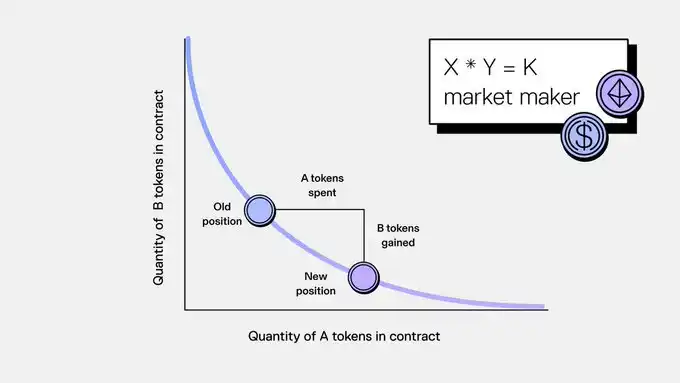
Its formula was deceptively simple: x * y = k.

Two tokens are placed in a pool, and the product of their quantities remains constant. When someone buys one token, they must deposit the other token, changing the ratio within the pool and adjusting the price accordingly. No order book, no matching engine, no professional market makers needed. Anyone can deposit tokens into the pool and earn fees from every transaction.

The automated market maker thus became the cornerstone of decentralized finance. Uniswap, Curve, Balancer, and dozens of other protocols handle billions of dollars in trading volume. On-chain order books are slow and expensive, and traditional market makers have no interest in tokens with only two hundred holders. Automated market makers allow anyone to create a liquid market for any asset at any time. Before AMMs, listing a new asset required permission and infrastructure. After AMMs, all you need is a liquidity pool.

The benefits were obvious. So, prediction markets naturally tried to adopt them too.

Automated Market Makers and Prediction Markets

Prediction markets face the same cold-start problem as token markets. You need liquidity before people are willing to trade, and you need traders before people are willing to provide liquidity. Little known is that Robin Hanson had proposed an automated market making solution for prediction markets years earlier in his 2002 Logarithmic Market Scoring Rule.

He thought he had theoretically solved the cold-start problem. However, in practice, the solution suffered from the same fundamental issue that every subsequent attempt to automate liquidity for prediction markets encountered: the formula couldn't distinguish between perpetually fluctuating tokens and equity certificates that expire.

Prediction market outcomes are binary. They ultimately settle to one or zero. In a token swap pool, both assets can fluctuate indefinitely, and the AMM formula works precisely because neither token is designed to go to zero.

Early Polymarket used an AMM based on the logarithmic market scoring rule. Augur also experimented with similar schemes. If automated liquidity pools worked for token swaps, they should, in theory, work for election betting too.

They didn't.

Why AMMs Fail in Prediction Markets

When a prediction market event settles, one side is worth one dollar, the other zero. For anyone providing liquidity to the pool, the mathematical outcome is nearly brutal. As the market moves towards settlement, the pool automatically rebalances towards the losing side.

Impermanent Loss

What decentralized finance traders call "impermanent loss" becomes completely "permanent" here. Every market settles, and every pool will eventually hold a pile of worthless shares.

In regular DeFi pools, trading fees can offset impermanent loss over time.
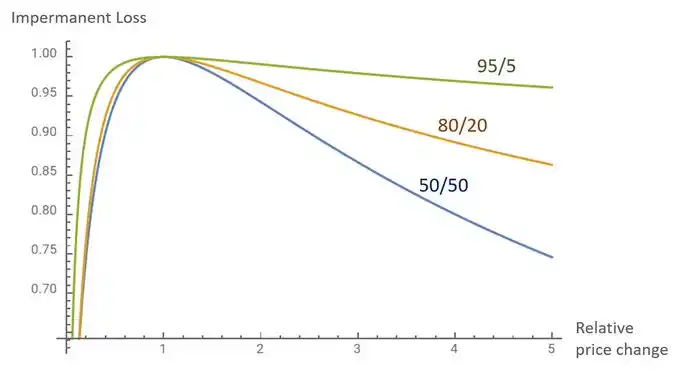
But in prediction markets, the loss is a structural certainty. The only question is how much the liquidity provider loses. Protocols have tried to persuade users to deposit assets into these pools through liquidity mining, reward programs, and various incentive structures. All of these are just different ways to subsidize users to lose money at a slower rate.

Price Discovery

Then there is the issue of price discovery. AMMs price assets based on the pool ratio and a fixed formula. For tokens, the "correct price" is a moving target, and a formula-driven approximation is sufficient. Prediction market prices are supposed to represent probabilities. The slippage introduced by the constant product curve distorts the signal, especially in low-liquidity markets, where a single trade can swing the implied probability by several basis points.

Is the Central Limit Order Book (CLOB) Better Than AMMs?

Polymarket realized this early on. In late 2022, the platform migrated from a logarithmic market scoring rule-based AMM to a central limit order book. AMMs were designed for continuous token swaps across a price range. Prediction markets require precise probability pricing on binary outcomes with known terminal values. They are entirely different problems.

The characteristics that made AMMs revolutionary for tokens—permissionless market creation, instant liquidity bootstrapping, no reliance on professional market makers—are exactly what prediction markets desperately need. The problem is that the specific mechanism, the constant function formula built for token swaps, breaks down when faced with the reality of binary outcomes and inevitable settlement.

The challenge for prediction markets is to replicate these effects with infrastructure that reflects how these markets actually settle.


Preguntas relacionadas

QWhat is the core mathematical formula behind the Automated Market Maker (AMM) mechanism introduced by Uniswap?

AThe core mathematical formula is x * y = k, where x and y represent the quantities of two tokens in the pool, and k is a constant product.

QWhy do AMMs fail in the prediction market space according to the article?

AAMMs fail in prediction markets because these markets involve binary outcomes that eventually settle to $1 or $0, causing structural and certain losses for liquidity providers, unlike in token swaps where both assets can fluctuate indefinitely and fees can offset impermanent loss.

QWhat did early prediction market platforms like Polymarket and Augur experiment with?

AEarly platforms like Polymarket used an AMM based on Robin Hanson's Logarithmic Market Scoring Rule, and Augur also experimented with similar automated liquidity solutions.

QWhat is the key difference between token trading and prediction markets that makes AMMs unsuitable for the latter?

AToken trading involves assets designed to never go to zero and allows for continuous price fluctuations, while prediction markets have binary outcomes that definitively settle to $1 or $0, making AMM-induced losses certain rather than 'impermanent'.

QWhat solution did Polymarket eventually adopt to address the limitations of AMMs?

APolymarket migrated from an AMM based on the Logarithmic Market Scoring Rule to a Central Limit Order Book (CLOB) to better handle precise probability pricing and binary settlement in prediction markets.

Lecturas Relacionadas

9,42 millones de minoristas se apresuran por comprar acciones de Longxin Technology, ¿quién resultó adjudicado?

El resultado de la OPV de Changxin Technology (Long鑫 Tech) se ha dado a conocer. Un total de 9.4288 millones de inversores minoristas y 285 instituciones participaron en la suscripción. Tras activar el mecanismo de reequilibrio, la tasa de asignación para minoristas en línea subió a aproximadamente el 0,4714%, la más alta para una nueva acción en la bolsa STAR, con unos 7,7 millones de números asignados. Se necesitaba un capital de aproximadamente 1,06 millones de RMB para obtener una asignación. Las instituciones recibieron el 28,25% de las acciones. Taikang Asset Management fue la institución que más asignaciones obtuvo. Entre los fondos públicos, los tres primeros fueron E Fund, Southern Fund y ICBC Credit Suisse. El fundador de la destacada empresa china de modelos de IA, Liang Wenfeng, a través de sus firmas de gestión cuantitativa Ningbo幻方 y Zhejiang九章, obtuvo la mayor asignación entre los fondos privados, con un valor total de 1750 millones de RMB. Se estima que podría obtener unas ganancias de 730 millones de RMB si la capitalización de mercado de la empresa alcanza los 3 billones de RMB tras su cotización. Se prevé que Changxin Technology cotice el 27 de julio. Su valoración se sitúa principalmente por encima del billón de RMB, con estimaciones que van desde 1 billón hasta más de 4 billones. Sin embargo, la reciente corrección del mercado tecnológico global podría afectar a su desempeño inicial en bolsa.

marsbitHace 17 min(s)

9,42 millones de minoristas se apresuran por comprar acciones de Longxin Technology, ¿quién resultó adjudicado?

marsbitHace 17 min(s)

Una ‘diosa’ de la caridad con 3 millones de seguidores era todo una IA: la farsa del ‘orfanato falso’ desmonta de la noche a la mañana una beneficencia transnacional

La australiana Lily Jay, una influencer de Instagram con casi 3 millones de seguidores, es investigada por ABC NEWS Verify por una supuesta red de estafa benéfica utilizando contenido generado por IA. A través de su 'Lily Jay Foundation', publicaba videos de proyectos en Uganda, Gaza, Nepal y Sudán, incluyendo la inauguración de un orfanato en Uganda, donde la imagen de ella con niños mostraba anomalías típicas de la IA, como letras mal escritas. Las autoridades de Uganda confirmaron que no existe registro de dicho orfanato. Además, imágenes de un premio humanitario que recibió contenían la marca de agua invisible SynthID de ChatGPT. La investigación revela que la fundación, que operaba desde Kosovo, se define en su sitio web como "no una organización benéfica". Aunque solicitaba donaciones, no figuraba como entidad benéfica registrada en Australia, lo que evita la obligación de transparencia financiera. Tres personas figuran como directores, uno vinculado a una firma de relaciones públicas que promocionó el falso premio. Tras la investigación de ABC, el sitio web eliminó para visitantes australianos los botones de donación y la advertencia sobre su estatus, aunque se mantuvieron activos para el extranjero. Expertos advierten que este caso explota la confianza y el deseo de creer en actos de bondad, marcando un peligroso precedente del uso del 'deepfake' y la IA para defraudar en el sector humanitario.

marsbitHace 57 min(s)

Una ‘diosa’ de la caridad con 3 millones de seguidores era todo una IA: la farsa del ‘orfanato falso’ desmonta de la noche a la mañana una beneficencia transnacional

marsbitHace 57 min(s)

L2 'Recalibrating': Cuando L1 se convierte en su propio Rollup, ¿cuál es el final del camino de Ethereum?

"L2 «recalibración»: cuando L1 se convierte en su propio Rollup, ¿cuál es el final de Ethereum?" La relación entre L1 y L2 en Ethereum está evolucionando. Originalmente, L2 (como los Rollups) se centraban en ofrecer espacio de transacción barato, mientras que L1 priorizaba la descentralización y seguridad. Sin embargo, los avances en Ethereum, como el aumento del límite de Gas y el desarrollo de zkEVM, permiten que L1 también escale significativamente. Esto obliga a repensar el valor de L2, que ya no puede basarse solo en costos bajos, sino que debe ofrecer funciones diferenciadas como privacidad o modelos de gobernanza flexibles. La creciente fragmentación entre múltiples L2 plantea problemas de interoperabilidad y experiencia de usuario. La comunidad está trabajando en soluciones como marcos de intenciones (intents) y una capa de interoperabilidad nativa (EIL) para que Ethereum "vuelva a sentirse como una sola cadena", facilitando las interacciones entre diferentes entornos de ejecución sin que el usuario note la complejidad subyacente. Acortar el tiempo de finalidad de L1 también es crucial para aplicaciones cross-chain. Un concepto provocador sugiere que, con la adopción de sistemas de prueba (zkEVM) en la red principal, Ethereum L1 podría, en un sentido arquitectónico, convertirse en una especie de "Rollup de sí mismo", donde la ejecución y la verificación se separan. Esto, junto con la visión de "Native Rollup", podría difuminar los límites tradicionales entre L1 y L2, transformándolos en un espectro de entornos de ejecución con diferentes funcionalidades pero que comparten seguridad, liquidez y un sistema de estado común. En conclusión, el futuro de Ethereum no es que L1 reemplace a L2 o viceversa. En cambio, el ecosistema podría evolucionar hacia un conjunto unificado de entornos de ejecución especializados que, trabajando en conjunto, ofrezcan escalabilidad, diversidad de funciones y una experiencia de usuario cohesiva. El reto es volver a ensamblar, sin perder los beneficios de la escalabilidad, un Ethereum que funcione como un todo integrado para el usuario final.

marsbitHace 58 min(s)

L2 'Recalibrating': Cuando L1 se convierte en su propio Rollup, ¿cuál es el final del camino de Ethereum?

marsbitHace 58 min(s)

Trading

Spot
活动图片