Valentine’s Day Crypto Warning: US Attorney Issues Crypto-Fueled Romance Scam Alert

ccn.comPublicado a 2026-02-14Actualizado a 2026-02-14

Resumen

The US Department of Justice has issued a Valentine’s Day warning about cryptocurrency-fueled romance scams. Fraudsters typically approach victims on dating sites or social media, using fake profiles and stolen photos to build emotional trust over weeks or months. They then fabricate emergencies and request payments in crypto, gift cards, or wire transfers—methods that are difficult to reverse. Recent cases include a Colorado man who lost $1.4 million after meeting a woman on a dating app who persuaded him to invest in crypto. According to Chainalysis, crypto scams received at least $14 billion in 2025, with impersonation scams surging by 1,400% compared to the previous year. Authorities advise conducting reverse image searches, consulting trusted friends before sending money, and reporting suspicious activity to the FBI.

Key Takeaways

  • The Department of Justice has issued a crypto warning as Valentine’s Day hits.
  • Real-world losses are escalating.
  • Crypto scam activity surged in 2025.

U.S. federal prosecutors are warning Americans not to let Valentine’s Day turn into a costly heartbreak, as romance scammers increasingly demand payment in cryptocurrency.

The U.S. Attorney’s Office for the Northern District of Ohio on Thursday urged the public to remain vigilant against online crypto romance scams that exploit victims’ trust and emotions.

Try Our Recommended Crypto Exchanges
Sponsored
Disclosure
We sometimes use affiliate links in our content, when clicking on those we might receive a commission at no extra cost to you. By using this website you agree to our terms and conditions and privacy policy.
"}' data-trk="6970dbafcbd599f15ce64045" href="https://links.ccn.com/links?code=6985b71f73f50d4865cba0f2" rel="nofollow" target="_blank">
ChangeNow<\/h3>"}' data-trk="6970dbafcbd599f15ce64045" href="https://links.ccn.com/links?code=6985b71f73f50d4865cba0f2" rel="nofollow" target="_blank">

ChangeNow

promotions
Receive 0.4% of the volume from each transaction with your referral link.<\/strong>"}' data-trk="6970dbafcbd599f15ce64045" href="https://links.ccn.com/links?code=6985b71f73f50d4865cba0f2" rel="nofollow" target="_blank"> Receive 0.4% of the volume from each transaction with your referral link.
Coins
217
Claim Offer
"}' data-trk="6899b9831836d97539c51aa6" href="https://links.ccn.com/links?code=693293fa4a5bcb6231949c97" rel="nofollow" target="_blank">
Bitunix<\/h3>"}' data-trk="6899b9831836d97539c51aa6" href="https://links.ccn.com/links?code=693293fa4a5bcb6231949c97" rel="nofollow" target="_blank">

Bitunix

promotions
Receive up to $100,000 worth of exclusive gifts for newcomers upon registration.<\/strong>"}' data-trk="6899b9831836d97539c51aa6" href="https://links.ccn.com/links?code=693293fa4a5bcb6231949c97" rel="nofollow" target="_blank"> Receive up to $100,000 worth of exclusive gifts for newcomers upon registration.
Coins
151
Claim Offer
"}' data-trk="67adf8d4f12aaec7e4808bf5" href="https://links.ccn.com/links?code=693291aa4a5bcb62319448b2" rel="nofollow" target="_blank">
Bitget<\/h3>"}' data-trk="67adf8d4f12aaec7e4808bf5" href="https://links.ccn.com/links?code=693291aa4a5bcb62319448b2" rel="nofollow" target="_blank">

Bitget

promotions
New user rewards up to 6,200 USDT.<\/strong>"}' data-trk="67adf8d4f12aaec7e4808bf5" href="https://links.ccn.com/links?code=693291aa4a5bcb62319448b2" rel="nofollow" target="_blank"> New user rewards up to 6,200 USDT.
Coins
89
Claim Offer
Explore All Offers

DOJ Flags Valentine’s Day Crypto Warning

Federal prosecutors said fraudsters typically approach victims on dating websites, social media platforms, and messaging apps, posing as romantic partners.

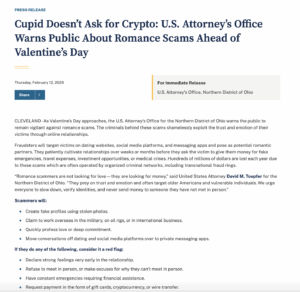
In a stark warning , titled “Cupid Doesn’t Ask for Crypto,” the DOJ explained how bad actors cultivate relationships over weeks or months before fabricating emergencies, travel needs, or medical crises.

Among the clearest warning signs, according to the Justice Department, are requests for payment in crypto, gift cards, or wire transfers, methods favored by scammers because they are hard to reverse.

The office said scammers frequently create fake profiles using stolen photos, claim to work overseas in the military or international business, and profess deep affection quickly.

The DOJ has issued a Valentine’s Day warning about crypto. | Source: DOJ

They often move conversations off mainstream dating platforms to private messaging apps and avoid meeting in person.

“Romance scammers are not looking for love — they are looking for money,” said U.S. Attorney David M. Toepfer for the Northern District of Ohio.

Adding: “They prey on trust and emotion and often target older Americans and vulnerable individuals. We urge everyone to slow down, verify identities, and never send money to someone they have not met in person.”

Regional Cases Underscore Growing Threat

Victims are advised to conduct reverse image searches of profile photos, consult trusted friends before sending funds, and report suspicious activity to the FBI’s Internet Crime Complaint Center (IC3).


In the report, authorities cited recent regional cases, including a Ghanaian national charged in an alleged scheme that took more than $8 million from elderly victims.

Last September, a Colorado man was also reported to have lost $1.4 million after falling victim to a crypto-linked romance scam.

The man, who first spoke to 9News , said he met a woman on Ashley Madison, a website marketed to married people seeking affairs.

After weeks of video chatting and exchanging photos, their conversations shifted to the woman’s interest in crypto and her view of it as a good opportunity for him.

Over roughly six weeks, the man said he made four separate cryptocurrency transfers, ultimately losing $1.4 million in retirement funds and life savings.

Crypto Scams Surge in 2025

The warning comes amid a broader surge in cryptocurrency-related fraud.

Blockchain analytics firm Chainalysis said in its 2026 report that crypto scams received at least $14 billion in on-chain funds last year, up sharply from initial 2024 estimates of $9.9 billion.

Based on historical trends, the firm projected that the 2025 total could exceed $17 billion as more illicit wallets are identified.

The average scam payment rose to $2,764 in 2025 from $782 in 2024, a 253% year-on-year increase, according to Chainalysis.

Impersonation scams, also known as Pig Butchering scams, recorded a 1,400% surge in inflows compared with the previous year.

Top Trending Crypto Articles
  • Best Exchanges Check Out Our Recommended Exchanges Here
  • Buy Crypto Fast How To Buy Crypto with a Credit Card Now
  • Safe Crypto Gambling See Our Picks for the Best Crypto Gambling Sites

Preguntas relacionadas

QWhat is the main warning issued by the U.S. Department of Justice regarding Valentine's Day?

AThe U.S. Department of Justice has issued a warning about romance scammers who increasingly demand payment in cryptocurrency, urging the public to remain vigilant against online crypto romance scams that exploit victims' trust and emotions.

QWhat are some of the red flags mentioned by the DOJ to identify crypto romance scams?

ARed flags include requests for payment in cryptocurrency, gift cards, or wire transfers; scammers creating fake profiles using stolen photos; claiming to work overseas in the military or international business; professing deep affection quickly; and moving conversations off mainstream platforms to private messaging apps while avoiding in-person meetings.

QHow much did crypto scams receive in on-chain funds in 2025 according to Chainalysis?

AAccording to Chainalysis, crypto scams received at least $14 billion in on-chain funds in 2025, with projections that the total could exceed $17 billion as more illicit wallets are identified.

QWhat was the average scam payment in 2025 compared to 2024?

AThe average scam payment rose to $2,764 in 2025, which is a 253% increase from the $782 average in 2024.

QWhat advice does the DOJ give to avoid falling victim to these scams?

AThe DOJ advises victims to conduct reverse image searches of profile photos, consult trusted friends before sending funds, and report suspicious activity to the FBI’s Internet Crime Complaint Center (IC3). They also emphasize never sending money to someone they have not met in person.

Lecturas Relacionadas

El Trilema de la Escalabilidad es un Falso Problema

Autor: Billy Gao Traducción: Jiahuan, ChainCatcher El sistema criptográfico más potente de la historia no puede proteger la privacidad de tus fondos. Cada transacción y cada posición se emiten públicamente en la cadena de bloques. La cadena de bloques es esencialmente una computadora compartida, lenta, costosa y sin propietario. Su principal ventaja es que nadie puede evitar que la uses ni engañarte sobre los resultados. La "trilema" tradicional —descentralización, escalabilidad, seguridad— ha sido en gran medida superada, pero no es el principal obstáculo. El problema real son dos defectos de diseño: la legitimidad y la falta de privacidad. La transparencia total en las cadenas públicas no es una característica positiva, es un impuesto que se paga en forma de MEV, front-running y exposición financiera. Los fondos (como las monedas estables) son el caso de uso ideal para la cadena, ya que el registro en el libro mayor es el activo en sí mismo. Sin embargo, el capital institucional y los grandes patrimonios no participan porque no exponen públicamente sus balances. La legitimidad está mejorando con marcos regulatorios, pero la privacidad sigue siendo la gran barrera. La privacidad con cumplimiento normativo demostrable, basada en pruebas criptográficas de conocimiento cero, es la solución. Permite verificar hechos (solvencia, KYC) sin revelar datos subyacentes, combinando privacidad y transparencia necesaria. Esto representa una mejora pura respecto al modelo actual y es el puente para atraer billones en capital hacia la cadena.

链捕手Hace 8 hora(s)

El Trilema de la Escalabilidad es un Falso Problema

链捕手Hace 8 hora(s)

Las stablecoins finalmente encuentran rendimientos reales: Un análisis detallado del reaseguro en cadena Re | Diálogo con el fundador de Re, Karan Saroya

Establemente las monedas finalmente encuentran rendimientos reales: Re, una plataforma de reaseguro en cadena, absorbe monedas estables de DeFi y las utiliza como garantía para respaldar a aseguradoras estadounidenses, devolviendo las primas obtenidas a los depositantes en cadena. Actualmente respalda a 35 aseguradoras, con un negocio suscrito de 5 mil millones de dólares, y planea superar los 10 mil millones en siete meses. **Puntos clave:** 1. **Fuente de rendimiento real:** Ofrece a los tenedores de monedas estables un rendimiento anual del 12%-14% o más, proveniente del mercado de reaseguro (un billón de dólares), no correlacionado con los mercados tradicionales. 2. **Eficiencia operativa:** Los contratos inteligentes reemplazan los costosos procesos tradicionales de captación de capital, permitiendo a un equipo pequeño competir con gigantes del sector. 3. **Apalancamiento regulatorio:** Por cada 1 dólar de garantía, se pueden respaldar 5-7 dólares en primas, multiplicando los rendimientos. 4. **Integración con DeFi:** Los depositantes reciben un token que puede reutilizarse en protocolos como Morpho para aumentar aún más el rendimiento. 5. **Token de gobernanza RE:** Inspirado en Lloyd's of London, permite a los poseedores gobernar la dirección del capital y los parámetros del sistema. Re representa un punto de inflexión, conectando el capital en cadena con la economía real y proporcionando la demanda necesaria para la infraestructura DeFi existente. Su arquitectura combina un frente regulado con un backend descentralizado eficiente.

链捕手Hace 12 hora(s)

Las stablecoins finalmente encuentran rendimientos reales: Un análisis detallado del reaseguro en cadena Re | Diálogo con el fundador de Re, Karan Saroya

链捕手Hace 12 hora(s)

¿1996 o 1999? La primera prueba de Walsh es 'cómo ver la IA'

El nuevo presidente de la Reserva Federal, Wash, enfrenta su primera gran prueba: determinar si el auge actual de la IA se asemeja más al escenario económico de 1996 o al de 1999. Esta decisión definirá la política monetaria y su legado. Por un lado, está la visión optimista, que asemeja a 1996, donde un crecimiento impulsado por ganancias de productividad permitiría a la Fed mantenerse paciente mientras la inflación retrocede. Wash ha mostrado simpatía por esta narrativa, advirtiendo contra el error de sofocar prematuramente un boom de productividad. Por otro lado, la visión cautelosa, similar a 1999, sostiene que la demanda ya se está calentando y esperar datos concluyentes de productividad podría forzar subidas de tasas más agresivas después. Chicago Fed's Goolsbee argumenta que, al ser un boom ampliamente anticipado, la IA podría inflar la demanda antes de materializar la oferta, presionando la inflación. Wash opera en un contexto más difícil que el de Greenspan en los 90, con presión arancelaria, alto déficit fiscal y menos ventajas globales. Un dilema adicional es su deseo de eliminar la "guía anticipada" de la Fed, un mecanismo creado precisamente en 1999 para gestionar expectativas. Si la economía se recalienta, podría verse forzado a usarlo o arriesgar volatilidad en los mercados. La respuesta a la pregunta central —¿1996 o 1999?— resolverá este y otros dilemas.

marsbitHace 13 hora(s)

¿1996 o 1999? La primera prueba de Walsh es 'cómo ver la IA'

marsbitHace 13 hora(s)

Trading

Spot
Futuros
活动图片