UAE Puts Diamonds On The XRP Ledger: $280 Million+ Now On-Chain

bitcoinistPublicado a 2026-02-04Actualizado a 2026-02-04

Resumen

The United Arab Emirates has tokenized over $280 million worth of certified polished diamonds on the XRP Ledger through a partnership between Billiton Diamond and Ctrl Alt. This initiative aims to digitize Dubai's diamond market by providing end-to-end tokenization, enabling verifiable provenance, grading, and ownership history while streamlining traditionally paper-heavy settlement processes. The XRP Ledger was chosen for its fast settlement, low fees, and scalability, with assets secured by Ripple's custody technology. The project, which requires regulatory approval from VARA, is designed to enhance liquidity, reduce operational complexity, and facilitate global investment in diamonds. XRP was trading at $1.60 at the time of the announcement.

Ripple says more than AED 1 billion (over $280 million) of certified polished diamonds held in the United Arab Emirates have been tokenized on the XRP Ledger, in a deal that ties a high-value physical inventory to on-chain issuance, custody, and (eventually) secondary-market rails.

The initiative, announced Tuesday by Billiton Diamond and Ctrl Alt, is pitched as an end-to-end tokenization effort for certified polished diamond inventory in the Dubai market, one that is designed to make provenance, grading, and ownership history verifiable before a transaction, while compressing settlement and operational workflows that have historically relied on offline certification and paper-heavy transfer processes.

XRP Ledger Powers Dubai Tokenization Push

According to the companies’ press release, Ctrl Alt has already tokenized more than AED 1 billion in diamonds, with tokens minted on the XRP Ledger. The partners said the network was selected for “fast settlement, low fees, and scalable architecture,” while the tokenized assets are secured through Ripple’s “enterprise-grade custody technology.”

Reece Merrick framed the move as a proof point that custody and auditability are central to institutional-grade commodity tokenization. “This initiative shows how Ripple’s technology can bridge the gap between physical assets and the digital economy, utilising our enterprise-grade custody solution to secure high-value diamond assets with unrivalled trust and security,” Merrick wrote on X.

He added that the firms were “providing the infrastructure needed to move physical commodities on-chain at scale,” calling it “a significant leap forward for the future of commodities tokenization.” Notably, the firms first announced their partnership in July last year.

Billiton, which the release describes as a leader in rough diamond auctions using a Vickrey auction model, said the collaboration is intended to expand into tokenized polished diamond sales phases. The planned platform would embed real-time inventory management and certification data on-chain, enabling verification of origin, grading, and ownership history before trades.

The firms also pointed to future “secondary market readiness” workstreams: custody, transfer, and market participation, implying the tokens are being structured not just as a digitized record, but as infrastructure for distribution.

The press release said the next stages are subject to regulatory approval by Virtual Assets Regulatory Authority (VARA) prior to launch. That detail matters: the partners are explicitly positioning the effort as compliant market infrastructure, not a one-off proof of concept.

Jamal Akhtar argued the core unlock is liquidity and time-to-cash in a market where diamonds have traditionally been operationally complex to finance and transfer.

“This partnership transforms polished diamonds from a traditionally illiquid asset class into a transparent, investable digital asset that supports manufacturers, brands, and investors alike,” Akhtar said. “Tokenization introduces an unprecedented level of transparency, unlocking the potential for new liquidity, shortening working capital cycles for manufacturers and traders, and opening the door to seamless global participation in Dubai’s growing luxury ecosystem.”

The announcement also credits DMCC with connecting stakeholders and helping build the ecosystem for diamond tokenization, with Ahmed Bin Sulayem describing DMCC as a “bridge between commodities, capital and next-generation digital markets,” and pointing to coordination with VARA as part of the framework underpinning the rollout.

Ctrl Alt’s Robert Farquhar said: “‍Billiton needed robust, institutional-grade infrastructure to handle the complexity and scale of its polished diamond supply. Our proven tokenization expertise and technology provide a clear, secure, and compliant route for diamond ownership to move on-chain, from asset origination to digital market participation. This establishes a more accessible and operationally efficient model for commodity investment in the UAE.”

At press time, XRP traded at $1.60.
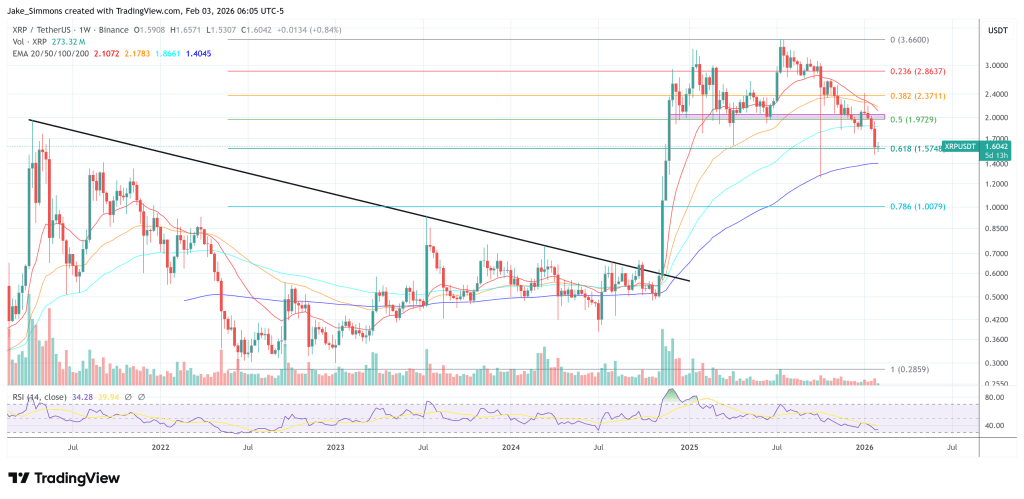
XRP stays above the 0.618 Fib, 1-week chart | Source: XRPUSDT on TradingView.com

Preguntas relacionadas

QWhat is the total value of diamonds that have been tokenized on the XRP Ledger in this initiative?

AMore than AED 1 billion, which is over $280 million.

QWhich two companies announced the partnership for tokenizing diamonds on the XRP Ledger?

ABilliton Diamond and Ctrl Alt.

QWhat are the three main reasons cited for choosing the XRP Ledger for this tokenization project?

AFast settlement, low fees, and scalable architecture.

QWhat regulatory body must approve the next stages of this project before launch?

AThe Virtual Assets Regulatory Authority (VARA).

QAccording to Jamal Akhtar, how does tokenization transform the diamond market?

AIt transforms polished diamonds from a traditionally illiquid asset class into a transparent, investable digital asset, unlocking new liquidity, shortening working capital cycles, and enabling seamless global participation.

Lecturas Relacionadas

Punto de tormenta en los mercados globales: La desapalancamiento del mercado bursátil de Corea está prácticamente completado

Tras una fuerte caída del 32% desde junio, el mercado coreano ha sido el epicentro de la volatilidad global, amplificada por la estructura de apalancamiento concentrado. Sin embargo, el proceso de desapalancamiento forzoso está alcanzando su fase final. Las principales fuentes de inestabilidad, los ETF apalancados y los fondos de cobertura, han reducido significativamente su exposición. Se estima que los ETF apalancados han eliminado aproximadamente el 75% del exceso, pasando de 500 mil millones a 260 mil millones de USD, y su tamaño debería converger hacia niveles sostenibles, apoyado por nuevas regulaciones estrictas de las autoridades. Por su parte, los fondos de cobertura han reducido su apalancamiento en más del 50%. El riesgo sistémico de los préstamos al consumo para inversión es limitado, con un balance que representa solo el 0.5% de la capitalización bursátil, muy por debajo de los niveles de EE.UU. o China, y sin un mecanismo de reequilibrio diario que desencadene ventas en cascada. En resumen, las estructuras de alto apalancamiento que provocaron la espiral de ventas se han purgado en gran medida. El mercado está pasando de una caída impulsada por la liquidez a una valoración impulsada por los fundamentos. Si la tendencia subyacente de la IA permanece intacta, esta corrección representa más una limpieza de posiciones congestionadas que el fin del ciclo. La disrupción tecnológica sigue su curso, y la volatilidad actual puede ser el costo de participar en esta transición estructural, no un riesgo terminal para la tesis de inversión.

链捕手Hace 50 min(s)

Punto de tormenta en los mercados globales: La desapalancamiento del mercado bursátil de Corea está prácticamente completado

链捕手Hace 50 min(s)

Fragmentos Eternos del Dinero: Los Pagos de Terceros No Tienen una Primera Naturaleza

El artículo analiza la actual situación de la industria de pagos, centrándose en los retos de Stripe y PayPal. Stripe, tras perder su ventana de IPO durante la pandemia, ha visto caer su valoración y busca crecimiento mediante adquisiciones, como su posible compra de PayPal. La autora argumenta que la industria de pagos está altamente fragmentada y es inherentemente dependiente de la banca tradicional, lo que limita el crecimiento disruptivo. Stripe intentó innovar apostando por las stablecoins (como OUSD) y la economía de los agentes IA (Agentic Payment) para acceder al mercado minorista (C2C) y crear nuevos modelos, pero estos esfuerzos no han replicado su éxito inicial con desarrolladores. Las stablecoins, aunque prometedoras, aún no son mainstream y los agentes IA se usan principalmente para inflar volúmenes de transacciones. El futuro de empresas como Stripe y Circle podría estar en construir redes de liquidación (clearing) eficientes sobre sus blockchains (Tempo y Arc), aprovechando licencias bancarias para capturar valor más allá de las simples comisiones por transacción. Sin embargo, la autora concluye que la industria de pagos es un campo de batalla permanente, donde la escala no garantiza la victoria debido a las barreras locales y regulatorias. La pregunta final es si este nuevo enfoque en eficiencia y liquidación tendrá éxito donde otros han fracasado.

链捕手Hace 1 hora(s)

Fragmentos Eternos del Dinero: Los Pagos de Terceros No Tienen una Primera Naturaleza

链捕手Hace 1 hora(s)

Trading

Spot
活动图片