Plummeting Around 12%, Duan Yongping's Bottom-Fishing CoreWeave Turns into a Fierce Battlefield Between Bulls and Bears

marsbitPublicado a 2026-05-09Actualizado a 2026-05-09

Resumen

On May 8th, AI cloud computing provider CoreWeave (CRWV) plunged 11.4% following its Q1 2026 earnings report, intensifying the polarized market view on the stock. While revenue doubled year-over-year to $2.08B and its Remaining Performance Obligations (RPO) surged to nearly $100B, its net loss also widened to $740M. The key trigger was a weaker-than-expected Q2 revenue forecast, coupled with rising costs that compressed adjusted operating margin to just 1%. The bull thesis centers on CoreWeave's massive order backlog, deep strategic ties with NVIDIA as a key customer and investor, and client diversification with major names like Anthropic and Meta. Supporters point to its 'hyperscale' status and over $20B in recent financing. Bears highlight the "growth at all costs" model: despite soaring revenue, losses are expanding, capital expenditures are massive (~$6.8B in Q1), and total debt has ballooned to around $25B. Significant insider selling by executives adds to skepticism. This contrast is embodied by investor Duan Yongping (known as "China's Buffett"), who initiated a small, exploratory position (~0.12% of his portfolio) in Q4 2025 near the stock's lows, viewing it as a speculative bet on the AI infrastructure chain. The upcoming Q2 report is seen as a critical test for management's promise of a profit margin rebound. CoreWeave remains a battleground stock where long-term narrative clashes with near-term financial reality.

Author: Deep Tide TechFlow

On May 8, AI cloud computing provider CoreWeave (CRWV) plummeted 11.4% in a single day, closing at $114.15. This marks another instance of "earnings day decline" for the company since its IPO in March of last year. However, unlike previous times, this sell-off is compounded by a more dramatic contrast: Duan Yongping, widely known in Chinese circles as a disciple of Warren Buffett, just established a new position in CoreWeave in Q4 2025, amounting to approximately $20 million. Based on the position size and the Q4 average price, his entry point was close to CoreWeave's lowest range for the year in December 2025.

CoreWeave is currently one of the most divisive AI assets in the US stock market. On one side is the narrative of being a "pick-and-shovel seller" deeply tied to Nvidia, backed by nearly $100 billion in order backlog; on the other side is the financial reality of expanding losses with scale, alongside continuous insider selling. The Q1 earnings report acted like a prism, refracting this divide with stark clarity.

Q1 Earnings: Revenue Doubles but Losses Widen, Q2 Guidance Punctures Valuation

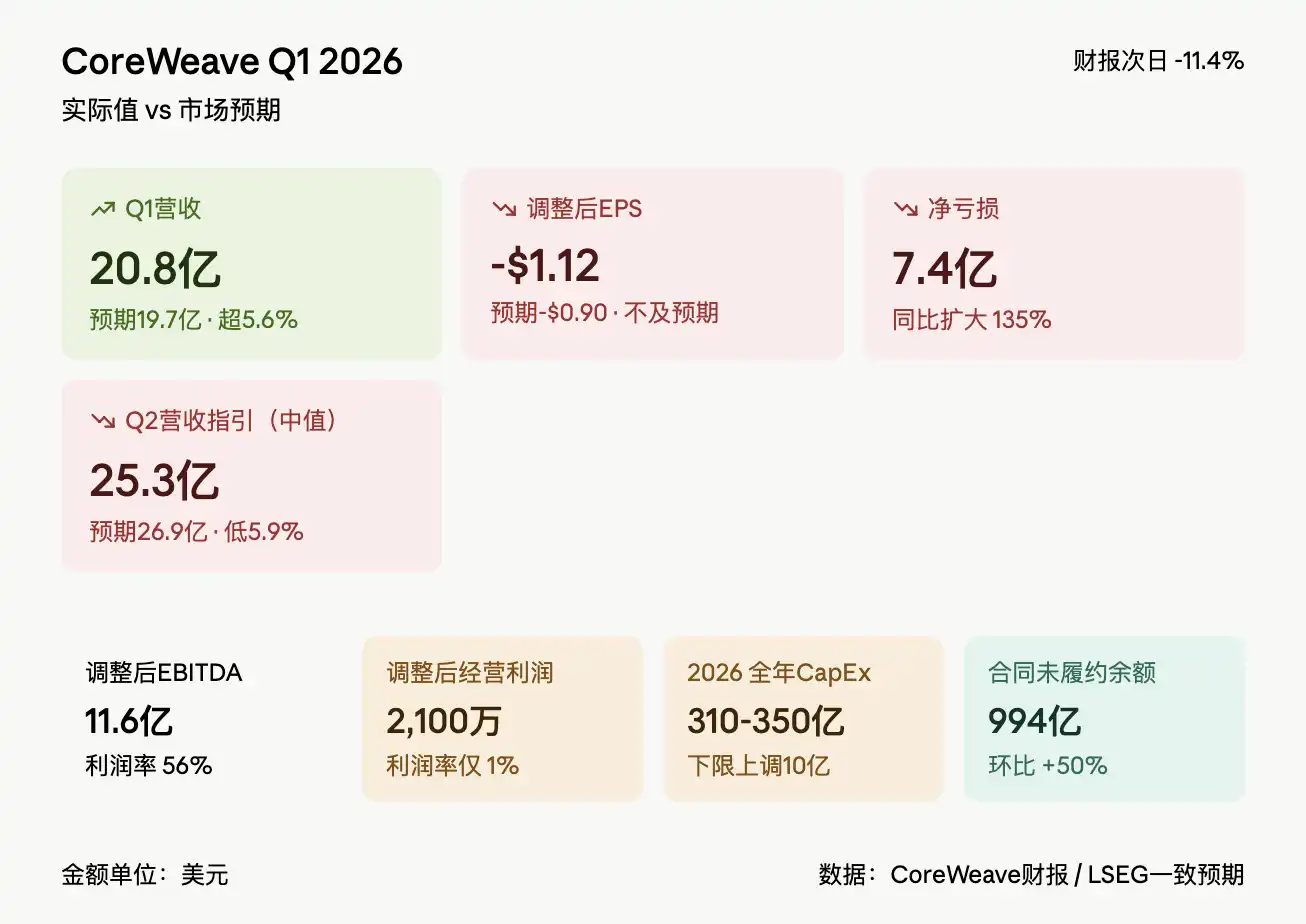
CoreWeave's Q1 revenue reached $2.08 billion, a 112% year-over-year increase and a 32% sequential increase, surpassing the LSEG market consensus of $1.97 billion. However, adjusted earnings per share loss was $1.12, worse than the expected loss of $0.90; the net loss widened to $740 million, more than doubling from $315 million a year ago.

The forward guidance is what truly ignited the sell-off. The company provided a Q2 revenue range of $2.45 billion to $2.6 billion, with a midpoint of $2.53 billion, significantly lower than the market expectation of $2.69 billion. Concurrently, the lower limit for the full-year 2026 capital expenditure was raised from $30 billion to $31 billion, with CFO Nitin Agrawal attributing the increase to rising component costs.

The fragility of the profit structure was laid bare. While Q1 adjusted EBITDA reached $1.16 billion (a 56% margin), which appeared impressive; adjusted operating profit was merely $21 million, compressing the operating margin to just 1%. The reason lies in the 127% year-over-year surge in technology and infrastructure costs to $1.27 billion, and sales and marketing expenses skyrocketing over sixfold to $69 million. Revenue is growing, but costs are growing faster.

CEO Michael Intrator emphasized on the earnings call: "We have reached hyperscale." He disclosed that the company now has 10 clients committed to spending over $1 billion each, a significant improvement in concentration risk compared to 2024 when 62% of revenue relied on a single customer, Microsoft. Intrator also projected that CoreWeave's annualized revenue should exceed $30 billion by the end of 2027.
The Bull Narrative: $100 Billion Order Backlog, Deep Ties with Nvidia

The core supporting the bull case is the order backlog. As of the end of Q1, CoreWeave's remaining performance obligations (RPO) stood at $99.4 billion, a net increase of approximately $33 billion sequentially and nearly quadrupling year-over-year. Intrator stated that new contracts signed in Q1 alone exceeded $40 billion.

The client roster is also reshaping market perception. In Q1, CoreWeave added Anthropic as a client, providing computing power for its Claude series models; signed a $2.1 billion AI cloud agreement with Meta; trading firm Jane Street committed to roughly $6 billion in orders and separately completed a $1 billion equity investment. Nvidia purchased an additional $2 billion worth of CoreWeave Class A common stock this quarter. This global largest GPU supplier is simultaneously an investor and a significant customer of CoreWeave, a tripartite relationship dubbed Nvidia's "favored son."

Regarding financing structure, CoreWeave completed an $8.5 billion investment-grade HPC (High-Performance Computing) secured delayed draw term loan (DDTL) in Q1, priced below 6%, hailed by management as "groundbreaking." Year-to-date, the company has raised over $20 billion in debt and equity financing, with the weighted average cost of debt decreasing by approximately 80 basis points. S&P Global Ratings concurrently upgraded CoreWeave's credit rating outlook from "stable" to "positive."

The Bear Logic: Bigger Scale, Less Profit, Debt Snowball Grows Larger

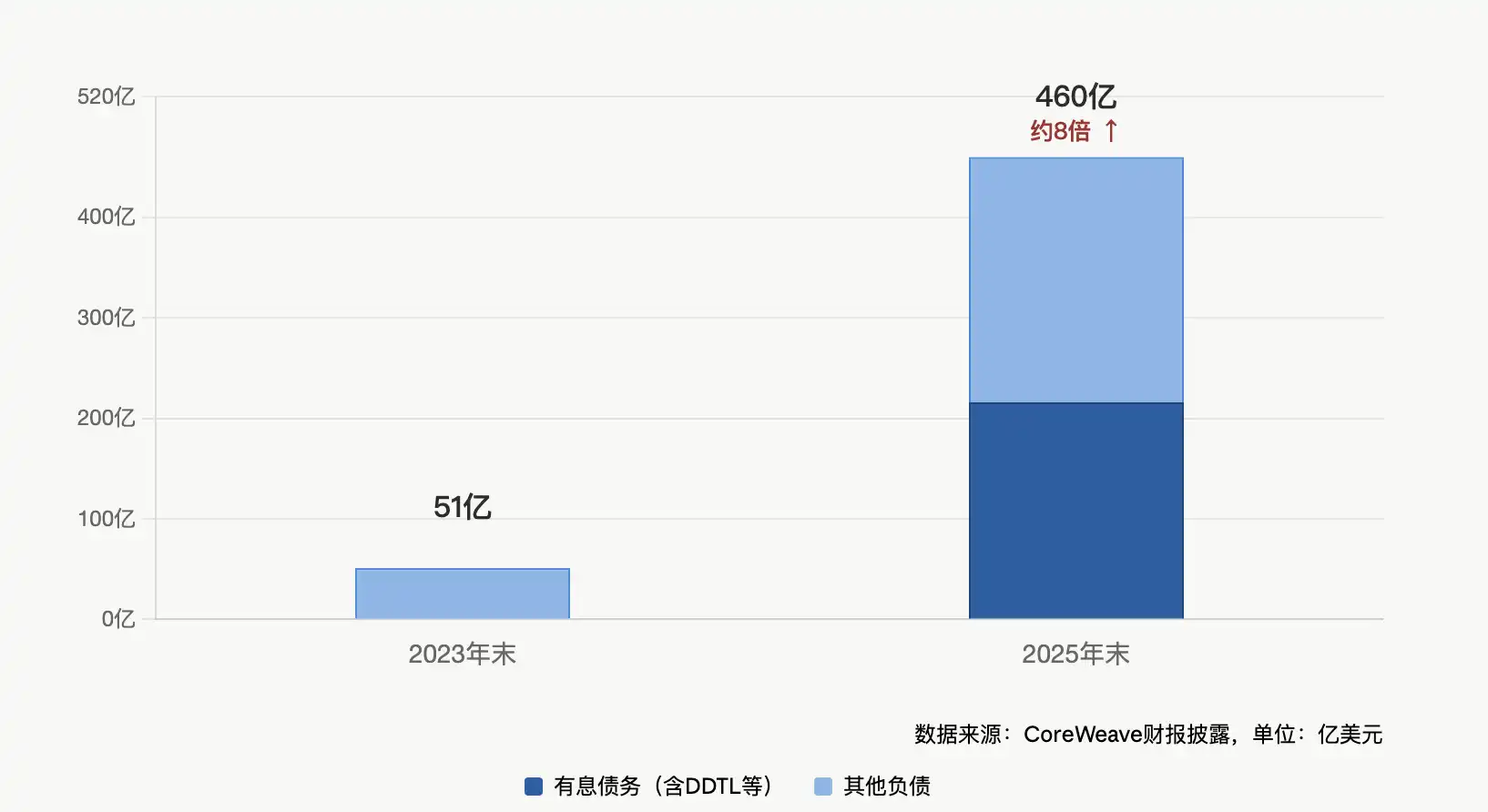
However, another set of numbers in the earnings report is causing anxiety. Q1 capital expenditure reached $6.8 billion, and the company expects Q2 capital expenditure to further climb to between $7 billion and $9 billion. The Q2 interest expense guidance range is $650 million to $730 million, reflecting the rapid expansion of the debt pile.

The total debt burden is already staggering. As of the end of Q1, CoreWeave's total debt was approximately $25 billion. Relative to the company's current annualized revenue scale, this leverage level is significantly higher than that of traditional cloud service providers. Morgan Stanley data shows that CoreWeave's debt financing for the full year 2025 reached about $11.8 billion, far exceeding the approximately $1.5 billion in equity financing during the same period. The company's core expansion tool is the DDTL, a "book-then-fund" model where it secures bank financing to purchase GPUs, using order contracts as collateral.

The sharpest criticism stems from profit quality. Although management repeatedly highlights the 56% EBITDA margin, the adjusted operating margin is only 1%, and the "real" gross margin after deducting technology and infrastructure costs is about 4%, showing compression both sequentially and against market expectations. On the call, Intrator attributed this to the phased effects of scaling, where the dilution effect on margins from adding new capacity is immense when expanding rapidly from a 1-gigawatt operational scale. He promised this was the "low point for margins," which would gradually rebound in future quarters.

However, the market is currently unwilling to pay for that promise. While analysts from Morgan Stanley and Jefferies issued positive evaluations, CoreWeave has experienced short-term pullbacks after every previous earnings report, with this decline being one of the steeper ones.
Ongoing Insider Selling, Mirroring Duan Yongping's Bottom Fishing

Around the earnings release, CoreWeave insiders continued their selling. CEO Mike Intrator sold 307,693 shares in late April; co-founders Brian Venturo and Chen Goldberg also recorded sales; institutional shareholder Magnetar Financial had previously offloaded over $300 million worth. The latest disclosures show another major shareholder recently sold approximately 1.2 million shares.

This forms a stark contrast with Duan Yongping's Q4 position building. According to a 13F filing by H&H International Investment in February 2026, Duan Yongping initiated a position in CoreWeave of 299,900 shares in Q4 2025, when the company's stock price had retreated over 65% from its highs, and market concern over its debt structure peaked.

It is noteworthy that CoreWeave constitutes only 0.12% of Duan Yongping's total H&H portfolio, a "light test" position. During the same period, Duan aggressively increased his Nvidia stake by over 1110% and initiated new positions in Credo Technology (high-speed connectivity) and Tempus AI (AI healthcare), with these three new AI positions combined accounting for less than 0.3%. This suggests Duan's real heavy bet is on Nvidia itself, with CoreWeave resembling a small, extended bet on the downstream AI computing supply chain.

The Key Question Now: Inflection Point or Trap?

During the Q&A session of the earnings call, Intrator posed an emotionally charged rhetorical question: "I've always felt like everyone is staring at the stock price tree and missing the whole forest."

This statement aptly summarizes the current bull-bear standoff. The bulls see the forest: the nearly $100 billion contract backlog, diversified customer base, tripartite Nvidia ties, and the credit rating upgrade. The bears see the tree: the 1% operating margin, widening net loss, aggressive capital expenditure, and continuously selling insiders.

CoreWeave's stock price is still up nearly 80% year-to-date and over 200% since its IPO. However, when a stock's bull case relies on long-term narratives while the bear case rests on current numbers, every earnings report becomes a battleground for these two narratives. In a previous interview with Fang Sanwen, Duan Yongping stated: "AI is a massive revolution brought about by qualitative changes in computing power, potentially exceeding the impact of the internet and industrial revolutions. There is a clear AI bubble currently; 90% of companies may be eliminated, but the survivors will become the next generation of giants." His 0.12% light position itself acknowledges the uncertainty of this gamble.

The next test point is already clear: the Q2 earnings report. If the operating margin fails to rebound as promised by management by then, the credibility of the "forest" narrative will face a real stress test.


Preguntas relacionadas

QWhy did CoreWeave's stock price drop sharply on May 8th?

ACoreWeave's stock price dropped 11.4% on May 8th primarily due to disappointing Q2 revenue guidance. The company forecast Q2 revenue between $2.45 and $2.6 billion, with a midpoint of $2.53 billion, which was significantly below market expectations of $2.69 billion. Additionally, the company's Q1 net loss widened to $740 million, more than double the loss from a year ago, and its adjusted operating margin was compressed to just 1%, fueling investor concerns about profitability despite rapid revenue growth.

QWhat are the main arguments of CoreWeave's bullish investors?

ABullish investors focus on CoreWeave's massive backlog of nearly $100 billion in Remaining Performance Obligations (RPO), which grew significantly in Q1. They highlight its deep ties with Nvidia, which is an investor, customer, and key GPU supplier. The company has diversified its client base, securing major agreements with companies like Meta and Anthropic, and improving its reliance on a single customer (previously Microsoft). Strong financing, including low-cost debt, and an 'investment-grade' credit rating upgrade from S&P also support the positive long-term narrative.

QWhat are the main concerns of CoreWeave's bearish investors?

ABearish investors point to CoreWeave's deteriorating profitability as scale increases. Key concerns include a net loss that more than doubled year-over-year, a razor-thin 1% adjusted operating margin, and capital expenditures that are soaring ($6.8B in Q1). The company's massive and growing debt load (approximately $25B) and high interest expense are seen as significant risks. Furthermore, the ongoing insider selling by executives and major shareholders contrasts with the bullish public narrative, raising questions about internal confidence.

QWhat was Duan Yongping's investment action regarding CoreWeave, and what does it signify?

ADuan Yongping, through his investment firm H&H International, initiated a position in CoreWeave in Q4 2025, purchasing approximately 299,900 shares worth around $20 million when the stock was near its yearly low. However, this position represents a very small 0.12% of his total portfolio. His much larger bet is on Nvidia itself. The CoreWeave investment is viewed as a minor, exploratory allocation to the downstream AI infrastructure sector, acknowledging both the sector's potential and its high uncertainty, rather than a strong conviction bet on the company.

QWhat is the key upcoming test for CoreWeave's investment thesis according to the article?

AThe next crucial test for CoreWeave will be its Q2 2026 earnings report. CEO Michael Intrator has promised that Q1 represented a 'low point' for margins and that profitability would improve in subsequent quarters. If the Q2 report fails to show a meaningful rebound in the operating margin from the current 1% level, the credibility of the company's long-term growth and profitability narrative ('the forest') will face severe pressure, potentially leading to further investor skepticism and stock price volatility.

Lecturas Relacionadas

Un análisis de 10.000 palabras: de 10 a 290 dólares, MRVL ganó toda la era de la IA 'sin hacer GPU'

En junio de 2026, la acción de Marvell Technology (MRVL) alcanzó un máximo histórico de 290 dólares, multiplicándose por 30 desde 2016. Este análisis explora la valoración del mercado, argumentando que Marvell es más que un "pequeño Broadcom". Su valor reside en un nicho único: la **conectividad** para la infraestructura de IA, donde lidera con el 70% del mercado en chips DSP ópticos de alta velocidad. Marvell no fabrica GPU; vende "conexión": el flujo de datos entre chips, servidores y centros de datos a través de la luz. Su estrategia, dirigida por el CEO Matt Murphy desde 2016, se centró en recortar negocios periféricos, adquirir empresas clave (como Inphi y Celestial AI) y asociarse a largo plazo con hiperescaladores como AWS. Su negocio tiene tres pilares: 1) Interconexión óptica (su ventaja más sólida), 2) Chips personalizados de IA para grandes tecnológicas (con 18 proyectos en curso), y 3) Chips de conmutación y almacenamiento empresarial. La inversión estratégica de 20.000 millones de NVIDIA en Marvall subraya su papel crucial en el ecosistema de IA, aunque también introduce una relación compleja de cooperación y competencia. Financieramente, Marvell muestra un crecimiento acelerado (40%+) y apalancamiento operativo, con un PEG atractivo de ~0,6. Los riesgos incluyen la pérdida del diseño Trainium3 para Amazon, márgenes estructuralmente más bajos que Broadcom, la concentración de clientes, ventas de ejecutivos y presiones en la cadena de suministro. Sin embargo, su posición dominante en interconexión óptica y su cartera integral de conectividad "eléctrica + óptica" ofrecen una ventaja competitiva duradera. La tesis central es que, en la era de la IA, el valor de "conectar" superará al de los "nodos" de computación, y Marvell está posicionado de manera única para capitalizar esta tendencia estructural.

marsbitHace 15 min(s)

Un análisis de 10.000 palabras: de 10 a 290 dólares, MRVL ganó toda la era de la IA 'sin hacer GPU'

marsbitHace 15 min(s)

Las estaciones intermedias de IA generan un debate candente en Zhihu: detrás de los Tokens baratos, ¿qué preocupa realmente a los usuarios?

La discusión en Zhihu sobre las "estaciones intermediarias de IA" ha trasladado el tema de los "tokens baratos" desde círculos de desarrolladores a un público más amplio, generando un debate centrado en costos y confianza. Las principales preocupaciones de los usuarios incluyen: - **Autenticidad del modelo**: Existe un temor generalizado de que los servicios intermedios puedan sustituir modelos de alta gama por versiones inferiores o simuladas ("modelos fantasma"), aprovechando la naturaleza aleatoria de las respuestas para enmascarar la diferencia. - **Costos reales**: La percepción de bajo precio suele basarse en la comparación con las tarifas oficiales por uso de API. Sin embargo, para muchos usuarios, suscripciones oficiales, modelos nacionales chinos o cuotas gratuitas podrían resultar más económicas. Se destaca la necesidad de evaluar primero el patrón de uso personal. - **Fuente de los tokens baratos**: Las explicaciones varían desde descuentos por volumen y optimizaciones técnicas hasta fuentes grises como la división de cuentas, explotación de cuotas gratuitas o arbitraje geográfico. Esta opacidad dificulta evaluar los riesgos asociados a cada servicio. - **Seguridad de los datos**: Más allá de la calidad de las respuestas, los usuarios expresan inquietud por la privacidad de *prompts*, fragmentos de código, documentos comerciales o claves API procesados a través de servidores de terceros. Este riesgo se amplifica en contextos empresariales o con agentes autónomos que ejecutan acciones basadas en respuestas del modelo. - **Consenso práctico**: La discusión converge en que estos servicios pueden ser útiles para tareas de bajo riesgo, desechables y no sensibles (como resúmenes o traducciones simples). Sin embargo, no se recomienda su uso por defecto, especialmente para datos confidenciales (código propietario, información legal, financiera o médica) o en flujos de trabajo productivos empresariales. Se aconseja precaución: no realizar grandes recargas, mantener rutas de respaldo, despersonalizar datos y evitar integrarlos en procesos críticos. En resumen, el debate subraya que el costo real del uso de IA no es solo el precio del token, sino una combinación de factores como la transparencia del modelo, la seguridad de los datos, la estabilidad del servicio y los riesgos de cumplimiento normativo.

marsbitHace 48 min(s)

Las estaciones intermedias de IA generan un debate candente en Zhihu: detrás de los Tokens baratos, ¿qué preocupa realmente a los usuarios?

marsbitHace 48 min(s)

Asociación Blockchain insta al Senado a aprobar la Ley CLARITY con carta respaldada por 160 exfuncionarios

La Blockchain Association, un importante grupo de defensa de la industria, ha instado al liderazgo del Senado de EE. UU. a avanzar en la ley CLARITY mediante una carta respaldada por 160 exfuncionarios de seguridad nacional, inteligencia y aplicación de la ley. Los firmantes argumentan que, sin un marco regulatorio federal claro, la actividad relacionada con las criptomonedas podría trasladarse a mercados extraterritoriales más opacos, dificultando la labor de investigación de delitos financieros. La carta destaca que la ley CLARITY reforzaría las capacidades de prevención del crimen financiero, con medidas como la ampliación de las obligaciones contra el financiamiento ilícito y el fortalecimiento de la supervisión de los cajeros de activos digitales. También propone una mejor coordinación y compartición de información entre el Departamento del Tesoro, el Departamento de Justicia y otras agencias. La asociación enfatiza que estas son mejoras para la aplicación de la ley, no una desregulación. El proyecto de ley, cuya parte correspondiente al Comité de Agricultura ya avanzó, podría someterse a votación en el Senado este verano. Sin embargo, aún necesitaría la aprobación de la Cámara de Representantes, lo que probablemente requerirá un proceso de conciliación con una versión anterior aprobada por dicha cámara.

bitcoinistHace 1 hora(s)

Asociación Blockchain insta al Senado a aprobar la Ley CLARITY con carta respaldada por 160 exfuncionarios

bitcoinistHace 1 hora(s)

微信 AI se pone manos a la obra después de bloquear a su propio proyecto 'Yuanbao'

El título "Cerrado su propio tesoro: WeChat AI entra en escena" refleja un momento decisivo para Tencent. Tras bloquear su propia aplicación de IA "Yuanbao" en WeChat por violar las normas de la plataforma, la compañía ha acelerado el desarrollo de un agente de IA nativo integrado directamente en la aplicación de mensajería. Esta decisión estratégica, motivada por la competencia con rivales como Doubao de ByteDance, busca transformar a WeChat de una plataforma donde los usuarios buscan servicios activamente a un sistema donde la IA ejecuta tareas completas. Según informes, el agente de IA de WeChat se activaría deslizando el dedo hacia la derecha en la pantalla principal, permitiendo a los usuarios dar órdenes en lenguaje natural para realizar acciones como reservar citas, pedir comida o comprar entradas, utilizando directamente los mini-programas y WeChat Pay dentro del ecosistema. Esto aprovecha la ventaja única de WeChat: más de 1.400 millones de usuarios activos mensuales, millones de mini-programas con API estandarizadas y un sistema integrado de identidad y pago. La estrategia marca un cambio crucial. En lugar de competir en el campo de las aplicaciones independientes de IA, donde Yuanbao se quedaba atrás, Tencent apuesta por potenciar su fortaleza principal: el ecosistema cerrado de WeChat. El éxito dependerá de factores como la capacidad del modelo de lenguaje base Hunyuan, la gestión de los costes de computación y, críticamente, de cómo se redefinen los incentivos para los desarrolladores de mini-programas, cuyo modelo de negocio podría verse afectado si la IA omite los pasos de navegación tradicionales. Con esta movida, WeChat no solo busca ponerse al día, sino redefinir la conexión entre las personas y los servicios en la era de la IA.

marsbitHace 1 hora(s)

微信 AI se pone manos a la obra después de bloquear a su propio proyecto 'Yuanbao'

marsbitHace 1 hora(s)

Trading

Spot
Futuros
活动图片




