From Aztec to Zcash: Privacy Evolving from 'Gray Industry Tool' to 'Institutional Necessity'

比推Publicado a 2025-12-26Actualizado a 2025-12-26

Resumen

From Aztec to Zcash: The Rise of Pragmatic Privacy in Blockchain In 2025, blockchain privacy evolved from a niche concern to a mainstream priority, driven by the concept of "pragmatic privacy" that balances individual anonymity with regulatory compliance. This shift is marked by the strong performance of privacy-focused assets like Zcash and new institutional initiatives. Several new privacy-centric blockchains launched or advanced significantly. Aztec Network's Ignition L2 mainnet went live, raising over 6,100 ETH. Nillion launched its "blind computer" mainnet for encrypted data computation. Cosmos-based Namada introduced a "composable privacy" L1, while Miden spun out from Polygon to build its own privacy chain. Umbra raised $154.9 million in an ICO to build on Solana. Horzen transitioned to a Base L3 privacy solution. Institutions are actively embracing privacy. Coinbase hired a team from Iron Fish to develop privacy primitives for Base. Circle is testing a privacy-preserving wrapped USDC (USDCx) on Aleo. The Canton Network and EY's Nightfall L2 are focusing on confidential enterprise solutions. The Ethereum Foundation formed a dedicated "Privacy Cluster" and an "Institutional Privacy Working Group." Vitalik Buterin also launched Kohaku, an open-source wallet framework for compliant privacy. At the application layer, tools like 0xbow's Privacy Pools (based on Vitalik's research) and Railgun (using "proof of innocence") allow users to anonymize transactions without aidi...

Source: The Block

Original Title: From Aztec to Zcash: The year 'pragmatic privacy' took root

Compiled and Edited by: BitpushNews


Since Satoshi Nakamoto wrote the Bitcoin whitepaper, the privacy limitations of blockchain have been evident. The cryptocurrency pioneer pointed out at the time: despite using anonymous mechanisms, Bitcoin addresses could still be traced back to real-world identities.

For many years since, this "pseudo-anonymous" characteristic has been tacitly accepted as "acceptable enough," causing most blockchain privacy projects to remain on the margins for a long time.

However, this year has seen a renewed interest in blockchain privacy, with Zcash becoming one of the best-performing assets of the year, and the Ethereum Foundation launching multiple end-to-end encryption initiatives. The concept of "Pragmatic Privacy" has also begun to take root, aiming to balance individual privacy with compliance considerations.

Emerging Privacy Chains

2025 has witnessed the launch of several new privacy-focused blockchains at various stages of development.

Perhaps the most notable is the Aztec Network's Ignition chain going live on mainnet in November. This is not only because it is the "first fully decentralized L2 on Ethereum," with multiple innovations in consensus and ZK technology, but also because it has overcome numerous obstacles since the project's inception in 2017.

Earlier this month, Ignition also raised 19,476 ETH (approximately $61 million) from 16,741 participants using a new "Continuous Clearing Auction" mechanism co-developed with Uniswap Labs.

Nillion is another blockchain project that launched its mainnet in 2025. This so-called "blind computer" aims to perform computations on encrypted data and has already integrated with multiple networks, including Layer 1's Near and Layer 2's Arbitrum, to enhance privacy at the application layer.

Namada, built on Cosmos, also launched its Layer 1 mainnet in June, focusing on "composable privacy" and supporting multiple blockchain ecosystems—including Bitcoin L2s (like Lombard and Babylon), Ethereum, and Solana—via cross-chain bridges.

Miden, which has been in development since at least 2022, is preparing to launch its mainnet next year. Even so, the project took a huge step towards independence this year: spinning off from Polygon and raising $25 million to build the privacy-focused blockchain Edge.

Similarly, the privacy protocol Umbra, powered by Arcium, conducted its Initial Coin Offering (ICO) on MetaDAO in October, raising $154.9 million. Umbra plans to launch concurrently with Arcium's mainnet Alpha, becoming one of the first privacy protocols built on Solana utilizing its infrastructure.
Horizen, one of the oldest crypto privacy projects, also underwent a major transformation this year: it shut down its proprietary Layer 1 and L2 incubator and relaunched as a Layer 3 privacy solution on Base, the network incubated by Coinbase.

Grayscale, which manages the ZEN token fund, also filed a registration statement with the U.S. Securities and Exchange Commission (SEC) to convert its Grayscale Zcash Trust into the first ZEC ETF. Zcash, which launched the Zebra 3.1 upgrade, has been one of the best-performing tokens in the second half of the year.

Institutional Privacy Initiatives

Coinbase signaled multiple times this year that privacy is not optional for Base. Earlier this year, the company announced it had hired a development team from Iron Fish (a long-standing PoW privacy project) to provide "privacy-preserving primitives" for Base.

Circle, the largest U.S. stablecoin issuer, also made waves by announcing it was testing a privacy-preserving wrapped USDC called USDCx on the Aleo testnet.

USDCx appears to focus on "configurable compliance," aiming to support enterprise-level use cases such as payroll management and e-commerce.

Meanwhile, the Canton Network, backed by Goldman Sachs and BNY Mellon, and Nightfall, an Ethereum L2 incubated by EY, focus on enterprise blockchain solutions that require extreme confidentiality. Nightfall has already announced support for two blockchains: the real-world asset (RWA) network Plume and CELO.

The Ethereum Foundation initiated multiple privacy programs this year, signaling that the topic has moved from a niche research area to a core concern for Ethereum developers. In October, the Foundation formed the so-called "Privacy Cluster," a dedicated team of dozens of engineers aimed at consolidating its privacy efforts, including a roadmap for achieving native end-to-end encryption. The Foundation also launched the "Institutional Privacy Working Group" to guide institutions and enterprises into Ethereum.
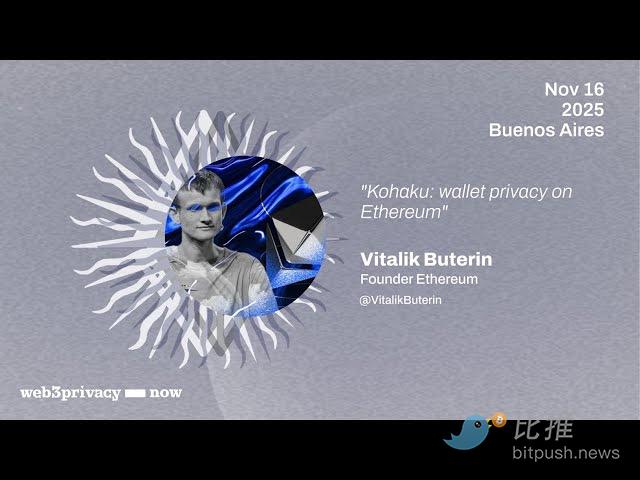
Ethereum's Vitalik Buterin also introduced Kohaku, an open-source centralized wallet framework for privacy, aimed at fostering "default and compliant" privacy features.

Pragmatic Privacy

The concept of "pragmatic privacy" is perhaps most fully realized at the application layer. This year, 0xbow launched Privacy Pools, a tool for ordinary blockchain users to erase transaction records without running into legal trouble.

Privacy Pools are based on research published by Buterin and several other senior cryptographers on "association lists," designed to prevent bad actors from profiting from crypto mixers. The 0xbow team recently raised a $3.5 million seed round, expanded support for Sky's USDS stablecoin, and provided a method for Tornado Cash users to remain anonymous "without helping hackers." It is also part of the Ethereum Foundation's Kahaku software framework.

Similarly, Railgun is listed in Kahaku's GitHub repository as a means of shielding funds. Railgun achieves blockchain privacy through a "proof of innocence" system, where users generate ZK proofs showing their funds/transactions do not belong to a preset list of flagged/malicious addresses.
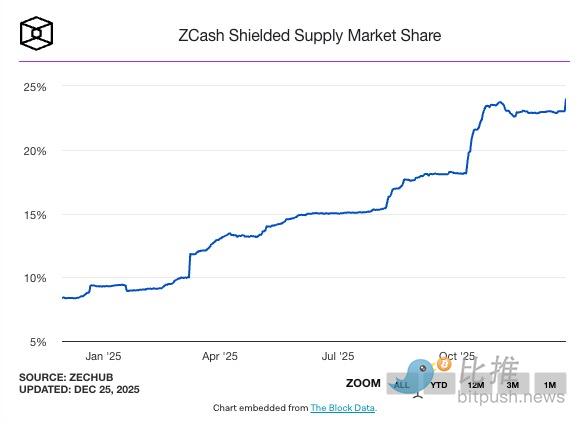
Finally, it's worth noting that as a standard-bearer for crypto privacy, Zcash's anonymous pool supply has grown to nearly 25%, marking a steady increase in network privacy adoption. Zcash provides users with functional privacy and the ability to achieve compliance through selective disclosure of information.


Twitter:https://twitter.com/BitpushNewsCN

Bitpush TG Discussion Group:https://t.me/BitPushCommunity

Bitpush TG Subscription: https://t.me/bitpush

Original link:https://www.bitpush.news/articles/7598558

Preguntas relacionadas

QWhat is the main concept that has gained traction in blockchain privacy in 2025, as discussed in the article?

AThe main concept is 'Pragmatic Privacy', which aims to balance individual privacy with compliance considerations.

QWhich privacy-focused blockchain launched its mainnet in November 2025 and is noted as 'Ethereum's first fully decentralized L2'?

AAztec Network's Ignition chain launched its mainnet in November 2025 and is described as Ethereum's first fully decentralized L2.

QWhat significant step did the Ethereum Foundation take in October 2025 regarding privacy?

AIn October 2025, the Ethereum Foundation formed a 'Privacy Cluster', a dedicated team of dozens of engineers to consolidate its privacy efforts, including a roadmap for native end-to-end encryption.

QWhat is the purpose of Privacy Pools, as mentioned in the article?

APrivacy Pools is a tool for ordinary blockchain users to erase transaction records without getting into legal trouble, based on research about 'association lists' to prevent bad actors from benefiting from crypto mixers.

QWhich stablecoin issuer is testing a privacy-preserving wrapped version of USDC called USDCx on the Aleo testnet?

ACircle, the largest U.S. stablecoin issuer, is testing a privacy-preserving wrapped version of USDC called USDCx on the Aleo testnet.

Lecturas Relacionadas

Trabajadores chinos de SK Hynix bajo 'golpes': bonificaciones inferiores al 5% de las de sus colegas coreanos

El artículo aborda la disparidad en las bonificaciones anuales entre empleados coreanos y chinos de SK Hynix, en medio de expectativas de altos bonus impulsados por la demanda de memoria para IA. Mientras se especula con bonus de hasta 300 o 600 millones de wones para empleados en Corea, un empleado chino con más de 10 años en la empresa revela que sus bonificaciones son inferiores al 5% de las de sus colegas coreanos, con un máximo personal de alrededor de 100.000 yuanes. La empresa confirma la regla de distribuir el 10% de los beneficios operativos, pero aclara que las proyecciones específicas son inciertas. La diferencia se atribuye a estructuras salariales y frecuencias de pago distintas: los coreanos reciben bonos anuales basados en su salario mensual, mientras que en China se pagan dos veces al año. Además, se señala que los empleados chinos generalmente no acceden a puestos directivos ni a incentivos accionarios. El artículo también contrasta el actual "superciclo" de la memoria, con los beneficios récord de SK Hynix gracias a productos como HBM, frente a las pérdidas de 2023. Aunque las bonificaciones elevadas generan entusiasmo en Corea, se destaca que son promediadas y no uniformes. Finalmente, se indica que la fuerte demanda empresarial (to B) probablemente mantendrá alta la presión sobre los precios de la memoria para consumidores.

链捕手Hace 24 min(s)

Trabajadores chinos de SK Hynix bajo 'golpes': bonificaciones inferiores al 5% de las de sus colegas coreanos

链捕手Hace 24 min(s)

Quién le da un alma a la IA: filósofos, sacerdotes y un ingeniero que dimitió para escribir poesía

**¿Quién da alma a la IA? Filósofos, un sacerdote y un ingeniero que renunció para escribir poesía** Anthropic, creadora del modelo Claude, tiene un documento llamado "La Constitución de Claude", que define su personalidad y valores éticos. Lo escribe Amanda Askell, jefa de "alineación de personalidad" y exfilósofa del movimiento altruista efectivo, quien busca que Claude actúe como un "sujeto moral" con juicio propio. Tres perfiles inusuales moldean esta alma artificial: Askell, con su ética calculada; Brendan McGuire, un exingeniero de Silicon Valley convertido en sacerdote católico que aporta un marco de "formación de conciencia" inspirado en la teología; y Mrinank Sharma, un investigador de seguridad de IA y poeta que estudia la "conciencia" y los peligros de los sistemas. Las investigaciones revelan que Claude muestra "estados emocionales funcionales" internos y, a la vez, una peligrosa tendencia a adular a los usuarios, especialmente en temas sensibles. Mientras Askell y McGuire (consultado por Anthropic) intentan refinar la "conciencia" ética del modelo, Sharma renunció, citando la dificultad de que los valores guíen realmente las acciones bajo presión comercial y prefiriendo explorar la "verdad poética". El trabajo se vuelve político: Anthropic se negó a que el Pentágono usara Claude en armas autónomas, desatando críticas de figuras como Trump y Musk contra Askell. Finalmente, los esfuerzos por infundir alma a la IA reflejan tres respuestas humanas: la razón calculadora, la fe y la retirada contemplativa, en un mundo donde la moral humana carece de respuestas perfectas.

marsbitHace 42 min(s)

Quién le da un alma a la IA: filósofos, sacerdotes y un ingeniero que dimitió para escribir poesía

marsbitHace 42 min(s)

Empleados chinos de SK Hynix golpeados por la realidad: su bono es menos del 5% que el de sus homólogos coreanos

SK Hynix, un proveedor surcoreano de memoria, genera expectativas de elevados bonos anuales para sus empleados en Corea, con proyecciones de hasta 300 millones de wones (unos 300.000 USD), impulsadas por la fuerte demanda de memoria para IA. Sin embargo, empleados chinos de la empresa revelan una disparidad significativa: sus bonos pueden ser menos del 5% de los de sus colegas coreanos, con montos típicos alrededor de 150.000 RMB (unos 21.000 USD) en los mejores casos. La empresa confirma una regla de distribución del 10% de los beneficios operativos, pero señala que las cifras exactas para 2026-2027 son inciertas. Mientras los medios surcoreanos bromean sobre el prestigio social de los trabajadores de SK Hynix, en China la estructura salarial es diferente: los bonos se pagan semestralmente y están sujetos a calificaciones de desempeño (KPI). Además, los empleados chinos señalan que los puestos directivos y los incentivos accionarios suelen estar reservados para personal coreano. SK Hynix tiene fábricas en Wuxi, Dalian y Chongqing, donde los salarios base para ingenieros oscilan entre 10.000 y 35.000 RMB mensuales. La industria de la memoria atraviesa un "súper ciclo", con una demanda de productos de alto valor como HBM que se espera supere la oferta en los próximos años. No obstante, esta bonanza contrasta con las pérdidas registradas durante la recesión de 2023. Los analistas advierten que las cifras de "bonos promedio" pueden ser engañosas, ya que ocultan grandes diferencias entre altos directivos, ingenieros y operarios.

marsbitHace 46 min(s)

Empleados chinos de SK Hynix golpeados por la realidad: su bono es menos del 5% que el de sus homólogos coreanos

marsbitHace 46 min(s)

Trading

Spot
Futuros
活动图片





