Crypto treasuries regain footing after recent downturn: Grayscale

ambcryptoPublicado a 2026-03-28Actualizado a 2026-03-28

Resumen

After a challenging period since late 2025, digital asset treasuries (DATs) are showing signs of recovery, according to Grayscale's head of research Zach Pandl. Companies have adopted strategies such as optimizing capital structures, generating income, and diversifying business models to navigate the crypto downturn. For instance, Strategy shifted from convertible bonds to preferred stocks and established a $2.25 billion USD reserve, while BitMine aims to generate $300 million annually by staking its Ethereum holdings. Other firms, like MARA, sold portions of their crypto assets to invest in AI. Although some companies, such as Nakamoto, faced significant stock declines, forced sell-offs were limited overall. DATs have been net accumulators in recent weeks, indicating a return to stability.

After rough headwinds since late 2025, digital asset treasuries are now showing signs of relief.

According to Zach Pandl, head of research at asset manager Grayscale, the sector has crawled out of distress through new strategies.

The DATs are finding their footing again. They have pulled this off by optimizing capital structures, generating income, and diversifying business models.

AD

How DATs are handling crypto winter

The market segment leader, Strategy, for example, pivoted from convertible bonds to preferred stocks. And Stretch (STRC) emerged as a key capital driver for its Bitcoin buying spree.

Additionally, it launched a $2.25 billion USD reserve. This would help cover short-term dividend obligations associated with its preferred stock line-up.

Collectively, the new and optimized capital structures helped the firm reduce its overall debt burden. By extension, it also helped Strategy avoid being removed from major benchmark indices such as the MSCI Index.

On the other hand, some players, such as SharpLink Gaming and BitMine Immersion Technologies, the world’s largest Ethereum treasury firm, opted to stake and restake their crypto holdings to generate income.

In fact, BitMine is targeting $300 million in annual revenue if it stakes its entire 4.6 million ETH stash in the following weeks.

At the same time, other treasury firms, such as Bitcoin miner MARA, sold part of their holdings to bet on AI adoption, as a means of diversifying away from the crypto sector to maximize revenue potential.

Treasury firms pivot amid pressure

But not all managed to adjust accordingly without burning through their holdings. For example, the BTC treasury firm backed by David Bailey, Nakamoto, saw its stock drop nearly to zero. Notably, Sequans sold 970 BTC and paid 50% of its convertible debt, slashing the burden from $189M to $94.5M.

Similarly, ETHZilla liquidated part of its ETH holdings, worth $114M, to fund share buybacks, pay down debt, and pivot to tokenization.

It’s worth pointing out that nearly all the treasury firms’ crypto holdings value fell below their enterprise value in the past few months, forcing most of them to buy back shares to boost their stocks.

This was done either by offloading crypto holdings or by taking additional loans. Metaplanet, for example, raised a $500 million loan and pledged its BTC holdings rather than selling them.

Overall, forced sell-offs among DATs were limited. In fact, they have been net accumulators in the past few weeks.
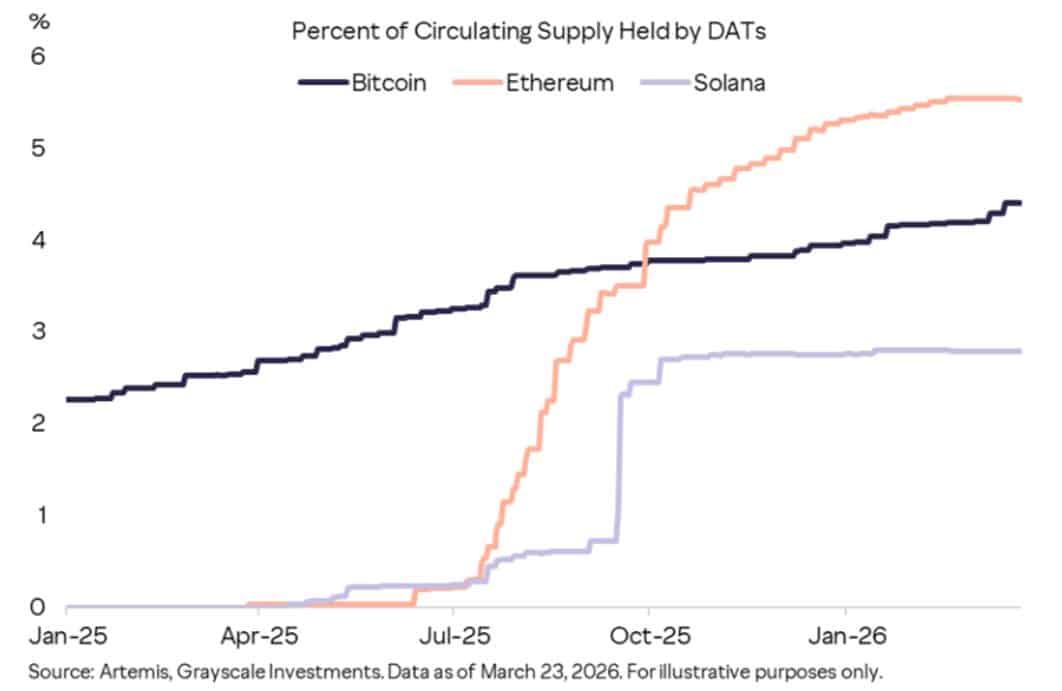
Source: Grayscale

Final Summary

  • DATs, led by Strategy, MARA, and BitMine, opted for new capital structures, new income streams, and diversification into other sectors to survive crypto distress.
  • Grayscale noted that DATs were net buyers in the past few weeks, underscoring that they were finding their ‘footing again.’


Preguntas relacionadas

QWhat are the key strategies that digital asset treasuries (DATs) used to recover from recent distress according to Grayscale?

ADATs recovered by optimizing capital structures, generating income through methods like staking, and diversifying business models into sectors like AI.

QWhich company emerged as a key capital driver due to its Bitcoin buying spree?

AStretch (STRC) emerged as a key capital driver for its Bitcoin buying spree.

QHow much annual revenue does BitMine Immersion Technologies target by staking its entire Ethereum holdings?

ABitMine is targeting $300 million in annual revenue by staking its entire 4.6 million ETH stash.

QWhat action did Metaplanet take to avoid selling its BTC holdings while raising funds?

AMetaplanet raised a $500 million loan and pledged its BTC holdings as collateral instead of selling them.

QWere digital asset treasuries net accumulators or sellers of crypto in the past few weeks?

ADATs were net accumulators (buyers) of crypto in the past few weeks, according to Grayscale.

Lecturas Relacionadas

Los retiros de Bitcoin continúan: 8 años de almacenamiento en una cartera fría Coldcard terminaron en cero

Retirada de bitcoin continúa: 8 años en cartera fría Coldcard terminan en cero La cartera hardware Coldcard ha sido vulnerada, provocando una nueva oleada de retiradas de fondos de dispositivos afectados. Galaxy Research informa que el volumen total robado asciende a 1.367,05 BTC (unos 88,6 millones de dólares) desde 4.585 direcciones, superando ampliamente los 594,5 BTC reportados inicialmente el 30 de julio de 2026. La mayor parte de lo robado permanece inactiva en las direcciones de los atacantes. El problema no reside en el firmware, que ya fue actualizado por Coinkite, sino en las frases semilla (seed phrases) generadas desde marzo de 2021 debido a un error de programación. Estas frases son fácilmente descifrables, y actualizar el firmware no las cambia. Solo transferir los fondos a una nueva dirección con una nueva frase semilla elimina la vulnerabilidad. El fallo se originó al integrar la biblioteca libNgU, lo que hizo que los dispositivos dejaran de usar el generador de números aleatorios por hardware STM32 y pasaran a usar el generador software Yasmarang, inicializado con datos públicamente accesibles como el número de serie del chip. Afecta a frases semilla creadas en dispositivos Mk2/Mk3 (firmware 4.0.1–4.1.9 y hasta 5.0.3), Mk4/Mk5 (hasta v5.6.0) y Q (hasta v1.5.0Q). Se excluyen aquellas creadas con al menos 50 lanzamientos de dados independientes o una passphrase BIP-39 fuerte y única. Los usuarios deben generar una nueva frase semilla en firmware corregido y transferir sus activos. Un caso ilustrativo es el de un inversor de 39 años que perdió 2 BTC (unos 130.000 dólares) en minutos, ahorrados durante ocho años mediante trabajo físico como protección contra la hiperinflación en su país, con el objetivo de una jubilación anticipada a los 50 años. Su estrategia conservadora de "comprar y mantener en frío" se vio truncada, dejándolo devastado y decidido a abandonar las criptomonedas. Este incidente recuerda vulnerabilidades históricas por generadores de números aleatorios débiles, como la de la biblioteca BitcoinJS (2011-2015), que causó grandes pérdidas. Subraya que el almacenamiento offline no garantiza automáticamente seguridad criptográfica, especialmente cuando la entropía se ve comprometida dentro del propio dispositivo "cerrado".

cryptonews.ruHace 2 hora(s)

Los retiros de Bitcoin continúan: 8 años de almacenamiento en una cartera fría Coldcard terminaron en cero

cryptonews.ruHace 2 hora(s)

Trading

Spot
活动图片




