Bittensor Goes Left, Virtuals Goes Right: Two Flywheel Paradigms of AI Crypto Projects

marsbitPublicado a 2026-03-26Actualizado a 2026-03-26

Resumen

The article compares two AI crypto project models: Bittensor's subnet ecosystem and Virtuals' agent-based system. Bittensor uses TAO emissions to incentivize subnets, which compete for daily TAO rewards. Subnets require significant capital to launch (e.g., 871 TAO for a subnet slot) and focus on infrastructure like decentralized computing and AI research. Its ecosystem has high entry barriers, complex onboarding, and targets technical users. Virtuals employs a pump.fun-like model where agent tokens gain value through trading volume, enabling rapid capital accumulation during speculative cycles. It has low entry costs for teams, supports quick iteration via a 60-day trial program, and excels at retail distribution due to its Base chain integration and consumer-friendly concepts. Both models share a liquidity flywheel: demand for subnet tokens boosts TAO, while demand for agent tokens boosts VIRTUAL. Bittensor is infrastructure-oriented with high funding potential, while Virtuals is application-focused, leveraging market momentum for consumer AI agents.

Original Author: 0xJeff

Original Compilation: AididiaoJP, Foresight News

This article aims to provide a brief comparison between Bittensor subnets and Virtuals agents to help understand their respective flywheel mechanisms, differences, and similarities.
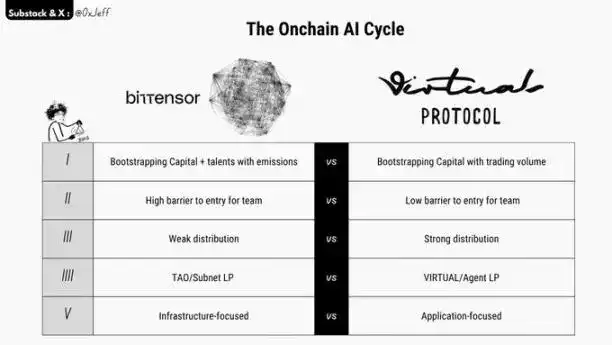
I. Guiding Capital and Talent Through Emissions Mechanism vs. Guiding Capital Through Trading Volume

Bittensor guides subnet development through its TAO emissions mechanism. Subnets are responsible for introducing the most innovative projects (or revenue-generating businesses) and compete for a share of the daily 3,600 TAO distribution.

Subnets also guide contributors (including miners performing tasks and validators verifying the miners' work) through their alpha token emissions mechanism. The emissions mechanism and the incentive coordination mechanism across stakeholders have been embedded since the project's inception.

Virtuals adopts a model similar to pump.fun, guiding development through trading volume. High trading activity translates into capital accumulation for the agent project. Agent teams can use their own emissions mechanisms to incentivize user participation.

In market cycles with high speculative token demand, this model has significant advantages—teams can quickly accumulate capital, gain product attention and market interest, thereby driving project launch and development.

II. High Entry Barrier vs. Low Entry Barrier (For Teams)

Launching a subnet on Bittensor requires substantial investment. Currently, acquiring a subnet slot requires 871 TAO (approximately $300,000), with the price fluctuating based on demand and the auction mechanism. This means subnet teams typically need mature ideas, clear plans, and solid execution capabilities.

To successfully operate a subnet, owners must ensure that the set tasks or objectives contribute to the R&D of their AI product/solution, prevent miner fraud, ensure validators effectively perform verification duties, generate revenue through business development and customer partnerships, and maintain investor confidence through buyback mechanisms.

The subnet token price needs to maintain an upward trend to attract more TAO inflow, increase the subnet's emission share, and thereby attract higher-level contributors to participate in mining.

In contrast, the barrier to launching an AI agent token on Virtuals is lower, requiring no initial cost, making it easier to test new ideas with less capital.

Virtuals also has a "60-day program" that allows founders to test new ideas and issue tokens during this period. If product-market fit is not found within 60 days, the relevant funds are reclaimed, and investors can retrieve a portion of their invested capital.

III. Weaker Distribution Capability vs. Stronger Distribution Capability

Bittensor operates independently on a blockchain built using the Polkadot Substrate framework. Cross-chain bridging is difficult, it lacks DeFi infrastructure components, and is not equipped with common infrastructure like the Ethereum Virtual Machine or Solana.

This results in a high entry barrier for the Bittensor ecosystem. Furthermore, relevant learning materials are filled with complex terminology, increasing the difficulty for new users to learn and understand. Consequently, its community members are mostly technical professionals willing to invest time in deep research, with relatively low retail participation.

In comparison, the understanding threshold for Virtuals is lower. Its team excels in marketing, branding, and distribution. Retail users can relatively intuitively understand concepts like AI agents, agent payments, and bots.

Since Virtuals is deployed on the Base chain, the process of purchasing AI agent tokens is convenient. The time from learning about a project, forming a bullish judgment, to making a purchase decision is short, which is a key reason for its rapid popularity from late 2024 to 2025 (earlier than Bittensor).

Currently, Bittensor is gradually entering the mainstream spotlight with pushes from Jason, Chamath, Barry Silbert (DCG & Yuma), and the community, leading to increased attention. However, the purchase process for subnet tokens remains relatively complex, and the issue has not been fundamentally resolved.

IV. TAO/Subnet Liquidity Pool vs. VIRTUAL/Agent Liquidity Pool

Bittensor and Virtuals share a key similarity in their liquidity pool flywheel mechanisms.

Investors wishing to purchase subnet alpha tokens need to hold TAO to do so. Therefore, rising demand for alpha tokens will drive up the price of TAO.

Similarly, within the Virtuals ecosystem, rising demand for AI agent tokens will drive up the price of VIRTUAL.

If the core tokens (TAO or VIRTUAL) can circulate within the ecosystem without outflow (e.g., through project teams trading goods and services to retain value), the advantages of this mechanism become more pronounced.

V. Infrastructure-Oriented vs. Application-Oriented

Bittensor subnets mostly focus on infrastructure or capital-intensive businesses, such as decentralized computing, inference, training, drug discovery, and quantum experiments.

Since Bittensor can provide over $10 million annually in funding for quality subnets and attract high-end talent, its model is suitable for driving ambitious, high-difficulty, high-investment ideas.

Virtuals agent teams, however, mostly focus on the application layer and consumer-facing agent products. Since agent tokens have a low initial price, if a team can launch a quality consumer product, it can leverage the token's market heat to quickly attract attention and drive project development.

Thanks to Virtuals' advantages in distribution, the flywheel effect of AI agent tokens demonstrated faster growth rates and higher price increases during periods of extreme market activity (such as late 2024 to early 2025).


Preguntas relacionadas

QWhat are the two main AI crypto projects compared in the article, and what are their core flywheel mechanisms?

AThe two main AI crypto projects compared are Bittensor and Virtuals. Bittensor's core flywheel mechanism is guided by TAO emissions to fund subnet development. Virtuals' core flywheel mechanism is guided by trading volume, similar to the pump.fun model, to accumulate capital for AI agent projects.

QHow does the entry barrier for launching a project differ between Bittensor and Virtuals?

ALaunching a subnet on Bittensor has a high entry barrier, currently requiring a significant investment (e.g., 871 TAO, ~$300k) to acquire a subnet slot. In contrast, launching an AI agent token on Virtuals has a low entry barrier, requiring no initial cost, allowing teams to test new ideas with minimal capital outlay.

QWhat is a key similarity in the liquidity pool flywheel mechanism between Bittensor and Virtuals?

AA key similarity is that demand for the ecosystem's project tokens drives the price of the core native token. In Bittensor, demand for subnet alpha tokens drives the price of TAO. In Virtuals, demand for AI agent tokens drives the price of VIRTUAL.

QAccording to the article, what is the primary focus of projects built on Bittensor versus those on Virtuals?

AProjects on Bittensor are primarily infrastructure-oriented, focusing on areas like decentralized computing, inference, training, drug discovery, and quantum experiments. Projects on Virtuals are primarily application-oriented, focusing on consumer-facing AI agent products.

QWhat advantage does Virtuals have over Bittensor in terms of distribution and user accessibility?

AVirtuals has a significant advantage in distribution and user accessibility. It has lower comprehension barriers, strong marketing, and is deployed on the Base chain, making the purchase process for AI agent tokens simple and intuitive for retail users. Bittensor has a higher learning curve, complex terminology, and a more difficult token purchase process, making it less accessible to the average retail participant.

Lecturas Relacionadas

¿Quién asumirá la responsabilidad después de que SpaceX salga a bolsa?

Autor: BitalkNews El 12 de junio, SpaceX saldrá a bolsa con una valoración de 1,8 billones de dólares. Sin embargo, solo circularán unas 556 millones de acciones, con una capitalización bursátil flotante de unos 75.000 millones de dólares (4,2% de la valoración total). La demanda inicial vendrá en tres oleadas. Primero, la suscripción de la OPV a 135 dólares por acción. Segundo, la negociación en el mercado secundario tras la apertura. Tercero, y más relevante, la compra obligatoria por parte de fondos indexados al Nasdaq 100, que se ha modificado para incluir a SpaceX solo 15 días después de su salida a bolsa, generando una demanda concentrada. No obstante, este desequilibrio entre oferta y demanda no durará. SpaceX ha diseñado un sistema de desbloqueo escalonado de las acciones restringidas (alrededor del 54% del capital) para inversores internos y empleados. Los primeros desbloqueos parciales podrían comenzar tras los resultados del Q2 (agosto), seguidos de varias rondas en días específicos y tras el Q3. Elon Musk mantendrá bloqueado su 42% durante 366 días. Así, en los primeros meses, la oferta estará limitada con una demanda fuerte. En la segunda mitad del año, la presión vendedora aumentará a medida que se liberen acciones. Curiosamente, hacia diciembre, durante la rebalanceo anual del Nasdaq 100, el peso de SpaceX en el índice se ajustará al alza, obligando a los fondos pasivos a comprar más, lo que podría actuar como soporte tras meses de ventas internas.

marsbitHace 31 min(s)

¿Quién asumirá la responsabilidad después de que SpaceX salga a bolsa?

marsbitHace 31 min(s)

Anthropic se disculpó, pero el negocio de la "seguridad" no se ha detenido

El 11 de junio, Anthropic se disculpó por una función de "clasificador de seguridad inteligente" en su nuevo modelo Claude Fable 5. Este sistema identificaba y degradaba silenciosamente solicitudes de desarrollo de IA avanzada a un modelo inferior, lo que generó críticas. Anthropic argumentó que era para "proteger" su ventaja competitiva y a los usuarios, pero muchos lo vieron como una defensa comercial disfrazada de seguridad, apuntando específicamente a investigadores rivales. Tras ser descubierto, la compañía prometió hacer las degradaciones visibles, admitiendo que esto podría causar más falsos positivos y afectar a usuarios comunes. El artículo sostiene que la "seguridad" para Anthropic es un negocio. Critica su estrategia de publicar investigaciones que amplifican los riesgos de la IA (como un modelo que acelera la creación de exploits) justo antes de lanzar productos premium con primas de seguridad, creando un ciclo de ansiedad y monetización. Su valoración de 965.000 millones de dólares y planes de OPV se basan en esta imagen de "IA más segura". Se contrasta con OpenAI, que se centra en herramientas y escala. Anthropic, en cambio, vende ansiedad y una supuesta indispensabilidad a clientes corporativos y gubernamentales preocupados por el riesgo. El incidente revela que su definición de "riesgo" incluye actividades que amenazan su liderazgo comercial. La disculpa, por tanto, es vista como un simple parche de relaciones públicas que no cambia su lógica comercial central: la seguridad como un producto rentable, donde incluso las disculpas son parte del servicio postventa.

marsbitHace 50 min(s)

Anthropic se disculpó, pero el negocio de la "seguridad" no se ha detenido

marsbitHace 50 min(s)

¿Consenso minoritario en la élite? ¿La universidad se ha convertido en un desperdicio costoso?

**Resumen: ¿Es la universidad un desperdicio caro? La "revolución anti-universidad" de las élites de Silicon Valley** En los círculos de élite de Silicon Valley, una corriente de pensamiento está ganando fuerza: la idea de que la universidad de cuatro años se ha convertido en una costosa y lenta pérdida de tiempo, desconectada del ritmo del mundo tecnológico. Esta "revolución anti-universidad" ya no es solo el mito del genio que abandona los estudios, sino un movimiento con teoría, organización y respaldo capital. Figuras como el inversor Peter Thiel, con su "Beca Thiel" que paga a jóvenes para que dejen la universidad, y empresas como Palantir, que ofrece una "Beca Meritocracia" como alternativa a un título, lideran esta tendencia. Su argumento es que la universidad es cara, impone una pesada deuda, enseña teorías desactualizadas y sofoca el espíritu innovador. Para ellos, en la era de la IA e internet, el autodidacta es el nuevo graduado. Los impulsores son tres: 1) **Económico**: el alto coste frente a oportunidades inmediatas de emprender. 2) **Tecnológico**: herramientas de IA que permiten crear con poca formación formal. 3) **Cultural**: rechazo al "woke culture" y a lo que ven como un elitismo universitario injusto. Sin embargo, economistas como David Deming advierten sobre los riesgos. Señala que muy pocos son verdaderos autodidactas, que la formación empresarial es estrecha y que la "prima salarial universitaria" sigue siendo muy alta y estable. La historia de Sebastian Tan, un joven que pospuso Stanford para trabajar en Palantir pero planea volver, simboliza esta tensión. El debate no es tanto "universidad sí o no", sino un síntoma de la crisis de un modelo educativo industrial en la era digital. Lo que está en juego es la evolución del aprendizaje hacia un modelo más híbrido, personal y permanente. La pregunta crucial ya no es si ir a la universidad, sino cómo aprender en un mundo que cambia más rápido que cualquier plan de estudios.

marsbitHace 1 hora(s)

¿Consenso minoritario en la élite? ¿La universidad se ha convertido en un desperdicio costoso?

marsbitHace 1 hora(s)

Subsidios → tarificación por Token → reducción de precios: ¿Inicia OpenAI la guerra de precios y se acerca el punto de inflexión de la economía del Token?

La comercialización de la IA generativa enfrenta una revisión profunda tras la evolución desde suscripciones mensuales hasta la facturación por tokens, que ha expuesto los altos costos reales para las empresas. Según The Wall Street Journal, OpenAI considera reducir drásticamente los precios de los tokens para competir con Anthropic, lo que podría desencadenar una guerra de precios. Esta situación es crítica, ya que ambas empresas ya registran pérdidas millonarias debido a los elevados costos de computación. La facturación por tokens ha revelado gastos descontrolados: empresas como Uber agotaron su presupuesto anual en meses, mientras estudios muestran que solo el 18% del gasto en tokens genera valor real para los usuarios. Ante esto, las empresas están implementando controles más estrictos. Expertos como Gary Marcus advierten que una caída de OpenAI podría afectar a gigantes como Nvidia y Oracle. Mientras tanto, actores como DeepSeek, con precios significativamente más bajos, ganan terreno en el mercado estadounidense. El futuro de la economía del token podría incluir modelos de precios por capas o basados en la escasez, enfocándose en maximizar el valor por token en lugar del volumen. Sin embargo, la batalla de precios actual podría redefinir el panorama, beneficiando a proveedores con modelos de coste más eficientes.

marsbitHace 1 hora(s)

Subsidios → tarificación por Token → reducción de precios: ¿Inicia OpenAI la guerra de precios y se acerca el punto de inflexión de la economía del Token?

marsbitHace 1 hora(s)

Trading

Spot
Futuros
活动图片