Bittensor Goes Left, Virtuals Goes Right: Two Flywheel Paradigms of AI Crypto Projects

marsbitPublicado a 2026-03-26Actualizado a 2026-03-26

Resumen

The article compares two AI crypto project models: Bittensor's subnet ecosystem and Virtuals' agent-based system. Bittensor uses TAO emissions to incentivize subnets, which compete for daily TAO rewards. Subnets require significant capital to launch (e.g., 871 TAO for a subnet slot) and focus on infrastructure like decentralized computing and AI research. Its ecosystem has high entry barriers, complex onboarding, and targets technical users. Virtuals employs a pump.fun-like model where agent tokens gain value through trading volume, enabling rapid capital accumulation during speculative cycles. It has low entry costs for teams, supports quick iteration via a 60-day trial program, and excels at retail distribution due to its Base chain integration and consumer-friendly concepts. Both models share a liquidity flywheel: demand for subnet tokens boosts TAO, while demand for agent tokens boosts VIRTUAL. Bittensor is infrastructure-oriented with high funding potential, while Virtuals is application-focused, leveraging market momentum for consumer AI agents.

Original Author: 0xJeff

Original Compilation: AididiaoJP, Foresight News

This article aims to provide a brief comparison between Bittensor subnets and Virtuals agents to help understand their respective flywheel mechanisms, differences, and similarities.
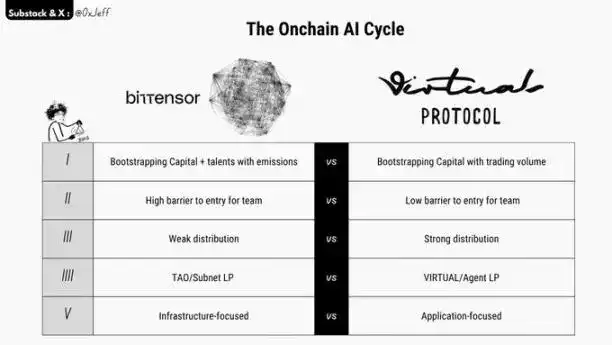
I. Guiding Capital and Talent Through Emissions Mechanism vs. Guiding Capital Through Trading Volume

Bittensor guides subnet development through its TAO emissions mechanism. Subnets are responsible for introducing the most innovative projects (or revenue-generating businesses) and compete for a share of the daily 3,600 TAO distribution.

Subnets also guide contributors (including miners performing tasks and validators verifying the miners' work) through their alpha token emissions mechanism. The emissions mechanism and the incentive coordination mechanism across stakeholders have been embedded since the project's inception.

Virtuals adopts a model similar to pump.fun, guiding development through trading volume. High trading activity translates into capital accumulation for the agent project. Agent teams can use their own emissions mechanisms to incentivize user participation.

In market cycles with high speculative token demand, this model has significant advantages—teams can quickly accumulate capital, gain product attention and market interest, thereby driving project launch and development.

II. High Entry Barrier vs. Low Entry Barrier (For Teams)

Launching a subnet on Bittensor requires substantial investment. Currently, acquiring a subnet slot requires 871 TAO (approximately $300,000), with the price fluctuating based on demand and the auction mechanism. This means subnet teams typically need mature ideas, clear plans, and solid execution capabilities.

To successfully operate a subnet, owners must ensure that the set tasks or objectives contribute to the R&D of their AI product/solution, prevent miner fraud, ensure validators effectively perform verification duties, generate revenue through business development and customer partnerships, and maintain investor confidence through buyback mechanisms.

The subnet token price needs to maintain an upward trend to attract more TAO inflow, increase the subnet's emission share, and thereby attract higher-level contributors to participate in mining.

In contrast, the barrier to launching an AI agent token on Virtuals is lower, requiring no initial cost, making it easier to test new ideas with less capital.

Virtuals also has a "60-day program" that allows founders to test new ideas and issue tokens during this period. If product-market fit is not found within 60 days, the relevant funds are reclaimed, and investors can retrieve a portion of their invested capital.

III. Weaker Distribution Capability vs. Stronger Distribution Capability

Bittensor operates independently on a blockchain built using the Polkadot Substrate framework. Cross-chain bridging is difficult, it lacks DeFi infrastructure components, and is not equipped with common infrastructure like the Ethereum Virtual Machine or Solana.

This results in a high entry barrier for the Bittensor ecosystem. Furthermore, relevant learning materials are filled with complex terminology, increasing the difficulty for new users to learn and understand. Consequently, its community members are mostly technical professionals willing to invest time in deep research, with relatively low retail participation.

In comparison, the understanding threshold for Virtuals is lower. Its team excels in marketing, branding, and distribution. Retail users can relatively intuitively understand concepts like AI agents, agent payments, and bots.

Since Virtuals is deployed on the Base chain, the process of purchasing AI agent tokens is convenient. The time from learning about a project, forming a bullish judgment, to making a purchase decision is short, which is a key reason for its rapid popularity from late 2024 to 2025 (earlier than Bittensor).

Currently, Bittensor is gradually entering the mainstream spotlight with pushes from Jason, Chamath, Barry Silbert (DCG & Yuma), and the community, leading to increased attention. However, the purchase process for subnet tokens remains relatively complex, and the issue has not been fundamentally resolved.

IV. TAO/Subnet Liquidity Pool vs. VIRTUAL/Agent Liquidity Pool

Bittensor and Virtuals share a key similarity in their liquidity pool flywheel mechanisms.

Investors wishing to purchase subnet alpha tokens need to hold TAO to do so. Therefore, rising demand for alpha tokens will drive up the price of TAO.

Similarly, within the Virtuals ecosystem, rising demand for AI agent tokens will drive up the price of VIRTUAL.

If the core tokens (TAO or VIRTUAL) can circulate within the ecosystem without outflow (e.g., through project teams trading goods and services to retain value), the advantages of this mechanism become more pronounced.

V. Infrastructure-Oriented vs. Application-Oriented

Bittensor subnets mostly focus on infrastructure or capital-intensive businesses, such as decentralized computing, inference, training, drug discovery, and quantum experiments.

Since Bittensor can provide over $10 million annually in funding for quality subnets and attract high-end talent, its model is suitable for driving ambitious, high-difficulty, high-investment ideas.

Virtuals agent teams, however, mostly focus on the application layer and consumer-facing agent products. Since agent tokens have a low initial price, if a team can launch a quality consumer product, it can leverage the token's market heat to quickly attract attention and drive project development.

Thanks to Virtuals' advantages in distribution, the flywheel effect of AI agent tokens demonstrated faster growth rates and higher price increases during periods of extreme market activity (such as late 2024 to early 2025).

Preguntas relacionadas

QWhat are the two main AI crypto projects compared in the article, and what are their core flywheel mechanisms?

AThe two main AI crypto projects compared are Bittensor and Virtuals. Bittensor's core flywheel mechanism is guided by TAO emissions to fund subnet development. Virtuals' core flywheel mechanism is guided by trading volume, similar to the pump.fun model, to accumulate capital for AI agent projects.

QHow does the entry barrier for launching a project differ between Bittensor and Virtuals?

ALaunching a subnet on Bittensor has a high entry barrier, currently requiring a significant investment (e.g., 871 TAO, ~$300k) to acquire a subnet slot. In contrast, launching an AI agent token on Virtuals has a low entry barrier, requiring no initial cost, allowing teams to test new ideas with minimal capital outlay.

QWhat is a key similarity in the liquidity pool flywheel mechanism between Bittensor and Virtuals?

AA key similarity is that demand for the ecosystem's project tokens drives the price of the core native token. In Bittensor, demand for subnet alpha tokens drives the price of TAO. In Virtuals, demand for AI agent tokens drives the price of VIRTUAL.

QAccording to the article, what is the primary focus of projects built on Bittensor versus those on Virtuals?

AProjects on Bittensor are primarily infrastructure-oriented, focusing on areas like decentralized computing, inference, training, drug discovery, and quantum experiments. Projects on Virtuals are primarily application-oriented, focusing on consumer-facing AI agent products.

QWhat advantage does Virtuals have over Bittensor in terms of distribution and user accessibility?

AVirtuals has a significant advantage in distribution and user accessibility. It has lower comprehension barriers, strong marketing, and is deployed on the Base chain, making the purchase process for AI agent tokens simple and intuitive for retail users. Bittensor has a higher learning curve, complex terminology, and a more difficult token purchase process, making it less accessible to the average retail participant.

Lecturas Relacionadas

9,42 millones de minoristas se apresuran por comprar acciones de Longxin Technology, ¿quién resultó adjudicado?

El resultado de la OPV de Changxin Technology (Long鑫 Tech) se ha dado a conocer. Un total de 9.4288 millones de inversores minoristas y 285 instituciones participaron en la suscripción. Tras activar el mecanismo de reequilibrio, la tasa de asignación para minoristas en línea subió a aproximadamente el 0,4714%, la más alta para una nueva acción en la bolsa STAR, con unos 7,7 millones de números asignados. Se necesitaba un capital de aproximadamente 1,06 millones de RMB para obtener una asignación. Las instituciones recibieron el 28,25% de las acciones. Taikang Asset Management fue la institución que más asignaciones obtuvo. Entre los fondos públicos, los tres primeros fueron E Fund, Southern Fund y ICBC Credit Suisse. El fundador de la destacada empresa china de modelos de IA, Liang Wenfeng, a través de sus firmas de gestión cuantitativa Ningbo幻方 y Zhejiang九章, obtuvo la mayor asignación entre los fondos privados, con un valor total de 1750 millones de RMB. Se estima que podría obtener unas ganancias de 730 millones de RMB si la capitalización de mercado de la empresa alcanza los 3 billones de RMB tras su cotización. Se prevé que Changxin Technology cotice el 27 de julio. Su valoración se sitúa principalmente por encima del billón de RMB, con estimaciones que van desde 1 billón hasta más de 4 billones. Sin embargo, la reciente corrección del mercado tecnológico global podría afectar a su desempeño inicial en bolsa.

marsbitHace 38 min(s)

9,42 millones de minoristas se apresuran por comprar acciones de Longxin Technology, ¿quién resultó adjudicado?

marsbitHace 38 min(s)

Una ‘diosa’ de la caridad con 3 millones de seguidores era todo una IA: la farsa del ‘orfanato falso’ desmonta de la noche a la mañana una beneficencia transnacional

La australiana Lily Jay, una influencer de Instagram con casi 3 millones de seguidores, es investigada por ABC NEWS Verify por una supuesta red de estafa benéfica utilizando contenido generado por IA. A través de su 'Lily Jay Foundation', publicaba videos de proyectos en Uganda, Gaza, Nepal y Sudán, incluyendo la inauguración de un orfanato en Uganda, donde la imagen de ella con niños mostraba anomalías típicas de la IA, como letras mal escritas. Las autoridades de Uganda confirmaron que no existe registro de dicho orfanato. Además, imágenes de un premio humanitario que recibió contenían la marca de agua invisible SynthID de ChatGPT. La investigación revela que la fundación, que operaba desde Kosovo, se define en su sitio web como "no una organización benéfica". Aunque solicitaba donaciones, no figuraba como entidad benéfica registrada en Australia, lo que evita la obligación de transparencia financiera. Tres personas figuran como directores, uno vinculado a una firma de relaciones públicas que promocionó el falso premio. Tras la investigación de ABC, el sitio web eliminó para visitantes australianos los botones de donación y la advertencia sobre su estatus, aunque se mantuvieron activos para el extranjero. Expertos advierten que este caso explota la confianza y el deseo de creer en actos de bondad, marcando un peligroso precedente del uso del 'deepfake' y la IA para defraudar en el sector humanitario.

marsbitHace 1 hora(s)

Una ‘diosa’ de la caridad con 3 millones de seguidores era todo una IA: la farsa del ‘orfanato falso’ desmonta de la noche a la mañana una beneficencia transnacional

marsbitHace 1 hora(s)

L2 'Recalibrating': Cuando L1 se convierte en su propio Rollup, ¿cuál es el final del camino de Ethereum?

"L2 «recalibración»: cuando L1 se convierte en su propio Rollup, ¿cuál es el final de Ethereum?" La relación entre L1 y L2 en Ethereum está evolucionando. Originalmente, L2 (como los Rollups) se centraban en ofrecer espacio de transacción barato, mientras que L1 priorizaba la descentralización y seguridad. Sin embargo, los avances en Ethereum, como el aumento del límite de Gas y el desarrollo de zkEVM, permiten que L1 también escale significativamente. Esto obliga a repensar el valor de L2, que ya no puede basarse solo en costos bajos, sino que debe ofrecer funciones diferenciadas como privacidad o modelos de gobernanza flexibles. La creciente fragmentación entre múltiples L2 plantea problemas de interoperabilidad y experiencia de usuario. La comunidad está trabajando en soluciones como marcos de intenciones (intents) y una capa de interoperabilidad nativa (EIL) para que Ethereum "vuelva a sentirse como una sola cadena", facilitando las interacciones entre diferentes entornos de ejecución sin que el usuario note la complejidad subyacente. Acortar el tiempo de finalidad de L1 también es crucial para aplicaciones cross-chain. Un concepto provocador sugiere que, con la adopción de sistemas de prueba (zkEVM) en la red principal, Ethereum L1 podría, en un sentido arquitectónico, convertirse en una especie de "Rollup de sí mismo", donde la ejecución y la verificación se separan. Esto, junto con la visión de "Native Rollup", podría difuminar los límites tradicionales entre L1 y L2, transformándolos en un espectro de entornos de ejecución con diferentes funcionalidades pero que comparten seguridad, liquidez y un sistema de estado común. En conclusión, el futuro de Ethereum no es que L1 reemplace a L2 o viceversa. En cambio, el ecosistema podría evolucionar hacia un conjunto unificado de entornos de ejecución especializados que, trabajando en conjunto, ofrezcan escalabilidad, diversidad de funciones y una experiencia de usuario cohesiva. El reto es volver a ensamblar, sin perder los beneficios de la escalabilidad, un Ethereum que funcione como un todo integrado para el usuario final.

marsbitHace 1 hora(s)

L2 'Recalibrating': Cuando L1 se convierte en su propio Rollup, ¿cuál es el final del camino de Ethereum?

marsbitHace 1 hora(s)

Trading

Spot
活动图片