Dylan Patel: Founder of SemiAnalysis, Praised by Jensen Huang, is a 'Beekeeper' and 'Forum Enthusiast'

marsbitPublicado a 2026-06-19Actualizado a 2026-06-19

Resumen

Dylan Patel, founder of the independent research firm SemiAnalysis, has an unconventional background. A former beekeeper from rural Georgia, he entered the semiconductor world as a self-taught "forum warrior," discussing chip technology anonymously online from a young age. He launched the SemiAnalysis blog in May 2020, which later transitioned to a paid subscription model. The firm has grown from a one-person operation to a global team of around 60, with a dedicated teardown lab. Its detailed, technically-focused analysis on semiconductor supply chains, AI infrastructure, and products has earned significant industry recognition. Notably, NVIDIA founder Jensen Huang has publicly cited their reports. In a landmark case, a critical 2024 report on AMD's MI300X GPU software stack led to a 90-minute call with AMD CEO Lisa Su, who thanked him for the constructive feedback. SemiAnalysis later acknowledged AMD's improvements. The firm's influence on markets was seen when a report on NVIDIA's Rubin memory configuration was partially shared, affecting memory stock prices. Dylan Patel emphasized the importance of context, contrasting the shared excerpt with the report's actual title. SemiAnalysis, now a multi-faceted consultancy with revenue projected to reach $100 million, is known for its deep technical insights that influence major industry players and investment decisions.

Original|Odaily Planet Daily(@OdailyChina)

Author|Wenser(@wenser2010 )
Speaking of SemiAnalysis, the massive earthquake in the US stock memory and chip industry triggered by the institution's research report content not long ago is still fresh in memory.

As an independent investment research institution with annual revenue expected to surpass $100 million, today's SemiAnalysis integrates multiple roles such as consulting firm, model service platform, and technology laboratory. At the helm of this rapidly developing, highly recognized research institution—praised by Nvidia founder Jensen Huang and AMD CEO Lisa Su—is not a technical expert or an engineer deeply involved in chip manufacturing, but a former beekeeper from Minnesota and a 'forum enthusiast' who anonymously discussed technical issues on various US hobbyist forums.

This edition of Character Decode by Odaily Planet Daily shares the story of —SemiAnalysis founder Dylan Patel.

SemiAnalysis Founder: A 'Forum Tech Wizard' Who 'Maxed Out Skill Points' and is Self-Taught

Compared to Citrini, which focuses more on macro trends and long-term themes, SemiAnalysis chooses to dig deeper and more narrowly into the semiconductor industry, and its founder Dylan Patel (hereafter referred to as Dylan) is a proper 'industry legend'.

Early Experience: Georgia Countryside Beekeeper, American Version 'Forum Enthusiast'

According to Dylan's sharing during an interview on Latent Space's culinary-themed program, he grew up in rural Georgia, attending the University of Georgia. After college, he even worked as a beekeeper in Minnesota for about a year and a half.

At that time, he was somewhat in a 'lost state'. Now, summarizing his past in his own words, he said: 'I feel like I've just gone through many stages of life... It seems there wasn't any clear, direct path to follow.' (Odaily Planet Daily Note: This refers to his identity shifts from chip enthusiast, semiconductor forum moderator, anonymous chip blogger, to investment research institution founder, hedge fund founder, and even more roles)

His entry into the industry was also 'full of twists and turns'.

As early as between the ages of 8 and 12, he was highly active on semiconductor forums as a 'forum warrior' (Odaily Planet Daily Note: similar to the domestic tech enthusiast gathering spots like Baidu Tieba, commonly known as 'Tieba old-timers'). He taught himself semiconductor knowledge by reading chip documentation while repairing hardware devices like Xbox and exchanging ideas with community enthusiasts.

Thus, starting as an anonymous chip blogger, he began sharing chip knowledge, discussing chip manufacturing technology, chip industry supply chains, and other hardcore topics on platforms like Reddit, WordPress, and Silicon Twitter.

In May 2020, Dylan officially founded his personal blog channel, SemiAnalysis, with the goal of providing accurate, independent technical analysis of the semiconductor industry. Looking at the timing back then, this was before the 'AI explosion moment driven by GPT', and the semiconductor industry was still a technically niche field, with very few such in-depth contents available in the market.

Initially, SemiAnalysis was just a very niche personal content channel built on WordPress. Upon repeated suggestions from his good friend Doug, Dylan later migrated it to the Substack platform and switched from a free model to a paid subscription model. (Odaily Planet Daily Note: According to Dylan himself, this friend later joined Substack a few years later)

From then on, Dylan began building his 'personal business system' around the paid content channel, including technical content analysis, business consulting, and research report production covering semiconductor supply chains, AI infrastructure products, cloud ecosystems, machine learning models, and even more cutting-edge industries.

SemiAnalysis: From a One-Person Company to a Global Team of Over 60

By 2025, SemiAnalysis had gradually transformed from Dylan's original 'One-Person Company model' (OPC) into a global company with a professional research team of about 60 people. They also established a professional chip and semiconductor product teardown laboratory, STEEL (SemiAnalysis Teardown Engineering & Evaluation Lab), in Oregon, USA.

Last year, the institution's revenue reached a scale of $20 million; this year, according to The Information's report, SemiAnalysis' revenue is expected to break $100 million, with main income coming from hyperscalers, semiconductor giants, startups, and institutional subscriptions/models/consulting. Dylan himself has indicated plans to subsequently establish a VC investment firm. Previously, he had personally invested/invested via SPV structures in about 20 startups, and even helped computing power giant Fluidstack raise $50 million in funding through an SPV structure.

External Influence: High Recognition from Jensen Huang, AMD CEO, and Others

After nearly six years of development, Dylan and SemiAnalysis have become the 'industry textbook' and 'must-read guide' in the current AI track and semiconductor industry.

Previously, Nvidia founder Jensen Huang mentioned SemiAnalysis multiple times during his speeches at the GTC Developer Conference, publicly praising the details of their reports, especially benchmarks like Nvidia's InferenceX, which could be considered a 'public endorsement'.

Earlier, in December 2024, after conducting about five months of in-depth testing and benchmark evaluation of AMD's MI300X GPU, the SemiAnalysis team published a critical report titled 'MI300X vs H100 vs H200 Benchmark Part 1: Training - CUDA Moat Still Alive'. The report pointed out that although the AMD MI300X GPU hardware had decent paper specifications, its ROCm software stack had significant gaps (e.g., many bugs, poor usability, immature ecosystem), resulting in a far inferior actual user experience compared to Nvidia's CUDA software stack architecture, making it ineffective as a powerful product for training workloads.

Within hours of the report's release, AMD CEO Lisa Su personally contacted Dylan and had a phone conversation with him the next day. Notably, this exchange was originally scheduled for 30 minutes but ultimately extended to 90 minutes due to the large amount of information, numerous feedback issues, and technical detail discussions involving engineers. This is a rare, in-depth dialogue between the CEO of a trillion-dollar market cap listed company and an independent third-party investment research institution. Finally, Lisa Su publicly thanked him for his 'constructive feedback' (even if it was critical) (Odaily Planet Daily Note: The original quote was 'Feedback is a gift even when it's critical').
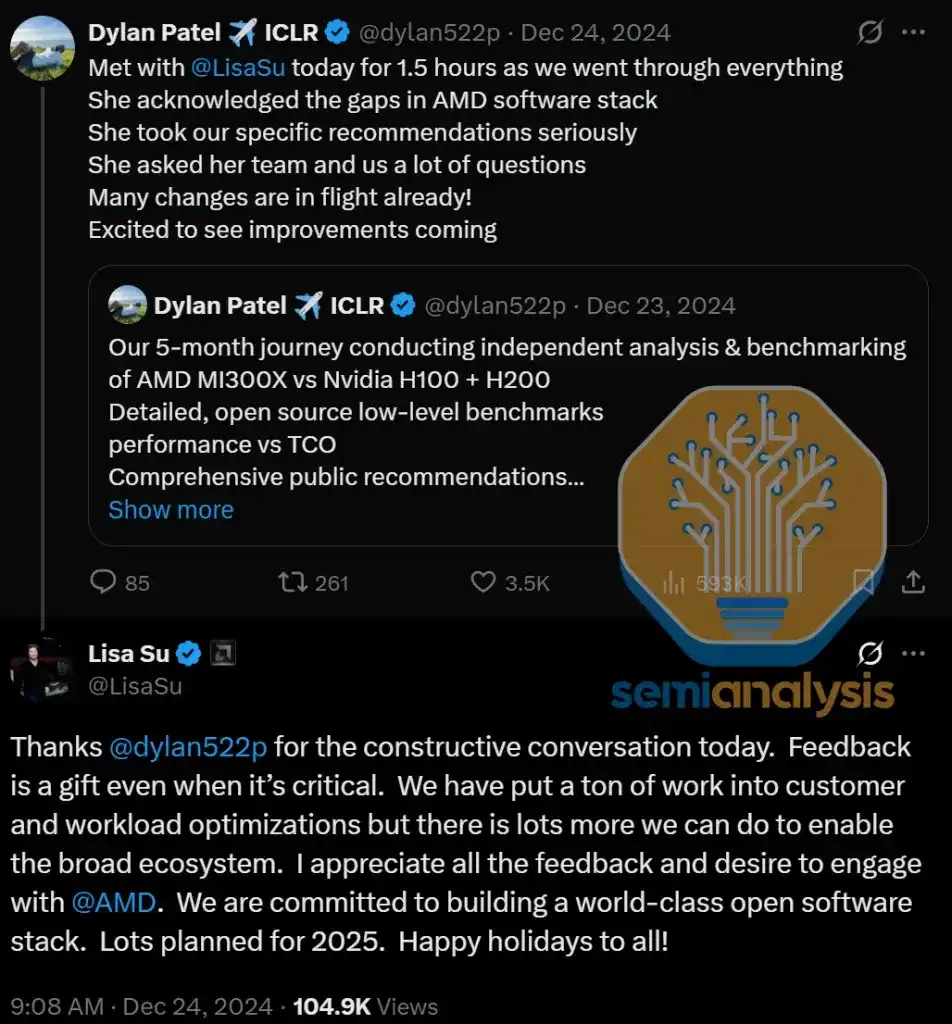
High praise and positive response from AMD CEO Lisa Su

In April 2025, SemiAnalysis againpublished a follow-up reportstating 'Over four months later, AMD is accelerating progress in ROCm, developer relations, CI/CD, etc. AMD MI450X is expected to beat Nvidia,' also acknowledging AMD's subsequent improvements, becoming a landmark case of its 'independent research directly influencing major company decisions.'

In early June, Citrini analyst Jukan forwarded parts of a SemiAnalysis research report, which indicated that 'Nvidia's next-generation AI server cluster Rubin NVL72 made significant adjustments to its memory configuration. To address tight supply chain constraints and ensure the on-time delivery of Rubin racks, the single-rack capacity was drastically reduced from the originally planned 55TB to 28TB, a reduction of about 50%, using scaled-down 96GB SOCAMM memory modules instead of the previous 192GB high-spec modules.' Possibly influenced by this news, many memory-related stocks including Micron and SK Hynix came under pressure and fell that day.

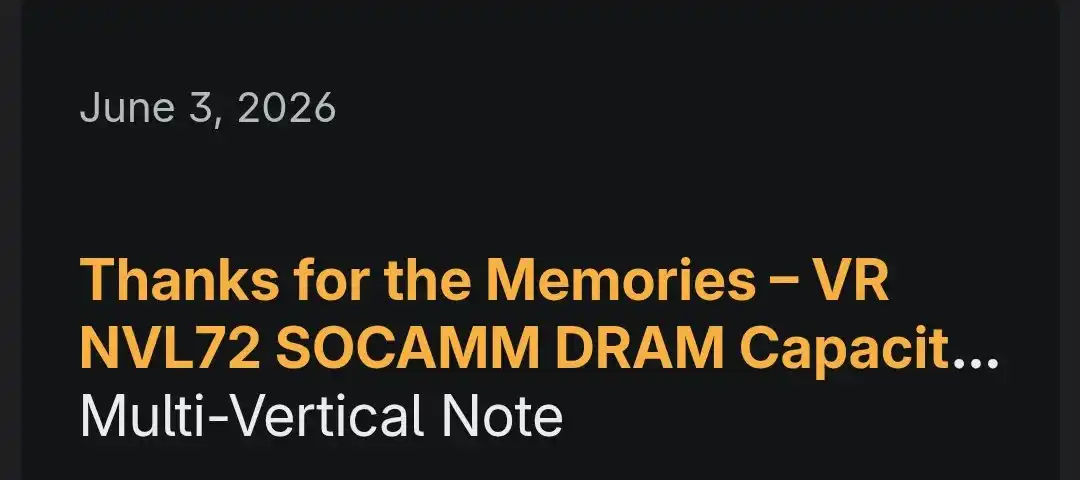
In response, Dylan stated: 'I love this: When people forward what we say, they often take it out of context. Actually, our original report did not use such a clickbait headline.' The image he subsequently posted showed the original report title was 'Thanks for the Memories...'.
In comparison, SemiAnalysis places greater emphasis on 'technical implementation details,' focusing on real bottlenecks in AI construction (power shortages, supply chain inheritance, inference scaling, Nvidia ecosystem dynamics, etc.). It often embeds realistic constraint analysis within optimistic demand judgments, making it more suitable for guiding specific investments and industrial decisions. For more details on SemiAnalysis, see 'From Community 'Hardware Geek' to AI Circle's 'Muddy Waters': How SemiAnalysis, Nearing $100 Million in Annual Revenue, Stirs the Semiconductor Market?'

Recommended Reading:

Latent Space Episode One: Scene Cooking with SemiAnalysis Founder Dylan Patel

Preguntas relacionadas

QWhat is the unique professional background of SemiAnalysis founder Dylan Patel before becoming a research analyst?

AHe worked as a beekeeper in Minnesota and was an active member on semiconductor hobbyist forums, essentially a 'forum warrior' or 'tech enthusiast' who taught himself about chips from a young age.

QHow did Dylan Patel's personal blog, SemiAnalysis, evolve into a major independent research firm?

AIt started as a small, free WordPress blog. Following a friend's advice, he moved it to Substack, implemented a paid subscription model, and gradually built a business around it, expanding into analysis, consulting, and reports. It has grown from a one-person company to a global team of about 60 people.

QWhat notable response did AMD CEO Lisa Su have after a critical SemiAnalysis report on the MI300X GPU?

ALisa Su personally contacted Dylan Patel and had a 90-minute call to discuss the report's findings. She publicly thanked him for the 'constructive feedback,' stating 'Feedback is a gift even when it's critical.'

QHow did a recent SemiAnalysis report reportedly impact the financial markets in early June 2025?

AA report excerpt, discussing potential memory configuration changes in Nvidia's upcoming Rubin server, was circulated. This was interpreted as signaling supply chain issues and led to a drop in the stock prices of memory-related companies like Micron and SK Hynix.

QWhat are the primary revenue sources for SemiAnalysis as of 2025, and what is its projected revenue?

AIts revenue primarily comes from subscriptions, models, and consulting services for hyperscalers, semiconductor giants, startups, and institutions. It reportedly achieved $20 million in revenue last year and is projected to surpass $100 million in 2025.

Lecturas Relacionadas

Diálogo con el inversor Zheng Di: Experimento de venta de criptomonedas de MicroStrategy, economía de IA y oportunidades en el mercado estadounidense

**Resumen: Diálogo con el inversor Didier Zheng: El experimento de venta de criptomonedas de MicroStrategy, la economía de la IA y las oportunidades en el mercado bursátil estadounidense** En un reciente podcast, el inversor en tecnologías de vanguardia Didier (Didier) Zheng analizó la caída del bitcoin, los cambios en la estrategia financiera de MicroStrategy, el auge de las acciones estadounidenses impulsado por la IA y el futuro de la industria cripto. **MicroStrategy y la presión de venta:** Zheng argumenta que la reciente caída del bitcoin se debe principalmente a la expectativa del mercado de que MicroStrategy podría vender pequeñas cantidades de forma recurrente para cubrir los dividendos de sus acciones preferentes, manteniendo así su principio de "neutralidad de bitcoin por acción". Esto crea una presión estructural, aunque no necesariamente desencadena una "espiral de la muerte" a menos que se combinen con nuevos shocks macroeconómicos. **La IA y el token como nueva fuerza laboral:** La discusión se centra en cómo la IA está reestructurando la economía. Zheng ve los *tokens* como la nueva "fuerza laboral" digital, reemplazando progresivamente tareas humanas en la ejecución. Esto impulsa la rentabilidad corporativa y beneficia a la cadena de suministro de la IA (semiconductores, centros de datos), lo cual es el motor fundamental del rally en el mercado bursátil estadounidense. La era de la "economía de las máquinas" acaba de comenzar. **CEX y la migración a acciones estadounidenses:** Para Zheng, la integración de acciones tradicionales (como las estadounidenses) por parte de los exchanges de criptomonedas (CEX) es un movimiento natural hacia activos con valor real y liquidez, dado el limitado número de activos cripto nativos con fundamentos sólidos. No cree que esto perjudique al ecosistema a largo plazo, sino que acerca activos del mundo real a la cadena. Además, sugiere que los traders de cripto pueden encontrar en el mercado bursátil estilos de inversión similares (ej. *meme stocks* que reemplazan a las *meme coins*). **Panorama macro y futuro:** Zheng se muestra cauteloso a corto plazo debido a posibles ajustes en el mercado y la incertidumbre política (elecciones en EE.UU.), pero mantiene una visión optimista a largo plazo sobre la IA y su convergencia con blockchain. Subraya la necesidad de mecanismos de redistribución (ej. un "impuesto a la IA") para evitar una desigualdad extrema en la era de la automatización. La industria cripto, en su opinión, está pasando de una fase especulativa a una más institucional e industrial.

marsbitHace 21 min(s)

Diálogo con el inversor Zheng Di: Experimento de venta de criptomonedas de MicroStrategy, economía de IA y oportunidades en el mercado estadounidense

marsbitHace 21 min(s)

$GCOIN de Playnance se lista en KoinBX en medio del rápido crecimiento en India

Playnance, el ecosistema web3 de iGaming basado en blockchain, anunció el 18 de junio que su token nativo, $GCOIN, se ha listado en el intercambio KoinBX. Esta medida busca facilitar el acceso a una de las comunidades de más rápido crecimiento de la plataforma, particularmente en India, donde más de 130 socios del programa "Be the Boss" se han unido, creando comunidades con miles de jugadores activos. A través del modelo "Be the Boss", los participantes pueden crear y gestionar sus propias comunidades de juego, recibiendo incentivos por su actividad. Pini Peter, CEO de Playnance, destacó que India se ha convertido en uno de los mercados más comprometidos. Un ejemplo es el socio Dr. Nicolas, quien ha ganado más de 57.000 dólares en los últimos meses y valora la oportunidad de construir una comunidad propia. El token $GCOIN es el centro de este ecosistema, actuando como token de utilidad para recompensar la participación y alinear incentivos entre jugadores y "Bosses". Su listado en KoinBX forma parte de la estrategia de expansión global de Playnance, que busca aumentar la utilidad y accesibilidad de $GCOIN combinando propiedad comunitaria, participación gamificada e incentivos en blockchain. Fundada en 2020, Playnance procesa alrededor de un millón de transacciones diarias y desarrolla productos en cadena no custodiados con el objetivo de atraer a usuarios convencionales (Web2) hacia entornos blockchain, simplificando la experiencia del usuario sin perder transparencia.

TheNewsCryptoHace 1 hora(s)

$GCOIN de Playnance se lista en KoinBX en medio del rápido crecimiento en India

TheNewsCryptoHace 1 hora(s)

STRC cae a un mínimo histórico, la máquina de movimiento perpetuo de Saylor se atasca

El año pasado, Michael Saylor presentó STRC a Wall Street como un "motor de crédito digital", un ciclo perpetuo donde los inversores obtenían dividendos, MicroStrategy compraba Bitcoin, y todos ganaban. Hoy, ese motor se ha detenido. El 19 de junio, STRC cayó a un mínimo histórico de 85,32 dólares, muy por debajo de su valor nominal de 100 dólares, con un volumen de negociación inusualmente alto. Esta caída pone en duda la lógica central del producto: mantener un precio estable cerca del valor nominal para financiar continuamente la compra de Bitcoin. La máquina de Saylor funciona así: si STRC cotiza por encima de 100$, MicroStrategy emite nuevas acciones (ATM) para recaudar dinero y comprar más Bitcoin. Si Bitcoin sube, la máquina continúa. Pero ahora, tres factores convergen para una "tormenta perfecta": 1) El precio de Bitcoin se ha reducido a más de la mitad desde sus máximos. 2) Los recursos para pagar el dividendo del 11,5% de STRC se han reducido drásticamente tras pagar deuda, obligando a MicroStrategy a vender, por primera vez desde 2022, 32 BTC para cubrir dividendos, rompiendo el tabú de "nunca vender". 3) Un producto rival, SATA de Strive, ofrece mayor rentabilidad y seguridad, atrayendo a los inversores y ampliando la brecha de precio con STRC. Así, se activa un "volante de inercia inverso": Bitcoin cae, STRC se desploma, se detiene la financiación vía ATM, se vende Bitcoin para pagar dividendos, la confianza se erosiona y STRC cae aún más. Aunque Saylor argumenta que el modelo es matemáticamente sostenible con una apreciación anual del Bitcoin del 2,3%, el mercado no solo opera con lógica matemática. La narrativa ha cambiado de "nunca vender" a "vender para pagar", probando la resistencia del modelo de "empresa del Tesoro de Bitcoin" en un mercado bajista. La supervivencia de MicroStrategy no está en juego, pero la prueba de estrés para su fe en el mecanismo de financiación ha comenzado. En el clima actual de temor del mercado y señales alcistas de la Fed, ese 2,3% necesario parece más pesado que nunca.

marsbitHace 1 hora(s)

STRC cae a un mínimo histórico, la máquina de movimiento perpetuo de Saylor se atasca

marsbitHace 1 hora(s)

Guía para aprovechar los mínimos del mercado: Cómo evaluar las criptomonedas utilizando el flujo de caja

**Guía de Inversión en Cripto: Evaluación por Flujo de Caja con Aave como Caso de Estudio** Los inversores enfrentan el desafío de valorar activos digitales tras las caídas del mercado. Mientras que activos como Bitcoin son similares a productos básicos, muchos tokens, especialmente en DeFi, se asemejan a derechos financieros y pueden valorarse mediante flujos de caja. Este análisis toma como ejemplo a Aave, un protocolo líder de préstamos descentralizados. El informe clasifica los criptoactivos en un espectro entre "activos tipo mercancía" (ej. Bitcoin) y "activos con flujo de caja" (ej. tokens DeFi). Estos últimos derivan su valor de los ingresos generados por el protocolo subyacente y de los mecanismos que capturan este valor para los tenedores del token. Aave opera como un mercado de préstamos en cadena, generando ingresos a partir de diferenciales de tasas de interés, su stablecoin nativa GHO y su tesorería. Presenta datos financieros transparentes con un fuerte crecimiento de ingresos y márgenes de beneficio neto cercanos al 50%. Aunque ha enfrentado desafíos recientes, su dominio en el sector de préstamos DeFi, su tesorería diversificada y su hoja de ruta de desarrollo (GHO, Horizon, V4) respaldan su fundamento. Utilizando un análisis de flujo de caja descontado (DCF) y comparaciones de múltiplos P/E, Grayscale Research estima un valor razonable para el token AAVE entre 80 y 100 dólares, cercano a su precio actual (~75$). En un escenario base optimista con adopción acelerada de stablecoins y tokenización de activos reales (RWA), el valor podría subir a aproximadamente 175 dólares en un año. El informe destaca la **importancia crítica del mecanismo de captura de valor**: que un protocolo genere ingresos no garantiza que el token se aprecie. Es esencial evaluar cómo las ganancias se transfieren a los tenedores, ya sea mediante recompra y quema, dividendos u otras estructuras. Aave ha evolucionado su gobernanza para alinear más directamente los incentivos económicos del protocolo con los poseedores de AAVE. A pesar de las incertidumbres regulatorias en torno a las DAOs, marcos como la propuesta "Ley CLARITY" podrían ofrecer mayor claridad. La maduración del mercado está premiando a los proyectos con fundamentales sólidos y modelos de negocio sostenibles, marcando un alejamiento de la pura especulación hacia un análisis basado en flujos de caja y métricas tradicionales.

marsbitHace 2 hora(s)

Guía para aprovechar los mínimos del mercado: Cómo evaluar las criptomonedas utilizando el flujo de caja

marsbitHace 2 hora(s)

Trading

Spot
Futuros
活动图片