8.5 Million USDT Flees Overnight: Can High-Yield Stablecoin Vaults Still Be Safely Deposited?

Foresight NewsPublicado a 2026-06-23Actualizado a 2026-06-23

Resumen

$8.5M USDT Exodus Triggers High-Yield Stablecoin Vault Shutdown Fears of a liquidity crunch following a third-party auditor's withdrawal from competitor MainStreet triggered over $8.5 million in user withdrawals from Altura's stablecoin vault in 24 hours, forcing it to begin an orderly wind-down. Altura clarified it holds no MainStreet assets, indicating the crisis stemmed from a sector-wide loss of confidence rather than direct asset contagion. The incident highlights a critical vulnerability in high-yield stablecoin products: a mismatch between user expectations for instant redemptions and the illiquid, long-duration nature of underlying investments like private credit and real-world assets (RWA). Even without actual losses, the mere prospect of being last in line for repayment can spark a debilitating bank run. The key lesson is that operational liquidity risk and market confidence are decisive factors. Tools like reserve audits, intended to reduce uncertainty, can backfire if their withdrawal accelerates panic faster than assurances can spread. The industry must now observe how Altura manages its asset liquidation and user reimbursements, a process that will test the feasibility of offering DeFi-native speeds on traditionally illiquid yield strategies.


Author: Liam Akiba Wright

Compiled by: Chopper, Foresight News


TL;DR:


  • Altura stated that users withdrew over 8.5 million USDT within 24 hours before the platform began an orderly closure of the vault.
  • This bank run indicates that even high-yield stablecoin products with no direct asset connection to other protocol disputes can still face liquidity pressure from a run.
  • The lingering question is: Can the platform's remaining positions be paid out on time? There are significant time differences in the liquidation cycles of different investment strategies.


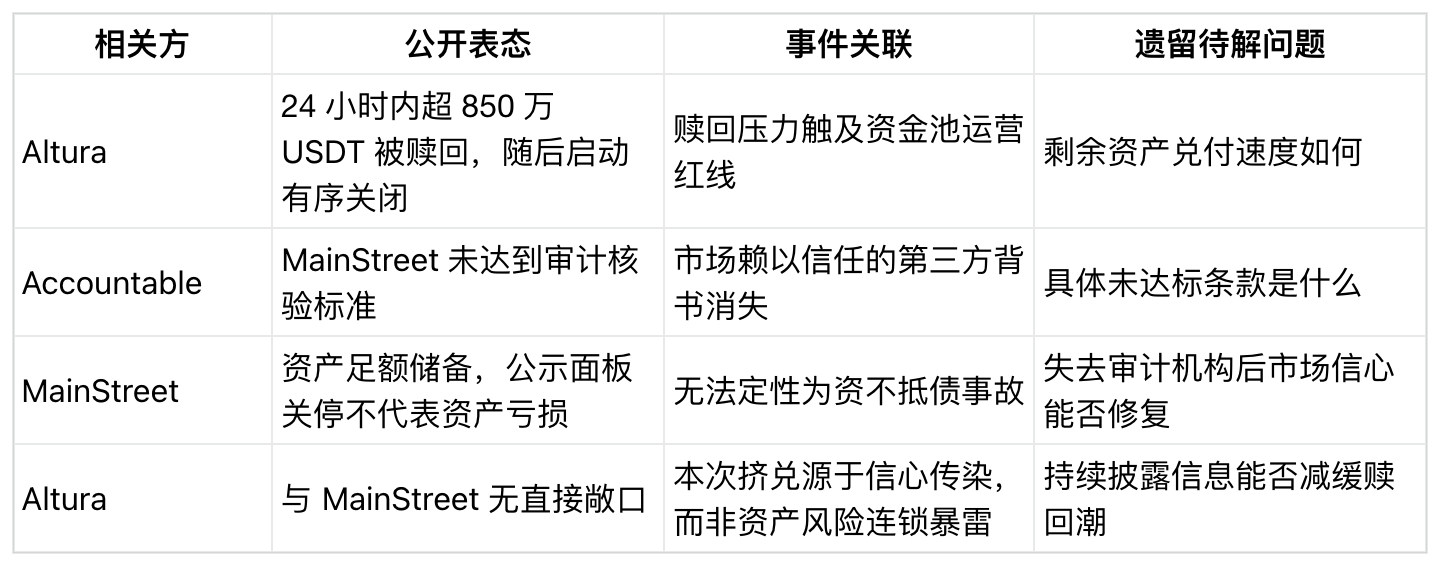
The reserve audit controversy at MainStreet triggered a collapse of market confidence across the entire stablecoin yield sector, with Altura experiencing outflows exceeding 8.5 million USDT in a single day, leading the project to decide on an orderly vault closure.


Altura CEO Ranveer Arora stated that user redemptions exceeded $8.5 million before the vault closure. Altura also asserted that it has no connection whatsoever with MainStreet or its underlying investment strategies. The core of this bank run incident is not the transmission of asset risk, but rather a chain reaction triggered by a collective loss of confidence in similar yield products.


The catalyst for the event was the termination of cooperation between MainStreet and the third-party audit firm Accountable, citing MainStreet's failure to meet audit verification standards. MainStreet publicly claimed to have sufficient asset reserves, but the lack of third-party audit endorsement led to widespread skepticism among users holding similar yield products: If everyone redeems at once, can the fund pool achieve rapid payout?


This is precisely the operational risk exposed by the Altura incident. From a user's perspective, redemption operations seem simple, but the platform's assets are dispersed across different segments such as exchange holdings, private credit lending, and real-world asset (RWA) settlements, each with completely unsynchronized repayment cycles.


MainStreet later stated that the shutdown of the third-party reserve display panel does not indicate asset losses or impairment in the investment portfolio.


Altura's own risk disclaimer is equally crucial: The project explicitly stated that it holds no MainStreet-related assets, and its HyperEVM lending pool, USDT/AVLT trading market, and Ethereum lending targets were unaffected by this event.


However, when users see an audit firm terminate cooperation with a certain stablecoin yield product, their focus shifts from whether a neighboring protocol has risk exposure to whether all similar products can withstand a concentrated redemption wave.


Liquidity Becomes the Core Contradiction in a Concentrated Redemption Wave


Stablecoin users often focus only on the token itself, and the USDT in this incident is also a core settlement vehicle in the crypto market. USDT's peg to the US dollar remains solid, with a total market cap of approximately $186 billion and a 24-hour trading volume exceeding $51 billion.


This market scale has a dual impact: on one hand, USDT's underlying liquidity is extremely abundant, making it difficult for a single USDT-denominated fund pool to shake the overall stablecoin market; but on the other hand, the liquidity of the fund pool itself depends entirely on capital allocation, asset storage channels, settlement rules, and whether counterparties can match users' expected redemption speeds.


Altura's announcement also highlighted this reality: funds stored on exchanges are easier to liquidate quickly compared to private credit or real-world asset (RWA) investments; however, exchange withdrawals are also subject to platform procedures, transfer channels, and market conditions. Private credit and RWA assets have fixed repayment cycles, and processes like loan recovery, share redemption, and settlement windows cannot match DeFi users' demand for instant withdrawals.


The misalignment of repayment cycles for different assets means that even in the absence of actual asset losses, market sentiment can dictate a product's survival. Users who redeem first can withdraw instantly, while those who redeem later can only wait for assets to mature and be liquidated. This expectation drives everyone to redeem early. The mere possibility of batch payouts is enough to accelerate a bank run stampede.


The scale of redemptions in this case is significant. Altura's overall fund pool size reaches tens of millions of dollars, making the 8.5 million USDT single-day redemption a very high proportion. Large-scale concentrated withdrawals force investment portfolios originally focused on yield enhancement to shift towards asset allocation prioritizing liquidity.


Redemption Cycle: The Next Key Indicator to Watch


Looking at the entire stablecoin sector, this lesson cannot be ignored. The total stablecoin market cap is hundreds of billions, with daily trading volumes in the tens of billions. Various yield-bearing stablecoin products promise principal stability plus yield, but their underlying investment strategies often cannot be liquidated instantly.


Such products are operationally feasible, but risks are concentrated at the operational level. Reserve proof displays, third-party audits, exchange holdings, private credit, RWA investments—the liquidity shortcomings of these links are only fully exposed when users abandon the pursuit of yield and simply want to retrieve their cash.


For Altura, the core observation point moving forward is the liquidation process: whether assets can be redeemed orderly, the frequency of platform updates and disclosures, the scale of funds returned at each stage, and whether the platform can prevent users from panic-selling long-term assets at low prices to exit hastily. Current information can only confirm liquidity risks, not prove underlying asset losses at Altura.


For the entire industry's stablecoin yield products, the test from this incident lies in whether third-party audit endorsements can stabilize confidence during market volatility, rather than becoming a trigger for panic. Reserve display panels and third-party verification are tools meant to reduce market uncertainty, but negative news about terminated audit partnerships spreads much faster than project clarifications.


This is the revelation the Altura bank run brings to the industry. In the DeFi fund pool sector, market confidence is by no means an insignificant soft metric; it directly determines whether users are willing to deposit funds long-term, allowing sufficient liquidation cycles for underlying investment strategies.


Preguntas relacionadas

QWhat event triggered the user panic and the subsequent mass withdrawal of over 8.5 million USDT from Altura?

AThe panic was triggered by the news that the third-party audit firm Accountable terminated its cooperation with another stablecoin yield platform, MainStreet, citing MainStreet's failure to meet audit verification standards. This eroded confidence in the entire stablecoin yield sector, leading users to question the liquidity and safety of similar platforms, including Altura.

QAccording to the article, what is the fundamental reason for the liquidity crisis at Altura, despite having no direct exposure to MainStreet's assets?

AThe fundamental reason is a collective loss of confidence in the stablecoin yield sector, leading to a bank run. The crisis is not due to direct asset risk transmission from MainStreet, but rather the mismatch between user expectations for instant withdrawals and the platform's underlying investment assets, which have different and often longer settlement cycles (e.g., exchange holdings vs. private credit or RWA investments).

QWhat key operational risk did the Altura incident expose for stablecoin yield platforms?

AThe incident exposed the liquidity mismatch risk. While platforms invest user funds into various assets (exchange holdings, private credit, RWAs) to generate yield, these assets have different redemption and settlement timelines. These timelines cannot match the DeFi user's expectation for instant withdrawals, creating a vulnerability during periods of mass redemption requests.

QWhat will be a critical indicator to watch regarding Altura's future, as mentioned in the article?

AA critical indicator will be the platform's redemption and wind-down process. This includes observing whether assets can be redeemed in an orderly manner, the frequency of platform updates, the scale of funds returned at each stage, and whether the process can avoid forcing users to sell long-term assets at a discount to exit quickly.

QWhat broader lesson for the stablecoin yield industry does the article draw from the Altura event?

AThe lesson is that market confidence is a critical, hard metric, not a soft one. Tools like third-party audit reports and reserve proof dashboards, intended to reduce uncertainty, can themselves become triggers for panic if their status changes negatively. Confidence directly determines whether users are willing to leave funds deposited long enough for the underlying investment strategies to reach their settlement cycles.

Lecturas Relacionadas

Momento de presión para Base

**Resumen: El Momento de Presión para Base** El cofundador de Base, Jesse Pollak, admitió recientemente que la cadena Robinhood Chain tiene razón al lanzar acciones tokenizadas en un entorno EVM, y que Base está rezagada en esta área, aunque trabaja con Coinbase en un producto similar. Este es el segundo "reconocimiento de error" público de Pollak, quien anteriormente admitió que apostar por tokens sociales y para creadores durante más de un año fue un error estratégico. Aunque Base es una de las principales L2, superada solo por BNB Chain en el ámbito de cadenas lanzadas por exchanges, su dependencia de Coinbase también plantea desafíos. La cadena ha sido criticada por su centralización, con dos interrupciones en la producción de bloques que apuntan a problemas con su secuenciador único. L2BEAT incluso consideró rebajar su nivel de descentralización de la Etapa 1 a la Etapa 0. La llegada de Robinhood Chain ha intensificado la competencia. En solo unas semanas, su volumen de intercambio en DEX entró en el top 5, superando temporalmente a Base en número de transacciones diarias. Mientras el CEO de Robinhood, Vlad Tenev, interactúa activamente con nuevos proyectos, una acción reciente del CEO de Coinbase, Brian Armstrong (cambiar su avatar, lo que impulsó y luego colapsó un meme token), generó descontento en la comunidad. Base aún tiene fortalezas, como el mayor TVL entre las L2 (cerca de $120B) y liderazgo en pagos automáticos. Sin embargo, la presión de Robinhood Chain expone debilidades de larga data. Para no quedarse atrás en la crucial área de la tokenización de activos reales (RWA), Base debe abordar con urgencia sus problemas técnicos y de confianza.

Foresight NewsHace 3 min(s)

Momento de presión para Base

Foresight NewsHace 3 min(s)

Entrevista sobre la Era de la IA, la Revolución Industrial y la Civilización Futura — Zhang Dingwen: El Futuro no Pertenece a Quienes Solo Persiguen

En la era de la inteligencia artificial, la revolución industrial y la civilización futura, Zhang Dingwen, un emprendedor tecnológico, comparte sus perspectivas sobre la innovación y el desarrollo empresarial. En lugar de perseguir tendencias pasajeras, enfatiza la importancia de entender la dirección del progreso de la época. Desde sus inicios en el desarrollo de productos de internet hasta su enfoque actual en hardware inteligente, su trayectoria ha estado guiada por una constante reflexión sobre cómo evoluciona la conexión entre las personas y el mundo digital. Zhang Dingwen destaca que el valor real de un emprendedor no reside en su capacidad para aprovechar oportunidades momentáneas, sino en su comprensión profunda del futuro. Para él, las empresas más exitosas no solo compiten con productos, sino que compiten a nivel de civilización, definiendo nuevas reglas y formas de interacción que moldean la sociedad. Además, subraya que la confianza, los valores y una visión a largo plazo son elementos fundamentales para construir organizaciones duraderas. En su visión, el hardware inteligente, como los relojes o las gafas, no son solo dispositivos, sino potenciales entradas a un ecosistema más amplio que integra servicios financieros, sociales y de salud. La clave está en crear plataformas que fomenten la colaboración y generen valor continuo para los usuarios. Al final, las empresas verdaderamente grandes no se miden por su valor de mercado, sino por su capacidad para resolver problemas de la época y contribuir a un futuro más eficiente y equitativo.

marsbitHace 5 min(s)

Entrevista sobre la Era de la IA, la Revolución Industrial y la Civilización Futura — Zhang Dingwen: El Futuro no Pertenece a Quienes Solo Persiguen

marsbitHace 5 min(s)

Indicador de tendencias de criptomonedas y acciones | Strategy aumenta su reserva de efectivo a 3,23 mil millones de dólares y suspende las compras de BTC; gestoras como Vanguard aumentan su participación en acciones de Strategy (21 de julio)

**Resumen de Indicadores Cripto-Acciones (21 de julio)** **Panorama general de los mercados:** Los mercados de valores globales enfrentan volatilidad debido a la compresión de liquidez, los altos niveles de apalancamiento y las tensiones geopolíticas. Se aconseja extrema precaución y evitar el apalancamiento. Las acciones relacionadas con criptomonedas (como Circle, Coinbase) carecen de impulso, excepto Robinhood. **Puntos clave de EE.UU.:** Las preocupaciones sobre una posible burbuja de la IA han llevado a que las apuestas bajistas en acciones estadounidenses alcancen máximos desde 2010. Las expectativas de subidas de tipos de la Fed y la rotación de capitales provocaron caídas, especialmente en tecnológicas y semiconductores. **Actualizaciones corporativas clave:** * **Strategy (MSTR):** Aumentó sus reservas de efectivo a 3.230 millones de dólares y **suspendió temporalmente las compras de Bitcoin**. Varios grandes gestores de activos como Vanguard Group, Swedbank AB y Capital Group aumentaron sus participaciones en acciones de Strategy. * **Bitcoin (Compras corporativas):** Las compras netas semanales de BTC por parte de empresas que no son mineras fueron de solo 1,33 millones de dólares. Strive compró 21 BTC. ORANGE JUICE recaudó 40M$ para comprar BTC. Bitcoin Japan recaudó 60M$ y destinó 4,08M$ a su primera compra de BTC. * **BitMine (ETH):** Aumentó sus tenencias de Ether a 5,78 millones, acercándose a su objetivo del 5% del suministro en circulación. El valor total de sus activos (cripto, efectivo, valores) es de 11.500 millones de dólares. * **Otros:** La empresa HypeStrat (DAT) no realizó ajustes en su tesorería esta semana.

marsbitHace 19 min(s)

Indicador de tendencias de criptomonedas y acciones | Strategy aumenta su reserva de efectivo a 3,23 mil millones de dólares y suspende las compras de BTC; gestoras como Vanguard aumentan su participación en acciones de Strategy (21 de julio)

marsbitHace 19 min(s)

Trading

Spot
活动图片