Not AI, Not War: Should the US Stock Market Be Most Concerned About Japan?

链捕手Publicado a 2026-07-24Actualizado a 2026-07-24

Resumen

The article warns that global markets may be underestimating a systemic risk from Japan, centered on the potential for its Government Pension Investment Fund (GPIF) to repatriate capital. With JPY at multi-decade lows and improving domestic investment appeal, political pressure is growing for GPIF—managing $1.8 trillion—to shift more assets home. Such a move, involving reallocating part of its ~$930 billion in overseas holdings, could boost demand for JPY and Japanese government bonds while pressuring US Treasuries (raising yields), weakening the USD, and weighing on risk assets like US stocks. A concurrent unwinding of yen carry trades could amplify the pressure. While markets currently price in little immediate risk, technical signals like the narrow USD/JPY cross-currency basis warrant attention. Conversely, the shift could benefit Japanese equities, which trade at a discount and are driven by corporate governance reforms rather than AI hype, though persistent JPY weakness remains a headwind for foreign investors.

Author: Zhao Ying

The global market is underestimating a potential systemic risk—Japan. As the yen falls to multi-decade lows and the attractiveness of Japanese domestic assets rises, the world's largest pension fund is facing policy pressure to repatriate assets on a massive scale. Once this process begins, the US stock market, bond market, and the US dollar could simultaneously face pressure.

Recently, Japanese Prime Minister Takaichi Sanae stated that the government will encourage the Government Pension Investment Fund (GPIF) and other national pension funds to increase investment in Japan's domestic financial assets. Finance Minister Katayama Satsuki had previously signaled similar intentions. Although GPIF has not announced any formal asset allocation adjustments, the market has begun to assess its potential impact: if the fund repatriates its overseas holdings, US Treasury yields could rise, the US dollar could weaken, and risk assets could come under pressure.

Currently, the market's pricing for the above risks remains relatively calm, but some technical indicators are already showing subtle changes. Investors should not be complacent.

The $1.8 Trillion Variable

GPIF manages about $1.8 trillion, with domestic and foreign assets each accounting for roughly half. Its overseas holdings total about $930 billion. In recent years, the fund's holdings of Japanese government bonds have decreased from about $770 billion to about $515 billion, while its holdings of foreign bonds have increased from about $128 billion to about $470 billion.

This structural change means that even a modest asset reallocation could trigger significant volatility in global markets. According to MarketWatch, analyst Michael Kramer points out that if GPIF repatriates some overseas assets, it would directly boost demand for the yen and introduce large-scale buying into the Japanese government bond market—a positive for Japan, but implying higher interest rates and a weaker dollar for the US.

At the same time, a large-scale unwinding of yen carry trades (borrowing low-interest yen, converting to dollars, and investing in US assets) would further weigh on the performance of risk assets.

Yen and JGBs: Rising Attractiveness of Domestic Assets

Driving GPIF's potential reallocation is a substantial improvement in the fundamentals of Japanese domestic assets. As Japan's inflation recovers and economic growth resumes, the appeal of domestic investment opportunities has increased significantly. In February of this year, the spread between US and Japanese two-year government bond yields narrowed to its lowest level since early 2022.

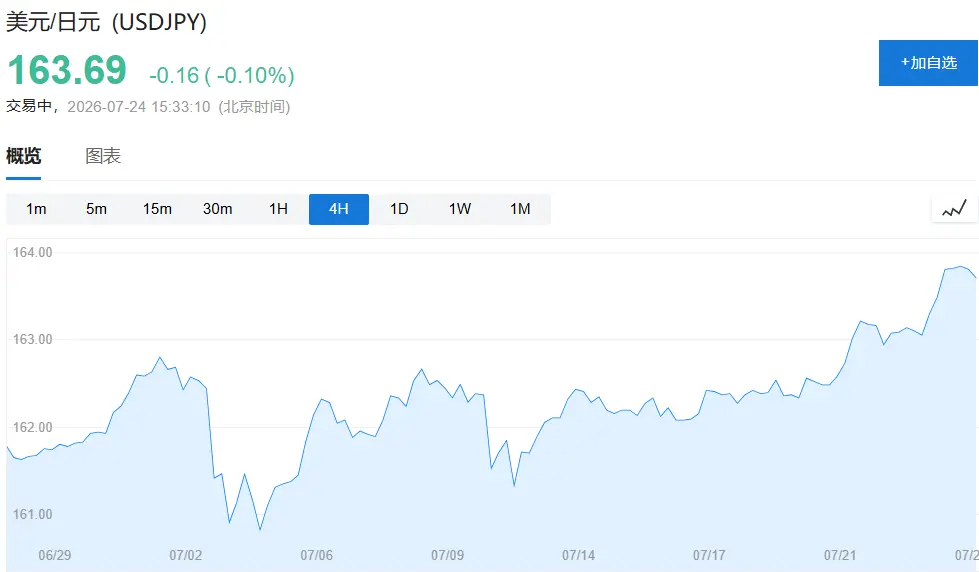
At the same time, the yen continues to weaken, with USD/JPY breaking above 163, reaching its highest level since 1986. From a technical analysis perspective, if the exchange rate rises further, the next resistance level is around 176. According to the Financial Times, Fredrik Repton of Neuberger Berman believes that if GPIF allocates more funds to domestic assets, it could be a "very elegant solution" to Japan's macro problems, but other domestic financial institutions would also need to follow suit, and "this process would take a very long time."
Japan's 10-year government bond yield recently touched 2.7%, the first time in 30 years. Deutsche Bank analyst Mallika Sachdeva noted in a recent report that the focus of Japanese authorities' policy may be shifting from exchange rate management to yield management. If this shift materializes, it would put further pressure on the yen.

The Market Hasn't Priced It In, But Signals Are Emerging

Currently, the global market's reaction to the risk of Japanese capital repatriation remains relatively restrained. The five-year USD/JPY cross-currency basis swap recently stood at around minus 30 basis points, the narrowest level since the data series began in 2021, indicating that the market's demand to hedge against yen appreciation has not risen significantly.

However, this indicator itself is a key signal for observing whether capital flows are beginning to shift. Historical data shows that the S&P 500 index and cross-currency basis swaps have moved in tandem during multiple periods—when hedging demand rises sharply, US stocks often fall as liquidity tightens. Once market expectations for yen appreciation heat up, demand for dollar hedging will climb, and the liquidity tightening effect will become more pronounced.

Japanese Stocks: The Other Side of the Risk

It is worth noting that GPIF's potential asset reallocation, while bringing pressure to the US market, also provides a new narrative for Japanese stocks. The Japanese stock market is benefiting from drivers quite different from those in the US market: the concentration of the technology sector in the Topix index is much lower than in the S&P 500, its exposure to artificial intelligence is relatively limited, and its valuation still trades at a discount of over 20% compared to the S&P 500.

Corporate governance reform is a core catalyst for Japanese stocks. Dan Rasmussen of Verdad Advisers points out that there are still about 1,000 companies in Japan whose stock prices are below book value. Among the cheapest one-fifth of companies, cross-shareholdings still account for about 40% of their market value. As cross-shareholdings are gradually unwound, a large amount of historically accumulated profits is expected to be released, providing a substantive positive impact on corporate earnings.

However, for foreign investors, the persistently weak yen is the biggest obstacle—yen depreciation over the past two years has significantly eroded the real returns for foreign capital in Japanese stocks. How to handle currency hedging, and whether the cost of hedging is bearable, remain core issues facing global investors.


Criptos en tendencia

Preguntas relacionadas

QAccording to the article, what is the potential systemic risk that global markets might be underestimating?

AThe article suggests that global markets are underestimating the potential systemic risk posed by Japan, specifically the possibility of massive capital repatriation by Japan's Government Pension Investment Fund (GPIF) back to domestic assets.

QWhat could be the impact on the US if Japan's GPIF reallocates its assets back to Japan?

AIf GPIF reallocates assets from overseas back to Japan, it could lead to higher U.S. Treasury yields, a weaker U.S. dollar, and put pressure on U.S. risk assets like stocks.

QWhat is the approximate size of Japan's GPIF and its overseas holdings?

AJapan's GPIF manages approximately $1.8 trillion. Its overseas holdings total around $930 billion, which is roughly half of its total assets.

QWhat are the two key factors that are increasing the attractiveness of Japanese domestic assets, according to the article?

AThe two key factors are: 1) The recovery of inflation and economic growth in Japan, and 2) The substantial depreciation of the yen to multi-decade lows against the dollar.

QWhat is a major obstacle for foreign investors in the Japanese stock market despite positive domestic catalysts?

AA major obstacle is the persistent weakness of the Japanese yen (JPY), which has significantly eroded the real returns for foreign investors in Japanese stocks over the past two years, raising concerns about the cost and feasibility of currency hedging.

Lecturas Relacionadas

Fallo del caso de divorcio de Chey Tae-won: Revelando las líneas ocultas de sucesión detrás del imperio trillonario de SK Hynix

El caso de divorcio de Choi Tae-won, presidente de SK Group, concluyó con una sentencia histórica de división patrimonial. Este hecho pone bajo el foco la sucesión en el imperio de SK Hynix, cuyo valor se disparó un 700% alcanzando los 1.000 billones de wones. A diferencia del guion tradicional de los *chaebol* coreanos, centrado en el primogénito varón, los tres hijos de Choi Tae-won siguen trayectorias atípicas. La hija mayor, Choi Yoon-jung (1989), es considerada la candidata más visible. Con formación en biología y un doctorado, ocupa un puesto directivo en SK Bioscience y supervisa la estrategia de crecimiento del grupo. Se casó con el cofundador de una *startup* de IA. La segunda hija, Choi Min-jung (1991), forjó un camino único: sirvió como oficial en la Marina de Corea, trabajó en políticas globales para SK Hynix en Washington y ahora es fundadora de una empresa de salud con IA. Se casó con un ex oficial del Cuerpo de Marines de EE.UU. El hijo menor, Choi In-geun (1995), a pesar de ser el primogénito varón y seguir el patrón formativo típico (consultoría en McKinsey), permanece en un discreto silencio público sin un rol definido dentro del grupo. El divorcio de sus padres, Choi Tae-won y Roh Soh-yeong, hija del expresidente Roh Tae-woo, culminó en una batalla legal multimillonaria que involucró a los tres hijos, quienes presentaron peticiones judiciales no divulgadas. Mientras SK Hynix se convierte en un activo geopolítico global, la sucesión ya no es un asunto meramente familiar. Los herederos de la tercera generación no heredan simplemente una empresa, sino el complejo desafío de navegar la era de la IA, las políticas globales y encontrar nuevas fuentes de crecimiento, redefiniendo así el legado del *chaebol*.

marsbitHace 9 hora(s)

Fallo del caso de divorcio de Chey Tae-won: Revelando las líneas ocultas de sucesión detrás del imperio trillonario de SK Hynix

marsbitHace 9 hora(s)

¡En solo 2 meses su valoración ha pasado de 8.800 millones a 68.000 millones de euros! OpenRouter, la mayor centralita de la IA, podría ser adquirida

Stripe está en conversaciones para adquirir la startup de inteligencia artificial OpenRouter, el mayor mercado de modelos de IA que actúa como intermediario, por un monto cercano a los 100.000 millones de dólares. Esta valoración representa un aumento de casi siete veces respecto a los 13.000 millones de dólares de hace dos meses. La plataforma de OpenRouter permite a los desarrolladores acceder a más de 400 grandes modelos de lenguaje a través de una única API, optimizando automáticamente la selección del modelo según la complejidad de la tarea, el coste y la velocidad, similar a un comparador de precios. Fundada en 2023 por Alex Atallah (cofundador de OpenSea) y Louis Vichy, la empresa tiene un ingreso anualizado de 50 millones de dólares y más de un millón de desarrolladores usuarios. Para Stripe, líder mundial en pagos en línea, esta adquisición es un paso estratégico hacia la consolidación de su infraestructura para la economía de la IA, tras la compra reciente de Metronome, una plataforma de facturación por uso. El objetivo es ofrecer un paquete integral que gestione desde la selección de modelos y la facturación por tokens hasta los pagos, convirtiéndose en el centro de control para las aplicaciones de IA. Aunque la transacción aún podría fracasar, refleja la apuesta por el crecimiento explosivo del sector y el valor de controlar la capa de intermediación que decide cómo se distribuyen las consultas y los costes entre los distintos proveedores de modelos.

链捕手Hace 9 hora(s)

¡En solo 2 meses su valoración ha pasado de 8.800 millones a 68.000 millones de euros! OpenRouter, la mayor centralita de la IA, podría ser adquirida

链捕手Hace 9 hora(s)

Trading

Spot

Artículos destacados

Cómo comprar WAR

¡Bienvenido a HTX.com! Hemos hecho que comprar WAR (WAR) sea simple y conveniente. Sigue nuestra guía paso a paso para iniciar tu viaje de criptos.Paso 1: crea tu cuenta HTXUtiliza tu correo electrónico o número de teléfono para registrarte y obtener una cuenta gratuita en HTX. Experimenta un proceso de registro sin complicaciones y desbloquea todas las funciones.Obtener mi cuentaPaso 2: ve a Comprar cripto y elige tu método de pagoTarjeta de crédito/débito: usa tu Visa o Mastercard para comprar WAR (WAR) al instante.Saldo: utiliza fondos del saldo de tu cuenta HTX para tradear sin problemas.Terceros: hemos agregado métodos de pago populares como Google Pay y Apple Pay para mejorar la comodidad.P2P: tradear directamente con otros usuarios en HTX.Over-the-Counter (OTC): ofrecemos servicios personalizados y tipos de cambio competitivos para los traders.Paso 3: guarda tu WAR (WAR)Después de comprar tu WAR (WAR), guárdalo en tu cuenta HTX. Alternativamente, puedes enviarlo a otro lugar mediante transferencia blockchain o utilizarlo para tradear otras criptomonedas.Paso 4: tradear WAR (WAR)Tradear fácilmente con WAR (WAR) en HTX's mercado spot. Simplemente accede a tu cuenta, selecciona tu par de trading, ejecuta tus trades y monitorea en tiempo real. Ofrecemos una experiencia fácil de usar tanto para principiantes como para traders experimentados.

762 Vistas totalesPublicado en 2024.12.11Actualizado en 2026.06.02

Cómo comprar WAR

Discusiones

Bienvenido a la comunidad de HTX. Aquí puedes mantenerte informado sobre los últimos desarrollos de la plataforma y acceder a análisis profesionales del mercado. A continuación se presentan las opiniones de los usuarios sobre el precio de WAR (WAR).

活动图片