By Su Yang, Tencent Tech
Intel is gradually entering a strong recovery cycle.
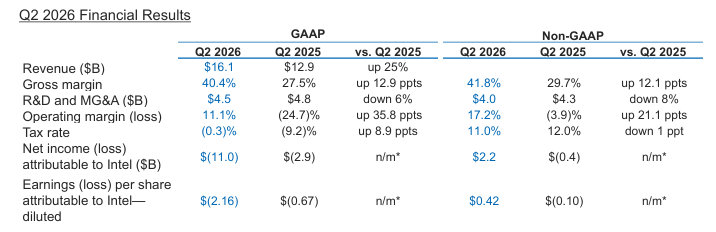
On July 23 (US time), Intel announced its financial results for the second quarter of 2026, ending June. Among them, revenue reached $16.1 billion, a 25% year-over-year increase. This growth rate is the highest since the third quarter of 2011. In contrast, analysts surveyed by the London Stock Exchange Group (LSEG) had an average expectation of $14.42 billion.
Under Generally Accepted Accounting Principles (GAAP), Intel reported a net loss of $11.0 billion for the second quarter, with a loss per share of $2.16. However, this significant loss is related to the 10% equity stake held by the US government being in an "escrow" state. It does not affect the company's actual cash flow nor reflect the true performance of its core operations.
Intel's Key Financial Data for Q2 2026
On a Non-GAAP basis, Intel's net income for the quarter was $2.2 billion, with earnings per share (EPS) of $0.42, compared to a net loss of $400 million and a loss per share of $0.10 in the same period last year. Analysts had previously expected EPS of only $0.21. It is worth noting that since turning profitable in the third quarter of 2025, Intel has achieved profitability for four consecutive quarters, with profits gradually expanding.
The recovery in profitability is also reflected in gross margin.
On a Non-GAAP basis, gross margin was 41.8%, significantly higher by 12.1 percentage points compared to 29.7% in the same period last year. Intel CFO David Zinsner emphasized that the margin improvement benefited from the scale effects of higher revenue and the company selling chips with higher profitability and better pricing.
Following the release of a series of positive signals, Intel's stock price rose approximately 11% in after-hours trading.
01
Price Hikes Drive 59% Data Center Revenue Growth
The biggest highlight in the earnings report is undoubtedly the data center business.
In the second quarter of 2026, Intel's Data Center and AI Group (DCAI) achieved revenue of $6.3 billion, a sharp increase of 59% year-over-year. This not only far exceeded the company's overall growth rate but also easily surpassed analyst expectations of $5.6 billion.
"AI is driving unprecedented demand for computing power. As we continue to execute our stated strategy, Intel is well-positioned in CPUs, ASICs, advanced packaging, and a vast foundry network, helping us seize sustainable growth opportunities," said CEO Patrick (Pat) Gelsinger in a statement.
More notably, market demand has reached a "sweet trouble" level. Gelsinger revealed: "In the data center space, CPU demand is taking off, and demand is outpacing our growing supply capacity."
It is precisely this supply-demand imbalance that has given Intel long-lost pricing power. Zinsner added: "From a pricing perspective, the situation is better than we expected."
In China, prices for some server CPU products have increased by more than 10% quarter-over-quarter, and cumulative increases since the beginning of 2026 have exceeded 40%. Foreign media reported that both Intel and AMD are actively negotiating long-term agreements with Chinese server customers—locking in purchase volumes but not prices, with some covering periods of up to two years or more.
Intel disclosed in its earnings report that the company has secured 10 such long-term agreements so far, and acknowledged that customer demand has exceeded current production capacity, putting the company in a supply-constrained state.
Compared to the strong momentum of the data center business, the client business was relatively steady. The Client Computing and Physical AI Group (CCPG), which includes the PC business, generated revenue of $8.9 billion in the quarter, up 13% year-over-year.
Zinsner stated that PC sales are expected to be flat in the third quarter due to memory shortage impacts.
02
Foundry Business Accelerates: Revenue Up 31%, Welcomes First Named Customer
Another major strategic pillar for Intel—the foundry business—achieved revenue of $5.8 billion in the second quarter, a 31% year-over-year increase. However, most of its revenue still comes from providing manufacturing services for Intel's own products, resulting in significant internal elimination. The financial report shows that the business remains in an operating loss for the period.
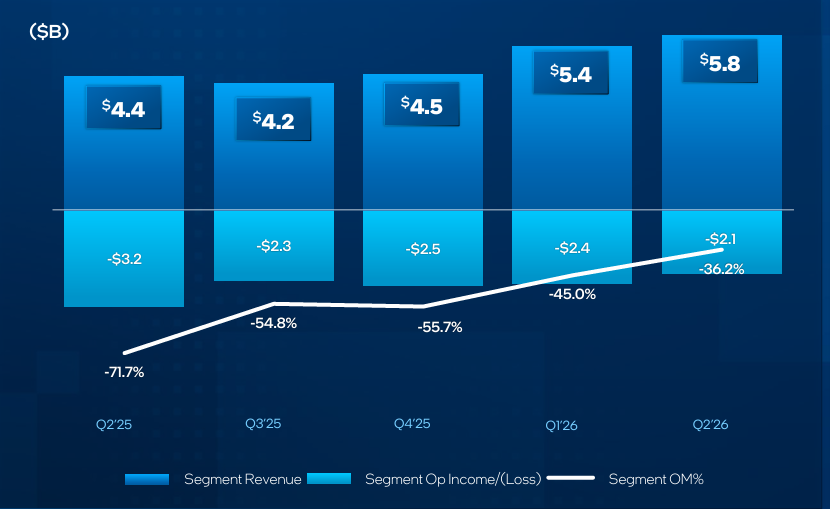
Intel Foundry Recovery Accelerates: Q2 Revenue $5.8B, Loss Narrows to $2.1B
Regarding the much-discussed 18A yield, Intel remains optimistic.
In May, Gelsinger revealed at J.P. Morgan's 54th Annual Global Technology, Media and Communications Conference that the Intel 18A process is already supporting the volume production of the Core Ultra 3 series processors codenamed Panther Lake. Yields are improving at a rate of about 7% per month, exceeding the company's internal expectations. Meanwhile, the data center processor Xeon 6+ has also entered volume production using the 18A process.
At the same time, the more advanced Intel 18A-P has also entered the risk production phase on schedule. Intel has even begun using ASML's High-NA EUV lithography machines to prepare for mass production of the "graphics layers" for the transistors of the Panther Lake processors.
In terms of external customer acquisition, Intel achieved a historic breakthrough this quarter. Cybersecurity company Fortinet announced a strategic collaboration with Intel to leverage its design, packaging, and manufacturing capabilities to develop Fortinet's security processors. This is the first named customer publicly disclosed by Intel's foundry business.
Meanwhile, market rumors about Apple collaborating with Intel to build factories have also attracted significant attention. Although President Trump publicly stated in June that Apple had agreed to partner with Intel to design and produce chips in the US, neither company has confirmed this.
Bernstein analysts speculate that if the collaboration is true, the initial focus may be on low-volume, low-risk, entry-level PC chips, more of a proof-of-concept nature. While the short-term revenue contribution might be limited, its symbolic significance is enormous.
When discussing the foundry business outlook in post-earnings interviews, Zinsner stated that Intel has "received significant customer interest" in advanced chip packaging products and the business has accumulated "a significant backlog." He also revealed that the most advanced 14A process technology is still under development as planned and is expected to enter volume production in 2028.
On a broader industrial collaboration front, Intel and Google Cloud expanded their multi-year strategic partnership to extend AI capabilities to all employees and drive internal AI-driven transformation. Additionally, strategic collaborations were established with companies like Foxconn, Siemens, and Hitachi to jointly develop industry-specific AI and computing solutions powered by Intel processors and specialized chips.
Facing a fundamental shift in the CPU market's supply-demand landscape, competitor AMD's CEO Lisa Su recently also significantly raised the projected CPU market size for 2030 from $120 billion to $220 billion, citing strong demand driven by agent workloads. This echoes Intel's current assessment of supply shortages.
However, after the stock price's strong rally, some cautious voices are beginning to emerge in the market.
Thomas George, portfolio manager at Grizzle Investment Management, pointed out that Intel's current forward price-to-earnings ratio is about 74x, far above its 10-year average (22x) and also higher than competitors like Nvidia and Broadcom. "This is a stock where the market has already moved ahead, at least from a valuation perspective."
03
Capital Expenditure Raised to $20 Billion to Fuel Future Growth
To convert customer interest into growth, Intel has decided to decisively increase investment.
The company announced it is raising its full-year 2026 capital expenditure plan from $18 billion to $20 billion. Zinsner stated that the previously relatively conservative spending plan has shifted. The company is now committing to a higher budget and predicts that spending in 2027 will further increase to support expected growth in products and foundry business next year.
In terms of specific investment actions, Intel announced an investment of approximately $5.7 billion to expand manufacturing capacity for Xeon 6 and next-generation Xeon processors based on the Intel 3 process. Additionally, Intel expanded capacity at its Bowers Park campus in California, USA, to enhance mask-making capabilities, supporting the development and manufacturing of current and future leading process technologies.
"We delivered a strong second quarter, benefiting from robust demand and improved execution, with revenue exceeding our financial guidance," Zinsner said in the statement. "AI-driven computing demand continues to strengthen. To support expected growth in both our product and foundry businesses this year and next, we are significantly increasing investments in equipment, cleanroom space, and substrates."
Meanwhile, Intel's guidance for the third quarter is also quite optimistic.
The company expects third-quarter revenue to be in the range of $15.8 billion to $16.8 billion, significantly higher than analysts' expectation of $15.1 billion. Non-GAAP EPS is expected to be $0.38, also better than the analyst expectation of $0.27. Gross margin is expected to remain around 42%.




















