HIP-4 Opens Permissionless Deployment: Can Hyperliquid Kill Polymarket?

Odaily星球日报Publicado a 2026-07-20Actualizado a 2026-07-20

Resumen

Hyperliquid recently announced that HIP-4 will soon support permissionless deployments, similar to its successful HIP-3 model for perpetual contracts. Deployers will need to stake 500,000 HYPE (locked for 6 months) and can earn up to 50% fee share from their created markets. This move aims to replicate the "decentralized" growth strategy that propelled Hyperliquid to leadership in tokenized stocks and commodities. However, HIP-4's initial performance in the prediction market sector has been weak, with only $216M in total volume over three months and a handful of active markets. This pales in comparison to leader Polymarket, which saw $4.587B in volume last month alone. The high staking requirement—valued at around $30 million—could exclude smaller teams, potentially limiting innovation and competition. The article questions whether this strategy can succeed, noting that Hyperliquid missed the crucial timing window of the recent World Cup, a major driver for prediction markets. While permissionless deployment could increase market variety and speed, the combination of high entry barriers and missed opportunities may hinder HIP-4's ability to challenge established players like Polymarket.

Original | Odaily Planet Daily (@OdailyChina)

Author | Golem (@web3_golem)
Just after the World Cup ended, Hyperliquid dropped a "nuclear bomb" into the prediction market sector.

On July 20th, Hyperliquid announced that HIP-4 will, in the future, support permissionless deployment just like HIP-3. The staking requirement for HIP-4 deployers is similarly 500,000 HYPE, which will be locked for 6 months. HIP-4 deployers will be able to set fee splits of up to 50% in the deployed markets. This feature will first be open on the testnet before going live on the mainnet.

Hyperliquid Announces HIP-4 Opens Permissionless Deployment

Although Hyperliquid's announcement is preliminary, and the specific time for HIP-4's permissionless deployment has not been determined, the market has already become excited upon hearing the news.

The reason Hyperliquid has become the world's largest stock token and on-chain commodity perpetual contract trading platform, even taking the lead over traditional financial markets in pricing corporate IPOs, is largely thanks to the launch of HIP-3 in October 2025 and the opening of third-party permissionless creation of perpetual contract markets.

Therefore, this time, investors believe Hyperliquid can once again rely on the power of "decentralization" to surpass all the leaders in the prediction market sector.

Who Will Be the Next Trade.xyz?

Hyperliquid launched the HIP-4 market on May 2, 2026, marking its official entry into the prediction market sector. Before the HIP-4 market launched, the market was generally optimistic that it would become Hyperliquid's next core narrative point. However, its performance over the nearly three months since launch can be described as poor.

According to official Hyperliquid data, the cumulative trading volume of the HIP-4 market over the past three months is only $216 million, with a daily average trading volume of just $10 million. Daily active users peaked at only 7,000, and total fee revenue is merely $442.38. In comparison, DeFiLlama data shows that Polymarket's trading volume in the past month alone reached $4.587 billion, with fees of $50 million.
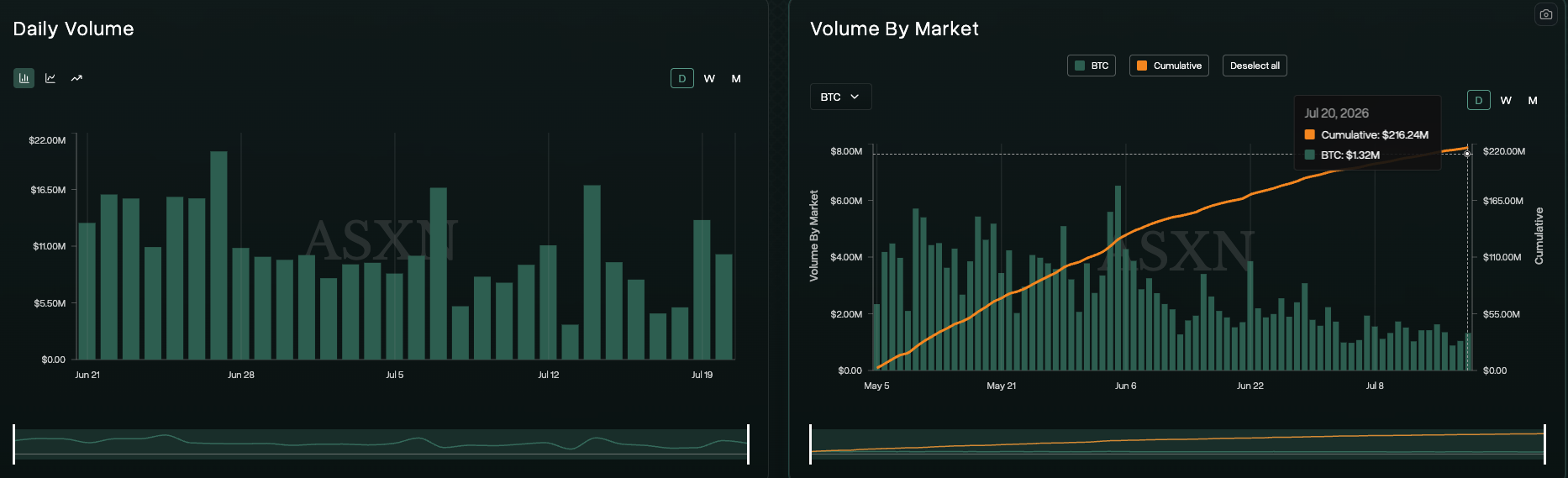
HIP-4 Average Daily and Total Trading Volume

Not only are users and trading volume low, but the number of tradable outcome events on HIP-4 is also very limited. Currently, the entire HIP-4 market has only 6 tradable prediction markets, which is a drop in the bucket compared to Polymarket in terms of both quantity and variety.
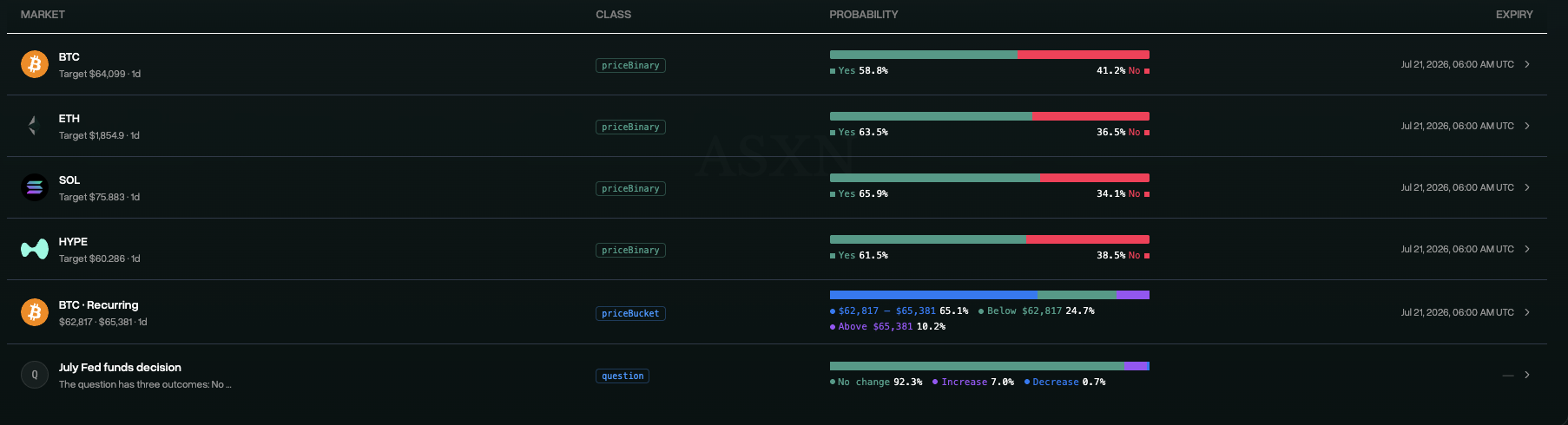
Currently Tradable Events on HIP-4

Faced with such a vast difference in scale, Hyperliquid chose the path of reliance, following the successful experience of HIP-3. Since it couldn't build momentum on its own, it would give the stage to the community to create another Trade.xyz within HIP-4.

Hyperliquid opening permissionless deployment for the HIP-4 market is equivalent to Polymarket allowing users to autonomously open prediction market events. Hyperliquid founder Jeff also stated that permissionless deployment is particularly important for the growth of outcome markets (HIP-4) because the scope for tradable outcomes is extremely broad. The number of independent events suitable for outcome trading far exceeds the number of underlying assets used for derivatives and real-world asset tokenization.

Moreover, having the community or third parties deploy prediction market events offers greater flexibility. The launch of existing prediction market contracts is mainly handled or reviewed by the team, which is not decentralized enough in process. Team members cannot possibly cover all areas of interest comprehensively, especially for hot events in the real world. This model slows down the time from market reaction to final execution and launch.

In the HIP-4 market, as long as a third party stakes enough HYPE tokens, they can launch prediction market events according to their own standards without needing review from the Hyperliquid team. Hyperliquid also stipulates that it will not restrict multiple deployers from simultaneously deploying identical events. This will incentivize healthy competition within the HIP-4 market. Only those providing users with more comprehensive events and deeper liquidity will succeed in the competition.

Hyperliquid's product philosophy has always adhered to a win-win strategy. The HIP-3 market has already nurtured the giant Trade.xyz, which accounts for over 90% of the HIP-3 market share, with the trading volume of its top 10 perpetual contract listings each exceeding $10 billion.

Perhaps many teams are now eager and ready. On the day Hyperliquid opens HIP-4 permissionless deployment on the mainnet, we may witness a lively "battle of the gods."

Can Hyperliquid Disrupt the Prediction Market Landscape?

But can Hyperliquid really "eat all day with one trick"?

First, Hyperliquid is no longer what it used to be. HYPE price has stabilized above $60, and the requirement for HIP-4 market deployers to stake 500,000 HYPE (approximately $30 million) effectively blocks small startup teams. A funding round for a crypto project today might not even reach $30 million, and prediction market projects capable of raising $30 million might prefer to develop their own prediction market platforms.

Therefore, the excessively high staking threshold for HIP-4 deployers may lead to a sharp decrease in third-party competitors. Ultimately, only "well-funded" prediction market projects might come to attract traffic. The number of tradable independent events would also be limited, severely hindering the entire HIP-4's innovation momentum.

Secondly, the timing of Hyperliquid's launch of HIP-4 permissionless deployment didn't even catch the last bus. One major reason 2026 became an opportune year for the development of the prediction market sector is the high density of sporting events in recent years, especially coinciding with the quadrennial World Cup. Various prediction markets have been focusing on World Cup matches. On Polymarket, the total trading volume for the July 20th Argentina vs. Spain match event alone reached $83.75 million.

But Hyperliquid completely missed the crucial time window of the World Cup, which is undoubtedly a huge strategic oversight. Even the success of the HIP-3 market combined various factors of right timing, advantageous location, and human harmony. The international crude oil price fluctuations caused by the US-Iran conflict in February this year served as a significant catalyst for the development of the HIP-3 market. On the first day of the conflict, which fell on a weekend when traditional markets were closed, traders urgently needing to adjust positions and hedge had to find new tradable markets. Hyperliquid's HIP-3 market became the first choice.

When Hyperliquid launched HIP-3, it did not emphasize it was built for stock tokenization and commodity tokenization, but it ultimately gave rise to Trade.xyz and Hyperliquid's current leading position in the tokenized trading market. If Hyperliquid had not seized the opportunity of the US-Iran conflict, perhaps Hyperliquid would not have a position in today's tokenized trading market.

Similarly, having missed the World Cup opportunity, how confident can Hyperliquid be now in disrupting the prediction market giants?


Criptos en tendencia

Preguntas relacionadas

QWhat is HIP-4 and what major update did Hyperliquid announce regarding it?

AHIP-4 is Hyperliquid's prediction market feature. Hyperliquid announced that HIP-4 will support permissionless deployment, similar to HIP-3. This allows third parties to independently create and deploy their own prediction markets by staking HYPE tokens.

QAccording to the article, what are the key concerns about HIP-4's permissionless deployment model?

AThe article raises two main concerns. First, the high staking requirement (500,000 HYPE, worth around $30 million) may exclude smaller teams, reducing competition and innovation. Second, Hyperliquid missed the crucial timing window of the World Cup, a major driver for prediction market activity, which could hinder its ability to compete with established players like Polymarket.

QHow does the performance of Hyperliquid's HIP-4 market compare to Polymarket's, based on the data in the article?

AHIP-4's performance is significantly lower than Polymarket's. HIP-4 had a cumulative trading volume of $216 million over 3 months, while Polymarket achieved a trading volume of $4.587 billion in just the past month. HIP-4 also has far fewer active users and tradable markets compared to Polymarket.

QWhat was the strategy behind HIP-3's success that Hyperliquid is trying to replicate with HIP-4?

AThe success of HIP-3 was driven by its permissionless deployment model for perpetual contracts, which empowered third parties like Trade.xyz to create markets. This decentralized approach led to massive growth. Hyperliquid is applying the same 'decentralization' strategy to HIP-4, hoping community-driven event creation will fuel similar expansion in the prediction market sector.

QWhat incentive does Hyperliquid provide for HIP-4 market deployers?

AHyperliquid allows HIP-4 deployers to set up to a 50% fee share on the markets they create. This provides a direct financial incentive for third parties to build and maintain high-quality, liquid prediction markets on the platform.

Lecturas Relacionadas

Fallo del caso de divorcio de Chey Tae-won: Revelando las líneas ocultas de sucesión detrás del imperio trillonario de SK Hynix

El caso de divorcio de Choi Tae-won, presidente de SK Group, concluyó con una sentencia histórica de división patrimonial. Este hecho pone bajo el foco la sucesión en el imperio de SK Hynix, cuyo valor se disparó un 700% alcanzando los 1.000 billones de wones. A diferencia del guion tradicional de los *chaebol* coreanos, centrado en el primogénito varón, los tres hijos de Choi Tae-won siguen trayectorias atípicas. La hija mayor, Choi Yoon-jung (1989), es considerada la candidata más visible. Con formación en biología y un doctorado, ocupa un puesto directivo en SK Bioscience y supervisa la estrategia de crecimiento del grupo. Se casó con el cofundador de una *startup* de IA. La segunda hija, Choi Min-jung (1991), forjó un camino único: sirvió como oficial en la Marina de Corea, trabajó en políticas globales para SK Hynix en Washington y ahora es fundadora de una empresa de salud con IA. Se casó con un ex oficial del Cuerpo de Marines de EE.UU. El hijo menor, Choi In-geun (1995), a pesar de ser el primogénito varón y seguir el patrón formativo típico (consultoría en McKinsey), permanece en un discreto silencio público sin un rol definido dentro del grupo. El divorcio de sus padres, Choi Tae-won y Roh Soh-yeong, hija del expresidente Roh Tae-woo, culminó en una batalla legal multimillonaria que involucró a los tres hijos, quienes presentaron peticiones judiciales no divulgadas. Mientras SK Hynix se convierte en un activo geopolítico global, la sucesión ya no es un asunto meramente familiar. Los herederos de la tercera generación no heredan simplemente una empresa, sino el complejo desafío de navegar la era de la IA, las políticas globales y encontrar nuevas fuentes de crecimiento, redefiniendo así el legado del *chaebol*.

marsbitAyer 09:13

Fallo del caso de divorcio de Chey Tae-won: Revelando las líneas ocultas de sucesión detrás del imperio trillonario de SK Hynix

marsbitAyer 09:13

¡En solo 2 meses su valoración ha pasado de 8.800 millones a 68.000 millones de euros! OpenRouter, la mayor centralita de la IA, podría ser adquirida

Stripe está en conversaciones para adquirir la startup de inteligencia artificial OpenRouter, el mayor mercado de modelos de IA que actúa como intermediario, por un monto cercano a los 100.000 millones de dólares. Esta valoración representa un aumento de casi siete veces respecto a los 13.000 millones de dólares de hace dos meses. La plataforma de OpenRouter permite a los desarrolladores acceder a más de 400 grandes modelos de lenguaje a través de una única API, optimizando automáticamente la selección del modelo según la complejidad de la tarea, el coste y la velocidad, similar a un comparador de precios. Fundada en 2023 por Alex Atallah (cofundador de OpenSea) y Louis Vichy, la empresa tiene un ingreso anualizado de 50 millones de dólares y más de un millón de desarrolladores usuarios. Para Stripe, líder mundial en pagos en línea, esta adquisición es un paso estratégico hacia la consolidación de su infraestructura para la economía de la IA, tras la compra reciente de Metronome, una plataforma de facturación por uso. El objetivo es ofrecer un paquete integral que gestione desde la selección de modelos y la facturación por tokens hasta los pagos, convirtiéndose en el centro de control para las aplicaciones de IA. Aunque la transacción aún podría fracasar, refleja la apuesta por el crecimiento explosivo del sector y el valor de controlar la capa de intermediación que decide cómo se distribuyen las consultas y los costes entre los distintos proveedores de modelos.

链捕手Ayer 09:04

¡En solo 2 meses su valoración ha pasado de 8.800 millones a 68.000 millones de euros! OpenRouter, la mayor centralita de la IA, podría ser adquirida

链捕手Ayer 09:04

Trading

Spot

Artículos destacados

Cómo comprar 4

¡Bienvenido a HTX.com! Hemos hecho que comprar 4 (4) sea simple y conveniente. Sigue nuestra guía paso a paso para iniciar tu viaje de criptos.Paso 1: crea tu cuenta HTXUtiliza tu correo electrónico o número de teléfono para registrarte y obtener una cuenta gratuita en HTX. Experimenta un proceso de registro sin complicaciones y desbloquea todas las funciones.Obtener mi cuentaPaso 2: ve a Comprar cripto y elige tu método de pagoTarjeta de crédito/débito: usa tu Visa o Mastercard para comprar 4 (4) al instante.Saldo: utiliza fondos del saldo de tu cuenta HTX para tradear sin problemas.Terceros: hemos agregado métodos de pago populares como Google Pay y Apple Pay para mejorar la comodidad.P2P: tradear directamente con otros usuarios en HTX.Over-the-Counter (OTC): ofrecemos servicios personalizados y tipos de cambio competitivos para los traders.Paso 3: guarda tu 4 (4)Después de comprar tu 4 (4), guárdalo en tu cuenta HTX. Alternativamente, puedes enviarlo a otro lugar mediante transferencia blockchain o utilizarlo para tradear otras criptomonedas.Paso 4: tradear 4 (4)Tradear fácilmente con 4 (4) en HTX's mercado spot. Simplemente accede a tu cuenta, selecciona tu par de trading, ejecuta tus trades y monitorea en tiempo real. Ofrecemos una experiencia fácil de usar tanto para principiantes como para traders experimentados.

659 Vistas totalesPublicado en 2025.10.20Actualizado en 2026.06.02

Cómo comprar 4

Discusiones

Bienvenido a la comunidad de HTX. Aquí puedes mantenerte informado sobre los últimos desarrollos de la plataforma y acceder a análisis profesionales del mercado. A continuación se presentan las opiniones de los usuarios sobre el precio de 4 (4).

活动图片