Citi's Interpretation: Upgrading China, Downgrading South Korea, Is the Emerging Markets Rally Beginning to Broaden?

marsbitPublicado a 2026-07-20Actualizado a 2026-07-20

Resumen

In its latest emerging markets strategy report, Citi has upgraded China to overweight from neutral, while downgrading South Korea to neutral from overweight. It maintains an overweight rating for China-Taiwan markets. The report sets MSCI EM index targets of 1870 by end-2026 and 2050 by mid-2027, implying further upside of approximately 12% and over 20% respectively from current levels. Citi's move reflects a search for "broadening" opportunities beyond the concentrated rally in AI hardware and tech, which has driven EM gains year-to-date, led by South Korea and China-Taiwan markets. The upgrade for China is based on factors including light investor positioning, potential benefits from lower oil prices, and relative attractiveness in a recovering global growth cycle. While maintaining a strong long-term view on South Korea, Citi notes its recent outperformance and elevated volatility prompted a tactical downgrade. The report highlights that EM earnings revisions remain narrow, with the IT sector contributing about 85% of 2026 EPS estimate upgrades. For a sustained rally, Citi argues that market gains need to broaden to other sectors and regions. China, South Africa, and Mexico rank highly as potential "broadening candidates" based on factors like sensitivity to a weaker dollar, lower bond yields, and oil prices. Key uncertainties include the sustainability of AI capital expenditure returns, geopolitical risks, and Federal Reserve policy. Citi's stance is cautiously optimis...

According to Citi's latest Emerging Markets Strategy report, the bank has upgraded its stance on China equities from Neutral to Overweight, while tactically downgrading South Korea from Overweight to Neutral. It maintains an Overweight on Taiwan-China markets and sets target levels for the MSCI EM Index at 1870 by the end of 2026 and 2050 by mid-2027.

The most immediate market hook of this report is that despite the MSCI EM Index rising approximately 20% year-to-date, Citi still sees room for further upside. From the current level of around 1664 points, 1870 points implies about 12% upside, while the 2050 point target suggests around 20% potential gains by mid-2027.

However, Citi is not betting on a broad-based emerging markets bull run. Gains in EM have been highly concentrated in South Korea, Taiwan-China tech, and the AI hardware supply chain recently, with other countries and sectors not keeping pace. China's upgrade to Overweight stems from Citi beginning to look for 'broadening' candidates beyond the AI chain.
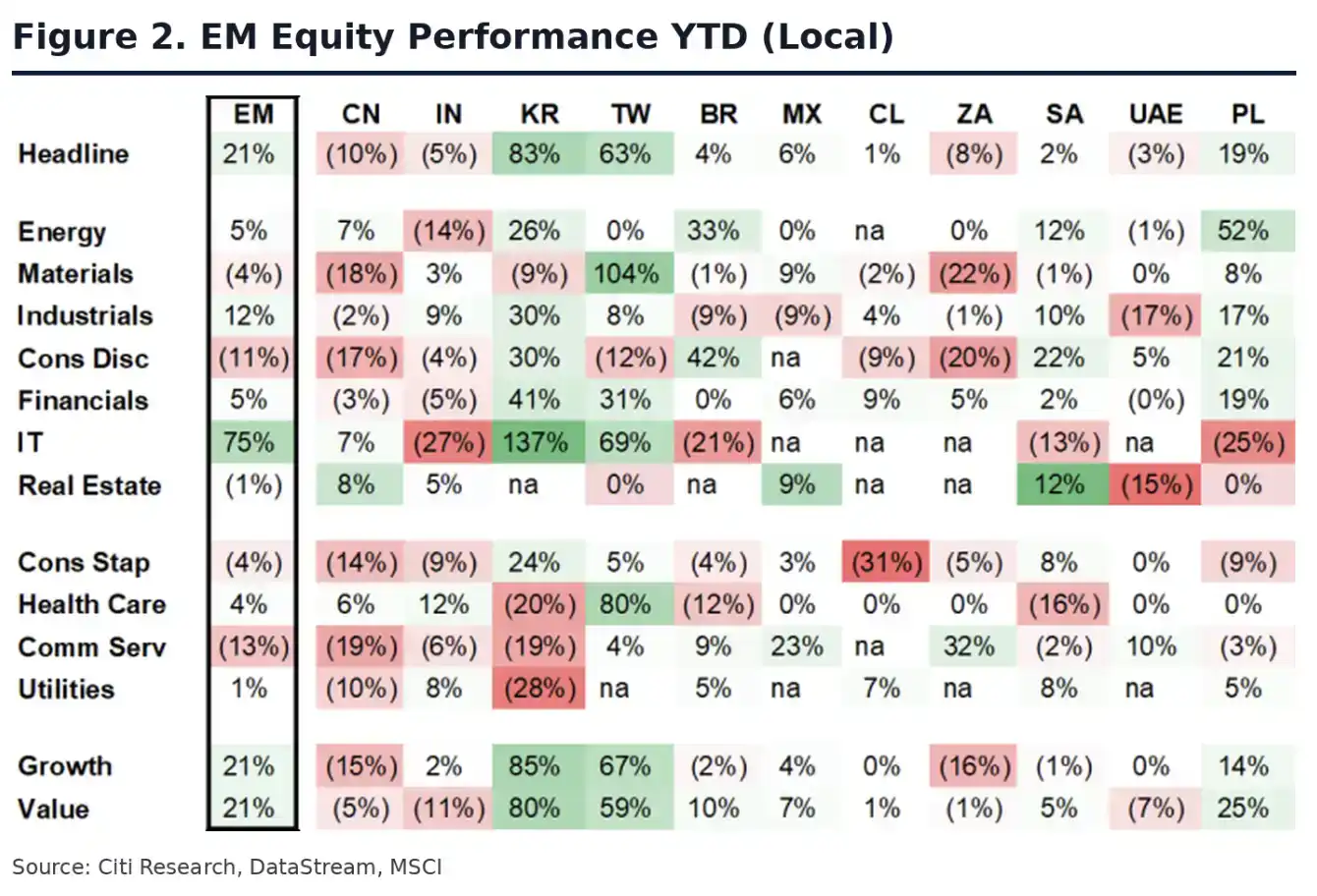
South Korea has delivered nearly 40% positive returns, and Taiwan-China markets over 30%, highlighting the high concentration of this year's EM rally.
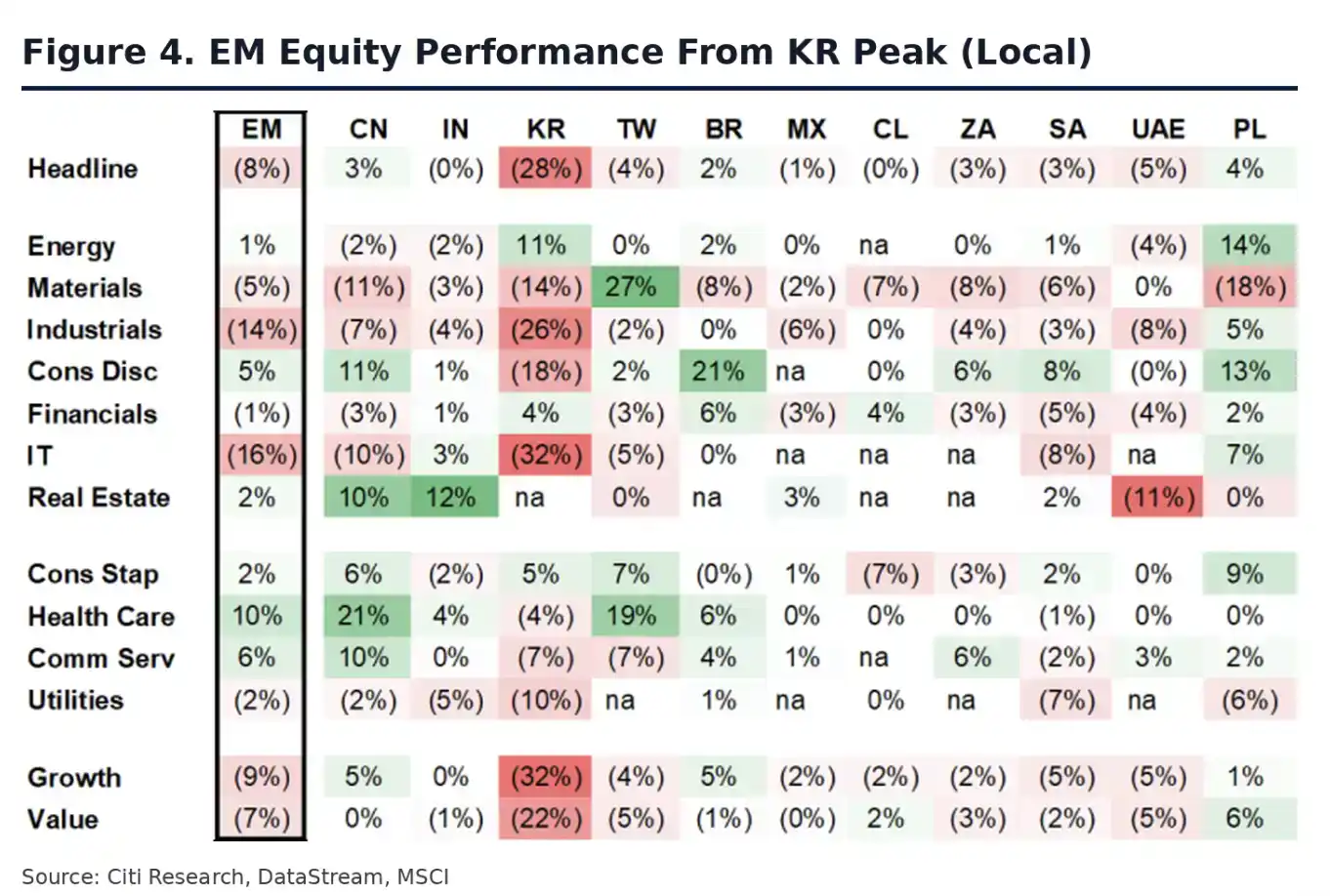
South Korea's pullback and the lack of comprehensive follow-through from other markets.

China Upgraded to Overweight, South Korea Cools Off First

In this round of allocation adjustments, China was upgraded from Neutral to Overweight, and Mexico was raised to Neutral. South Korea was downgraded from Overweight to Neutral, while Taiwan-China markets remain on the Overweight list.

China's appeal primarily stems from three factors. Global investors remain underweight on Chinese stocks, leaving significant room for capital inflows if global risk appetite improves. Falling oil prices benefit energy-importing markets like China. As global growth data improves, some cyclical assets regain support, with China ranking relatively high among macro-sensitive markets in this cycle.

This contrasts with the dominant theme in emerging markets over the past two years. The strongest trades were previously concentrated in the AI hardware supply chain, with South Korea and Taiwan-China markets being the biggest winners due to demand for semiconductors, memory, and AI servers. However, for the index to continue rising, relying solely on a few tech stocks becomes increasingly difficult, requiring funds to find more markets capable of sustaining the rally.

South Korea's downgrade does not equate to a weakening fundamental outlook. Public reports indicate that Citi retains a relatively strong long-term view on the South Korean equity market, with local strategists having previously set a KOSPI target of 10,000 points. According to the source report, the logic includes the potential for memory shortages to persist into 2027, and continued demand growth from AI tokens and customization supporting the memory upcycle. The near-term issue lies in South Korea's outsized prior gains, elevated implied volatility, and the amplification of fluctuations by retail leveraged products.

Taiwan-China markets remain one of the most direct beneficiaries within the AI hardware chain. According to the source report, local strategists have set a mid-2027 target for the Taiwan Weighted Index at 53,500 points. However, this market faces similar issues – trading has become crowded, and volatility often manifests first in these prior winners if greater skepticism emerges regarding the returns on AI capital expenditure.

EM Has Room to Run, Yet Earnings Revisions Remain Narrow

The two specific index targets set by Citi for MSCI EM are the clearest numerical calls in this report: 1870 by end-2026 and 2050 by mid-2027.

The support does not come from significant valuation expansion. The current 12-month forward P/E for MSCI EM is around 11.5x, roughly in line with its long-term average. Following this year's rally in emerging markets, valuations have not been pushed into a clear bubble zone; index gains have come more from improved earnings expectations.

The earnings numbers appear robust. The 2026 EPS growth forecast for MSCI EM reaches 63%, revised up by 28 percentage points cumulatively since late February. Growth is expected to moderate to 24% in 2027, but still remains above comparable assets in developed markets.

The issue is that the source of earnings improvement remains narrow. The Information Technology sector contributed about 85% of the 2026 EPS upward revisions, with South Korean and Taiwan-China AI supply chains still being the primary sources. Revisions for most non-tech sectors like Consumer, Real Estate, and Utilities remain weak. In other words, while the EM index appears supported by earnings on the surface, the upward earnings revisions have not yet broadened out to more industries.
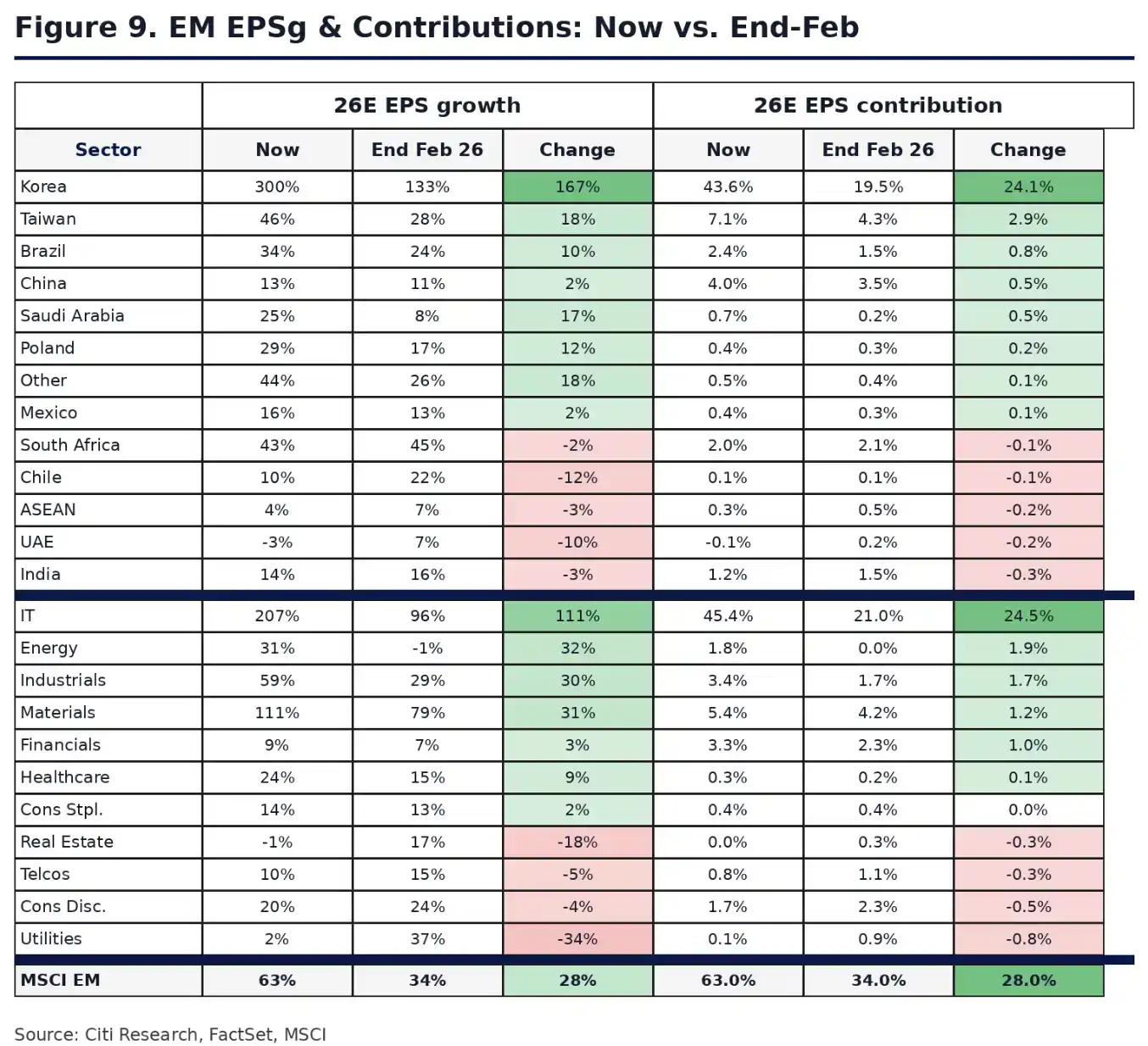
MSCI EM 2026E EPS growth of 63%, with the IT sector contributing roughly 85% of the upward revision magnitude.

This is also why Citi has not upgraded Emerging Markets to an Overweight stance within its global asset allocation framework. It can increase weights to markets like China within the region, but at the global asset allocation level, Emerging Markets remains Neutral. Citi's stance is closer to 'selectively adding exposure to broadening beneficiaries' rather than confirming a full-blown bull market.

The So-Called 'Broadening' Means Momentum Needs to Move Beyond a Few AI Winners

In plain terms, what Citi refers to as 'broadening trades' means this year's emerging market rally cannot continue to rely solely on gains in South Korea, Taiwan-China markets, and the AI chain. Funds either need to find new countries and sectors, or the index's further upside will be constrained.

This screening framework primarily looks at several conditions: whether a market benefits from a weaker US Dollar and declining US Treasury yields, whether it benefits from falling oil prices, its historical performance during improvements in global economic data, whether its near-term earnings revisions are turning positive, and whether its current trading is already too crowded.

Under this framework, China, South Africa, and Mexico rank high. According to the source report, their composite scores in the 'broadening candidate' screen are 4.2, 5.0, and 5.3 respectively. While South Korea and Taiwan-China markets remain recent winners, they face more pronounced issues of near-term crowding and volatility.

Oil prices present a real-world condition. Citi's baseline assumption is that oil averages around $75/barrel in Q3 2026, declining to around $65/barrel by early 2027. Falling oil prices typically benefit energy-importing markets like South Korea, Taiwan-China, India, and China, while posing challenges for some resource-heavy and oil-sensitive markets.
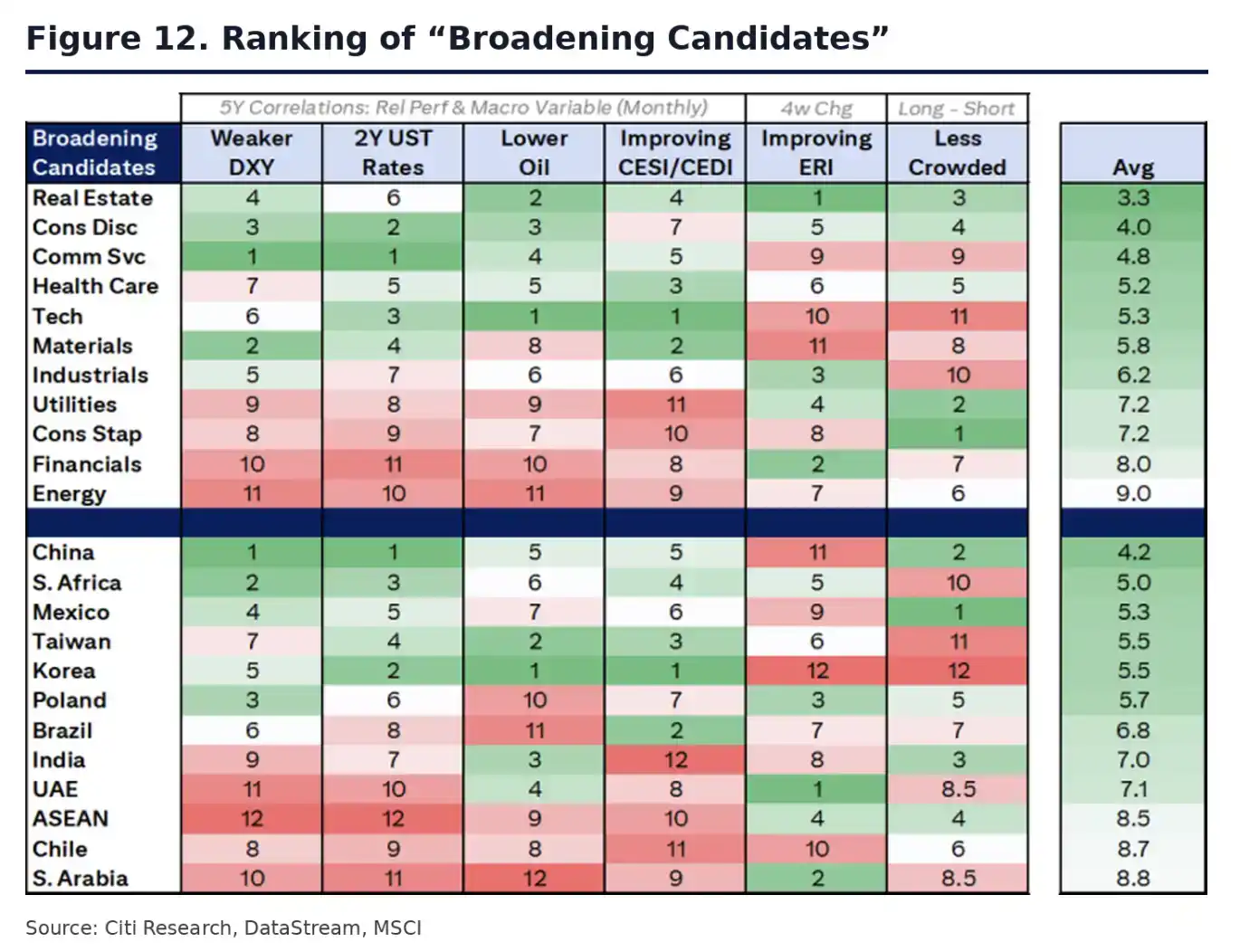
The 'Broadening Candidates' table shows China, South Africa, and Mexico ranking high across dimensions including weak USD, US Treasury yields, oil prices, and crowding.

This context is key to China's upgrade. It is neither this year's strongest performer nor the most crowded trade within the AI hardware chain. However, under the combination of improving global growth, declining oil prices, and room for positioning catch-up, it possesses the conditions to attract rotational flows.

Broadening Not Yet Complete; AI Chain Remains the Biggest Divergence

The cautious aspect of this report is that Citi does not present 'broadening' as an accomplished fact.

This year's EM gains are highly concentrated, with cross-market return dispersion reaching levels among the highest in the past 25 years. South Korean and Taiwan-China tech/AI sectors have contributed almost all the index-level returns. If future earnings revisions remain confined to the IT sector, the so-called broadening looks more like a short-term portfolio rotation rather than a broad-based fundamental improvement.

AI capital expenditure remains the greatest uncertainty. Previously, the market was willing to assign higher expectations to memory, semiconductors, and AI infrastructure due to sustained demand for training and inference pushing compute investment. However, if investors begin to question the returns on this capital expenditure, the prior winners like South Korea and Taiwan-China could face greater pressure.

Macro risks have not disappeared. Renewed geopolitical escalation could push oil prices away from the downward scenario. Fed policy remains a point of divergence; if rate cuts fall short of expectations, the US Dollar and Treasury yields could pressure emerging markets. A potential super El Niño could also bring new inflationary pressures.
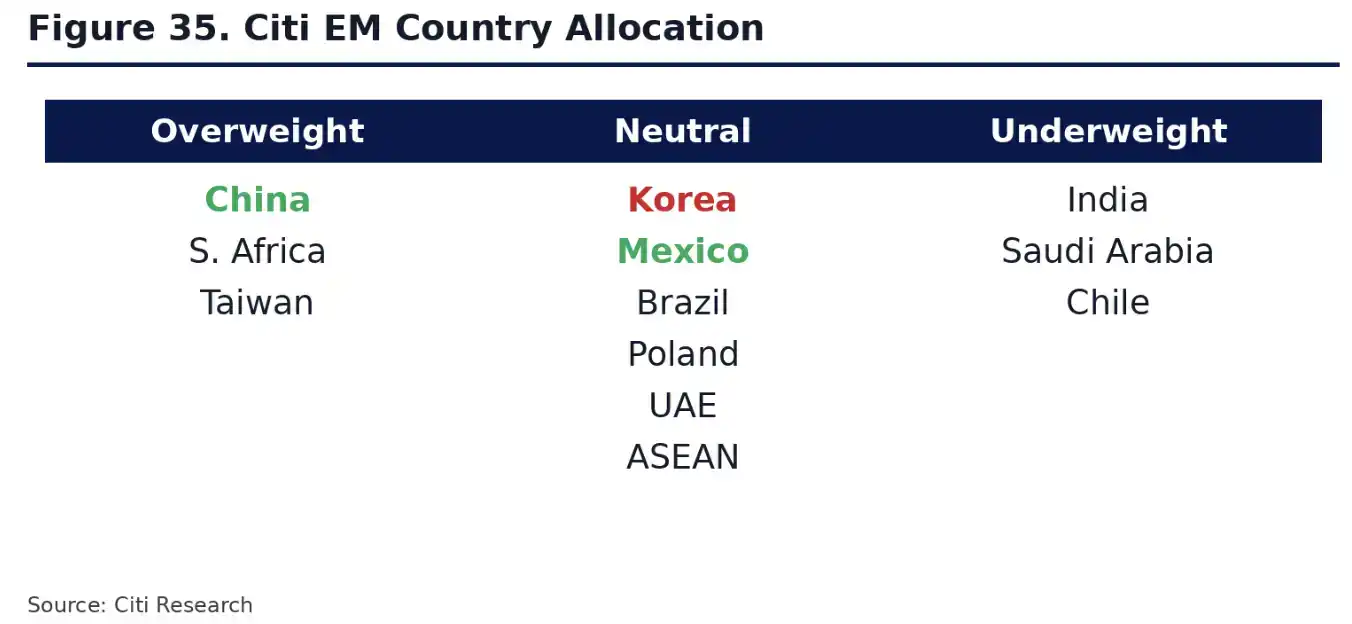
Citi's EM country allocation table shows Overweight positions in China, South Africa, and Taiwan-China markets, with South Korea downgraded to Neutral.

Citi's judgment on emerging markets is more akin to 'the rally has the potential to broaden' rather than 'a full-blown bull market is already confirmed.' China was upgraded because it offers better risk-reward in this potential broadening trade. South Korea was cooled off, indicating that prior winners are not necessarily incapable of further gains, but that their short-term gains and volatility have diminished their near-term appeal.

Whether MSCI EM can reach 1870 or even 2050 points depends not only on how much further the AI chain can rise but also on whether non-tech sector earnings can halt their downward revisions, whether the global cyclical improvement can be sustained, and whether funds are genuinely willing to flow from the few winners to a wider range of markets.


Criptos en tendencia

Preguntas relacionadas

QWhat were the main changes made by Citi in its emerging market strategy report regarding China and South Korea?

ACiti upgraded China from neutral to overweight and tactically downgraded South Korea from overweight to neutral.

QWhat are the two price targets set by Citi for the MSCI EM Index, and what do they imply in terms of upside?

ACiti set a target of 1870 points for the MSCI EM Index by the end of 2026 and 2050 points by mid-2027. From the current level of approximately 1664 points, this implies an upside of about 12% and 20% respectively.

QWhat is the 'broadening' trade that Citi refers to in the context of emerging markets?

AThe 'broadening' trade refers to the potential for market gains to spread beyond the concentrated winners of the AI hardware chain (like South Korea and Taiwan/China tech) to other countries and sectors, such as China, South Africa, and Mexico, to sustain the index's upward momentum.

QWhat are the primary reasons Citi cites for upgrading China to overweight?

ACiti's reasons for upgrading China include: 1) Overseas investors remain underweight on Chinese stocks, leaving room for reallocation if global risk appetite improves. 2) Falling oil prices benefit energy-importing markets like China. 3) China ranks high among macro-sensitive markets as global growth data improves, supporting some cyclical assets.

QWhy does Citi maintain a neutral stance on emerging markets at the global asset allocation level despite its positive internal adjustments?

ACiti maintains a neutral stance globally because the earnings recovery in emerging markets is still narrow, driven overwhelmingly by the IT sector (especially the AI chain). For a more bullish overweight call, improvements need to broaden to more non-tech sectors and countries beyond the current concentrated winners.

Lecturas Relacionadas

Tras tres trimestres consecutivos de caída, ¿puede el mercado cripto encontrar una ventana de estabilización en el tercer trimestre?

El mercado cripto sufrió su peor trimestre desde 2022, con una caída del 12.6% en la capitalización total (ahora en $2.1 billones). El volumen de operaciones y el valor de las stablecoins también disminuyeron, señalando una salida generalizada de capitales. Bitcoin y Ethereum cayeron un 14.2% y 25.4% respectivamente, rompiendo su correlación con los mercados de riesgo tradicionales. Los ETFs de Bitcoin en EE.UU. registraron importantes salidas netas ($4.67 mil millones en Q2), aunque datos sugieren que el ciclo de ventas podría estar cerca de su fin. La atención del mercado se centra ahora en la reunión de la FED a finales de julio, cuya postura (halcón o paloma) podría definir el rango de trading de Bitcoin para el trimestre. El avance de la ley CLARITY en el Senado estadounidense se ha estancado, reduciendo la probabilidad de aprobación en 2026 y manteniendo una prima de riesgo regulatorio alta. Solo dos sectores mostraron crecimiento: los mercados de predicción (volumen +48.7%) y los coleccionables tokenizados (volumen +143% vs. Q1). El sentimiento general es de cautela. La lógica del mercado ha cambiado, priorizando fundamentos como la política monetaria y la regulación frente a los simples impulsos narrativos. Aunque las bases para una caída extrema parecen limitadas, la recuperación sostenida en Q3 depende críticamente de la FED y de un posible progreso regulatorio.

marsbitHace 23 hora(s)

Tras tres trimestres consecutivos de caída, ¿puede el mercado cripto encontrar una ventana de estabilización en el tercer trimestre?

marsbitHace 23 hora(s)

BIT Trading Moments: BTC aún presionado por la EMA 200 semanal, tras el rechazo podría reiniciar la caída, los valores de almacenamiento y semiconductores que subieron fuertemente anoche comenzaron a caer en la sesión nocturna

**BIT Trading Moments: BTC aún presionado por la EMA 200 semanal; almacenamiento y semiconductores caen en el after-hours** El mercado de cripto continúa su recuperación, con **Bitcoin** manteniéndose cerca de los $66,000. Enfrenta una fuerte resistencia en la zona de los $68,000, nivel que coincide con el costo promedio de los inversores en los últimos cinco meses y un punto de fallo anterior. Los analistas señalan que se encuentra atrapado entre la media móvil simple (MA) de 200 semanas (~$63,333) y la media exponencial (EMA) de 200 semanas (~$68,328). Se necesitaría un cierre semanal por debajo de $55,000 o por encima de $70,000 para confirmar una dirección de mayor alcance. Los ETF de Bitcoin registran entradas netas por sexto día consecutivo. En Wall Street, los **futuros de los principales índices** caen. Después de fuertes ganancias el martes, las acciones de **semiconductores y almacenamiento** retroceden en el after-hours: el ETF de semiconductores cae un 2.22%, Micron un 2.29% y SK Hynix casi un 5%. Sin embargo, **Super Micro Computer (SMCI)** se dispara más de un 20% tras el cierre, impulsada por sólidos pedidos. Otras noticias positivas incluyen un contrato de $266M de la Fuerza Aérea para **Rocket Lab**. A pesar del repunte bursátil, factores como el **crudo Brent por encima de $91** y el **rendimiento del bono estadounidense a 10 años subiendo a ~4.64%** generan preocupaciones inflacionarias y enfrían el optimismo. Las acciones relacionadas con cripto, como Coinbase y Robinhood, tuvieron un buen desempeño apoyadas por avances regulatorios. En Asia, los mercados siguieron la recuperación tecnológica. El **índice KOSPI de Corea del Sur** subió un 0.74%, con acciones de semiconductores mostrando volatilidad. El principal riesgo es el **yen japonés**, que tocó su nivel más bajo desde 1986, lo que genera temores a una intervención del gobierno. **Próximos eventos clave:** Este miércoles 22 de julio, el enfoque está en los eventos de **AMD AI** y los resultados financieros de **Alphabet (Google), Tesla e IBM** después del cierre. El jueves 23, la **decisión de tasas del BCE** y los resultados de **Intel** serán cruciales para el sentimiento del mercado.

marsbitHace 23 hora(s)

BIT Trading Moments: BTC aún presionado por la EMA 200 semanal, tras el rechazo podría reiniciar la caída, los valores de almacenamiento y semiconductores que subieron fuertemente anoche comenzaron a caer en la sesión nocturna

marsbitHace 23 hora(s)

Trading

Spot

Artículos destacados

Qué es $BANK

Bank AI: Un Paso Revolucionario en el Futuro de la Banca Introducción En una era marcada por avances rápidos en tecnología, Bank AI se encuentra en la intersección de la inteligencia artificial (IA) y los servicios bancarios. Este proyecto innovador busca redefinir el panorama financiero, mejorando la eficiencia operativa, las medidas de seguridad y las experiencias del cliente a través del poder de la IA. A medida que iniciamos esta exploración de Bank AI, profundizaremos en lo que implica el proyecto, sus dinámicas operativas, su contexto histórico y los hitos significativos. ¿Qué es Bank AI? En su esencia, Bank AI representa una iniciativa transformadora destinada a integrar la inteligencia artificial en diversas operaciones bancarias. Este proyecto aprovecha las capacidades de la IA para automatizar procesos, mejorar los protocolos de gestión de riesgos y mejorar la interacción con el cliente a través de servicios personalizados. Los objetivos principales de Bank AI incluyen: Automatización de Funciones Bancarias: Al aprovechar las tecnologías de IA, Bank AI tiene como objetivo automatizar tareas rutinarias, reduciendo la carga sobre los recursos humanos y mejorando la eficiencia. Mejora en la Gestión de Riesgos: El proyecto utiliza algoritmos de IA para predecir e identificar riesgos, fortaleciendo las medidas de seguridad contra el fraude y otras amenazas. Personalización de Servicios Bancarios: Bank AI se centra en ofrecer productos y servicios financieros a medida al analizar datos y comportamientos de los clientes. Mejora de la Experiencia del Cliente: La implementación de soluciones impulsadas por IA, como chatbots y asistentes virtuales, tiene como objetivo proporcionar a los usuarios interacciones más humanas, revolucionando la forma en que los clientes se relacionan con los bancos. Con estos objetivos, Bank AI se posiciona como un jugador crucial para hacer que la banca sea más eficiente, segura y centrada en el usuario. ¿Quién es el Creador de Bank AI? Los detalles sobre el creador de Bank AI siguen siendo desconocidos. Como tal, no se ha identificado a ninguna persona u organización específica en la información disponible. El anonimato que rodea el inicio del proyecto plantea preguntas, pero no resta valor a su ambiciosa visión y objetivos. ¿Quiénes son los Inversores de Bank AI? Al igual que con el creador del proyecto, no se ha divulgado información específica sobre los inversores u organizaciones de apoyo de Bank AI. Sin esta información, es difícil delinear el respaldo financiero y el apoyo institucional que podrían estar impulsando el proyecto hacia adelante. No obstante, la importancia de tener una base de inversión sólida es fundamental para sostener el desarrollo en un campo tan innovador. ¿Cómo Funciona Bank AI? Bank AI opera en varios frentes innovadores, centrándose en factores únicos que lo diferencian de los marcos bancarios tradicionales. A continuación se presentan las características operativas clave: Automatización: Al aplicar algoritmos de aprendizaje automático, Bank AI automatiza varios procesos manuales dentro de los bancos. Esto resulta en la reducción de costos operativos y permite a los trabajadores humanos redirigir sus esfuerzos hacia actividades más estratégicas. Gestión Avanzada de Riesgos: La integración de la IA en las prácticas de gestión de riesgos proporciona a los bancos herramientas para predecir con precisión posibles amenazas como el fraude, asegurando que la información y los activos de los clientes permanezcan seguros. Recomendaciones Financieras Personalizadas: A través del aprendizaje continuo a partir de las interacciones con los clientes, los sistemas de IA desarrollan una comprensión matizada de las necesidades del usuario, lo que les permite ofrecer asesoramiento personalizado sobre decisiones financieras. Interacciones Mejoradas con el Cliente: Utilizando chatbots y asistentes virtuales impulsados por IA, Bank AI permite una experiencia más atractiva para el cliente, permitiendo que los usuarios obtengan respuestas a sus consultas rápidamente, reduciendo así los tiempos de espera y mejorando los niveles de satisfacción. En conjunto, estas características operativas posicionan a Bank AI como un pionero en el sector bancario, estableciendo nuevos estándares para la entrega de servicios y la excelencia operativa. Cronología de Bank AI Entender la trayectoria de Bank AI requiere un vistazo a su contexto histórico. A continuación se muestra una cronología que destaca hitos y desarrollos importantes: Principios de 2010: La conceptualización de la integración de la IA en los servicios bancarios comenzó a ganar atención a medida que las instituciones bancarias reconocían los beneficios potenciales. 2018: Se produjo un aumento notable en la implementación de tecnologías de IA cuando los bancos comenzaron a utilizar herramientas de IA como chatbots para el servicio al cliente básico y sistemas de gestión de riesgos para mejorar la seguridad. 2023: La sofisticación de la IA siguió avanzando, con la introducción de la IA generativa para tareas más complejas como el procesamiento de documentos y el análisis de inversiones en tiempo real. Este año marcó un salto significativo en las capacidades que la tecnología de IA proporcionó a los bancos. 2024-Estado Actual: A partir de este año, Bank AI está en una trayectoria ascendente, con investigaciones y desarrollos en curso que están listos para mejorar aún más las capacidades en las operaciones bancarias. La continua exploración de aplicaciones de IA sugiere desarrollos emocionantes que aún están por venir. Puntos Clave Sobre Bank AI Integración de la IA en la Banca: Bank AI se centra en adoptar la inteligencia artificial para agilizar los procesos bancarios y mejorar las experiencias de los usuarios. Enfoque en Automatización y Gestión de Riesgos: El proyecto enfatiza fuertemente estas áreas, con el objetivo de cambiar la carga de tareas rutinarias mientras se mejoran los marcos de seguridad a través de análisis predictivos. Soluciones Bancarias Personalizadas: Al aprovechar los datos de los clientes, Bank AI permite servicios bancarios a medida que satisfacen las necesidades individuales de los usuarios. Compromiso con el Desarrollo: Bank AI sigue comprometido con los esfuerzos de investigación y desarrollo continuo, asegurando su adaptabilidad y relevancia continua a medida que la tecnología sigue evolucionando. Conclusión En resumen, Bank AI ejemplifica un paso crucial hacia adelante en la industria bancaria, aprovechando la inteligencia artificial para remodelar los paradigmas operativos, mejorar la seguridad y promover la satisfacción del cliente. A pesar de las lagunas en la información sobre el creador y los inversores, los objetivos claros y los mecanismos funcionales de Bank AI proporcionan una sólida base para su evolución continua. A medida que la tecnología de IA sigue avanzando y fusionándose con el sector bancario, Bank AI está bien posicionado para impactar significativamente en el futuro de los servicios financieros, mejorando la forma en que entendemos e interactuamos con la banca.

223 Vistas totalesPublicado en 2024.04.06Actualizado en 2024.12.03

Qué es $BANK

Cómo comprar BANK

¡Bienvenido a HTX.com! Hemos hecho que comprar Lorenzo Protocol (BANK) sea simple y conveniente. Sigue nuestra guía paso a paso para iniciar tu viaje de criptos.Paso 1: crea tu cuenta HTXUtiliza tu correo electrónico o número de teléfono para registrarte y obtener una cuenta gratuita en HTX. Experimenta un proceso de registro sin complicaciones y desbloquea todas las funciones.Obtener mi cuentaPaso 2: ve a Comprar cripto y elige tu método de pagoTarjeta de crédito/débito: usa tu Visa o Mastercard para comprar Lorenzo Protocol (BANK) al instante.Saldo: utiliza fondos del saldo de tu cuenta HTX para tradear sin problemas.Terceros: hemos agregado métodos de pago populares como Google Pay y Apple Pay para mejorar la comodidad.P2P: tradear directamente con otros usuarios en HTX.Over-the-Counter (OTC): ofrecemos servicios personalizados y tipos de cambio competitivos para los traders.Paso 3: guarda tu Lorenzo Protocol (BANK)Después de comprar tu Lorenzo Protocol (BANK), guárdalo en tu cuenta HTX. Alternativamente, puedes enviarlo a otro lugar mediante transferencia blockchain o utilizarlo para tradear otras criptomonedas.Paso 4: tradear Lorenzo Protocol (BANK)Tradear fácilmente con Lorenzo Protocol (BANK) en HTX's mercado spot. Simplemente accede a tu cuenta, selecciona tu par de trading, ejecuta tus trades y monitorea en tiempo real. Ofrecemos una experiencia fácil de usar tanto para principiantes como para traders experimentados.

860 Vistas totalesPublicado en 2025.05.09Actualizado en 2026.06.02

Cómo comprar BANK

Discusiones

Bienvenido a la comunidad de HTX. Aquí puedes mantenerte informado sobre los últimos desarrollos de la plataforma y acceder a análisis profesionales del mercado. A continuación se presentan las opiniones de los usuarios sobre el precio de BANK (BANK).

活动图片