Ansem: Why I Believe Token Buybacks Don't Solve Anything?

marsbitPublicado a 2026-07-17Actualizado a 2026-07-17

Resumen

Crypto trader Ansem argues that token buybacks alone do not create value. Instead, a project's valuation multiple is driven by "trust premium" built between the team and its community. He compares two high-revenue Solana protocols: Hyperliquid (estimated $800M annualized revenue, ~$650B FDV) and pump.fun (estimated $440M annualized revenue, ~$14B FDV). Both aggressively use most protocol revenue for buybacks, yet their valuation multiples differ by nearly 50x. Ansem attributes Hyperliquid's high valuation to the trust earned by its founder Jeff and team through consistent execution, transparent community rewards, and a dedicated user base. In contrast, he criticizes pump.fun for failing to fulfill a promised airdrop of 24% of its token supply for over a year since its July 2025 ICO, despite generating over $1B in revenue and raising $1B in the ICO. He suggests that honoring its commitments could significantly boost its token price and platform metrics. The core thesis is that trust, not just financial mechanics, is the key driver of crypto asset valuations.

Author: Claude, Deep Tide TechFlow

Deep Tide Introduction: Famous Solana trader Ansem posted that the buyback mechanism itself does not create value, and what determines the token valuation multiple is the "trust premium" between the team and the community. Using Hyperliquid (annualized revenue approx. $8 billion, FDV approx. $65 billion) and pump.fun (annualized revenue approx. $440 million, FDV only approx. $1.4 billion) as a comparison, he pointed out that both are conducting large-scale buybacks, but their valuation multiples differ by nearly 50 times.
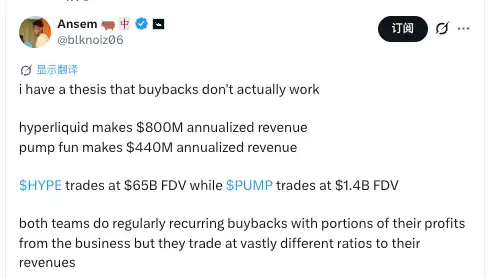
One of the most enduring narratives in the crypto market is being challenged: dumping protocol revenue into buybacks will make the token price rise.

On July 16, famous Solana trader Ansem (@blknoiz06) posted a long thread on platform X, proposing a counterintuitive argument: the buyback mechanism itself does not create value; what truly determines the token trading multiple is the "trust premium" between the team and the community. This post quickly gained over 469,000 views, 3,240 likes, and 509 reposts.

Ansem selected two of the crypto industry's highest-earning protocols for comparison. Hyperliquid's annualized revenue is approximately $8 billion, HYPE's FDV is approximately $65 billion; pump.fun's annualized revenue is approximately $440 million, PUMP's FDV is only about $1.4 billion. Both teams are using the vast majority of their revenue for buybacks, but their valuation multiples differ by nearly 50 times.

Ansem's conclusion is: the gap is not in the scale of revenue, but in the trust accumulated through the team's actions.

Both Spending Heavily on Buybacks, Why Do Hyperliquid and pump.fun Have Such Widely Different Valuations?

Ansem deconstructed the buyback strategies of the two platforms in his post.

Hyperliquid directs 97% to 99% of protocol fees directly into HYPE buyback and burn. According to CryptoNews data, as of June 30, Hyperliquid's cumulative protocol revenue had exceeded $1 billion, with an annualized run rate close to $840 million. The platform has burned over 41 million HYPE tokens, worth over $1 billion, reducing the circulating supply by approximately 4.2%. At the time of writing, HYPE is quoted around $60 to $67, with an FDV of approximately $57 to $62 billion.

pump.fun is similarly aggressive. In 2025, the platform's total revenue was approximately $970 million, and it invested close to 100% of revenue into PUMP buybacks, accumulating about $213 million in buybacks. In April 2026, the team executed a one-time burn of PUMP tokens worth $370 million (about 36% of the circulating supply) and locked 50% of subsequent revenue for continuous burns. However, PUMP is currently quoted around $0.0016, with an FDV of approximately $1.4 to $1.7 billion.

pump.fun's annualized revenue is a bit more than half of Hyperliquid's, but its FDV is less than 3% of Hyperliquid's. If the buyback mechanism were the core driver of valuation, this multiple gap would be unexplainable.

Ansem's Explanation: Trust Premium is the Core of Pricing

Ansem believes the high valuation the market gives Hyperliquid stems from the trust established by Jeff (Hyperliquid founder) and his team.

He listed several points in his post: Hyperliquid has never overpromised; the team focuses solely on shipping products; user rewards are strictly distributed based on pre-determined on-chain metrics without opaque operations; the core user base has an extremely high trust rating for Jeff and the team. Ansem's original words stated that this trust premium "is one of the main reasons the token is trading so well."

Hyperliquid's historical actions support this judgment. The project did not accept VC investment, allocating 70% of the total supply to the community; the massive airdrop at launch in November 2024 fulfilled early promises; the platform showed resilience during the market sell-off in February 2026, indicating its user base includes many serious traders who rely on the platform for daily trading.

The pump.fun Problem: $1 Billion in Revenue, Promised Airdrop Unfulfilled for a Year

Ansem's criticism of pump.fun is more direct.

He pointed out that pump.fun has accumulated over $1 billion in revenue, raised another $1 billion in its ICO, but the airdrop promised to users has never been delivered. According to a Protos report, pump.fun clearly stated "airdrop coming soon" when announcing the PUMP token ICO on July 9, 2025, promising to allocate 24% of the supply to the community. By mid-July 2026, this promise has been outstanding for a full year, with no airdrop in sight.

Ansem had previously criticized this on June 25: "pump.fun is the only application in crypto that has sustained attention for several years, not even OpenSea achieved that. But people are angry because they promised a 24% airdrop and never delivered, just sitting on the cash now."

The $370 million token burn in April 2026 was intended to repair trust, but the community reaction backfired. Some users believed the burned tokens should have been used for the airdrop allocation, and burning them directly eliminated the community's deserved share. According to a Cryptopolitan report, the widespread community interpretation of this move was that it "deepened distrust."

In his latest post, Ansem made a hypothetical scenario: if pump.fun seriously fulfilled its airdrop promise and addressed the concerns of its core users, the token price could potentially increase 10 to 15 times, while trading volume, attention, and platform revenue would also see substantial growth.


Criptos en tendencia

Preguntas relacionadas

QWhat is the core argument presented by Ansem regarding token buybacks?

AAnsem argues that token buyback mechanisms themselves do not create value. He believes the key driver of a token's valuation multiple is the 'trust premium' established between the project team and its community.

QAccording to the article, what is the significant valuation difference between Hyperliquid and pump.fun despite both engaging in buybacks?

ADespite both platforms aggressively using protocol revenue for buybacks, Hyperliquid's FDV is approximately $650 billion while pump.fun's FDV is only about $14 billion, representing a nearly 50x difference in valuation multiples.

QWhat reasons does Ansem give for the high 'trust premium' enjoyed by Hyperliquid?

AAnsem attributes Hyperliquid's trust premium to the team's focus on product delivery without overpromising, transparent and rule-based user reward distribution, and a core user base with high trust in founder Jeff and the team's execution.

QWhat is the specific criticism Ansem levels against pump.fun regarding community commitments?

AAnsem criticizes pump.fun for failing to fulfill its promise of a community airdrop allocating 24% of the token supply, a commitment made during its July 2025 ICO announcement that remained unfulfilled a year later.

QWhat was the community's reaction to pump.fun's $370 million token burn in April 2026, and why?

AThe community reaction was largely negative and deepened distrust. Many users perceived that the burned tokens should have been allocated for the promised airdrop, viewing the burn as destroying the community's rightful share.

Lecturas Relacionadas

Tras tres trimestres consecutivos de caída, ¿puede el mercado cripto encontrar una ventana de estabilización en el tercer trimestre?

El mercado cripto sufrió su peor trimestre desde 2022, con una caída del 12.6% en la capitalización total (ahora en $2.1 billones). El volumen de operaciones y el valor de las stablecoins también disminuyeron, señalando una salida generalizada de capitales. Bitcoin y Ethereum cayeron un 14.2% y 25.4% respectivamente, rompiendo su correlación con los mercados de riesgo tradicionales. Los ETFs de Bitcoin en EE.UU. registraron importantes salidas netas ($4.67 mil millones en Q2), aunque datos sugieren que el ciclo de ventas podría estar cerca de su fin. La atención del mercado se centra ahora en la reunión de la FED a finales de julio, cuya postura (halcón o paloma) podría definir el rango de trading de Bitcoin para el trimestre. El avance de la ley CLARITY en el Senado estadounidense se ha estancado, reduciendo la probabilidad de aprobación en 2026 y manteniendo una prima de riesgo regulatorio alta. Solo dos sectores mostraron crecimiento: los mercados de predicción (volumen +48.7%) y los coleccionables tokenizados (volumen +143% vs. Q1). El sentimiento general es de cautela. La lógica del mercado ha cambiado, priorizando fundamentos como la política monetaria y la regulación frente a los simples impulsos narrativos. Aunque las bases para una caída extrema parecen limitadas, la recuperación sostenida en Q3 depende críticamente de la FED y de un posible progreso regulatorio.

marsbitHace 15 hora(s)

Tras tres trimestres consecutivos de caída, ¿puede el mercado cripto encontrar una ventana de estabilización en el tercer trimestre?

marsbitHace 15 hora(s)

BIT Trading Moments: BTC aún presionado por la EMA 200 semanal, tras el rechazo podría reiniciar la caída, los valores de almacenamiento y semiconductores que subieron fuertemente anoche comenzaron a caer en la sesión nocturna

**BIT Trading Moments: BTC aún presionado por la EMA 200 semanal; almacenamiento y semiconductores caen en el after-hours** El mercado de cripto continúa su recuperación, con **Bitcoin** manteniéndose cerca de los $66,000. Enfrenta una fuerte resistencia en la zona de los $68,000, nivel que coincide con el costo promedio de los inversores en los últimos cinco meses y un punto de fallo anterior. Los analistas señalan que se encuentra atrapado entre la media móvil simple (MA) de 200 semanas (~$63,333) y la media exponencial (EMA) de 200 semanas (~$68,328). Se necesitaría un cierre semanal por debajo de $55,000 o por encima de $70,000 para confirmar una dirección de mayor alcance. Los ETF de Bitcoin registran entradas netas por sexto día consecutivo. En Wall Street, los **futuros de los principales índices** caen. Después de fuertes ganancias el martes, las acciones de **semiconductores y almacenamiento** retroceden en el after-hours: el ETF de semiconductores cae un 2.22%, Micron un 2.29% y SK Hynix casi un 5%. Sin embargo, **Super Micro Computer (SMCI)** se dispara más de un 20% tras el cierre, impulsada por sólidos pedidos. Otras noticias positivas incluyen un contrato de $266M de la Fuerza Aérea para **Rocket Lab**. A pesar del repunte bursátil, factores como el **crudo Brent por encima de $91** y el **rendimiento del bono estadounidense a 10 años subiendo a ~4.64%** generan preocupaciones inflacionarias y enfrían el optimismo. Las acciones relacionadas con cripto, como Coinbase y Robinhood, tuvieron un buen desempeño apoyadas por avances regulatorios. En Asia, los mercados siguieron la recuperación tecnológica. El **índice KOSPI de Corea del Sur** subió un 0.74%, con acciones de semiconductores mostrando volatilidad. El principal riesgo es el **yen japonés**, que tocó su nivel más bajo desde 1986, lo que genera temores a una intervención del gobierno. **Próximos eventos clave:** Este miércoles 22 de julio, el enfoque está en los eventos de **AMD AI** y los resultados financieros de **Alphabet (Google), Tesla e IBM** después del cierre. El jueves 23, la **decisión de tasas del BCE** y los resultados de **Intel** serán cruciales para el sentimiento del mercado.

marsbitHace 15 hora(s)

BIT Trading Moments: BTC aún presionado por la EMA 200 semanal, tras el rechazo podría reiniciar la caída, los valores de almacenamiento y semiconductores que subieron fuertemente anoche comenzaron a caer en la sesión nocturna

marsbitHace 15 hora(s)

Trading

Spot

Artículos destacados

Cómo comprar ANSEM

¡Bienvenido a HTX.com! Hemos hecho que comprar The Black Bull (ANSEM) sea simple y conveniente. Sigue nuestra guía paso a paso para iniciar tu viaje de criptos.Paso 1: crea tu cuenta HTXUtiliza tu correo electrónico o número de teléfono para registrarte y obtener una cuenta gratuita en HTX. Experimenta un proceso de registro sin complicaciones y desbloquea todas las funciones.Obtener mi cuentaPaso 2: ve a Comprar cripto y elige tu método de pagoTarjeta de crédito/débito: usa tu Visa o Mastercard para comprar The Black Bull (ANSEM) al instante.Saldo: utiliza fondos del saldo de tu cuenta HTX para tradear sin problemas.Terceros: hemos agregado métodos de pago populares como Google Pay y Apple Pay para mejorar la comodidad.P2P: tradear directamente con otros usuarios en HTX.Over-the-Counter (OTC): ofrecemos servicios personalizados y tipos de cambio competitivos para los traders.Paso 3: guarda tu The Black Bull (ANSEM)Después de comprar tu The Black Bull (ANSEM), guárdalo en tu cuenta HTX. Alternativamente, puedes enviarlo a otro lugar mediante transferencia blockchain o utilizarlo para tradear otras criptomonedas.Paso 4: tradear The Black Bull (ANSEM)Tradear fácilmente con The Black Bull (ANSEM) en HTX's mercado spot. Simplemente accede a tu cuenta, selecciona tu par de trading, ejecuta tus trades y monitorea en tiempo real. Ofrecemos una experiencia fácil de usar tanto para principiantes como para traders experimentados.

128 Vistas totalesPublicado en 2026.07.01Actualizado en 2026.07.01

Cómo comprar ANSEM

Discusiones

Bienvenido a la comunidad de HTX. Aquí puedes mantenerte informado sobre los últimos desarrollos de la plataforma y acceder a análisis profesionales del mercado. A continuación se presentan las opiniones de los usuarios sobre el precio de ANSEM (ANSEM).

活动图片