U.S., U.K. unveil stablecoin roadmap as CLARITY Act stalls: ‘For their own political gain!’

ambcryptoPublicado a 2026-07-15Actualizado a 2026-07-15

Resumen

The U.S. and U.K. have jointly affirmed their commitment to fostering innovation in digital assets by outlining a cooperative roadmap for stablecoins and tokenized assets. Their 10-point statement emphasizes reducing regulatory friction, particularly by avoiding disproportionately burdensome reserve requirements for stablecoin issuers. This follows the Bank of England's softened stance on reserve rules, now more aligned with the U.S. GENIUS Act framework. However, a divergence in regulatory progress is emerging. The U.K. is advancing towards a comprehensive crypto regulatory framework set for 2027, which includes measures like deferring capital gains tax on crypto lending. In contrast, the U.S. faces significant political hurdles, with the key crypto market structure bill, the CLARITY Act, stalled and its chances of passage dropping to yearly lows. This political deadlock, marked by anti-tech rhetoric, risks leaving the U.S. behind in establishing a clear and frictionless framework for digital assets.

The U.S. and U.K. have reaffirmed their commitment to reducing regulatory friction for digital assets and the modernization of capital markets.

In a joint statement issued on the 14th of July, the two governments shared a 10-point view on stablecoins and tokenized assets, with innovation as the anchor pillar.

The UK and United States affirm that stablecoins are an important vehicle for innovation in digital money. The UK and United States intend to enable the use of stablecoins in cross-border finance.

AD

Some of the issues addressed include reserves, liquidity, and prudential requirements for stablecoin issuers to operate across the two markets.

In particular, the countries pledged to avoid ‘imposing burdensome’ reserve requirements for stablecoins.

Neither government intends to impose burdensome reserve requirements that are disproportionate to risk and that create unwarranted barriers to entry.

The above stance is noteworthy given the recent U.K. softer stance on stablecoin reserves. Initially, it pushed for a strict plan where only 60% of reserves would earn interest, while 40% would be non-yielding at the central bank. The industry pushed against this and called it anti-competitive.

In response, the Bank of England softened the proposal, allowing up to 70% in yield-bearing bonds and reducing cash requirements to 30%. This somewhat mirrored the U.S. GENIUS Act framework, which mandates reserves to be backed by highly liquid assets like U.S. Treasury bonds.

Additionally, it scrapped its caps on individual stablecoin holdings to match the U.S. open market. Still, the two countries have divergences on some aspects of crypto regulation.

The U.S.’s CLARITY Act stalls as the U.K. eyes clear rules by 2027

First, the U.K. will defer capital gains tax for crypto lending to avoid burden and double taxation. The rules will be live in 2027, alongside its broader crypto regulatory framework covering stablecoins, exchanges, staking, and market abuse, among others.

However, a similar U.S. crypto market structure bill, the CLARITY Act, has stalled and risks being deferred to the 2030s. With ethics provisions becoming a sticky issue, odds of CLARITY Act passage dropped to a record yearly low of 32% before briefly hitting 38%.

The bill has now become a political issue with increasing anti-tech rhetoric between Republicans and Democrats, according to Miles Jennings, legal chief at a16z VC firm.
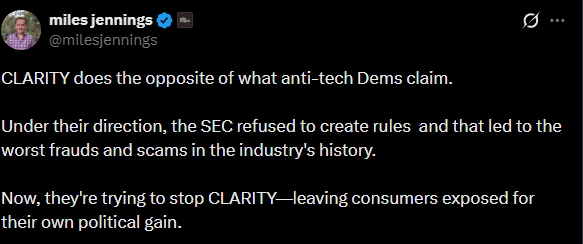
Source: X

The U.S. and the U.K. are pushing for a frictionless stablecoin and tokenization framework. But the U.S. risks falling behind amid uncertainty around the CLARITY Act.


Final Summary

  • The U.S. and U.K. vowed to reduce friction for stablecoin usage as part of driving innovation in capital markets.
  • But the U.S. could fall behind as CLARITY Act passage expectations have fallen to record lows.

Criptos en tendencia

Preguntas relacionadas

QWhat is the main topic announced by the U.S. and U.K. in their joint statement?

AThe U.S. and U.K. reaffirmed their commitment to reducing regulatory friction for digital assets and the modernization of capital markets. They shared a 10-point view focused on enabling stablecoins and tokenized assets, with innovation as a key pillar, and intend to allow the use of stablecoins in cross-border finance.

QWhat specific regulatory issue regarding stablecoin reserves did the U.S. and U.K. address?

ABoth governments pledged to avoid imposing burdensome reserve requirements that are disproportionate to risk and create unwarranted barriers to entry. This stance follows the U.K.'s softened position on reserves, moving from a stricter plan to allowing up to 70% in yield-bearing bonds and reducing cash requirements to 30%.

QHow does the progress of crypto regulation in the U.K. compare to that in the U.S., according to the article?

AThe U.K. is moving forward with clear crypto rules, including deferring capital gains tax for crypto lending, set to be live by 2027. In contrast, the U.S.'s key crypto market structure bill, the CLARITY Act, has stalled, with passage expectations dropping to as low as 32%, risking delay into the 2030s due to political issues.

QWhat is the CLARITY Act and why has it become a contentious issue in the U.S.?

AThe CLARITY Act is a U.S. crypto market structure bill that has stalled in Congress. It has become a political issue with increasing anti-tech rhetoric between Republicans and Democrats. According to Miles Jennings of a16z, ethics provisions have become a sticky point, causing the odds of its passage to drop significantly.

QWhat is the potential consequence for the U.S. if the CLARITY Act continues to stall?

AIf the CLARITY Act continues to stall, the U.S. risks falling behind in establishing a clear regulatory framework for stablecoins and tokenized assets, while the U.K. moves forward with its plans. This could impact innovation and the U.S.'s competitive position in the digital asset space.

Lecturas Relacionadas

Tras tres trimestres consecutivos de caída, ¿puede el mercado cripto encontrar una ventana de estabilización en el tercer trimestre?

El mercado cripto sufrió su peor trimestre desde 2022, con una caída del 12.6% en la capitalización total (ahora en $2.1 billones). El volumen de operaciones y el valor de las stablecoins también disminuyeron, señalando una salida generalizada de capitales. Bitcoin y Ethereum cayeron un 14.2% y 25.4% respectivamente, rompiendo su correlación con los mercados de riesgo tradicionales. Los ETFs de Bitcoin en EE.UU. registraron importantes salidas netas ($4.67 mil millones en Q2), aunque datos sugieren que el ciclo de ventas podría estar cerca de su fin. La atención del mercado se centra ahora en la reunión de la FED a finales de julio, cuya postura (halcón o paloma) podría definir el rango de trading de Bitcoin para el trimestre. El avance de la ley CLARITY en el Senado estadounidense se ha estancado, reduciendo la probabilidad de aprobación en 2026 y manteniendo una prima de riesgo regulatorio alta. Solo dos sectores mostraron crecimiento: los mercados de predicción (volumen +48.7%) y los coleccionables tokenizados (volumen +143% vs. Q1). El sentimiento general es de cautela. La lógica del mercado ha cambiado, priorizando fundamentos como la política monetaria y la regulación frente a los simples impulsos narrativos. Aunque las bases para una caída extrema parecen limitadas, la recuperación sostenida en Q3 depende críticamente de la FED y de un posible progreso regulatorio.

marsbitAyer 08:41

Tras tres trimestres consecutivos de caída, ¿puede el mercado cripto encontrar una ventana de estabilización en el tercer trimestre?

marsbitAyer 08:41

BIT Trading Moments: BTC aún presionado por la EMA 200 semanal, tras el rechazo podría reiniciar la caída, los valores de almacenamiento y semiconductores que subieron fuertemente anoche comenzaron a caer en la sesión nocturna

**BIT Trading Moments: BTC aún presionado por la EMA 200 semanal; almacenamiento y semiconductores caen en el after-hours** El mercado de cripto continúa su recuperación, con **Bitcoin** manteniéndose cerca de los $66,000. Enfrenta una fuerte resistencia en la zona de los $68,000, nivel que coincide con el costo promedio de los inversores en los últimos cinco meses y un punto de fallo anterior. Los analistas señalan que se encuentra atrapado entre la media móvil simple (MA) de 200 semanas (~$63,333) y la media exponencial (EMA) de 200 semanas (~$68,328). Se necesitaría un cierre semanal por debajo de $55,000 o por encima de $70,000 para confirmar una dirección de mayor alcance. Los ETF de Bitcoin registran entradas netas por sexto día consecutivo. En Wall Street, los **futuros de los principales índices** caen. Después de fuertes ganancias el martes, las acciones de **semiconductores y almacenamiento** retroceden en el after-hours: el ETF de semiconductores cae un 2.22%, Micron un 2.29% y SK Hynix casi un 5%. Sin embargo, **Super Micro Computer (SMCI)** se dispara más de un 20% tras el cierre, impulsada por sólidos pedidos. Otras noticias positivas incluyen un contrato de $266M de la Fuerza Aérea para **Rocket Lab**. A pesar del repunte bursátil, factores como el **crudo Brent por encima de $91** y el **rendimiento del bono estadounidense a 10 años subiendo a ~4.64%** generan preocupaciones inflacionarias y enfrían el optimismo. Las acciones relacionadas con cripto, como Coinbase y Robinhood, tuvieron un buen desempeño apoyadas por avances regulatorios. En Asia, los mercados siguieron la recuperación tecnológica. El **índice KOSPI de Corea del Sur** subió un 0.74%, con acciones de semiconductores mostrando volatilidad. El principal riesgo es el **yen japonés**, que tocó su nivel más bajo desde 1986, lo que genera temores a una intervención del gobierno. **Próximos eventos clave:** Este miércoles 22 de julio, el enfoque está en los eventos de **AMD AI** y los resultados financieros de **Alphabet (Google), Tesla e IBM** después del cierre. El jueves 23, la **decisión de tasas del BCE** y los resultados de **Intel** serán cruciales para el sentimiento del mercado.

marsbitAyer 08:33

BIT Trading Moments: BTC aún presionado por la EMA 200 semanal, tras el rechazo podría reiniciar la caída, los valores de almacenamiento y semiconductores que subieron fuertemente anoche comenzaron a caer en la sesión nocturna

marsbitAyer 08:33

Trading

Spot

Artículos destacados

Cómo comprar GAIN

¡Bienvenido a HTX.com! Hemos hecho que comprar GriffinAI (GAIN) sea simple y conveniente. Sigue nuestra guía paso a paso para iniciar tu viaje de criptos.Paso 1: crea tu cuenta HTXUtiliza tu correo electrónico o número de teléfono para registrarte y obtener una cuenta gratuita en HTX. Experimenta un proceso de registro sin complicaciones y desbloquea todas las funciones.Obtener mi cuentaPaso 2: ve a Comprar cripto y elige tu método de pagoTarjeta de crédito/débito: usa tu Visa o Mastercard para comprar GriffinAI (GAIN) al instante.Saldo: utiliza fondos del saldo de tu cuenta HTX para tradear sin problemas.Terceros: hemos agregado métodos de pago populares como Google Pay y Apple Pay para mejorar la comodidad.P2P: tradear directamente con otros usuarios en HTX.Over-the-Counter (OTC): ofrecemos servicios personalizados y tipos de cambio competitivos para los traders.Paso 3: guarda tu GriffinAI (GAIN)Después de comprar tu GriffinAI (GAIN), guárdalo en tu cuenta HTX. Alternativamente, puedes enviarlo a otro lugar mediante transferencia blockchain o utilizarlo para tradear otras criptomonedas.Paso 4: tradear GriffinAI (GAIN)Tradear fácilmente con GriffinAI (GAIN) en HTX's mercado spot. Simplemente accede a tu cuenta, selecciona tu par de trading, ejecuta tus trades y monitorea en tiempo real. Ofrecemos una experiencia fácil de usar tanto para principiantes como para traders experimentados.

584 Vistas totalesPublicado en 2025.09.24Actualizado en 2026.06.02

Cómo comprar GAIN

Discusiones

Bienvenido a la comunidad de HTX. Aquí puedes mantenerte informado sobre los últimos desarrollos de la plataforma y acceder a análisis profesionales del mercado. A continuación se presentan las opiniones de los usuarios sobre el precio de GAIN (GAIN).

活动图片