Original | Odaily Planet Daily (@OdailyChina)
Author | Asher (@Asher_ 0210)
With the World Cup quarterfinalists set, the real knockout stage has just begun.
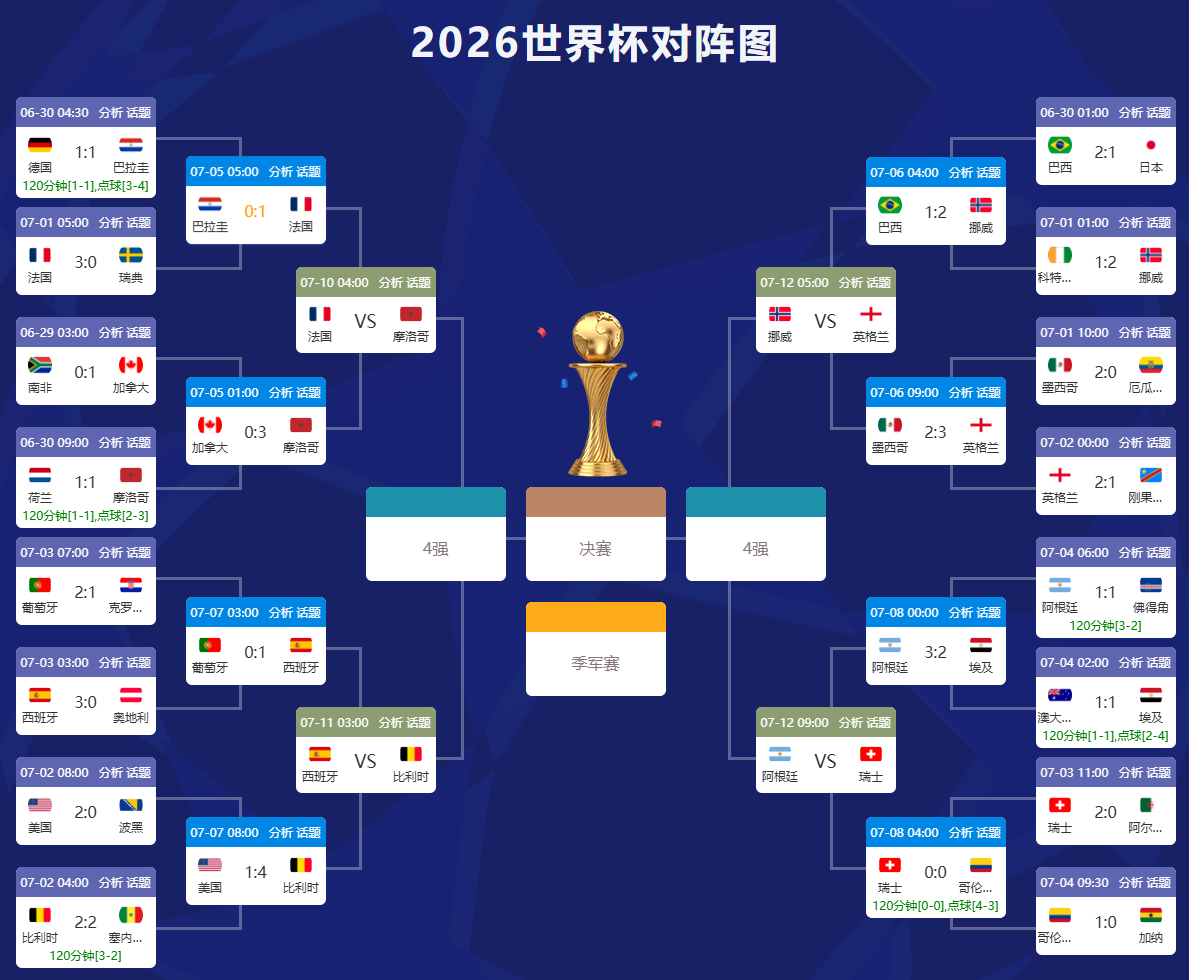
France has maintained a strong team posture, with stable offensive firepower and key players stepping up at crucial moments; Morocco continues its dark horse run, eliminating Canada 3-0 in the round of 16, proving once again they are not a flash in the pan. Spain plays the most steadily, with defensive discipline and possession-based control in place, clinching a last-gasp victory over Portugal in the round of 16 to keep Cristiano Ronaldo out of the quarterfinals; Belgium has reasserted its offensive presence with a resounding 4-1 win over the United States.
On the other side, Norway has become the tournament's biggest surprise, with Erling Haaland leading the team to a 2-1 victory over Brazil, creating the most shocking upset of the knockout stage so far; England, despite a bumpy journey, narrowly defeated Mexico 3-2 thanks to squad depth. Argentina's advancement was the most dramatic, coming back from 0-2 down against Egypt to win 3-2; Switzerland dragged Colombia into a penalty shootout, advancing to the quarterfinals in the most typical "tough nut" fashion.
To provide reference for upcoming predictions related to the four quarterfinal matches, I asked ChatGPT, Claude, Gemini, DeepSeek, Qwen, and Grok separately, requesting them to predict the winner, scoreline, and whether each match would go into extra time or penalties for every game.
Looking at the results, the AIs are aligned on the direction of advancement for the four quarterfinal matches, giving the same final four answer: France, Spain, England, and Argentina. The real differences mainly appear in the details such as scores, extra time, and penalties.
AIs All Predict France to Advance, Morocco Unlikely to Repeat Dark Horse Miracle
The first quarterfinal of this World Cup is France vs. Morocco, scheduled for 4:00 AM Beijing Time on July 10th. According to predict.fun data, in regular time, France has a 63% probability of winning; draw probability is 25%; Morocco has a 14% probability of winning. Furthermore, including extra time and penalties, France's advancement probability is 79%, while Morocco's is 22%.
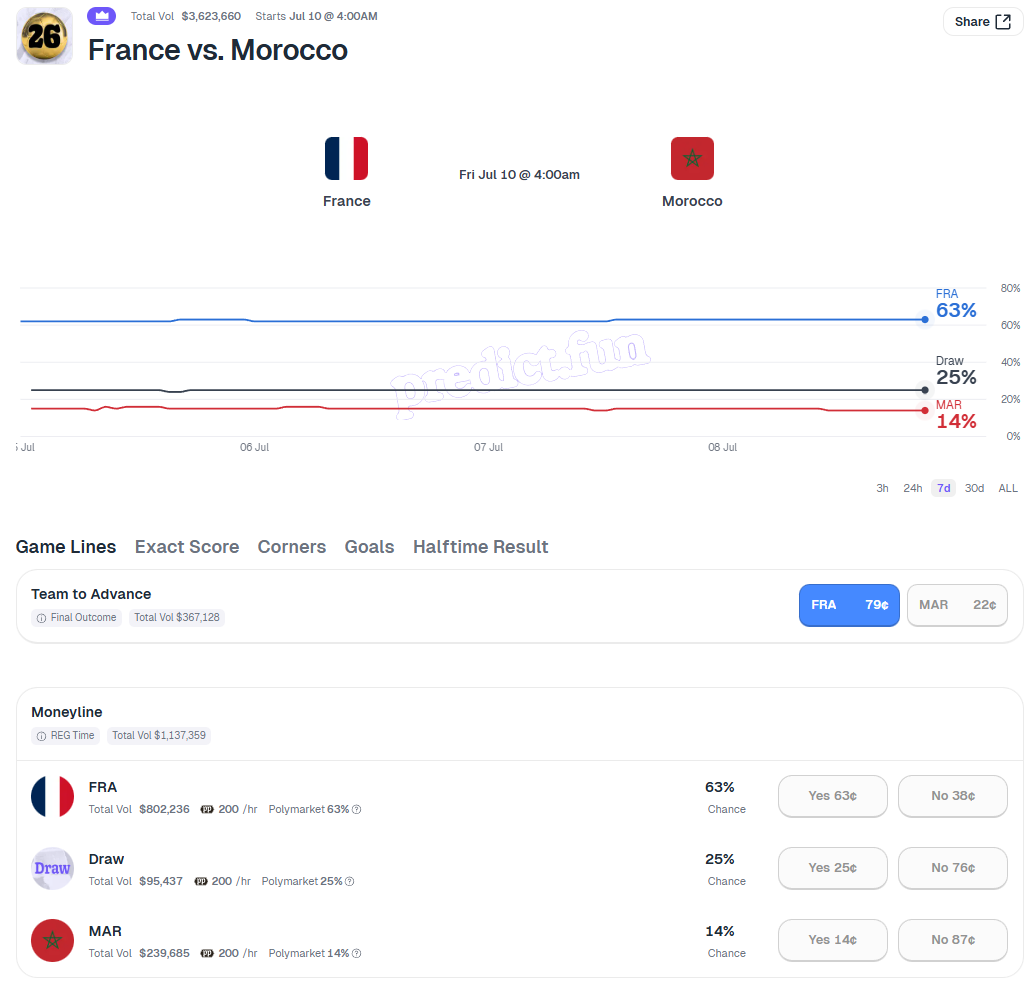
This is also the quarterfinal with the least disagreement among the six AI models. ChatGPT, Claude, Gemini, DeepSeek, Qwen, and Grok all favor France to advance. The only differences lie in whether France will win 2:0 or 2:1, and whether Morocco can score a goal.
Claude and Qwen both predict a 2:0 victory for France. They believe France is the team closest to the championship template this tournament, with forwards like Mbappé, Dembélé, and Olise continuously creating impact, and midfielders like Kanté, Tchouaméni, and Rabiot providing support. France is more complete than Morocco in both offense and defense. While Morocco has proven it's no ordinary dark horse, its squad depth and individual ability are still unlikely to match France head-on.
DeepSeek, Gemini, Grok, and ChatGPT lean more towards a 2:1 win for France. Their judgment is that Morocco won't be easily broken down and still has a chance to create threats through counter-attacks, set pieces, or wing play. However, the issue is that Morocco will find it difficult to consistently contain France's attacking stars for the full 90 minutes. Once the match enters the second half, France's individual quality and bench depth will become increasingly evident.
Overall, the AI models unanimously believe that France will advance within regular time, unlikely to need extra time or penalties.
AIs Place More Trust in Spain, Belgium's Counter-Attack as the Only Variable
The second quarterfinal of this World Cup is Spain vs. Belgium, scheduled for 3:00 AM Beijing Time on July 11th. According to predict.fun data, in regular time, Spain has a 61% probability of winning; draw probability is 25%; Belgium has a 17% probability of winning. Furthermore, including extra time and penalties, Spain's advancement probability is 79%, while Belgium's is 22%.
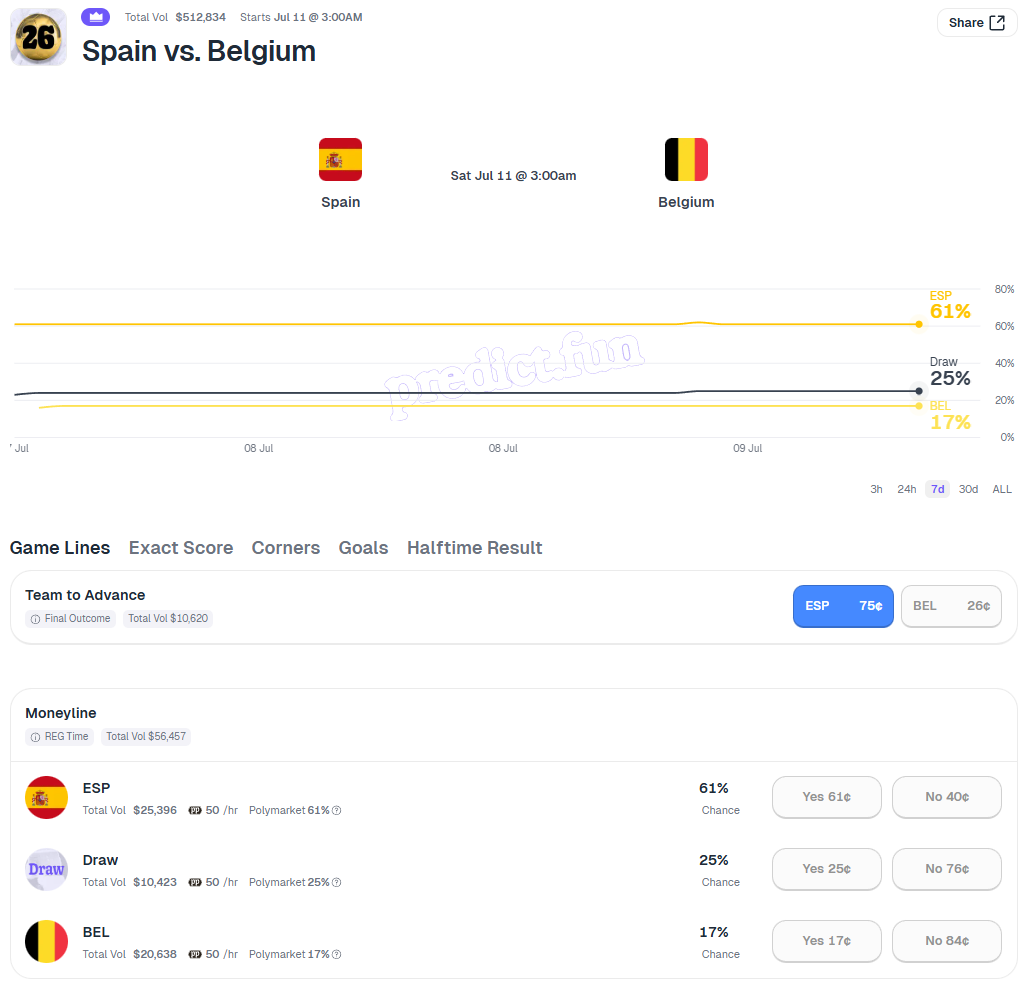
For this match, the six AI models also all favor Spain to advance, but disagreements over the match process are more pronounced than in the France vs. Morocco game.
Claude, Qwen, DeepSeek, and Grok all believe Spain is highly likely to secure victory within regular time, with predicted scores concentrated around 2:0 or 2:1. Their core reasoning is that Spain currently has stronger collective play, with possession, pressing, and defensive discipline all stable, and the match tempo is highly likely to be dictated by Spain.
ChatGPT's prediction is more conservative, favoring a 1:0 win for Spain. It suggests this won't be an open attacking battle but more of a contest between "system stability" and "offensive explosiveness." Spain might not score many goals but is more likely to win the match through possession-based attrition, wing play variations, or a set-piece opportunity.
The only model suggesting extra time and penalties is Gemini. It predicts a 1:1 draw in regular time, with no change in score during extra time, and Spain advancing via a penalty shootout. The key to this prediction is that if Belgium can seize a counter-attack opportunity to score first, Spain could be dragged into a more exhausting, grinding match.
The Match with Greatest AI Disagreement, Haaland Becomes England's Biggest Headache
The third quarterfinal of this World Cup is Norway vs. England, scheduled for 5:00 AM Beijing Time on July 12th. According to predict.fun data, in regular time, Norway has a 23% probability of winning; draw probability is 27%; England has a 53% probability of winning. Furthermore, including extra time and penalties, Norway's advancement probability is 36%, while England's is 66%.
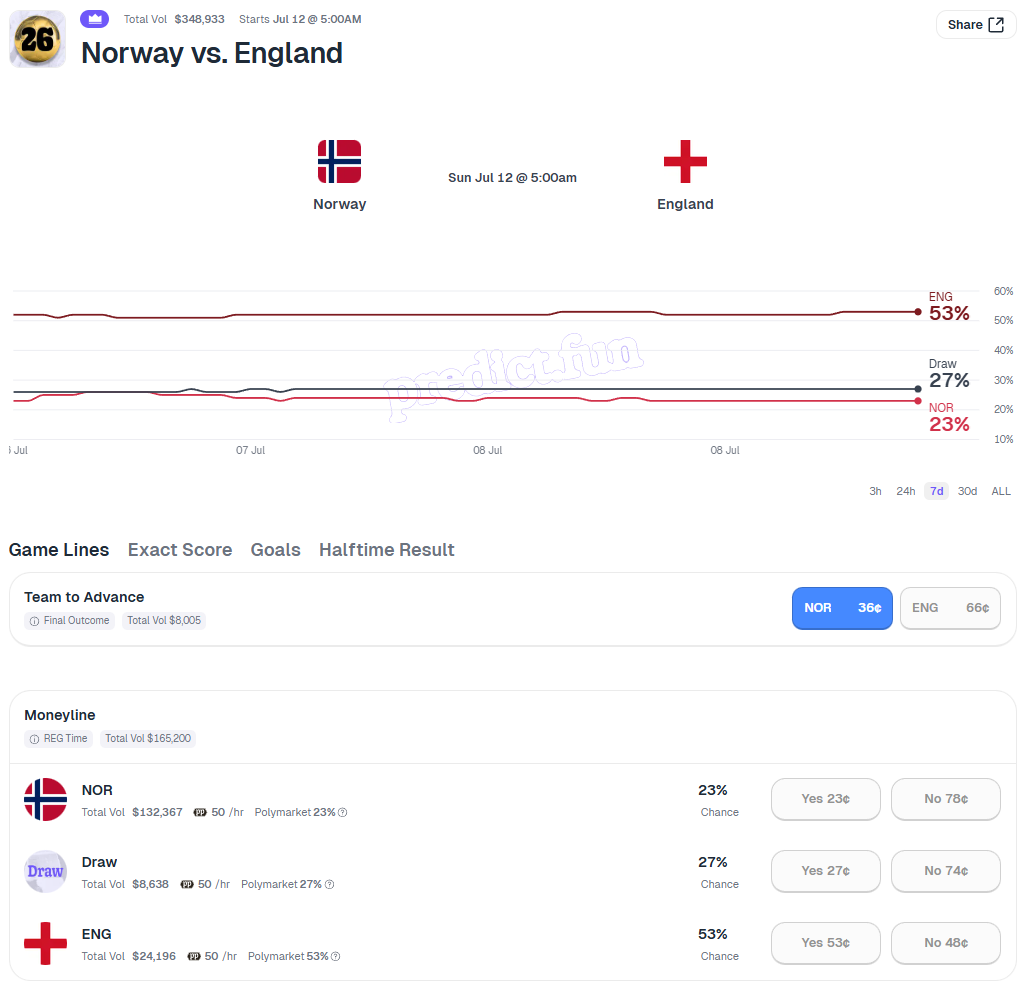
The presence of Haaland makes this knockout match the quarterfinal most likely to produce an upset. Although all six AIs ultimately voted for England to advance, the predictions are noticeably less certain than for the first two matches. Norway's 2:1 victory over Brazil in the previous round is no longer a question of "can they pull off an upset?"—they just did. More importantly, a player like Haaland doesn't need overall dominance; just one opportunity could plunge England into trouble.
Qwen, DeepSeek, and Grok all believe England is highly likely to win 2:1 within regular time. England has better squad depth, with players like Bellingham, Kane, Saka, and Foden all capable of deciding the match. In contrast, Norway's attack relies more heavily on the link-up between Haaland and Ødegaard. Once that connection is cut, Norway's offensive threat will significantly decrease.
However, Claude, Gemini, and ChatGPT are all clearly hedging against the possibility of extra time. Claude thinks England might narrowly win in regular time or be dragged into extra time by Norway; Gemini predicts a 2:2 draw in regular time, with England clinching victory in extra time thanks to bench depth; ChatGPT gives a prediction of 1:1 after 90 minutes, with England advancing 2:1 in extra time.
AIs Favor Argentina to Advance, Switzerland May Drag Match to Penalties
The fourth quarterfinal of this World Cup is Argentina vs. Switzerland, scheduled for 9:00 AM Beijing Time on July 12th. According to predict.fun data, in regular time, Argentina has a 58% probability of winning; draw probability is 28%; Switzerland has a 17% probability of winning. Furthermore, including extra time and penalties, Argentina's advancement probability is 74%, while Switzerland's is 27%.
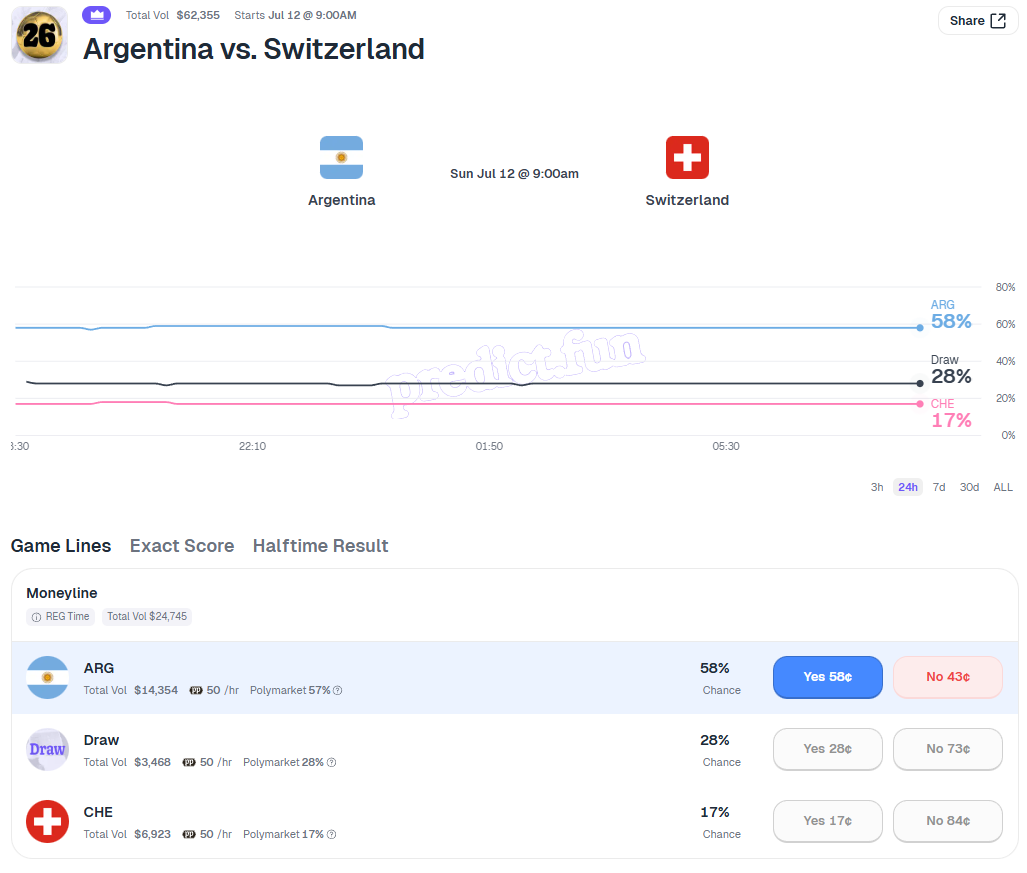
For this match, the AIs unanimously believe Argentina will advance. Unlike the more "dominant favorite" predictions for France and Spain, Argentina vs. Switzerland seems more like a match of patience.
Qwen and Gemini offer the most optimistic predictions, both favoring a 2:0 win for Argentina in regular time. Argentina's comeback from 0:2 down to win 3:2 against Egypt in the previous round has already revitalized the team's form and morale. Facing a team like Switzerland, which isn't particularly prolific in attack, Argentina, as long as they minimize defensive errors, has a chance to settle the match within 90 minutes.
DeepSeek and Grok are more cautious, leaning towards a 2:1 win for Argentina. Switzerland is organized defensively, disciplined, and won't be easily broken down by Argentina. However, the problem lies in Switzerland's lack of sustained offensive pressure. Once Argentina scores first, Switzerland will find it difficult to consistently pull the match back into their preferred rhythm for an extended period.
Those hedging for extra time and penalties are Claude and ChatGPT. Claude believes an opponent like Switzerland could easily force Argentina into a tough battle, possibly leading to a 1:1 draw and extra time, ultimately decided by penalties. ChatGPT directly predicts Argentina advancing via penalties, believing Switzerland has the ability to turn the match into a low-scoring war of attrition, dragging it to the end before relying on goalkeeping and penalty quality.
Related Content
World Cup Kicks Off, Some AI Prediction Models Become Prophets, Others Flop
Predicting World Cup Knockout Matches, Why Such a Big Difference in AI Performance?






