Token FOLD Auction Imminent, What is The Interfold, Supported by Vitalik?

Foresight NewsPublicado a 2026-07-08Actualizado a 2026-07-08

Resumen

**Title:** FOLD Token Auction Approaches: What is The Interfold, Supported by Vitalik? **Summary:** The Interfold, a "confidential coordination infrastructure" previously known as Enclave, is launching its functional token FOLD via a Uniswap Continuous Clearing Auction (CCA) starting July 8th. Endorsed by Ethereum co-founder Vitalik Buterin in May, the protocol tackles the core problem of governance bribery in decentralized voting (e.g., on platforms like Votium) by enabling multiple parties to compute a verifiable result without exposing their private input data. Its core technology, the Encrypted Execution Environment (E3), uses a distributed network of "Ciphernodes" that perform computations on fully encrypted data using Fully Homomorphic Encryption (FHE), with process integrity verified by Zero-Knowledge (ZK) proofs and decryption keys managed via Decentralized Threshold Cryptography (DTC) to eliminate a single point of trust. The primary application is CRISP (Coercion-Resistant Impartial Selection Protocol) for DAO governance, which ensures encrypted voting, "receipt-free" votes to prevent bribery, and verifiable tallying. The Interfold, developed by the Gnosis Guild team (creators of the Zodiac DAO tooling), positions itself as a focused solution to make on-chain voting truly un-buyable, realizing the vision of Vitalik's earlier MACI (Minimal Anti-Collusion Infrastructure) framework without its reliance on a single trusted coordinator. FOLD tokens will be used for C...


Author:angelilu,Foresight News

Originally Published on June 2nd


Vitalik wrote an article in May this year supporting The Interfold, a confidential coordination infrastructure. Its token FOLD will officially start auctioning today (July 8th) at 22:00 via the Uniswap CCA (Continuous Commitment Auction) mechanism, lasting for 48 hours until July 10th.


FOLD is the functional token of The Interfold: Ciphernodes can use it to stake and join the network and receive rewards, applications can use it to pay for encrypted computation requests, and holders can participate in protocol governance.


This auction adopts a uniform clearing price mechanism, where all successful bidders transact at the same price. Portions of bids exceeding the clearing price can be withdrawn for rebidding. Participation in the auction requires KYC verification via Predicate, and the pre-registration window closed yesterday. After the auction, there is a 40-day cooling period, during which FOLD can only be used for Ciphernode staking and cannot be freely transferred. The official TGE is expected on August 19th.


Below is the original article:


On-chain voting is one of the most attractive aspects of decentralized protocols—transparent, open, and accessible to anyone. But openness does not guarantee it fully represents community consensus. The existence of 'governance bribery markets' like Votium allows anyone with sufficient funds to directly bid to voters before the voting deadline. The result is: the direction of a protocol is often not decided by community consensus, but by the highest bidder.


A protocol called The Interfold has chosen to tackle this problem at its root.


Confidential Coordination Infrastructure


The Interfold (formerly known as Enclave) positions itself as a 'confidential coordination infrastructure,' aiming to allow multiple independent participants to jointly produce a verifiable result without exposing their respective input data.
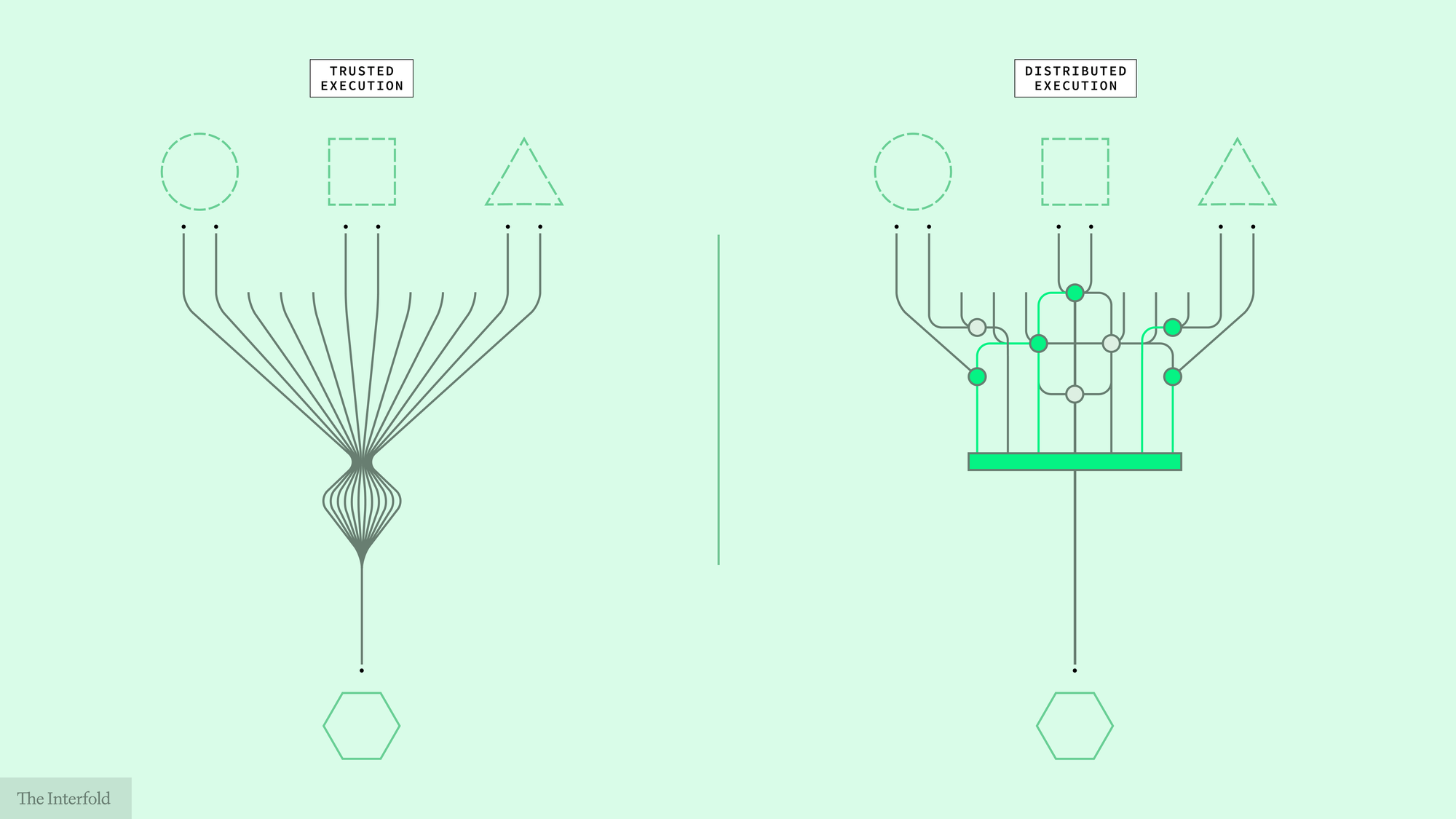


The core concept of The Interfold is E3 (Encrypted Execution Environment). Its principle is: computation tasks are assigned to a distributed network of 'Ciphernodes': user input always remains encrypted, computations are performed directly on ciphertext, and finally, only the aggregated result is decrypted and made public. No party can see anyone else's original data throughout the entire process.
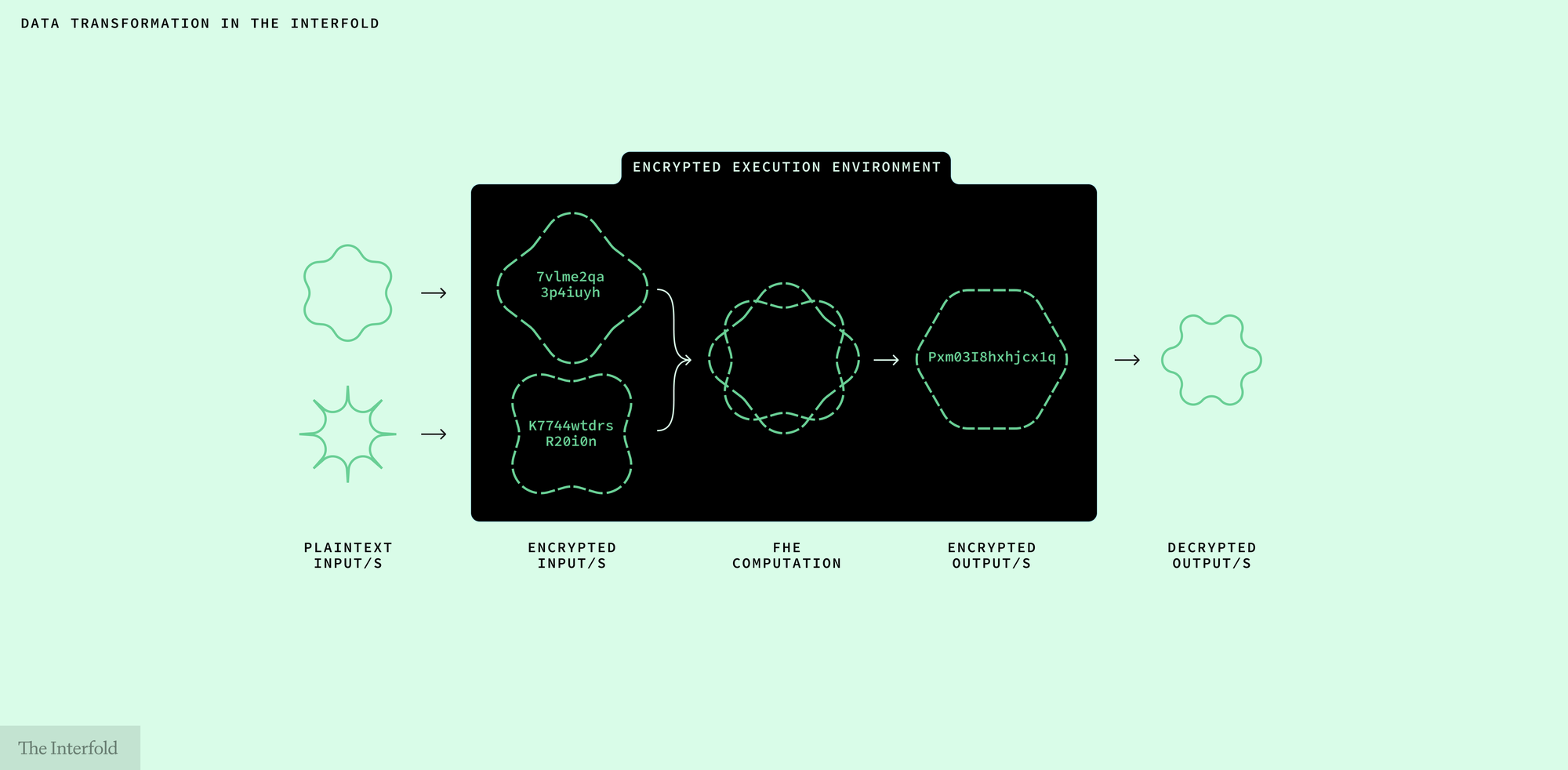


The technology stack supporting this mechanism consists of three layers: FHE (Fully Homomorphic Encryption) allows computations directly on encrypted data; ZK proofs (Zero-Knowledge proofs) verify whether the computation process itself was executed honestly; and DTC (Decentralized Threshold Cryptography) distributes decryption authority across multiple nodes, eliminating single points of trust.


The Interfold's currently promoted application scenario is CRISP (Coercion-Resistant Impartial Selection Protocol), designed for voting scenarios within DAO governance. CRISP achieves three things: the entire voting process is encrypted, and no one can view individual votes before the tally; 'receipt-free voting,' where users cannot prove to a third party how they voted, fundamentally cutting off bribery paths; and ZK proofs ensure the verifiability of tally results.


Two demo versions of CRISP are already live, with the team currently in the system integration and internal testnet validation phase. Confirmed ecosystem partnerships include: Zcash community's private governance tool Zecret Ballots, mobile DAO governance application Goverland, and joint integrations with Aragon and Status App.


Vitalik's Public Endorsement


On-chain governance bribery is not a new problem, but its measurable scale has rapidly expanded since 2024. Within the Curve ecosystem alone, the total value of bribes flowing through platforms like Votium exceeded $120 million in 2024; meanwhile, the median voter participation rate for various DAO proposals remains in the single digits.


The Ethereum community has not been unaware of this issue. In 2019, Vitalik posted a research note on ethresear.ch, proposing the conceptual framework of MACI (Minimal Anti-Collusion Infrastructure), envisioning the use of cryptographic means to eliminate voting bribery. This post has since been frequently cited, but practical implementation progress has been limited—the MACI scheme relies on a trusted 'Coordinator' role, who can see all votes. Once data is leaked, privacy guarantees immediately fail.


On May 28th, 2026, Vitalik publicly endorsed The Interfold on the X platform, stating: 'It basically is the thing I've been yelling for almost a decade for someone to build, and it's now built in a generalized way.'


The Interfold's core bet is: a single trusted coordinator is the fundamental bottleneck of MACI, and distributed threshold decryption is the correct path.


Team Background


The Interfold is developed by Gnosis Guild, a team with long-term expertise in Ethereum DAO infrastructure, previously well-known for its modular DAO toolset Zodiac. Zodiac is one of the most widely used permission and execution frameworks in the Ethereum DAO ecosystem, with partners covering several leading protocols. Specific core member names have not been publicly disclosed through official channels. The project also has no publicly disclosed institutional funding records.


Compared to larger-scale general-purpose privacy protocols like Aztec and Zama, The Interfold is a 'small but beautiful' project. It does not attempt to become a general-purpose privacy infrastructure; instead, it focuses on a specific, long-unresolved problem—making on-chain votes truly un-purchasable. The ambition may not be vast, but the target is precise.


From MACI to The Interfold


The conceptual framework of MACI (Minimal Anti-Collusion Infrastructure), proposed by Vitalik in 2019, has seen deployment in scenarios like Gitcoin but always had a structural flaw: it required a trusted coordinator, and if its private key were leaked, the entire privacy guarantee would fail. The Interfold is a generalized implementation of this framework—replacing a single coordinator with a distributed network of Ciphernodes, turning 'trust in a person' into 'trust in cryptography.'


Criptos en tendencia

Preguntas relacionadas

QWhat is the main problem in DAO governance that The Interfold aims to solve?

AThe Interfold aims to solve the problem of governance bribery in DAO voting, where individuals or entities with sufficient funds can directly 'bribe' voters to sway decisions, undermining true community consensus.

QWhat is the core technological concept of The Interfold, and what does it stand for?

AThe core technological concept of The Interfold is the E3, or Encrypted Execution Environment. It enables a distributed network of 'Ciphernodes' to perform computations directly on encrypted user data, with only the final aggregated result being decrypted and revealed.

QAccording to the article, what is the key difference between The Interfold's approach and the earlier MACI framework proposed by Vitalik Buterin?

AThe key difference is that the original MACI framework relied on a single trusted 'coordinator' who could see all votes, creating a privacy vulnerability. The Interfold replaces this single point of trust with a distributed network of nodes using threshold cryptography.

QWhat are the primary uses of the FOLD token within The Interfold ecosystem?

AThe FOLD token has three primary uses: 1) For Ciphernodes to stake and join the network to earn rewards. 2) For applications to pay for encrypted computation requests. 3) For holders to participate in protocol governance.

QWhat major public endorsement did The Interfold receive, and who gave it?

AVitalik Buterin publicly endorsed The Interfold on the X platform on May 28, 2026, stating, 'It's basically the thing I've been shouting for almost a decade that someone should build, and it's now implemented in a general form.'

Lecturas Relacionadas

human.tech lanza el Clean SDK para aplicaciones Web3 centradas en la privacidad

human.tech ha lanzado el Clean SDK, un kit de desarrollo que permite crear aplicaciones Web3 con privacidad por defecto y responsabilidad transparente. Este SDK, lanzado junto a Aztec v5, proporciona componentes para integrar verificación de identidad de conocimiento cero, screening de sanciones y transacciones privadas, sin necesidad de manejar datos sensibles o infraestructura de cumplimiento desde cero. El SDK resuelve el dilema entre privacidad y responsabilidad, combinando pruebas de conocimiento cero con verificación programable. Esto permite a las aplicaciones demostrar que los usuarios son legítimos y que los fondos han pasado controles, manteniendo la confidencialidad. Shield, la primera aplicación construida con el Clean SDK, es un puente privado a Aztec. Permite a usuarios y agentes autónomos transferir activos demostrando, sin revelar identidades, que hay una persona real detrás de cada transferencia y que los fondos han sido verificados contra sanciones. El kit incluye tres técnicas de verificación: Prueba de Inocencia (screening contra 23 fuentes de sanciones), Prueba de Personalidad (verificación simplificada con Human Passport) y Prueba de Manos Limpias (credenciales de identidad gubernamental de conocimiento cero para transacciones de alto valor). Diseñado para desarrolladores en Aztec, el SDK permite integrar privacidad programable directamente en aplicaciones descentralizadas. Shield ejemplifica su uso, pero el objetivo es habilitar un ecosistema completo de aplicaciones financieras y servicios descentralizados que requieran verificación respetuosa con la privacidad. human.tech desarrolla soluciones de conocimiento cero para demostrar personalidad, mantener la privacidad y crear sistemas digitales escalables y responsables, con un ecosistema que incluye también Human Passport, Wallet as a Protocol (WaaP) y Human Network.

TheNewsCryptoHace 44 min(s)

human.tech lanza el Clean SDK para aplicaciones Web3 centradas en la privacidad

TheNewsCryptoHace 44 min(s)

¿Liberando 100 millones de dólares en liquidez? La nueva política de Pump.fun pone a prueba la técnica del 'pump' de 5 minutos

**Resumen en español europeo: Pump.fun lanza el modo BOOST para redirigir 1.000 millones de dólares en liquidez "inerte"** El 21 de julio, Pump.fun anunció oficialmente el modo BOOST, un nuevo mecanismo por defecto para el lanzamiento de memecoins. El objetivo es abordar un problema central de su plataforma: aproximadamente el 20% de la liquidez que se bloquea en los pools (LP) cuando un token se migra desde su curva de enlace (bonding curve) queda permanentemente inutilizable, incluso si el precio del token cae a cero. La plataforma estima que esta "liquidez muerta" supone un desperdicio de más de 1.000 millones de dólares anuales. El funcionamiento de BOOST es directo: en lugar de inmovilizar ese 20% de fondos en el LP, la plataforma los utiliza durante los primeros 5 minutos tras la migración para comprar el propio token en el mercado secundario mediante un sistema TWAP (Precio Medio Ponderado en el Tiempo). Todos los tokens comprados se queman inmediatamente, creando presión de compra a corto plazo y reduciendo permanentemente la oferta en circulación. Este cambio no añade liquidez externa ni altera la experiencia de trading en la bonding curve. Su propósito es mejorar la experiencia post-migración: generar un "fuego artificial" de 5 minutos que podría aumentar la retención de traders y la actividad comercial. La lógica subyacente es que para que el modelo de negocio de Pump.fun sea sostenible, los tokens lanzados necesitan generar volumen de trading continuo después de su lanzamiento inicial. Sin embargo, el mecanismo genera debate. Los críticos señalan que el breve impulso de 5 minutos podría facilitar que proyectos de baja calidad parezcan exitosos, fomentando lanzamientos más especulativos. Además, una vez finalizada la compra automática, los tokens podrían sufrir caídas bruscas si se enfrentan a grandes órdenes de venta, intercambiando el riesgo de un colapso posterior por una breve ilusión de bombeo inicial.

marsbitHace 51 min(s)

¿Liberando 100 millones de dólares en liquidez? La nueva política de Pump.fun pone a prueba la técnica del 'pump' de 5 minutos

marsbitHace 51 min(s)

Vender espacio de bloques está muerto: las blockchains públicas deben encontrar nuevas formas de sobrevivir

El modelo de negocio de vender espacio en bloques para las cadenas públicas (L1/L2) está en crisis. Mientras aplicaciones y otros proyectos generan grandes ingresos, la mayoría de las blockchains luchan por monetizar. Un ejemplo claro: Hyperliquid generó unos 58 millones de dólares en 30 días, frente a los 430.000 de Arbitrum. La conclusión es clara: las cadenas públicas deben evolucionar más allá de ser infraestructuras neutrales. El futuro está en convertirse en estudios de productos, distribuidores de aplicaciones, pasarelas de pago o soluciones SaaS especializadas para nichos verticales específicos. El artículo también analiza otros temas clave: 1. **El ataque a Ostium:** Un fallo en su infraestructura off-chain para importar precios permitió a un atacante robar más de 23 millones de USDC, reduciendo su TVL en más del 40%. Este caso subraya los riesgos críticos al conectar mercados tradicionales con DeFi. 2. **El futuro de las opciones on-chain:** Para lograr adopción masiva, los derivados complejos como las opciones deben dejar de comercializarse como tales. El éxito reside en abstraer su complejidad en productos sencillos como bóvedas de rendimiento, opciones binarias a corto plazo o productos estructurados, donde el usuario final solo ve el resultado, no la mecánica. En resumen, la industria se mueve hacia una especialización profunda, donde la seguridad, la experiencia de usuario simplificada y un claro enfoque en generar valor para clientes específicos serán claves para la supervivencia y los ingresos.

marsbitHace 1 hora(s)

Vender espacio de bloques está muerto: las blockchains públicas deben encontrar nuevas formas de sobrevivir

marsbitHace 1 hora(s)

Trading

Spot

Artículos destacados

Cómo comprar AUCTION

¡Bienvenido a HTX.com! Hemos hecho que comprar Auction (AUCTION) sea simple y conveniente. Sigue nuestra guía paso a paso para iniciar tu viaje de criptos.Paso 1: crea tu cuenta HTXUtiliza tu correo electrónico o número de teléfono para registrarte y obtener una cuenta gratuita en HTX. Experimenta un proceso de registro sin complicaciones y desbloquea todas las funciones.Obtener mi cuentaPaso 2: ve a Comprar cripto y elige tu método de pagoTarjeta de crédito/débito: usa tu Visa o Mastercard para comprar Auction (AUCTION) al instante.Saldo: utiliza fondos del saldo de tu cuenta HTX para tradear sin problemas.Terceros: hemos agregado métodos de pago populares como Google Pay y Apple Pay para mejorar la comodidad.P2P: tradear directamente con otros usuarios en HTX.Over-the-Counter (OTC): ofrecemos servicios personalizados y tipos de cambio competitivos para los traders.Paso 3: guarda tu Auction (AUCTION)Después de comprar tu Auction (AUCTION), guárdalo en tu cuenta HTX. Alternativamente, puedes enviarlo a otro lugar mediante transferencia blockchain o utilizarlo para tradear otras criptomonedas.Paso 4: tradear Auction (AUCTION)Tradear fácilmente con Auction (AUCTION) en HTX's mercado spot. Simplemente accede a tu cuenta, selecciona tu par de trading, ejecuta tus trades y monitorea en tiempo real. Ofrecemos una experiencia fácil de usar tanto para principiantes como para traders experimentados.

215 Vistas totalesPublicado en 2024.12.12Actualizado en 2026.06.02

Cómo comprar AUCTION

Discusiones

Bienvenido a la comunidad de HTX. Aquí puedes mantenerte informado sobre los últimos desarrollos de la plataforma y acceder a análisis profesionales del mercado. A continuación se presentan las opiniones de los usuarios sobre el precio de AUCTION (AUCTION).

活动图片