Nobel Laureate Becomes New Employee at Anthropic

marsbitPublicado a 2026-06-20Actualizado a 2026-06-20

Resumen

Nobel laureate and AlphaFold lead John Jumper has left Google DeepMind after nearly nine years to join AI company Anthropic. Jumper, who co-won the 2024 Nobel Prize in Chemistry for his work on the protein-structure-predicting AI, led the AlphaFold project from its early stages, revolutionizing structural biology by predicting hundreds of millions of protein structures. His departure follows closely that of Transformer co-inventor Noam Shazeer, who recently left Google for OpenAI, marking a significant talent drain for the tech giant. Analysts suggest top AI researchers are seeking environments where individual impact can more directly shape a company's trajectory. Anthropic's hiring of Jumper signals a major push into AI for life sciences. The company recently acquired biotech firm Coefficient Bio and is building wet labs, aiming to drastically accelerate drug discovery and biomedical research. This move aligns with a broader trend, as OpenAI and Google DeepMind (via Isomorphic Labs) are also heavily investing in AI-driven biology and healthcare. The stage is now set for intensified competition among AI leaders to redefine life sciences through artificial intelligence.

Nobel laureate joins Anthropic!

Today, AlphaFold core leader John Jumper announced: He is leaving Google DeepMind after nearly 9 years and joining Anthropic.

A Nobel laureate who rewrote structural biology with an AI model has turned and left.
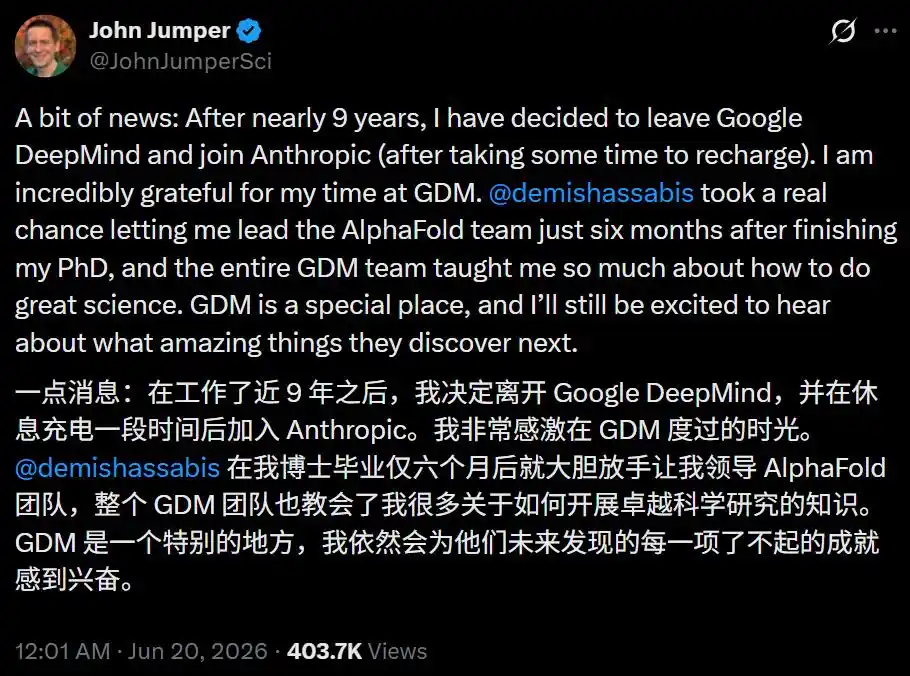
Hassabis responded quickly: "Thank you John for an incredible partnership over the past 9 years! What we achieved with AlphaFold changed the world."

Nine years of collaboration, sharing a Nobel Prize—this is probably the most amicable farewell in the tech circle.

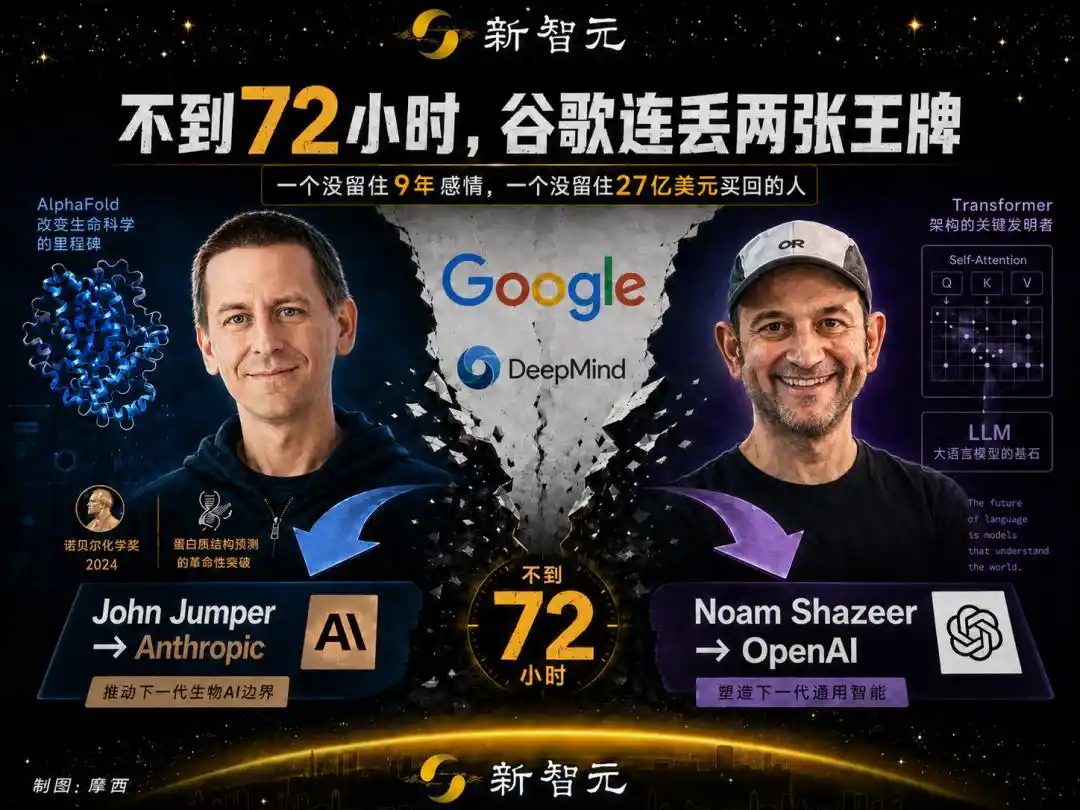
And just two days ago, the legendary co-first author of the Transformer paper and Gemini co-lead, Noam Shazeer, announced he was leaving Google for OpenAI.

In less than 72 hours, Google lost two aces.

One couldn't be kept even after a $2.7 billion buyback, the other couldn't be kept even after 9 years of shared history.

Leading AlphaFold Directly, 6 Months After PhD Graduation

In the life sciences world, John Jumper is practically synonymous with "rewriting an entire discipline with AI."

Born in 1985 in Little Rock, Arkansas, an ordinary small town in the American South.

He earned a dual bachelor's degree in Mathematics and Physics from Vanderbilt, then went on to the University of Chicago all the way to his Ph.D., researching theoretical chemistry. Specifically, using computational methods to simulate the dynamic behavior of proteins.

Mathematics gave him intuition for modeling, physics gave him understanding of complex systems, and theoretical chemistry made him understand the protein problem itself better than any pure AI researcher.

The combination of these three fields just happens to be the rarest knowledge set needed to solve the protein folding problem.

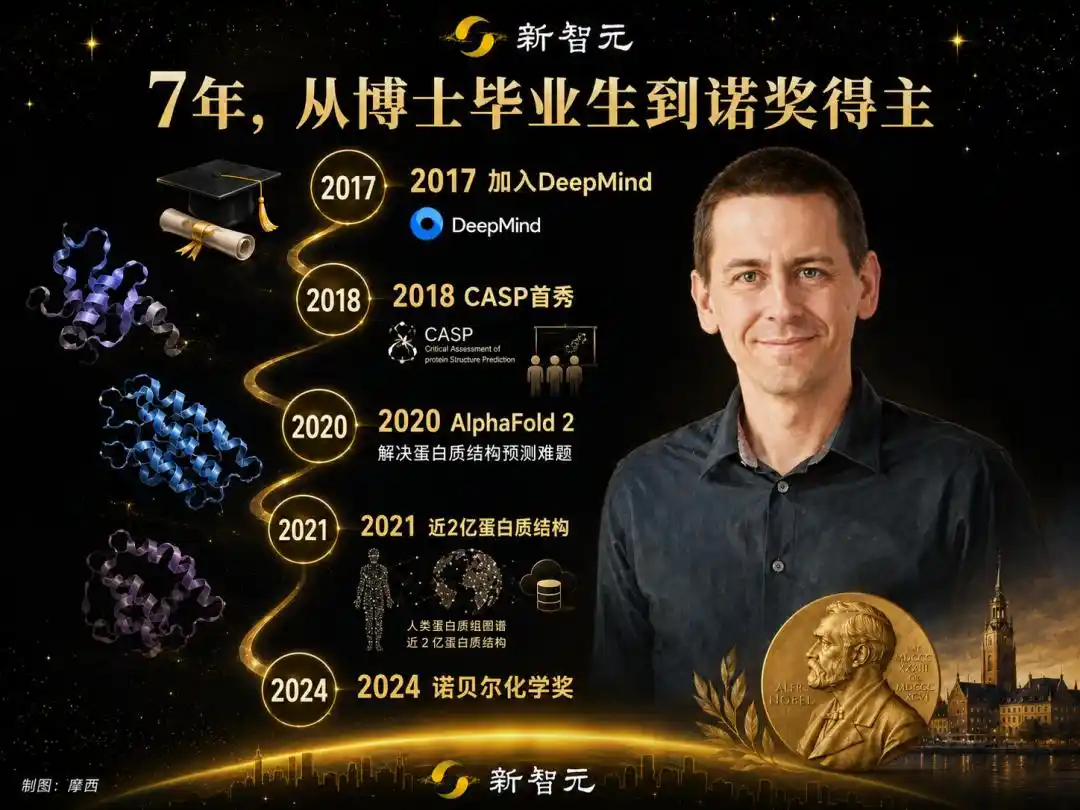
After receiving his Ph.D. in 2017, Jumper directly joined DeepMind.
Notably, at that time he had almost no deep learning experience. What stood out on his resume was not mastery of neural networks, but his understanding of protein physics.

But that's precisely what Hassabis valued.

Immediately after, he made a decision no one expected—letting this young man, who had graduated only 6 months prior and had to learn deep learning on the job, directly lead the AlphaFold team.

No transition period, no "do a few years as a researcher to build seniority."

Hassabis was betting that solving the protein folding puzzle required understanding proteins more than understanding AI. And what Jumper took on was the biggest gamble in the entire field of computational biology.

Single-handedly Scaling Biology by 1000x

What happened in the following years can only be described as "unbelievable"—

2018, AlphaFold made its debut at the protein structure prediction competition CASP, crushing traditional methods.

2020, AlphaFold 2 emerged, directly "solving" the protein folding problem that had puzzled biologists for 50 years.

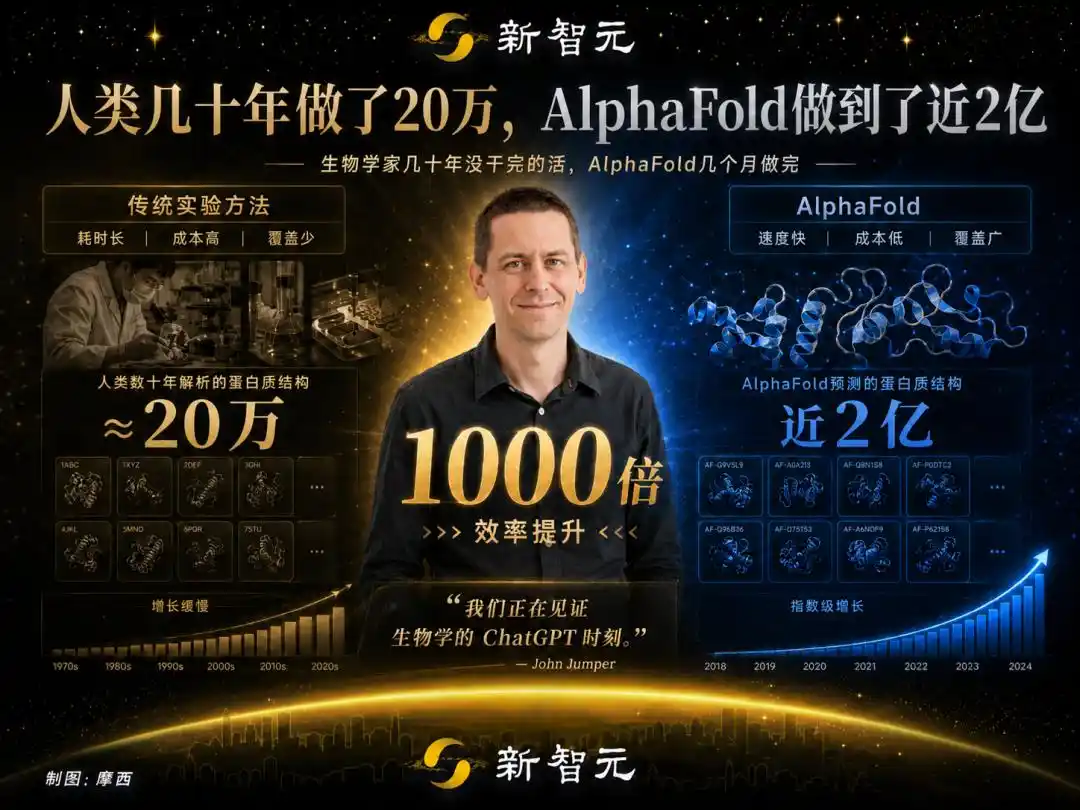
2021, Jumper's team calculated the 3D structures of nearly all 50,000+ human proteins. Ultimately, they generated structures for about 1 million species, nearly 200 million known protein structures.

Before AlphaFold, humanity spent decades using experimental methods like X-ray crystallography, cryo-electron microscopy to solve about 200,000 protein structures in total.

Jumper's team scaled that by 1000x in one go.

It's no exaggeration to say that the work biologists hadn't finished in the past hundred years, AlphaFold did in a few months.
May 2024, AlphaFold 3 was released—not just predicting proteins anymore, it can calculate interactions between DNA, RNA, small molecule drugs. Protein-ligand docking accuracy 76.4%, 1.8x improvement over previous methods.

Five months later in Stockholm, John Jumper and Demis Hassabis stood together on the Nobel Chemistry Prize podium.

That year Jumper was 39, the youngest Chemistry Nobel laureate in 70 years.

From a fresh Ph.D. graduate who had to learn deep learning on the fly, to standing under the Stockholm spotlight, it took him only 7 years.

Thus, the return on Hassabis's bet back then is probably among the highest in the history of human science.

So his departure today is not simply about Google DeepMind losing a Director.

What's Really Going on with Google?

After the news exploded, comments on X directly boiled over.

User Chubby exclaimed: "This is a huge loss for Google, and absolutely insane for Anthropic!"
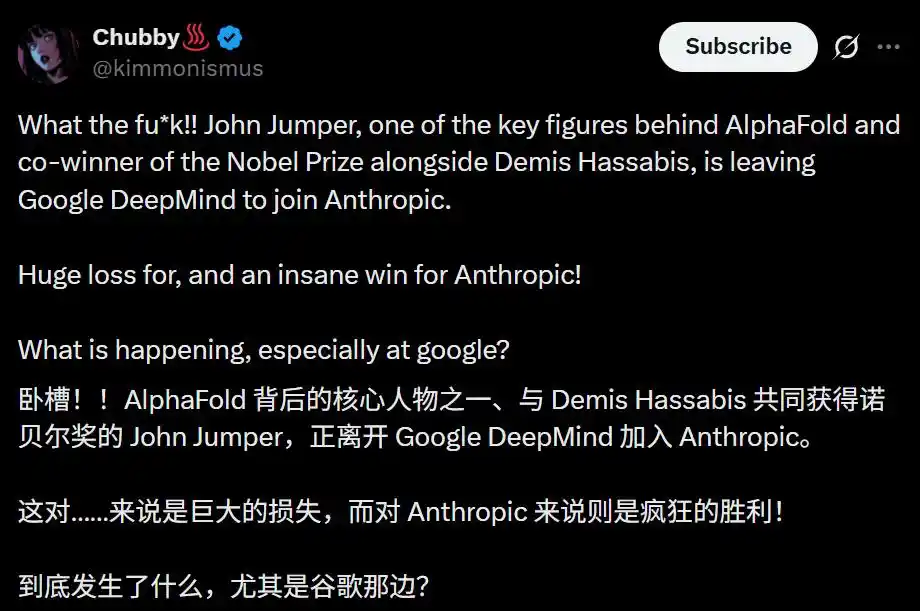
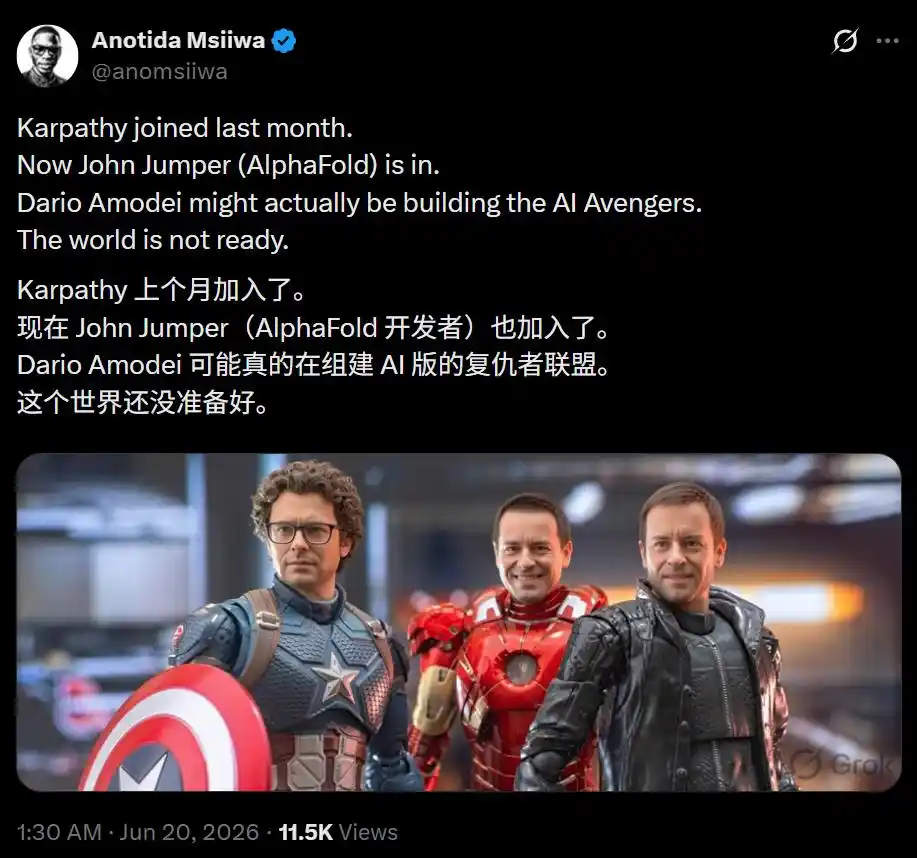
Some lamented, "Anthropic welcomes a Nobel laureate, talent is continuously concentrating towards OpenAI and Anthropic." Others outright declared: "First Karpathy, now the person behind AlphaFold, Anthropic is assembling an AI Avengers."

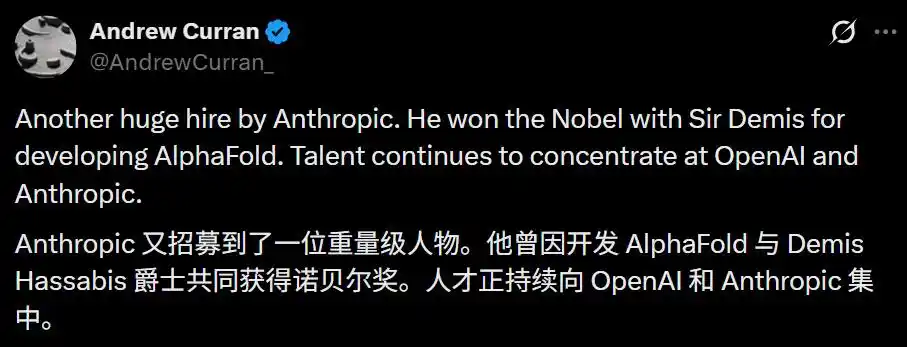
Logan Kilpatrick joked about expecting Jumper to "win another Nobel Prize." The tone was teasing, but on second thought, it's not really an exaggeration.

And after the shock, everyone was asking the same question—what's wrong with Google?

Jumper didn't say, Anthropic didn't say, Google didn't say.

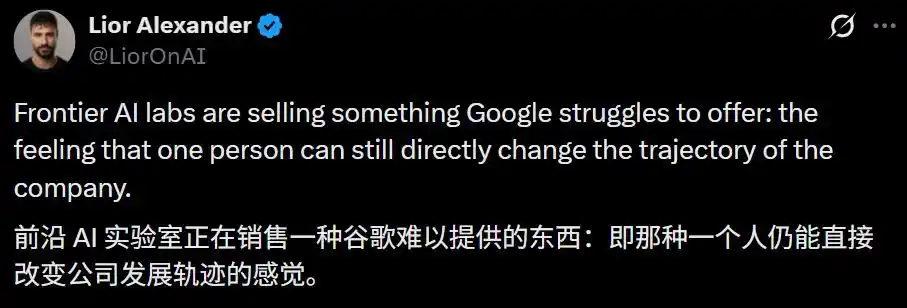
Perhaps a comment by investor Lior Alexander is the closest to an answer currently—

"Frontier AI labs are selling something Google can't offer: the feeling that one person can change a company's trajectory."
Couldn't Keep the Person Bought Back for $2.7 Billion Either

Just two days before Jumper's announcement, Noam Shazeer announced leaving Google for OpenAI, as "Head of Architecture Research."

In the 2017 foundational paper of modern AI, "Attention Is All You Need," he was one of the core authors. The multi-head attention mechanism was his design, the first usable implementation that beat SOTA was coded line by line by him.

And Google spent $2.7 billion to bring him back from Character.AI.

After returning, Shazeer became Gemini co-lead, a key figure in Google's counterattack with large models.

Result: less than two years later, he left again. Two days after that, Jumper left.

They are neither the first, nor will they be the last.
Over the past 8 years, more than 20 top researchers who authored milestone papers have left DeepMind/Brain one after another.

In 2025 alone, at least 11 executives left. DeepMind co-founder Mustafa Suleyman himself was also poached by Microsoft in a $650 million acqui-hire round.

Life Sciences, the Next Battlefield for the AI Big Three

Back to Anthropic's side. The groundwork began over two months ago.

April 3rd, Anthropic acquired biotech company Coefficient Bio for $400 million in stock. The team was less than 10 people but had already achieved top-tier results in AI-driven antibody design.

Meanwhile, Anthropic is also building its own wet lab. Last October, they launched Claude for Life Sciences to help researchers accelerate drug discovery and biological experiment design. This January, they launched Claude for Healthcare for medical institutions.

They say the goal is to compress the life science R&D cycle by 10x. And now, a Nobel-caliber protein scientist is leading this effort.

In fact, it's not just Anthropic betting on life sciences.
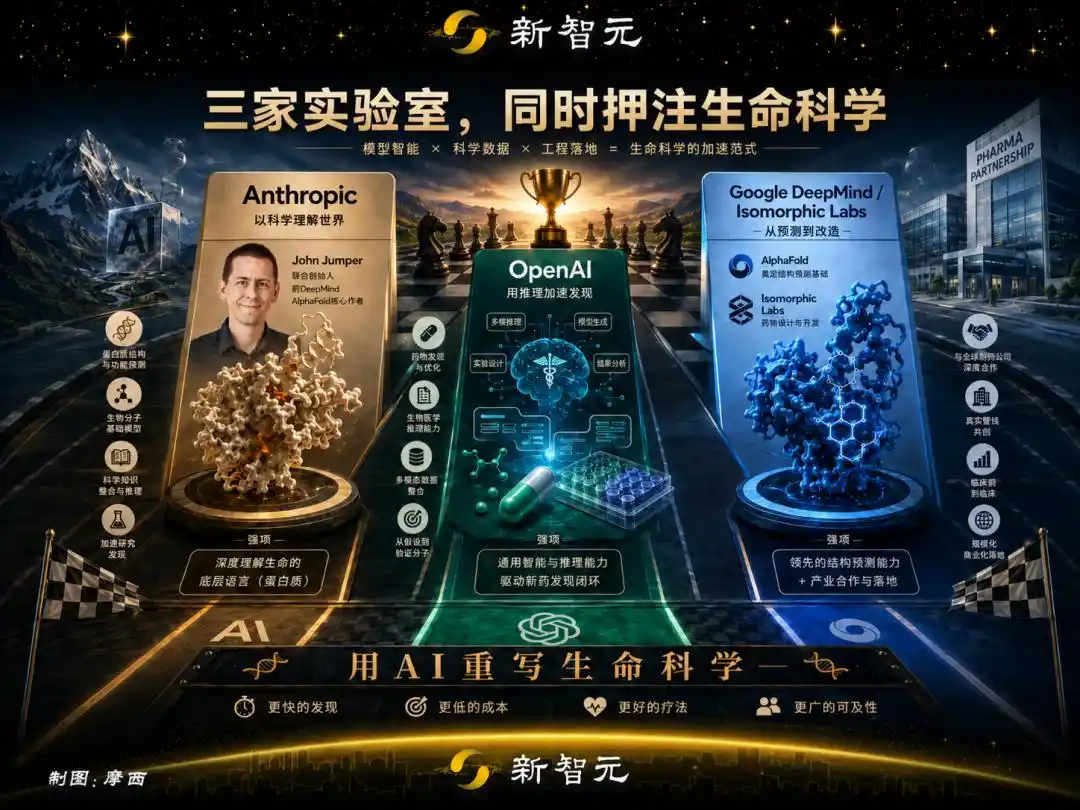
OpenAI released GPT-Rosalind in April this year, a reasoning model specifically for biomedicine, focusing on drug discovery, genomic analysis, and protein engineering. They have already partnered with top pharmaceutical companies like Amgen, Moderna, Thermo Fisher.

The OpenAI Foundation directly stated: investments in life sciences in the coming year will be no less than $1 billion. With the newly poached Shazeer overseeing architecture research, OpenAI is also making a strong move on this track.

On Google DeepMind's side, Hassabis's Isomorphic Labs raised $600 million last year, signed collaboration agreements with Eli Lilly and Novartis with total milestone values up to $3 billion. The AlphaFold technology foundation remains the industry benchmark.

Three labs simultaneously placed their bets on the same direction—rewriting life sciences with AI.

Jumper's choice is just the latest move in this grand chess game.

References:

https://x.com/JohnJumperSci/status/2068001285173834106

Editor: Moses

This article is from the WeChat public account "新智元", author: ASI启示录

Criptos en tendencia

Preguntas relacionadas

QWhat significant move did Nobel laureate John Jumper recently make?

ANobel laureate John Jumper recently announced that he has left Google DeepMind, where he worked for nearly nine years, to join the AI company Anthropic.

QWhat major scientific contribution is John Jumper best known for?

AJohn Jumper is best known for leading the AlphaFold team at Google DeepMind, which developed the AI system that revolutionized structural biology by solving the protein folding problem and predicting the structures of nearly 200 million proteins.

QWhy is John Jumper's departure considered a significant loss for Google?

AHis departure is a significant loss because Jumper was a key leader of the groundbreaking AlphaFold project, a recent Nobel Prize winner, and his move follows closely after another top AI researcher, Noam Shazeer, also left Google, indicating a pattern of top talent leaving for competitors.

QWhat area is Anthropic focusing on with its recent acquisitions and hires?

AAnthropic is focusing on the life sciences sector. This is evidenced by its $400 million stock acquisition of biotech company Coefficient Bio, the establishment of its own wet lab, and now the hiring of Nobel laureate John Jumper, aiming to compress life science R&D cycles.

QWhich other major AI companies are also heavily investing in the life sciences field?

AAlongside Anthropic, OpenAI and Google DeepMind are also heavily investing in life sciences. OpenAI has released GPT-Rosalind for biomedicine and pledged over $1 billion, while Google's Isomorphic Labs has secured major partnerships in drug discovery, all aiming to use AI to rewrite the field.

Lecturas Relacionadas

Los Oso Mantienen el Control Mientras que el ETH Rechaza la Resistencia de la Línea de Tendencia

El último rebote de Ethereum no ha convencido a todos los analistas de que la tendencia bajista haya terminado. En una idea publicada en TradingView el 20 de junio, TheSignalyst argumenta que ETH se mantiene en territorio bajista. Esto se debe a que continúa cotizando por debajo de una línea de tendencia roja descendente y ha formado una secuencia de máximos y mínimos más bajos. El gráfico del analista muestra que el precio de ETH fue rechazado en una zona de confluencia que incluye dicha línea de tendencia y una zona de resistencia horizontal. Este tipo de resistencia combinada suele atraer a vendedores de forma más agresiva. El fracaso en superar ambos niveles se interpreta como una confirmación de que los vendedores mantienen el control. El área de soporte clave se sitúa entre 1.350 y 1.500 dólares. Una ruptura decisiva por debajo de este rango debilitaría significativamente la estructura general de ETH. Por ahora, el precio está comprimido entre este soporte y la línea de tendencia bajista. El desempeño de Ethereum es crucial para el mercado altcoin en general. Cuando ETH lucha frente al dólar, el apetito por el riesgo en DeFi y activos de menor capitalización suele debilitarse también. Por lo tanto, este análisis sirve como advertencia: los alcistas necesitan una ruptura clara por encima de la resistencia antes de poder hablar de un cambio de tendencia sostenido.

bitcoinistHace 7 hora(s)

Los Oso Mantienen el Control Mientras que el ETH Rechaza la Resistencia de la Línea de Tendencia

bitcoinistHace 7 hora(s)

TechFlow Oficina de Inteligencia: Las probabilidades de que Anthropic realice una OPI superan el 80%, Irán vuelve a cerrar el estrecho de Ormuz y desestabiliza los precios del petróleo

Resumen del informe TechFlow: Los mercados anticipan que Anthropic anunciará su OPV antes de noviembre de 2026, planteando dudas sobre si una valoración billonaria puede coexistir con su promesa central de seguridad en IA. Otras tendencias clave: * **Marketing digital:** Marcas adoptan influencers virtuales generados por IA para promocionar productos. * **Energía y Geopolítica:** Irán anuncia el cierre del estrecho de Ormuz, causando volatilidad en el precio del petróleo, aunque datos de seguimiento muestran cierto tráfico marítimo persistente. Paralelamente, Irán reanuda la carga de crudo en la isla de Kharg. * **Finanzas/Tecnología:** Goldman Sachs advierte que los gastos de capital en IA (5,3 billones de dólares) podrían acercarse al límite de crédito. En Europa, se produce la primera incumplimiento en acciones de CLO desde la crisis financiera. * **Empresas tecnológicas:** Cloudflare introduce cuentas temporales para agentes de IA; el tráfico IPv6 de Google supera el 50%; Hyundai adquiere el control total de Boston Dynamics. * **Mercados:** Inversores minoristas invierten fuertemente en la OPV de SpaceX. Elon Musk especula sobre futuras inversiones astronómicas en antimateria para viajes interestelares. **Conclusión subyacente:** Tres señales (tensión en Ormuz, incumplimiento en CLO y advertencias sobre gasto en IA) apuntan a una creciente restricción de la liquidez global y al aumento de los costes marginales. Mientras tanto, el capital sigue buscando narrativas de crecimiento a gran escala (como la OPV de Anthropic, SpaceX y los proyectos de Musk), indicando una bifurcación entre un "viejo mundo" con creciente presión financiera y un "nuevo mundo" que construye narrativas aún más ambiciosas.

marsbitHace 8 hora(s)

TechFlow Oficina de Inteligencia: Las probabilidades de que Anthropic realice una OPI superan el 80%, Irán vuelve a cerrar el estrecho de Ormuz y desestabiliza los precios del petróleo

marsbitHace 8 hora(s)

El cazador cazado: el bot MEV más rentable fue hackeado

**El cazador cazado: El bot de MEV más rentable es hackeado** El conocido bot de MEV en Ethereum, Jaredfromsubway.eth, sufrió un ataque dirigido el sábado, perdiendo más de 7,5 millones de dólares. Según investigaciones, no fue un phishing tradicional ni una explotación de contrato inteligente, sino un sofisticado "ataque de honeypot contra-MEV" diseñado específicamente para explotar la lógica de comportamiento de estos bots. El atacante desplegó durante semanas 66 contratos de tokens falsos y pools de liquidez, disfrazados como activos principales como WETH, USDC o USDT, para crear rutas de arbitraje falsas. El bot, al detectar la aparente oportunidad, ejecutó una transacción que concedió permisos a un contrato controlado por el atacante. Estos permisos no fueron revocados, permitiendo finalmente que el atacante drenara los fondos del bot en una sola transacción. Jaredfromsubway.eth es uno de los bots de MEV más activos e infames de Ethereum, especializado en ataques de "sándwich" para capturar ganancias de los deslizamientos de precio en las transacciones de usuarios. Se estima que ha acumulado decenas de millones en ganancias y estaba relacionado con alrededor del 70% de estos ataques en un período reciente. Este incidente subraya la creciente sofisticación de las amenazas en cripto, demostrando que incluso los actores más agresivos y automatizados ("depredadores") ahora son vulnerables a ataques multidimensionales que explotan sus propias reglas y automatizaciones. Tras el hackeo, una cuenta no oficial en X se hizo pasar por el bot ofreciendo una recompensa falsa, lo que ha generado advertencias de seguridad adicionales.

marsbitHace 10 hora(s)

El cazador cazado: el bot MEV más rentable fue hackeado

marsbitHace 10 hora(s)

Trading

Spot
Futuros

Artículos destacados

Cómo comprar CORE

¡Bienvenido a HTX.com! Hemos hecho que comprar CORE (CORE) sea simple y conveniente. Sigue nuestra guía paso a paso para iniciar tu viaje de criptos.Paso 1: crea tu cuenta HTXUtiliza tu correo electrónico o número de teléfono para registrarte y obtener una cuenta gratuita en HTX. Experimenta un proceso de registro sin complicaciones y desbloquea todas las funciones.Obtener mi cuentaPaso 2: ve a Comprar cripto y elige tu método de pagoTarjeta de crédito/débito: usa tu Visa o Mastercard para comprar CORE (CORE) al instante.Saldo: utiliza fondos del saldo de tu cuenta HTX para tradear sin problemas.Terceros: hemos agregado métodos de pago populares como Google Pay y Apple Pay para mejorar la comodidad.P2P: tradear directamente con otros usuarios en HTX.Over-the-Counter (OTC): ofrecemos servicios personalizados y tipos de cambio competitivos para los traders.Paso 3: guarda tu CORE (CORE)Después de comprar tu CORE (CORE), guárdalo en tu cuenta HTX. Alternativamente, puedes enviarlo a otro lugar mediante transferencia blockchain o utilizarlo para tradear otras criptomonedas.Paso 4: tradear CORE (CORE)Tradear fácilmente con CORE (CORE) en HTX's mercado spot. Simplemente accede a tu cuenta, selecciona tu par de trading, ejecuta tus trades y monitorea en tiempo real. Ofrecemos una experiencia fácil de usar tanto para principiantes como para traders experimentados.

362 Vistas totalesPublicado en 2024.12.13Actualizado en 2026.06.02

Cómo comprar CORE

Discusiones

Bienvenido a la comunidad de HTX. Aquí puedes mantenerte informado sobre los últimos desarrollos de la plataforma y acceder a análisis profesionales del mercado. A continuación se presentan las opiniones de los usuarios sobre el precio de CORE (CORE).

活动图片