The Largest IPO in History Ignites Heated Debate: Is SpaceX Worth $1.77 Trillion?

marsbitPublicado a 2026-06-11Actualizado a 2026-06-11

Resumen

SpaceX's potential IPO is priced at $135 per share, aiming to raise $75 billion and valuing the company at approximately $1.77 trillion, which would make it the largest IPO in history. This valuation has sparked intense debate among investors. Bullish analysts, including major underwriters Goldman Sachs and Morgan Stanley, argue the valuation is justified by SpaceX's long-term potential. They see it not just as a rocket company but as a future leader in space infrastructure, with key growth drivers being Starlink satellite internet, low-cost rocket launches, and future AI-related ventures. They project revenues reaching hundreds of billions to trillions of dollars by 2030-2040. ARK Invest's model suggests a 2030 enterprise value could reach $2.5 trillion. Bearish analysts from independent research firms like Morningstar, PitchBook, and New Constructs contend the IPO price is excessively high, already pricing in unrealistic future growth. Using DCF and sum-of-the-parts models, they estimate fair value between $780 billion and $1.7 trillion, significantly below the IPO target. They highlight risks such as the speculative nature of AI projections, over-dependence on Elon Musk, high growth expectations, and corporate governance concerns. Trefis set a target price of just $79 per share. While both sides acknowledge SpaceX's unique position in commercial space, the core disagreement centers on whether the $135 share price offers a reasonable margin of safety or is overly optimis...

Original Author: Biteye

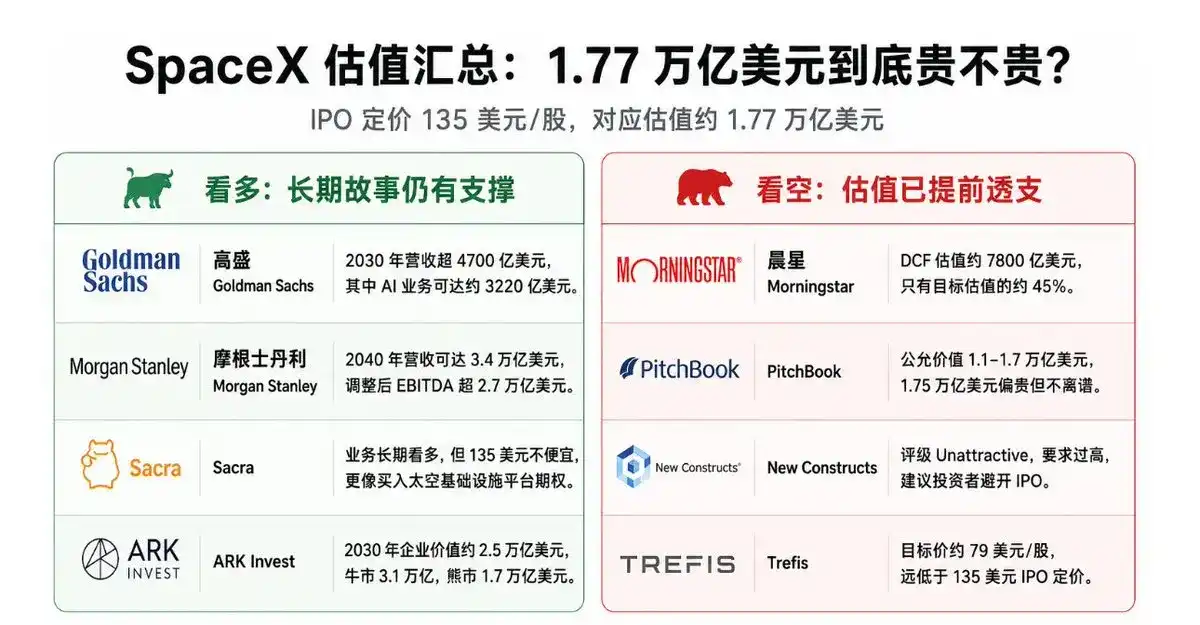
Currently, the SpaceX IPO pricing is preliminarily set at $135 per share, with a planned fundraising scale of approximately $75 billion, corresponding to a fully diluted valuation of about $1.77 trillion. This essentially secures its position as the largest IPO in the history of capital markets.

If this scale is ultimately achieved, Musk's net worth is expected to surge by over $220 billion, challenging for the title of the world's first trillionaire.

However, heavy is the head that wears the crown. The reason the SpaceX IPO attracts such attention is not only its potential to become the largest IPO ever but also because the capital markets are already fiercely debating its valuation.

Is SpaceX really worth $1.77 trillion? With an extra $220 billion in his wallet, will Musk be able to sleep soundly?

🌟 The Bull Case: Underwriters Weave a Long-Term Story with Starlink + Rocket Launches + AI

Bulls believe investing in SpaceX is not merely about backing a rocket company but rather about getting an early stake in the future gateway to space infrastructure.

The $1.77 trillion valuation seems high, but if Starlink, low-cost launches, and AI businesses continue to deliver, $135 has a long-term story to support it.

Goldman Sachs @GoldmanSachs

X Followers: 1.132M | XHunt Rank: 12015 | Global top-tier investment bank, one of the core underwriters for the SpaceX IPO.

Core View: SpaceX's valuation should not be understood solely as a traditional aerospace company; Starlink and future AI business must be incorporated into the long-term growth model.

Goldman Sachs expects SpaceX's revenue in 2028 to be around $160 billion, exceeding $470 billion by 2030.

The AI division is considered the most aggressive part. Goldman Sachs projects SpaceX's AI-related revenue could reach approximately $322 billion by 2030.

Morgan Stanley @MorganStanley

X Followers: 742K | XHunt Rank: 32049 | Global top-tier investment bank, one of the core underwriters for the SpaceX IPO.

Core View: SpaceX's long-term value stems from the compound growth of "Space + AI," with a future revenue ceiling far higher than traditional aerospace companies.

Morgan Stanley similarly expects SpaceX's 2028 revenue to be around $160 billion.

More aggressive is the long-term forecast: by 2040, Morgan Stanley projects SpaceX's revenue could reach $3.4 trillion, with adjusted EBITDA exceeding $2.7 trillion.

If you're buying the gateway to space infrastructure for the next decade+, $135 is undervalued, but it will take a long time to realize.

Sacra

An independent research firm focused on private tech companies, specializing in deep-dive company analysis and valuation breakdowns.

Core View: Bullish on the business long-term, but $135 is not a low valuation; it's more like paying upfront for an option on SpaceX transforming from an aerospace company into a space infrastructure platform.

Sacra estimates SpaceX's 2025 revenue at approximately $18.7 billion, with Starlink contributing $11.4 billion, already becoming the company's most important profit center.

It believes SpaceX's core advantage lies in vertical integration: building its own rockets, launching them, deploying its own satellites, and controlling terminals and ground networks, creating a cost advantage difficult for competitors to replicate.

If only considering the current Starlink and rocket launch businesses, $135 is not cheap. If one believes SpaceX can further expand from an aerospace company into a comprehensive platform covering satellite internet, low-cost launches, and more space infrastructure, this price becomes easier to accept.

ARK Invest @ARKInvest

X Followers: 816K | XHunt Rank: 1637 | Innovation-focused investment firm led by Cathie Wood, long-term tracker of disruptive technology assets.

Core View: While SpaceX's $1.77 trillion valuation is high, it's not entirely without support when considering the long-term opportunity through 2030.

ARK Invest's open-source valuation model for SpaceX shows an expected enterprise value of approximately $2.5 trillion by 2030. According to its model, the bull case scenario is around $3.1 trillion, and the bear case scenario is around $1.7 trillion.

ARK's core logic is that SpaceX's value comes not just from rocket launches but from Starlink's global satellite internet network, low-cost launch capability, and future space infrastructure businesses.

Based on ARK's projections, the IPO subscription price of $135 still has some upside potential.

🌟 The Bear Case: Independent Firms Believe IPO Valuation is Already Severely Overextended

The bear camp does not deny that SpaceX is one of the world's most unique commercial aerospace assets, nor do they deny Starlink's long-term value.

However, they believe the $1.77 trillion IPO valuation has already priced in too much future growth, especially given the significant uncertainty surrounding the AI business.

Morningstar @MorningstarInc

X Followers: 238K | XHunt Rank: 98209 | Globally renowned independent investment research firm, commonly using fundamental analysis and DCF models to assess company value.

Core View: SpaceX is a good company, but the IPO valuation is clearly on the high side.

Using a DCF model, Morningstar gives SpaceX a fair value estimate of approximately $780 billion, only about 45% of the IPO target valuation of $1.77 trillion.

In Morningstar's breakdown, the valuation for SpaceX's core launch business + Starlink is approximately $611 billion, with the xAI / AI-related business valued at around $170 billion on a probability-weighted basis.

Morningstar also highlights two risks: Musk is a key figure at SpaceX, and the company's valuation carries a significant "Musk premium." After the IPO, selling pressure may arise as lock-up periods expire for early shareholders and employees.

Morningstar believes the $135 price is clearly expensive and not suitable for rushing into the IPO; there may be better buying opportunities post-IPO.

PitchBook @PitchBook

X Followers: 48K | XHunt Rank: 49174 | Global platform for private equity, venture capital, and private company data, covering valuations and financing information for numerous private companies.

Core View: Around $1.5 trillion is acceptable, $1.75 trillion is expensive, but not entirely irrational.

PitchBook uses a Sum-of-the-Parts model to estimate SpaceX's fair value range between $1.1 trillion and $1.7 trillion, primarily focusing on the launch business and Starlink, not entirely reliant on the xAI narrative.

The $135 price is already near or slightly above the upper end of PitchBook's valuation range – not cheap, but not completely outrageous if one takes a long-term view on Starship and Starlink execution.

New Constructs @NewConstructs

X Followers: 5675 | XHunt Rank: - | Independent equity research firm focusing on financial quality, valuation risks, and reverse DCF analysis.

Core View: SpaceX is not worth participating in at a $1.75 trillion valuation; it advises investors to avoid the IPO.

New Constructs rates SpaceX as Unattractive. They argue that the $1.75 trillion valuation implies excessively high future growth and profit requirements. SpaceX would need to simultaneously become one of the highest revenue and profit-generating companies in the U.S. stock market to justify this price.

Risks cited include: inadequate internal accounting controls at SpaceX, public investors having almost no voting rights, a large portion of IPO proceeds potentially used to repay debt, potentially misleading non-GAAP metrics, and related-party transaction risks.

To justify a $1.75 trillion valuation, SpaceX's revenue may need to reach $1.1 trillion by 2035, implying an average annual growth rate of about 50% over the next decade. New Constructs believes such growth rates have almost no historical precedent.

New Constructs' judgment is the most direct: the risk-reward at this price is unfavorable, and they recommend not participating in the IPO.

Trefis @Trefis

X Followers: 2661 | XHunt Rank: - | Independent U.S. stock valuation platform that derives target prices by breaking down business models.

Core View: SpaceX is an exceptionally unique company, but the $135 offering price is clearly overvalued.

Trefis acknowledges SpaceX's long-term advantages in commercial aerospace, Starlink satellite internet, and low-cost launches but argues these advantages do not mean investors should ignore price.

Trefis gives SpaceX a target price of approximately $79 per share, far below the $135 IPO price.

🌟 Final Thoughts

Whether from the bull or bear side, most essentially acknowledge that SpaceX is one of the world's most unique commercial aerospace companies.

The real point of contention is whether the $135 price offers any margin of safety.

📈 Bulls believe buying SpaceX is about the long-term story of Starlink, low-cost launches, AI, and future space infrastructure.

📉 Bears argue that $135 has already priced in expectations to the fullest.

Currently, the $SPCX IPO subscription is already oversubscribed by 4 times, indicating that despite the valuation debate, capital enthusiasm for SpaceX remains high.

🙋 So the question is: Will you participate in the $SPCX IPO? Do you think Musk's $220 billion gain is well-deserved, or will it keep him up at night?
Preguntas relacionadas

QWhat is SpaceX's proposed IPO share price and what would the corresponding fully diluted valuation be?

ASpaceX's proposed IPO price is $135 per share, which would result in a fully diluted valuation of approximately $1.77 trillion.

QAccording to Goldman Sachs and Morgan Stanley, what is the core narrative supporting the bullish case for SpaceX's high valuation?

AThe bullish case, as presented by Goldman Sachs and Morgan Stanley, revolves around SpaceX being a long-term investment in future space infrastructure, combining growth from Starlink, low-cost launch services, and future AI-related business segments.

QWhat is Morningstar's fair value estimate for SpaceX and how does it compare to the proposed IPO valuation?

AMorningstar's fair value estimate for SpaceX is approximately $780 billion, which is only about 45% of the proposed $1.77 trillion IPO valuation.

QWhat are some of the key risks associated with SpaceX's IPO as highlighted by New Constructs?

ANew Constructs highlighted several key risks: the valuation implies extremely high future growth requirements, insufficient internal accounting controls, minimal voting rights for public investors, the possibility of IPO proceeds being used to repay debt, potentially misleading non-GAAP metrics, and risks related to related-party transactions.

QWhat is the main point of contention between the bullish and bearish perspectives on SpaceX's IPO according to the article's conclusion?

AThe main point of contention is whether the IPO price of $135 per share provides a reasonable margin of safety. Bulls see it as justified by long-term growth in space infrastructure, while bears believe it already fully prices in optimistic future expectations.

Lecturas Relacionadas

Un país que minó Bitcoin durante 8 años construye un banco exclusivo de criptomonedas

El pequeño reino de Bután, conocido por priorizar la Felicidad Nacional Bruta, ha estado minando Bitcoin desde 2018 utilizando su energía hidroeléctrica. Ahora, a través de su nueva ciudad administrativa especial, Gakiling (GMC), está llevando su compromiso con las criptomonedas un paso más allá con el lanzamiento de DK Bank. DK Bank, el único banco con licencia en GMC, se presenta como una solución a la gran falta de servicios bancarios para empresas de cripto. A diferencia de otros bancos, DK Bank integra activos tradicionales y digitales en una sola cuenta, permitiendo a los usuarios mantener y gestionar tanto monedas fiduciarias como stablecoins (USDT, USDC). El banco ofrece servicios de custodia, préstamos respaldados por Bitcoin y canales de conversión entre monedas. El marco regulatorio de GMC se basa en las leyes de Singapur y las normas de Abu Dhabi Global Market (ADGM), ofreciendo un proceso de licencia rápida para empresas ya reguladas en esas jurisdicciones. Las autoridades subrayan que los estándares no se relajan y exigen una presencia comercial real para optar a beneficios fiscales. Los impulsores del proyecto ven a GMC como un futuro centro financiero para el sur de Asia. Argumentan que la migración global de los servicios financieros a la cadena de bloques es inevitable y que los países más pequeños necesitan infraestructura soberana de cripto para reducir la dependencia de los sistemas financieros dominantes por grandes potencias. Bután no centra su estrategia únicamente en Bitcoin. Los líderes del proyecto enfatizan una cartera diversificada que incluya tokenización de activos reales y enfocan sus esfuerzos en servicios institucionales, no en tokens especulativos para minoristas. Aunque partes clave de la ciudad, como un aeropuerto internacional, están aún en construcción, DK Bank ya está operativo, representando un experimento único que combina la visión butanesa con la innovación financiera del siglo XXI.

marsbitHace 14 min(s)

Un país que minó Bitcoin durante 8 años construye un banco exclusivo de criptomonedas

marsbitHace 14 min(s)

El equipo de NVIDIA permite a un agente de programación hacerse cargo de experimentos con robots reales, logrando una tasa de éxito del 99%

La investigación en automatización ha dado un paso significativo al salir del entorno simulado y adentrarse en el mundo físico real. El equipo de NVIDIA GEAR, dirigido por Jim Fan, presentó el proyecto ENPIRE, un marco que permite por primera vez que agentes de programación autónomos realicen investigación en hardware robótico real. El sistema coloca ocho agentes Codex en una flota de robots con recursos de GPU y un presupuesto de tokens, asignándoles el objetivo de resolver tareas de forma eficiente y segura. Estos agentes operan con mínima intervención humana, manejando de forma autónoma un ciclo cerrado que incluye el reinicio automático de escenarios, la búsqueda en literatura, la implementación y entrenamiento de estrategias, la verificación y el análisis de registros para iterar continuamente. Han logrado una tasa de éxito del 99% en tareas de manipulación diestra como atar bridas, organizar clavos en una caja o instalar GPUs. Un hallazgo clave es que para muchas tareas robóticas, restablecer el entorno es más fácil que completar la tarea principal. Por ello, ENPIRE se centra primero en que los agentes creen procedimientos automáticos de reinicio. El sistema consta de cuatro módulos principales que forman el bucle de retroalimentación física: Entorno (EN), Mejora de Políticas (PI), Evaluación (Rollout, R) y Evolución (E). El proyecto también observó una "ley de escala física": aumentar el número de robots en paralelo (por ejemplo, a 8) acelera significativamente la resolución de tareas. Se introdujeron nuevas métricas como la Utilización Media del Robot (MRU) y la Utilización Media de Tokens (MTU) para medir la eficiencia. Actualmente, algunos sistemas pueden iterar durante toda la noche sin supervisión. El objetivo final es lograr una operación completamente autónoma. El proyecto ENPIRE será de código abierto, permitiendo a los desarrolladores replicar sistemas similares.

marsbitHace 1 hora(s)

El equipo de NVIDIA permite a un agente de programación hacerse cargo de experimentos con robots reales, logrando una tasa de éxito del 99%

marsbitHace 1 hora(s)

Un modelo pequeño de 3B con puntuación de programación comparable a Opus 4.5, un modelo misterioso genera debate, resulta ser chino

Un pequeño modelo de 3B parámetros, VibeThinker-3B, desarrollado por el equipo de Sina Weibo, está generando revuelo al alcanzar un rendimiento en tareas de razonamiento verificable (como programación) comparable al de modelos líderes como GPT-5, Claude Opus 4.5 o Gemini 3 Pro, a pesar de su tamaño significativamente menor. Basado en Qwen2.5-Coder-3B, el modelo fue entrenado con un proceso "Spectrum-to-Signal" que incluye fine-tuning supervisado en dos etapas con aprendizaje curricular, aprendizaje por refuerzo aplicado a múltiples dominios (matemáticas, programación, razonamiento STEM) y destilación de conocimiento. También incorpora una estrategia de evaluación de confiabilidad "Claim-Level" (CLR) para mejorar aún más los resultados en benchmarks. Sus puntuaciones sobresalientes incluyen 94.3 en AIME26, 80.2 en LiveCodeBench v6 y una tasa de aprobación del 96.1% en competiciones recientes de LeetCode. Los autores proponen la "hipótesis de compresión paramétrica", sugiriendo que el razonamiento verificable es una capacidad altamente comprimible que puede alcanzar niveles de vanguardia en modelos pequeños cuando las tareas tienen una estructura clara y señales de feedback confiables, desacoplándose parcialmente del conocimiento factual que requiere más parámetros. El objetivo no es reemplazar a los modelos grandes, sino explorar los límites de los modelos pequeños en dominios específicos. El modelo está disponible públicamente, aunque su rendimiento es intencionalmente especializado y no sobresale en tareas que requieren conocimiento general o de mundo abierto.

marsbitHace 1 hora(s)

Un modelo pequeño de 3B con puntuación de programación comparable a Opus 4.5, un modelo misterioso genera debate, resulta ser chino

marsbitHace 1 hora(s)

Trading

Spot
Futuros
活动图片