Analyst Exposes Bitcoin Market Maker Buy Strategy, Shows What Happens When Accumulation Ends

bitcoinistPublicado a 2026-04-18Actualizado a 2026-04-18

Resumen

A crypto analyst, Merlijn The Trader, has presented a market structure model suggesting Bitcoin is following an institutional trading cycle. The model outlines four key phases: a "Distribution" phase where large holders sold BTC near highs, a sharp "Flush" that dropped prices 38% to eliminate weak traders, the current "Accumulation" phase where institutions are buying in a tight range between $60k-$77k, and a future "Re-accumulation" period. The analyst projects that once accumulation ends, Bitcoin could break out to new all-time highs, with a potential target above $142,000 by early 2027. Holding above the $70,000 resistance level is critical for this bullish scenario to remain valid.

A crypto analyst has outlined a detailed market structure, suggesting that Bitcoin (BTC) may be entering a decisive stage after months of consolidation and price declines. His strategy maps recent price behavior into a sequence of institutionally driven phases, arguing that the end of accumulation often signals the start of a stronger upward expansion.

The Bitcoin MarketMaker Buy Strategy

Crypto market expert Merlijn The Trader has presented a market structure model on X, showing that Bitcoin’s recent price action is unfolding in line with an institutional trading cycle. The chart framework, known as the MarketMaker Buy Model, argues that large institutional players move markets in predictable stages designed to transfer Bitcoin from emotional retail traders into stronger, long-term holders before pushing prices significantly higher.

According to the analyst, the first stage of the cycle, highlighted in the first green box on the chart, began with a “Distribution” phase that occurred between about $100,000 and $120,000 in mid-2024. During this period, Bitcoin traded in a choppy downward pattern. This type of movement indicated that large holders were selling their Bitcoin amid strong demand from retail traders buying aggressively near the market top.

The second stage identified by Merlijn The Trader is the “Flush,” marked by the red box on the chart. This phase saw a sharp and aggressive price decline designed to force weaker traders out of the market. Here, Bitcoin reportedly fell from $100,000 to $62,000, a roughly 38% drop.
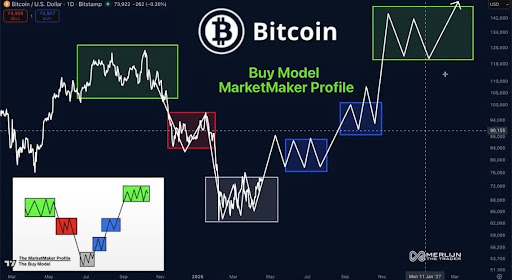
Source: Chart from Merlijn The Trader on X

Following this correction, the MarketMaker model transitions into the “Accumulation” phase, represented by the larger grey box on the chart. According to the model, this is the stage where the market is currently consolidating. Merlijn The Trader places this phase between roughly $60,000 and $77,000.

Within this zone, Bitcoin is trading in a relatively tight and choppy range rather than trending strongly in one direction. The sideways movement during this period also suggests that Bitcoin is building a foundation near a potential price bottom, as institutional buyers gradually accumulate more coins.

In the fourth stage, Merlijn The Trader identifies the two blue boxes on the chart as a “Re-accumulation.” This zone, between approximately $80,000 and $95,000, marks a secondary consolidation period that typically follows a price bottom. This phase provides another opportunity for large investors to strengthen their positions before BTC potentially begins its next upward movement.

What’s Next For BTC After Accumulation

Looking ahead, Merlijn The Trader projects a potential upside target above $142,000 once Bitcoin emerges from its accumulation and re-accumulation phases. In his chart model, the path to this level may involve another short consolidation period before a possible breakout into new all-time highs by January 2027.

The analyst also highlights a key resistance level around $70,000. Holding above this resistance is critical to maintaining the integrity of the MarketMaker model. Meanwhile, falling below the level suggests the structure may not be following the expected path.

BTC trading at $75,550 on the 1D chart | Source: BTCUSDT on Tradingview.com

Preguntas relacionadas

QWhat is the name of the market structure model presented by the analyst Merlijn The Trader?

AThe MarketMaker Buy Model.

QAccording to the model, what is the purpose of the 'Flush' phase?

AThe 'Flush' phase is a sharp and aggressive price decline designed to force weaker traders out of the market.

QIn which price range is the current 'Accumulation' phase taking place, according to the analyst?

AThe 'Accumulation' phase is taking place between roughly $60,000 and $77,000.

QWhat is the potential upside price target for Bitcoin once it emerges from the accumulation phases?

AThe potential upside price target is above $142,000.

QWhat is the critical resistance level that Bitcoin must hold above to maintain the integrity of the MarketMaker model?

AThe critical resistance level is around $70,000.

Lecturas Relacionadas

Apuestas por las noticias, los expertos leen las reglas: La verdadera brecha cognitiva de perder dinero en Polymarket

Resumen: En Polymarket, los "cabezas de tren" (usuarios expertos) tienen ventaja porque leen las reglas como abogados, no solo predicen eventos. Un ejemplo clave: en 2026, un mercado preguntaba "¿Quién será el líder de Venezuela a finales de 2026?". Muchos apostaron por Delcy Rodríguez, asumiendo que gobernaba, pero las reglas especificaban que "oficialmente ocupa el cargo" se refería al presidente formalmente nombrado y jurado. Aunque Maduro estaba en prisión, seguía siendo el presidente oficial según la ONU y las reglas aclaraban que "la autorización temporal para ejercer poderes presidenciales no equivale a una transferencia del cargo". Polymarket tiene un mecanismo de resolución de disputas de cinco pasos: 1) Cualquiera puede proponer un resultado con un depósito de 750 USDC; 2) Ventana de 2 horas para disputas (con otro depósito de 750 USDC); 3) Discusión de hasta 48 horas en Discord; 4) Votación de 48 horas por holders de UMA, con umbrales de participación y consenso; 5) Liquidación automática. A diferencia de un tribunal tradicional, donde jueces y partes están separados, en Polymarket los votantes (holders de UMA) pueden tener intereses en los mercados, creando conflictos. Esto debilita la discusión (efecto rebaño, cambios de postura) y hace que los resultados sean opacos (sin explicaciones, sin precedentes claros). La clave para ganar no es solo predecir eventos, sino entender la brecha entre la realidad y las reglas escritas.

marsbitHace 2 min(s)

Apuestas por las noticias, los expertos leen las reglas: La verdadera brecha cognitiva de perder dinero en Polymarket

marsbitHace 2 min(s)

Trading

Spot
Futuros
活动图片