Gold beats Bitcoin in the ‘safe-asset’ debate once again: ‘Get out while you still can!’

ambcryptoPublicado a 2026-03-30Actualizado a 2026-03-30

Resumen

The ongoing debate between Gold and Bitcoin as safe-haven assets continues, with recent developments favoring gold. While Bitcoin initially outperformed gold during U.S.-Iran geopolitical tensions in early March 2026—even nearing $74,000—it has since lost momentum, struggling to maintain levels above $67,000. The XAU/BTC chart shows green candles on the 4-hour timeframe, indicating gold's current outperformance, though the bounce remains minimal and lacks clear trend reversal signals, with RSI in overbought territory. The correlation between Bitcoin and Gold stands at -0.47, reflecting opposing price movements. On-chain analysis reinforces Bitcoin's perception as a riskier asset compared to gold, a view echoed by critic Peter Schiff. Market cap rankings further highlight gold’s dominance, placing first while Bitcoin ranks 12th. At press time, Bitcoin traded around $67,258 and gold at $4,536. Despite Bitcoin briefly acting as a safe haven during gold’s worst five-day drop since 1983, the market remains divided heading into Q2 2026. The key takeaway is that both assets exhibit strength under different conditions, with no consensus yet on the true safe-haven asset.

The good old debate between Gold [XAU] and Bitcoin [BTC] never seems to conclude. Earlier in March, after the U.S.-Iran escalations, Bitcoin started outperforming gold. It even climbed back to around $74,000, acting as a hedge during geopolitical tensions.

But as we move towards the end of the month and the end of the first quarter of 2026, Bitcoin is losing its charm.

Gold vs. Bitcoin: An analysis

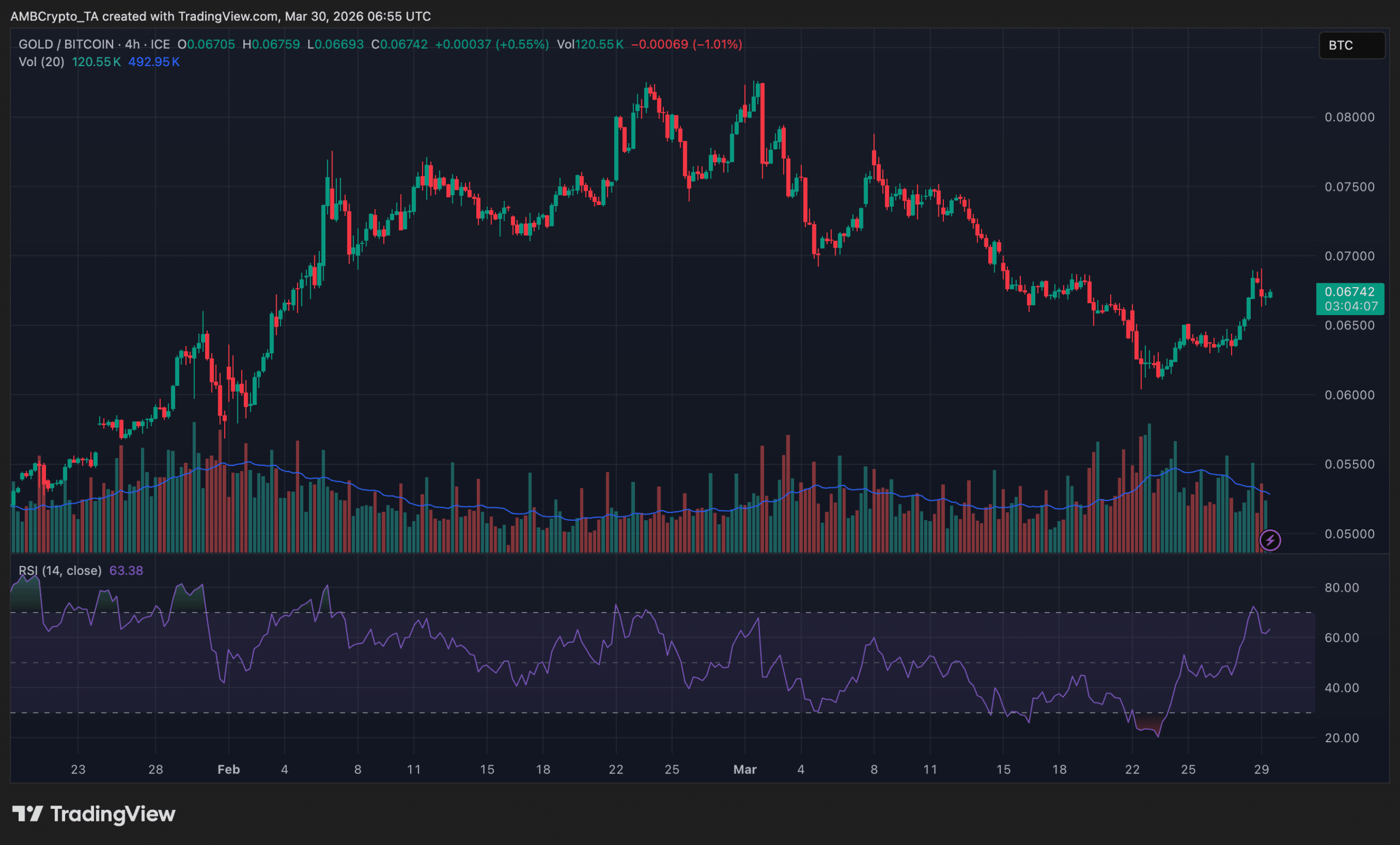
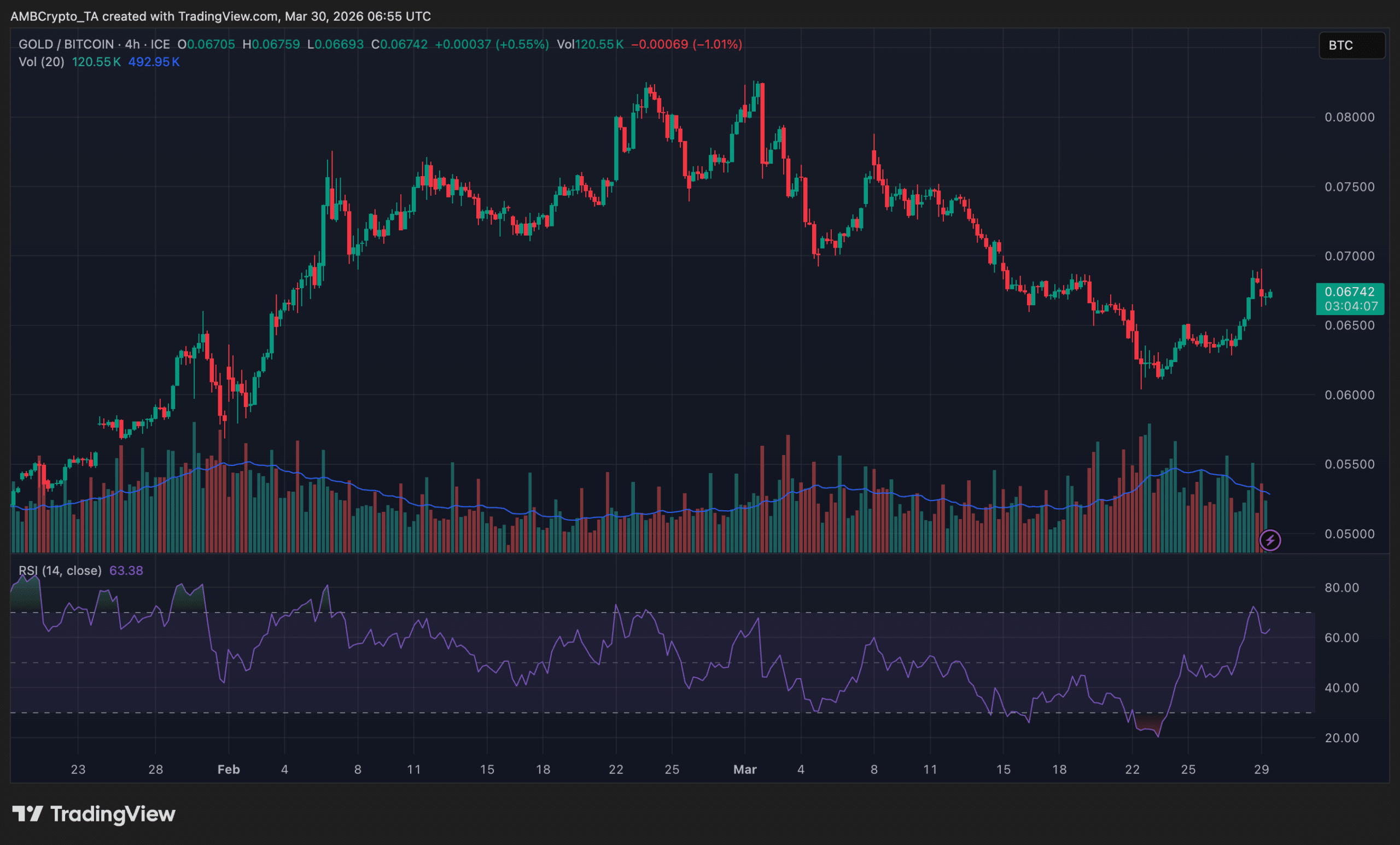
At the time of reporting, the XAU/BTC chart was showing green candles on the 4-hour time frame, indicating that gold was performing better than Bitcoin again. At the same time, Bitcoin was struggling to stay above the important $67,000 level.
Source: TradingView

Looking back, one can see that earlier this month, the chart dropped sharply. That meant Bitcoin was doing much better than Gold. Thereafter, both assets moved sideways for a while, showing a balance between them, but now things have shifted.

However, it’s also important to note that this bounce is currently minimal and does not hint at a real trend change. That said, the RSI was also around 72, in the overbought zone, which further confirmed the sentiment.

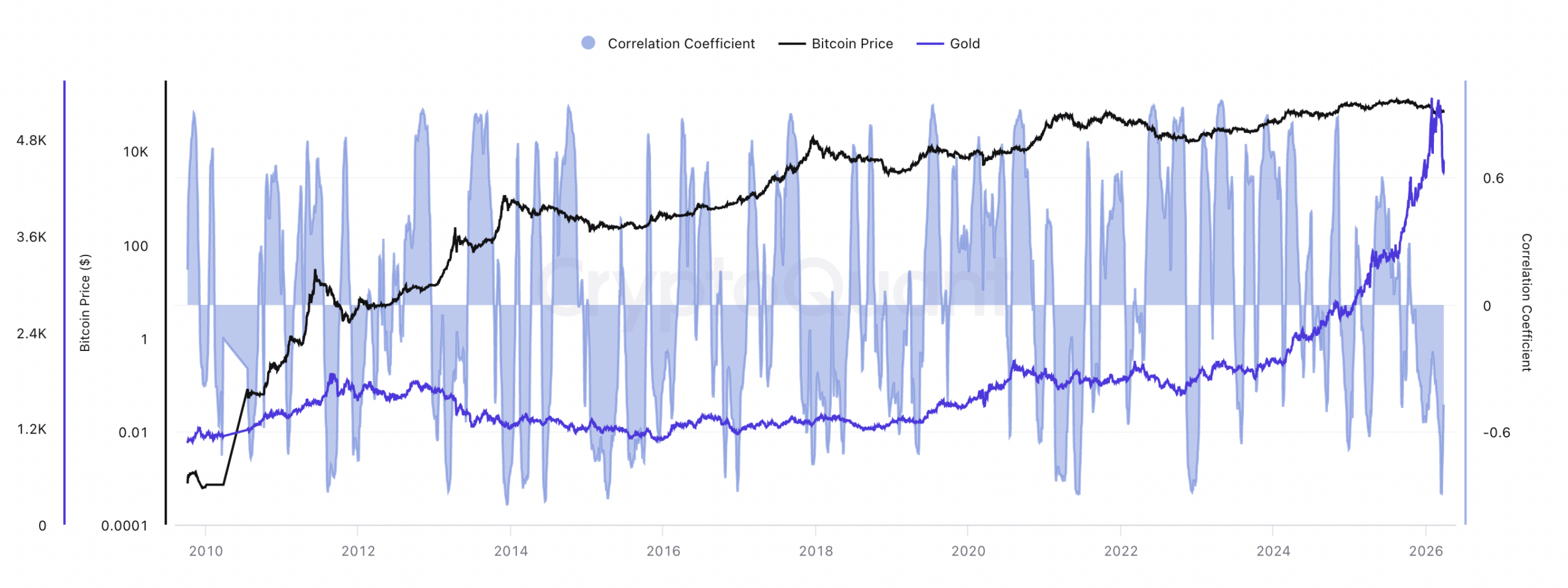
Bitcoin-Gold correlation hits rock bottom

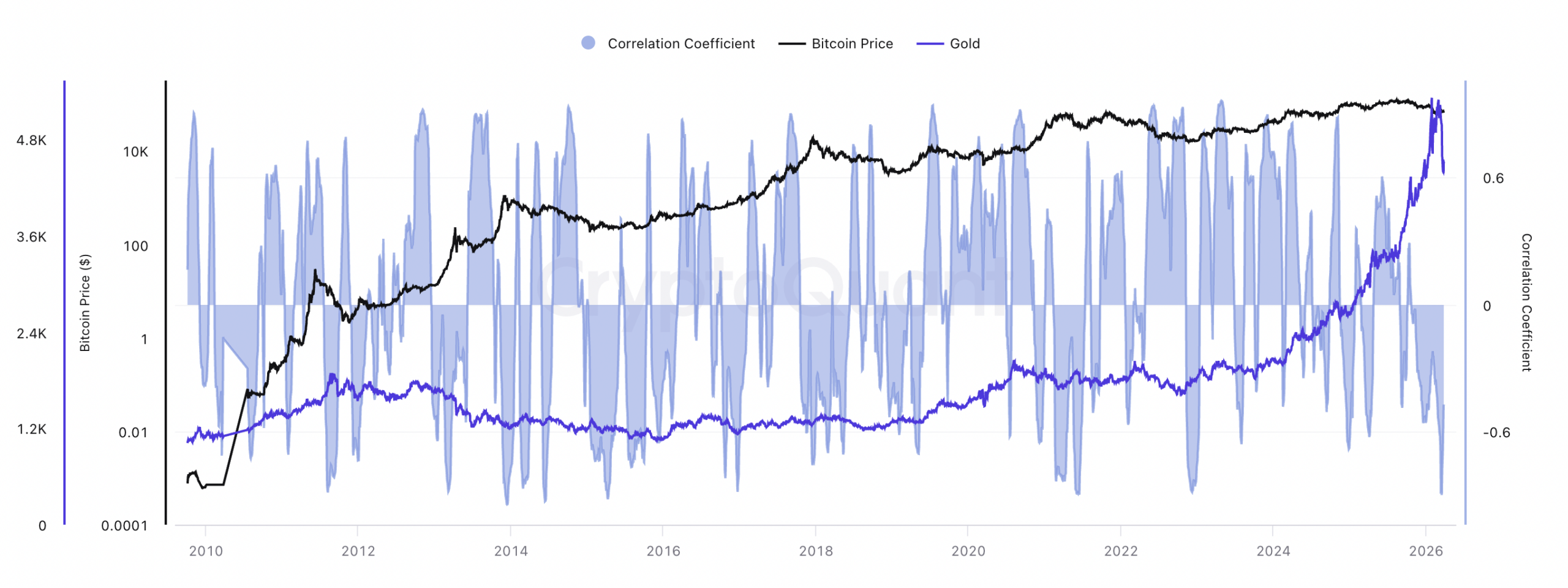
At press time, Bitcoin and Gold’s price correlation stood at -0.47, meaning that both assets were moving in opposite directions.
Source: CryptoQuant

So, according to on-chain analysis, Bitcoin is still being considered a risky asset in comparison to gold.

Bitcoin’s all-time critic, Peter Schiff, echoed this sentiment, noting,

Source: Peter Schiff/X

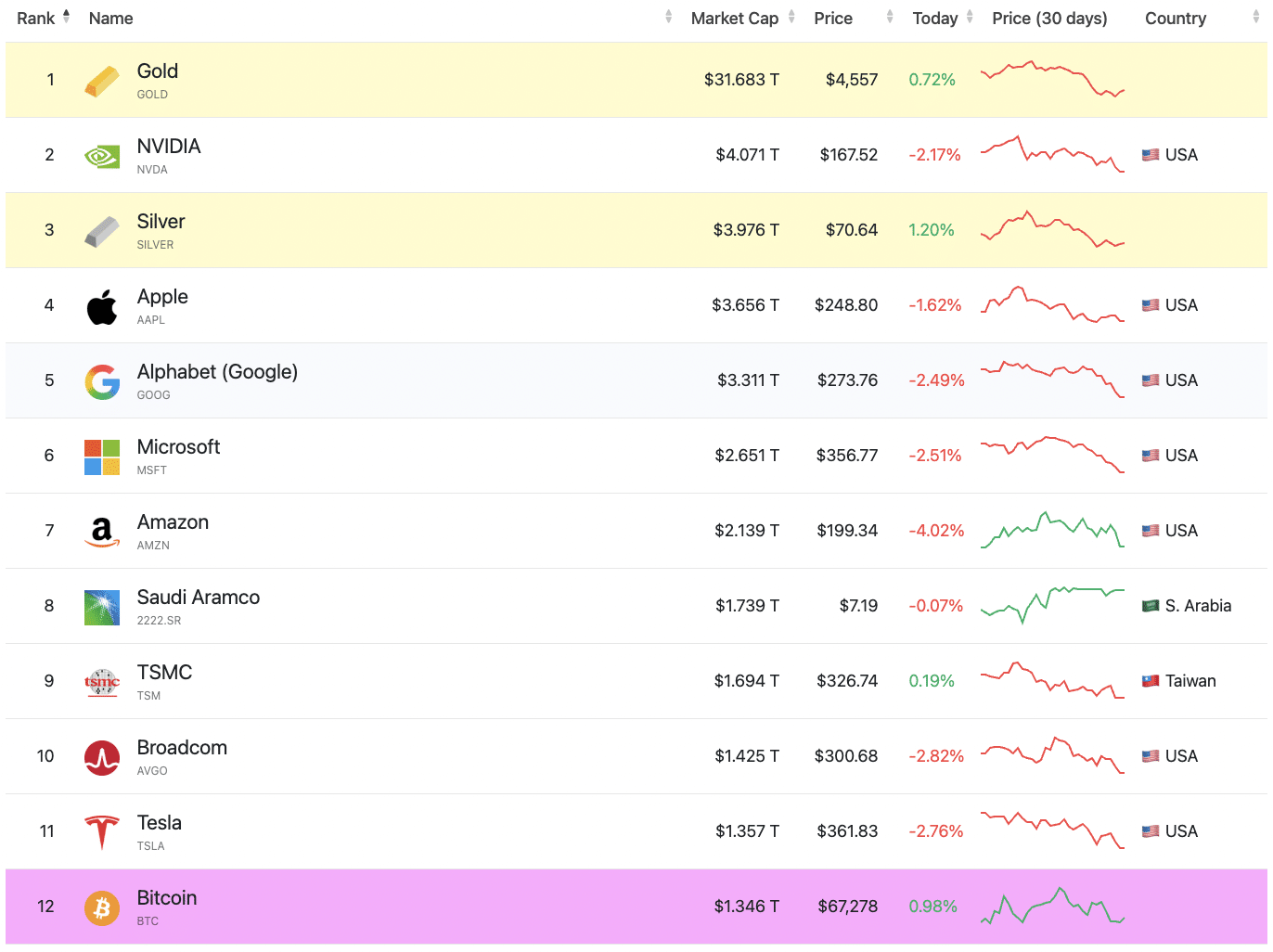
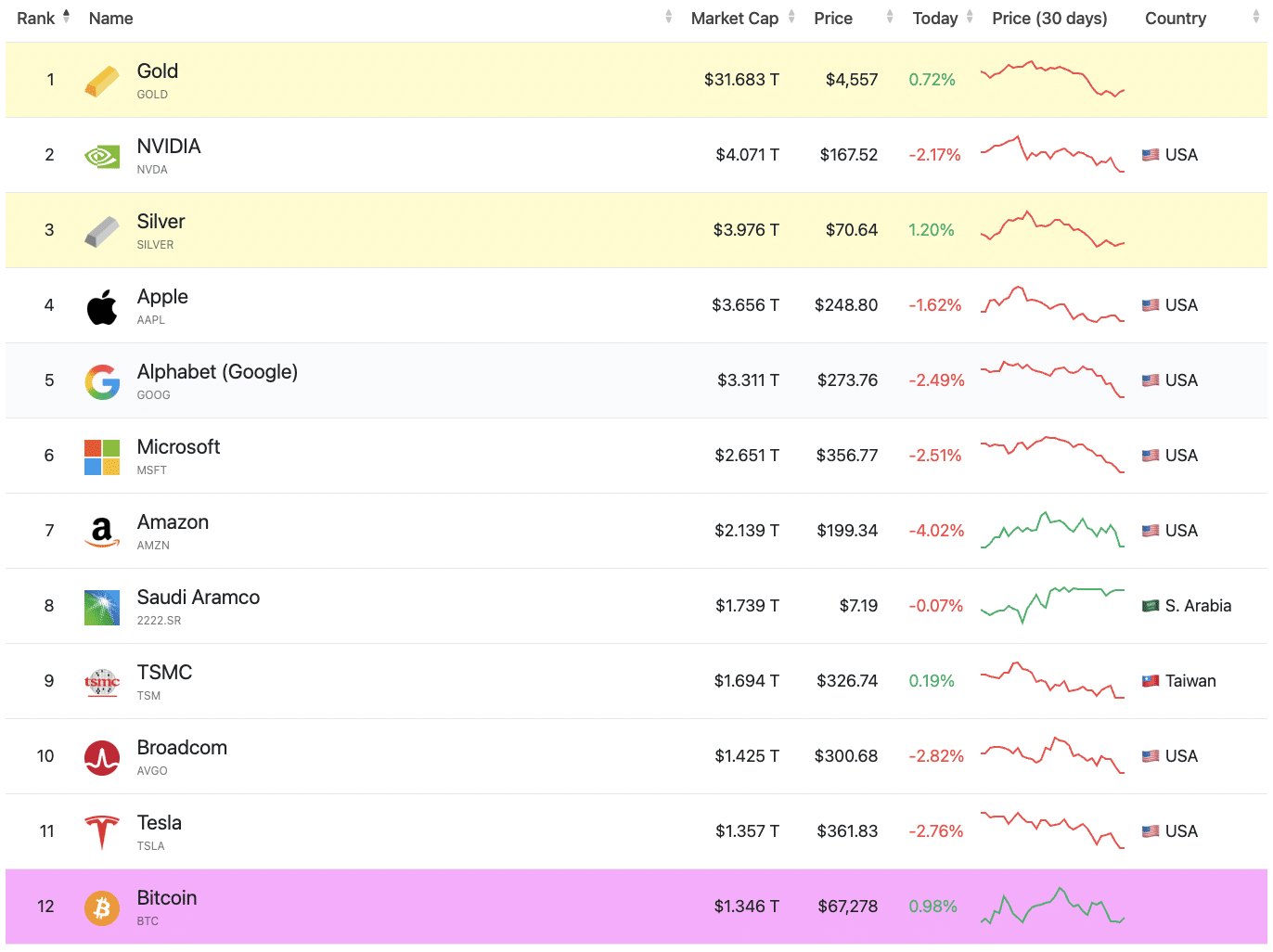
Schiff’s narrative was further supported by the asset market cap chart, which showed that Bitcoin was ranking 12th, whereas gold was at the top.
Source: CompaniesMarketCap

This comes as Bitcoin was trading around $67,258, and gold was priced at $4,536 at press time.

However, when you zoom out and look at the full month, Bitcoin was acting as a ‘safe haven’ when gold was witnessing its worst five-day drop since 1983.

Thus, as we move to Q2 of 2026, it remains to be seen whether the market is still divided or there is some agreement in terms of the actual ‘safe haven’ notion.


Final Summary

  • The Gold vs. Bitcoin debate continues to unfold, as both assets show strength at different times under different market conditions.
  • The negative correlation metric further confirms that both assets are not moving in the same direction.


Preguntas relacionadas

QWhat was the price correlation between Bitcoin and Gold at the time of reporting, and what does it indicate?

AThe price correlation between Bitcoin and Gold was -0.47, indicating that the two assets were moving in opposite directions.

QAccording to the article, which asset was performing better on the XAU/BTC 4-hour chart at the time of reporting?

AGold was performing better than Bitcoin, as indicated by the green candles on the XAU/BTC 4-hour chart.

QWhat did the RSI level of 72 suggest about the market sentiment for the assets discussed?

AThe RSI level of 72 was in the overbought zone, which confirmed the sentiment that the bounce was minimal and not indicative of a real trend change.

QWho is cited in the article as a major critic of Bitcoin, and what was his stance?

APeter Schiff is cited as a major critic of Bitcoin, echoing the sentiment that Bitcoin is a risky asset compared to gold and advising people to 'get out while you still can'.

QHow did Bitcoin's role as a 'safe haven' asset compare to Gold's during the worst five-day drop for gold since 1983?

ABitcoin acted as a 'safe haven' asset during gold's worst five-day drop since 1983, outperforming gold and providing a hedge during that period of market stress.

Lecturas Relacionadas

Tras tres trimestres consecutivos de caída, ¿puede el mercado cripto encontrar una ventana de estabilización en el tercer trimestre?

El mercado cripto sufrió su peor trimestre desde 2022, con una caída del 12.6% en la capitalización total (ahora en $2.1 billones). El volumen de operaciones y el valor de las stablecoins también disminuyeron, señalando una salida generalizada de capitales. Bitcoin y Ethereum cayeron un 14.2% y 25.4% respectivamente, rompiendo su correlación con los mercados de riesgo tradicionales. Los ETFs de Bitcoin en EE.UU. registraron importantes salidas netas ($4.67 mil millones en Q2), aunque datos sugieren que el ciclo de ventas podría estar cerca de su fin. La atención del mercado se centra ahora en la reunión de la FED a finales de julio, cuya postura (halcón o paloma) podría definir el rango de trading de Bitcoin para el trimestre. El avance de la ley CLARITY en el Senado estadounidense se ha estancado, reduciendo la probabilidad de aprobación en 2026 y manteniendo una prima de riesgo regulatorio alta. Solo dos sectores mostraron crecimiento: los mercados de predicción (volumen +48.7%) y los coleccionables tokenizados (volumen +143% vs. Q1). El sentimiento general es de cautela. La lógica del mercado ha cambiado, priorizando fundamentos como la política monetaria y la regulación frente a los simples impulsos narrativos. Aunque las bases para una caída extrema parecen limitadas, la recuperación sostenida en Q3 depende críticamente de la FED y de un posible progreso regulatorio.

marsbitAyer 08:41

Tras tres trimestres consecutivos de caída, ¿puede el mercado cripto encontrar una ventana de estabilización en el tercer trimestre?

marsbitAyer 08:41

BIT Trading Moments: BTC aún presionado por la EMA 200 semanal, tras el rechazo podría reiniciar la caída, los valores de almacenamiento y semiconductores que subieron fuertemente anoche comenzaron a caer en la sesión nocturna

**BIT Trading Moments: BTC aún presionado por la EMA 200 semanal; almacenamiento y semiconductores caen en el after-hours** El mercado de cripto continúa su recuperación, con **Bitcoin** manteniéndose cerca de los $66,000. Enfrenta una fuerte resistencia en la zona de los $68,000, nivel que coincide con el costo promedio de los inversores en los últimos cinco meses y un punto de fallo anterior. Los analistas señalan que se encuentra atrapado entre la media móvil simple (MA) de 200 semanas (~$63,333) y la media exponencial (EMA) de 200 semanas (~$68,328). Se necesitaría un cierre semanal por debajo de $55,000 o por encima de $70,000 para confirmar una dirección de mayor alcance. Los ETF de Bitcoin registran entradas netas por sexto día consecutivo. En Wall Street, los **futuros de los principales índices** caen. Después de fuertes ganancias el martes, las acciones de **semiconductores y almacenamiento** retroceden en el after-hours: el ETF de semiconductores cae un 2.22%, Micron un 2.29% y SK Hynix casi un 5%. Sin embargo, **Super Micro Computer (SMCI)** se dispara más de un 20% tras el cierre, impulsada por sólidos pedidos. Otras noticias positivas incluyen un contrato de $266M de la Fuerza Aérea para **Rocket Lab**. A pesar del repunte bursátil, factores como el **crudo Brent por encima de $91** y el **rendimiento del bono estadounidense a 10 años subiendo a ~4.64%** generan preocupaciones inflacionarias y enfrían el optimismo. Las acciones relacionadas con cripto, como Coinbase y Robinhood, tuvieron un buen desempeño apoyadas por avances regulatorios. En Asia, los mercados siguieron la recuperación tecnológica. El **índice KOSPI de Corea del Sur** subió un 0.74%, con acciones de semiconductores mostrando volatilidad. El principal riesgo es el **yen japonés**, que tocó su nivel más bajo desde 1986, lo que genera temores a una intervención del gobierno. **Próximos eventos clave:** Este miércoles 22 de julio, el enfoque está en los eventos de **AMD AI** y los resultados financieros de **Alphabet (Google), Tesla e IBM** después del cierre. El jueves 23, la **decisión de tasas del BCE** y los resultados de **Intel** serán cruciales para el sentimiento del mercado.

marsbitAyer 08:33

BIT Trading Moments: BTC aún presionado por la EMA 200 semanal, tras el rechazo podría reiniciar la caída, los valores de almacenamiento y semiconductores que subieron fuertemente anoche comenzaron a caer en la sesión nocturna

marsbitAyer 08:33

Trading

Spot
活动图片