High-Frequency Trading, $100K Annual Income: The Most 'Boring' Profit Myth on Polymarket

marsbitPublicado a 2026-02-11Actualizado a 2026-02-11

Resumen

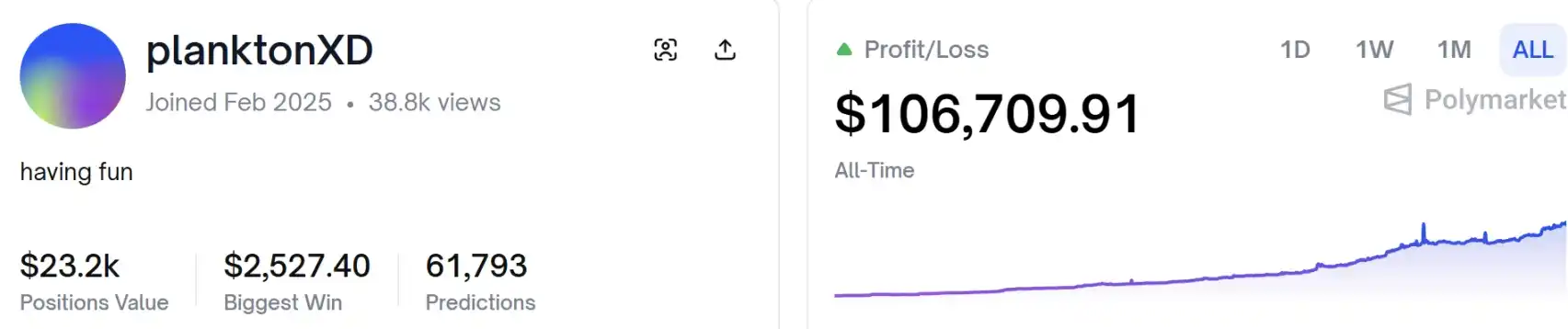
A user known as planktonXD (0x4ffe49ba2a4cae123536a8af4fda48faeb609f71) has generated over $106,000 in profit on Polymarket within a year by executing more than 61,000 predictions—averaging around 170 trades per day. This high-frequency, automated strategy focuses on exploiting small, certain opportunities rather than betting on high-risk, high-reward outcomes. The approach is characterized by market-making and micro-arbitrage: placing orders on both sides of the order book to capture spreads or profiting from mispriced options in low-liquidity markets. The largest single win was only $2,527, illustrating a disciplined, risk-managed method that avoids large drawdowns. The bot operates across diverse categories—sports, weather, crypto prices, politics—constantly scanning for pricing inefficiencies. Notable examples include buying heavily undervalued options in niche markets, such as esports matches or extreme crypto price movements, where probability is mispriced due to emotional trading or thin order books. For instance, a $16 bet on SOL falling to $130 (priced at 0.7¢, implying <1% chance) returned $1,574 during a volatile period. Key takeaways: The strategy highlights the power of compounding small gains, the necessity of automation and API tools, and the superiority of high-probability opportunities over high-risk bets. In prediction markets, the most advanced approach isn’t forecasting—it’s managing probability and liquidity.

Original Author: Ma He, Foresight News

Another miracle has emerged on Polymarket.

Through extensive monitoring and frenzied betting, an address has netted $100,000 in just one year by compounding small profits.

The address we are reviewing, planktonXD (0x4ffe49ba2a4cae123536a8af4fda48faeb609f71), is an extremely typical high-frequency quantitative trader. From February 2025 to the present, in just one year, it has generated a net profit of $106,000 through over 61,000 predictions.
In prediction markets, most people are gambling on "black swans" or chasing big news, but planktonXD takes a completely different path: extreme certainty and terrifying execution frequency.

Looking at planktonXD's historical trading data, the most astonishing aspect is its 61,000 predictions. From February 2025 to February 2026, it averages about 170 transactions per day.

This frequency far exceeds the limits of manual human operation, confirming that this player uses an automated trading script (Bot). It is not "predicting" outcomes but "harvesting" price differences.

A very interesting phenomenon is that planktonXD's "Biggest Win" is only $2,527.4. Compared to its total profit of $100,000, this single largest gain appears very "small" (only about 2% of the total profit).

Some retail players always hope to make a big score, betting all their chips on a confident judgment.

Winning is good, of course, but losing makes it hard to get back to the table.

Even if every ALL-IN could win, just one loss would mean a big defeat.

Reviewing its trading history, it never goes all-in on a single extreme event, nor does it bet on high odds. Its profit curve shows a perfect 45-degree smooth rise with almost no significant drawdowns. This indicates it employs a market-making strategy: placing orders on both sides of the order book to earn the bid-ask spread, or performing micro-arbitrage using price fluctuations between different markets.
It does not always hold positions long-term (Buy and Hold) but frequently enters and exits the market. This "light position, fast turnover" approach greatly reduces single-point risk. Even if an unexpected event occurs in a prediction market (like a sudden election result change), its impact on the total capital pool is minimal.

This quantitative robot does not specialize in trading vertical sectors like weather but places bets across multiple sectors: sports, weather, coin prices, politics, etc. It monitors thousands of prediction markets on the platform 24/7, looking for moments of pricing inefficiency.

VALORANT Challengers is a classic实战 case study for this trader.

You can think of it as the "minor league" or "regional league" of the esports circle. Fuego and LYON are professional teams in the Latin American region. Because such matches have a small audience and extremely high information asymmetry, they become a "套利天堂" (arbitrage paradise) for quantitative robots.

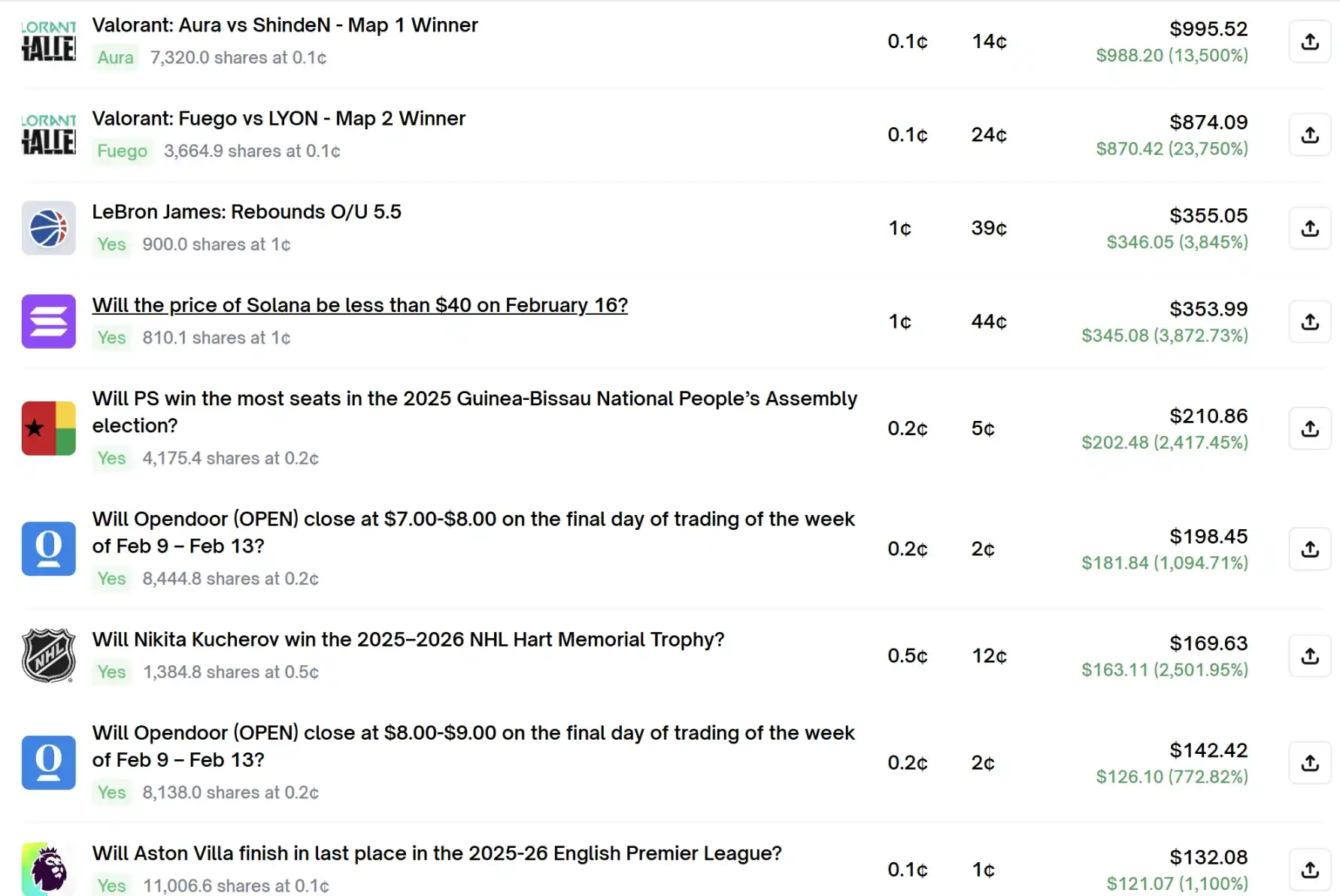
It bought 3,664.9 shares of Fuego winning at a unit price of $0.001, and this trade ultimately yielded a return of $874.09, with a staggering return rate of 23,750%!

This is a typical "small position, big odds" play. In long-tail markets with extremely poor liquidity or where the public is extremely bearish on a certain option (like the round results of esports matches), it uses a Bot to monitor options that are mispriced to near "zero." It doesn't need to predict who will win; it only needs to know that Fuego's probability of winning is definitely not 0.1%. This is essentially harvesting the market's "extreme sentiment" and "lack of liquidity."

When it comes to sentiment, coin prices embody it most vividly.
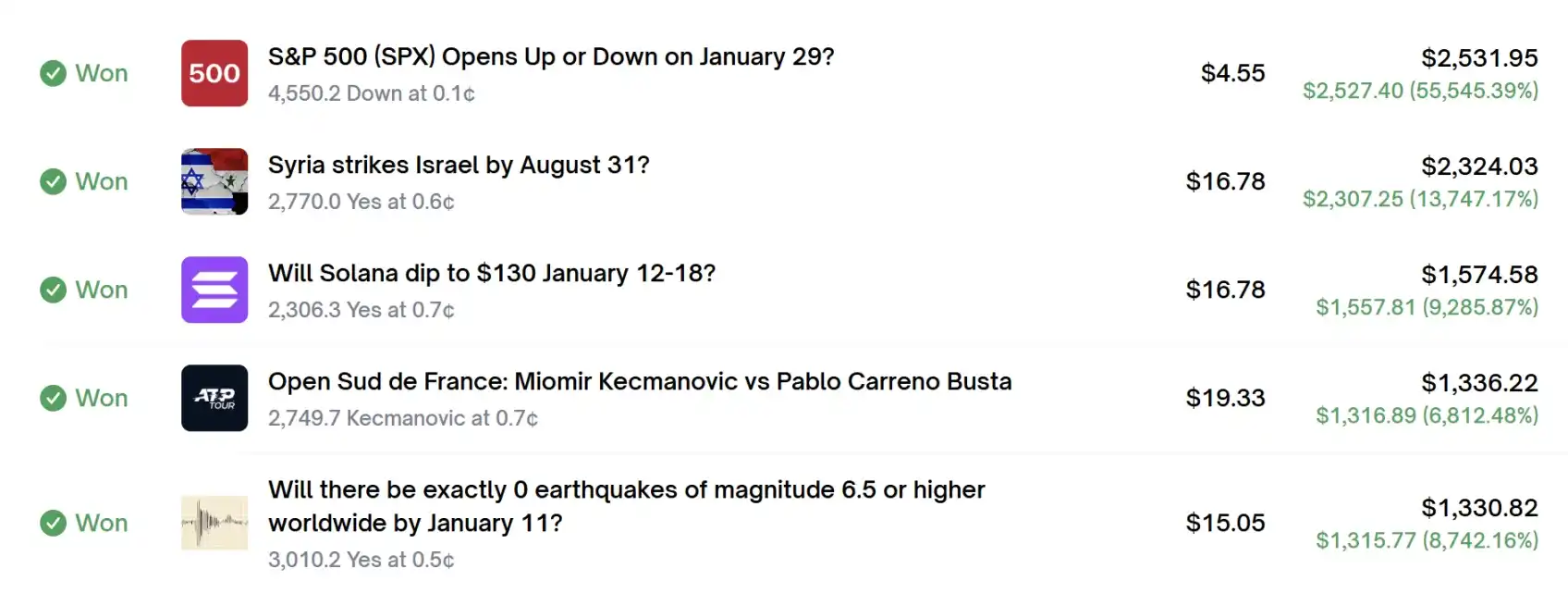
Will the SOL price drop to $130 between January 12-18?

It invested about $16 at $0.007 (the market believed the probability of success was less than 1%) and ultimately took away $1,574, with an amazing return rate of 9,285%.

Why did this "almost impossible" prediction allow it to make big money at that time?

During periods of剧烈波动 (sharp volatility) in the cryptocurrency market, mainstream predictions tend to be bullish or sideways. planktonXD would捕捉 (capture) those "extremely bearish" options priced at $0.001 - $0.01 around the clock. These options are like worthless paper to ordinary people, but they are extremely cheap insurance to quant traders. As long as the market experiences a deep wick or sudden bad news, these "worthless papers" can instantly surge thousands of times. Additionally, in specific price ranges (e.g., SOL < $40), because the current price is far from the predicted price, the order book is often very thin. planktonXD uses automated scripts to place orders in these "no-man's land," eating up the cheap shares抛出的 (thrown out) due to panic or misoperation, essentially acting as a probability搬运工 (mover).

planktonXD's SOL strategy shows that on Polymarket, buying the "impossible" does not mean it believes it will happen, but because the "probability of it happening" is underestimated by the market. It uses a few dollars to buy out the market's one-in-ten-thousand possibility of panic. This is a typical "antifragile" trade.

planktonXD's success offers three core启示 (insights) for ordinary retail users:

The power of compound interest should not be underestimated. Earning 0.5% daily through high-frequency trading yields much more stable returns after a year than betting on a 10x coin. Technology is the killer skill. In the Crypto era, quantitative tools and API capabilities are standard for top players. Finally, certainty is greater than odds. In prediction markets,寻找 (finding) those small profit opportunities with extremely high probability (e.g., 90%+ certainty) is easier to survive than gambling on 50/50 major events.

After all, the highest level of play in prediction markets is not predicting the future, but managing probability and liquidity.


Preguntas relacionadas

QWhat is the key strategy used by the address planktonXD to earn over $100,000 on Polymarket in a year?

AThe key strategy is high-frequency automated trading (using a bot) that focuses on small, certain profits through market making and micro-arbitrage, rather than betting on high-risk, high-reward events. It executed over 61,000 predictions in a year, averaging about 170 trades per day.

QHow does planktonXD achieve such a smooth profit curve with minimal drawdowns?

AIt achieves this by using a market maker strategy: placing orders on both sides of the order book to capture the bid-ask spread, and engaging in micro-arbitrage across different markets. This 'light position, fast turnover' approach minimizes single-point risk and avoids large bets on volatile outcomes.

QWhat type of markets does planktonXD typically target for its trades?

AIt targets multiple sectors including sports, weather, cryptocurrency prices, and politics. It monitors thousands of prediction markets 24/7 to identify mispriced opportunities, especially in illiquid or emotionally driven markets where extreme mispricing occurs.

QCan you give an example of a high-return trade made by planktonXD and explain why it was successful?

AOne example is buying 3,664.9 shares of Fuego winning a VALORANT Challengers match at 0.1¢ each, which resulted in an 874.09 USD profit with a 23,750% return. The success came from exploiting extreme mispricing in a low-liquidity, information-asymmetric market where the probability of Fuego winning was significantly higher than the market price reflected.

QWhat are the three key lessons for retail traders from planktonXD's success on Polymarket?

A1. The power of compounding: small daily gains through high-frequency trading can yield more stable returns than betting on high-risk events. 2. Technology is essential: automated tools and API capabilities are crucial for top performers. 3. Certainty over odds: seeking high-probability, small-profit opportunities is more sustainable than gambling on 50/50 outcomes.

Lecturas Relacionadas

Tras tres trimestres consecutivos de caída, ¿puede el mercado cripto encontrar una ventana de estabilización en el tercer trimestre?

El mercado cripto sufrió su peor trimestre desde 2022, con una caída del 12.6% en la capitalización total (ahora en $2.1 billones). El volumen de operaciones y el valor de las stablecoins también disminuyeron, señalando una salida generalizada de capitales. Bitcoin y Ethereum cayeron un 14.2% y 25.4% respectivamente, rompiendo su correlación con los mercados de riesgo tradicionales. Los ETFs de Bitcoin en EE.UU. registraron importantes salidas netas ($4.67 mil millones en Q2), aunque datos sugieren que el ciclo de ventas podría estar cerca de su fin. La atención del mercado se centra ahora en la reunión de la FED a finales de julio, cuya postura (halcón o paloma) podría definir el rango de trading de Bitcoin para el trimestre. El avance de la ley CLARITY en el Senado estadounidense se ha estancado, reduciendo la probabilidad de aprobación en 2026 y manteniendo una prima de riesgo regulatorio alta. Solo dos sectores mostraron crecimiento: los mercados de predicción (volumen +48.7%) y los coleccionables tokenizados (volumen +143% vs. Q1). El sentimiento general es de cautela. La lógica del mercado ha cambiado, priorizando fundamentos como la política monetaria y la regulación frente a los simples impulsos narrativos. Aunque las bases para una caída extrema parecen limitadas, la recuperación sostenida en Q3 depende críticamente de la FED y de un posible progreso regulatorio.

marsbitAyer 08:41

Tras tres trimestres consecutivos de caída, ¿puede el mercado cripto encontrar una ventana de estabilización en el tercer trimestre?

marsbitAyer 08:41

BIT Trading Moments: BTC aún presionado por la EMA 200 semanal, tras el rechazo podría reiniciar la caída, los valores de almacenamiento y semiconductores que subieron fuertemente anoche comenzaron a caer en la sesión nocturna

**BIT Trading Moments: BTC aún presionado por la EMA 200 semanal; almacenamiento y semiconductores caen en el after-hours** El mercado de cripto continúa su recuperación, con **Bitcoin** manteniéndose cerca de los $66,000. Enfrenta una fuerte resistencia en la zona de los $68,000, nivel que coincide con el costo promedio de los inversores en los últimos cinco meses y un punto de fallo anterior. Los analistas señalan que se encuentra atrapado entre la media móvil simple (MA) de 200 semanas (~$63,333) y la media exponencial (EMA) de 200 semanas (~$68,328). Se necesitaría un cierre semanal por debajo de $55,000 o por encima de $70,000 para confirmar una dirección de mayor alcance. Los ETF de Bitcoin registran entradas netas por sexto día consecutivo. En Wall Street, los **futuros de los principales índices** caen. Después de fuertes ganancias el martes, las acciones de **semiconductores y almacenamiento** retroceden en el after-hours: el ETF de semiconductores cae un 2.22%, Micron un 2.29% y SK Hynix casi un 5%. Sin embargo, **Super Micro Computer (SMCI)** se dispara más de un 20% tras el cierre, impulsada por sólidos pedidos. Otras noticias positivas incluyen un contrato de $266M de la Fuerza Aérea para **Rocket Lab**. A pesar del repunte bursátil, factores como el **crudo Brent por encima de $91** y el **rendimiento del bono estadounidense a 10 años subiendo a ~4.64%** generan preocupaciones inflacionarias y enfrían el optimismo. Las acciones relacionadas con cripto, como Coinbase y Robinhood, tuvieron un buen desempeño apoyadas por avances regulatorios. En Asia, los mercados siguieron la recuperación tecnológica. El **índice KOSPI de Corea del Sur** subió un 0.74%, con acciones de semiconductores mostrando volatilidad. El principal riesgo es el **yen japonés**, que tocó su nivel más bajo desde 1986, lo que genera temores a una intervención del gobierno. **Próximos eventos clave:** Este miércoles 22 de julio, el enfoque está en los eventos de **AMD AI** y los resultados financieros de **Alphabet (Google), Tesla e IBM** después del cierre. El jueves 23, la **decisión de tasas del BCE** y los resultados de **Intel** serán cruciales para el sentimiento del mercado.

marsbitAyer 08:33

BIT Trading Moments: BTC aún presionado por la EMA 200 semanal, tras el rechazo podría reiniciar la caída, los valores de almacenamiento y semiconductores que subieron fuertemente anoche comenzaron a caer en la sesión nocturna

marsbitAyer 08:33

Trading

Spot
活动图片




