Ethereum Foundation Backs SEAL Initiative as LiquidChain L3 Protocol Gains Traction

bitcoinistPublicado a 2026-02-10Actualizado a 2026-02-10

Resumen

The Ethereum Foundation has officially backed the Security Alliance (SEAL), a coalition of white-hat hackers and researchers, to strengthen the crypto industry’s coordinated defense against drainer attacks. SEAL’s "SEAL 911" initiative enables real-time reporting of exploits, helping intercept stolen funds before they are laundered. This move signals a shift from reactive security measures to more structural solutions that reduce complexity and risk. LiquidChain ($LIQUID), a Layer 3 protocol, is gaining traction as a architectural solution to cross-chain vulnerabilities. By unifying liquidity across Bitcoin, Ethereum, and Solana into a single execution layer, it eliminates the need for risky bridging operations—a common attack vector. The project has raised over $533K in its presale, reflecting growing institutional interest in infrastructure that abstracts away cross-chain complexity and enhances security through design rather than intervention.

Trusted Editorial content, reviewed by leading industry experts and seasoned editors. Ad Disclosure

Quick Facts:

  • ➡️ The Ethereum Foundation has officially backed the Security Alliance (SEAL), strengthening the industry’s coordinated response against crypto drainers.
  • ➡️ Market focus is shifting from reactive security measures to architectural solutions that reduce complexity.
  • ➡️ LiquidChain is capitalizing on this trend by unifying Bitcoin, Ethereum, and Solana liquidity into a single, secure L3 execution layer.
  • ➡️ Institutional support for white-hat initiatives signals a maturing market where security is treated as a public good rather than a luxury.

The decentralized finance security landscape just shifted.

By formally backing the Security Alliance (SEAL), the Ethereum Foundation is acknowledging a hard truth: code audits alone aren’t enough to stop the rising tide of sophisticated crypto drainers.

SEAL, a coalition of white-hat hackers and researchers, has quietly become the industry’s emergency response team. Their ‘SEAL 911’ initiative lets victims and protocols report active exploits in real-time, often intercepting funds before they hit mixers.

The Foundation’s backing isn’t just financial; it’s an institutional nod to coordinated defense. Previously, protocols fought threats in silos. Now, the centralization of threat intelligence creates a “herd immunity” effect that makes drainer-as-a-service operations significantly harder to scale.

But let’s be honest: while SEAL treats the symptoms (exploits), the market is hunting for a cure to the root cause: complexity. Most losses happen during the intricate dance of bridging assets and signing obscure permissions.

Ironically, for an industry built on trustless code, our security still relies heavily on human intervention. Recognizing this, investors are rotating toward architectural solutions that remove the need for risky bridging entirely.

This thesis is driving capital into LiquidChain ($LIQUID), a Layer 3 infrastructure project designed to unify liquidity across Bitcoin, Ethereum, and Solana.

Learn more about LiquidChain here.

LiquidChain Unifies Liquidity To Remove Bridge Risk

Fragmentation is the enemy of security. Every time you wrap an asset or use a third-party bridge, you introduce a new point of failure, a vector that drainers exploit with ruthless efficiency. LiquidChain ($LIQUID) positions itself as the structural antidote, fusing the liquidity of the three largest ecosystems into a single execution environment.

By operating as a Layer 3 (L3) protocol, LiquidChain allows developers to deploy applications once that access Bitcoin, Ethereum, and Solana simultaneously.

For the end-user, this means ‘single-step execution.’ Instead of the perilous multi-step process of bridging $ETH to $SOL, swapping, and then staking, actions that often require signing multiple blind approvals, LiquidChain handles the cross-chain complexity at the protocol level.

This creates a verifiable settlement layer where the friction (and risk) of interoperability is abstracted away. The project’s unique proposition isn’t building a better bridge; it’s creating an environment where bridges are rendered invisible. Developers gain access to a Cross-Chain VM, allowing them to tap into Bitcoin’s capital base while using Solana’s speed.

No more navigating the dark forest of cross-chain transfers.

$LIQUID is available here.

Smart Money Rotates Into L3 Infrastructure As Presale Crosses $533K

While the broader market reacts to security headlines, astute capital is quietly positioning itself in infrastructure plays that streamline the user experience. The data tells the story: LiquidChain ($LIQUID) has raised over $533K to date.

Currently priced at $0.0136, the token represents a bet on the ‘abstraction narrative’, the idea that the next billion users won’t care (or know) which chain they’re using.
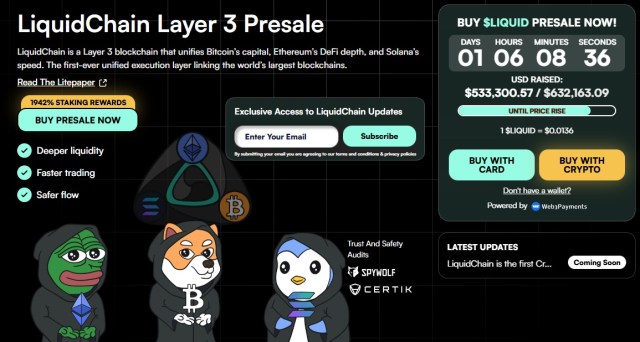
The capital inflow suggests investors are looking beyond commoditized Layer 2 scaling solutions toward Layer 3 protocols with specific interoperability use cases.

The utility of the $LIQUID token extends beyond simple governance. It functions as the transaction fuel for this cross-chain environment and facilitates liquidity staking. In a market where yield is often chased at the expense of safety, LiquidChain’s model offers a compelling alternative: rewards derived from the friction of unifying the world’s disparate blockchains.

With the presale gaining momentum, the window for early entry at these valuations is narrowing as the project approaches mainnet deployment.

Buy $LIQUID here.

Disclaimer: The content provided in this article is for informational purposes only and does not constitute financial advice. Cryptocurrency investments carry inherent risks, including high volatility and potential loss of principal. Always conduct your own research.

Editorial Process for bitcoinist is centered on delivering thoroughly researched, accurate, and unbiased content. We uphold strict sourcing standards, and each page undergoes diligent review by our team of top technology experts and seasoned editors. This process ensures the integrity, relevance, and value of our content for our readers.

patrubogdan

Follow

Full Profile

Related Posts

Crypto Exchange Backpack Targets Token Launch Soon, as BMIC Fires Up Quantum Defense

Vitalik Buterin Outlines Ethereum’s AI Future, While SUBBD Token Targets the Creator Economy

Binance Dominates Trump’s USD1 Supply as Bitcoin Hyper Breaks Records

Cathie Wood’s Ark Invest Buys More Bullish Assets Just Days After Last Purchase, While LiquidChain Turns Heads

Polymarket Sues Massachusetts Over Prediction Market Regulation – SUBBD Token Takes Advantage

Bitcoin Hyper Could Conquer 2026 if Bitcoin Regains Lost Ground

Criptos en tendencia

Preguntas relacionadas

QWhat is the SEAL initiative and why is the Ethereum Foundation backing it?

AThe SEAL (Security Alliance) initiative is a coalition of white-hat hackers and researchers that serves as the industry's emergency response team against crypto drainers. The Ethereum Foundation is backing it to strengthen the coordinated defense against exploits, providing both financial support and institutional validation for centralized threat intelligence to create a 'herd immunity' effect.

QHow does LiquidChain's L3 protocol address security concerns in DeFi?

ALiquidChain's Layer 3 protocol unifies liquidity from Bitcoin, Ethereum, and Solana into a single execution layer, eliminating the need for risky cross-chain bridges. It reduces complexity by allowing 'single-step execution' and abstracting away interoperability friction, thereby removing common attack vectors used by drainers.

QWhat is the current presale status and token price of LiquidChain ($LIQUID)?

ALiquidChain's presale has raised over $533,000 to date, with the $LIQUID token currently priced at $0.0136.

QHow does SEAL's 'SEAL 911' initiative work?

ASEAL's 'SEAL 911' initiative allows victims and protocols to report active exploits in real-time, enabling white-hat hackers to intercept funds before they reach mixers or are laundered.

QWhat is the core investment thesis behind capital flowing into L3 infrastructure like LiquidChain?

AThe investment thesis centers on the 'abstraction narrative' - that next-generation users won't care about underlying blockchain complexity. Investors are betting on infrastructure that streamlines user experience by unifying liquidity across chains and eliminating bridging risks, treating security as a fundamental architectural feature rather than an add-on.

Lecturas Relacionadas

Sin equipo de ventas y con ingresos de 20 millones de dólares, ¿cómo conquistó Viktor, el empleado de IA, a 30.000 empresas?

El asistente de IA Viktor, creado por un equipo con experiencia en DeepMind, ha logrado ingresos anuales de 20 millones de dólares sirviendo a 30,000 empresas, sin un equipo de ventas. Funciona como un "compañero de trabajo de IA de Nivel 3" que ejecuta tareas de principio a fin directamente en herramientas como Slack o Microsoft Teams mediante simples menciones (@). Permite a los usuarios realizar solicitudes en lenguaje natural, eliminando la necesidad de conocimientos en ingeniería de prompts. Su modelo de crecimiento impulsado por el producto (PLG) y facturación basada en créditos o consumo de tareas, en lugar de por usuario, facilita la adopción. Ofrece 100 dólares en créditos gratuitos para demostrar su valor rápidamente, como en procesos automatizados de conciliación nocturna o creación de presentaciones PPT. Viktor se integra con más de 3,200 aplicaciones y puede activarse automáticamente según horarios o eventos. También posee memoria organizacional, aprendiendo de correcciones para mejorar su ejecución. Al expandirse a Microsoft Teams, Viktor enfrenta nuevos desafíos de cumplimiento normativo y seguridad en grandes organizaciones. Su enfoque de ejecución autónoma, aunque eficiente, introduce riesgos de "caja negra" y posibles errores operativos. El éxito a gran escala dependerá de encontrar un equilibrio entre la automatización total, la gestión de riesgos y la construcción de confianza mediante un marco sólido de gobernanza, permisos y auditoría.

marsbitHace 2 hora(s)

Sin equipo de ventas y con ingresos de 20 millones de dólares, ¿cómo conquistó Viktor, el empleado de IA, a 30.000 empresas?

marsbitHace 2 hora(s)

Entrevista a los cofundadores de CoreWeave, acción relacionada con Nvidia: La demanda de IA parece 'intensificarse' cada día

CoreWeave, líder en neocloud, analiza la evolución de la demanda de IA con sus ejecutivos Brannin McBee y Nick Robbins. La necesidad de capacidad de computación para IA no se está enfriando, sino que se intensifica cada día, impulsada por las aplicaciones de agentes inteligentes, inferencia y IA empresarial. La entrevista destaca un cambio estructural: el cuello de botella ya no son solo las GPU, sino problemas de infraestructura más complejos como la disponibilidad de centros de datos con energía ("powered shells"), CPU, almacenamiento, cadena de suministro y costos. CoreWeave, que sirve a clientes como OpenAI, Anthropic y grandes tecnológicas, observa un aumento relativo en la necesidad de CPU (como las futuras Vera de Nvidia) y almacenamiento junto a las GPU, lo que ha llevado a rediseñar sus centros de datos. La competencia en infraestructura de IA ya no se centra solo en adquirir chips, sino en la capacidad de ejecución: desplegar rápida y eficientemente sistemas complejos. CoreWeave atribuye su éxito a su historial de ejecución, su rendimiento superior y su plataforma madura para llevar la IA a producción. Actualmente, la principal limitación es la disponibilidad de instalaciones de centros de datos listas, aunque la escasez y el costo de componentes como la memoria HBM son factores gestionados mediante contratos que trasladan los costos a los clientes. Se espera que el despliegue masivo de la próxima generación de servidores, como Vera Rubin, gane fuerza a lo largo de 2027.

marsbitHace 2 hora(s)

Entrevista a los cofundadores de CoreWeave, acción relacionada con Nvidia: La demanda de IA parece 'intensificarse' cada día

marsbitHace 2 hora(s)

Trading

Spot
Futuros

Artículos destacados

Cómo comprar L3

¡Bienvenido a HTX.com! Hemos hecho que comprar Layer3 (L3) sea simple y conveniente. Sigue nuestra guía paso a paso para iniciar tu viaje de criptos.Paso 1: crea tu cuenta HTXUtiliza tu correo electrónico o número de teléfono para registrarte y obtener una cuenta gratuita en HTX. Experimenta un proceso de registro sin complicaciones y desbloquea todas las funciones.Obtener mi cuentaPaso 2: ve a Comprar cripto y elige tu método de pagoTarjeta de crédito/débito: usa tu Visa o Mastercard para comprar Layer3 (L3) al instante.Saldo: utiliza fondos del saldo de tu cuenta HTX para tradear sin problemas.Terceros: hemos agregado métodos de pago populares como Google Pay y Apple Pay para mejorar la comodidad.P2P: tradear directamente con otros usuarios en HTX.Over-the-Counter (OTC): ofrecemos servicios personalizados y tipos de cambio competitivos para los traders.Paso 3: guarda tu Layer3 (L3)Después de comprar tu Layer3 (L3), guárdalo en tu cuenta HTX. Alternativamente, puedes enviarlo a otro lugar mediante transferencia blockchain o utilizarlo para tradear otras criptomonedas.Paso 4: tradear Layer3 (L3)Tradear fácilmente con Layer3 (L3) en HTX's mercado spot. Simplemente accede a tu cuenta, selecciona tu par de trading, ejecuta tus trades y monitorea en tiempo real. Ofrecemos una experiencia fácil de usar tanto para principiantes como para traders experimentados.

224 Vistas totalesPublicado en 2024.12.06Actualizado en 2026.06.02

Cómo comprar L3

Discusiones

Bienvenido a la comunidad de HTX. Aquí puedes mantenerte informado sobre los últimos desarrollos de la plataforma y acceder a análisis profesionales del mercado. A continuación se presentan las opiniones de los usuarios sobre el precio de L3 (L3).

活动图片