Author: Shenchao TechFlow
Yesterday's Market Dynamics
Trump: Prefers Warsh or Hassett to Lead the Fed, Interest Rates Should Be No Higher Than 1% in a Year
US President Trump stated in an interview in the Oval Office on Friday: Both Kevins (Warsh and Hassett) are outstanding, and several other candidates are also excellent.
According to informed sources, Trump met with Warsh for 45 minutes at the White House on Wednesday, during which he pressured Warsh, asking if he would guarantee support for interest rate cuts if elected Fed Chair. Trump confirmed this in the interview: "He believes rate cuts are necessary, and everyone I've spoken to thinks so too." Trump said he believes the next Fed Chair should seek his opinion when formulating interest rate policy.
When asked about the desired interest rate level a year from now, Trump said: 1%, perhaps even lower; we should have the lowest interest rates in the world. Rate cuts would help the US Treasury reduce the financing costs of its $30 trillion government debt.
US SEC Issues Cryptocurrency Custody Guidelines
According to a Cointelegraph report, the US Securities and Exchange Commission (SEC) issued an Investor Bulletin on cryptocurrency wallets and custody guidelines on Friday, outlining best practices and common risks for different forms of cryptocurrency storage for the investing public.
The guidelines detail the pros and cons of different cryptocurrency custody methods, including self-custody versus allowing a third party to hold digital assets on one's behalf. For investors choosing third-party custody, the SEC recommends understanding the custodian's policies, including whether it "re-hypothecates" custodial assets or commingles client assets.
The guidelines also analyze the characteristics of hot and cold wallets. Hot wallets are connected to the internet but face hacking risks; cold wallets are stored offline and are more secure but carry the risk of permanent loss due to device failure or private key leakage.
Ripple, BitGo, Fidelity, Paxos, Circle Receive Conditional Approval for Trust Bank Charters
According to a crowdfundinsider report, the US Office of the Comptroller of the Currency (OCC) has just conditionally approved trust bank charter applications from Ripple, BitGo, Fidelity Digital Assets, Paxos, and Circle.
"Conditional approval" is a form of preliminary recognition, indicating that the OCC has reviewed the application and found the company substantially meets regulatory requirements (such as capital adequacy, risk management framework, and business plan), but it is not the final license. The company must meet specific conditions within a stipulated time to convert to full operational status. Once all conditions are met, the OCC will issue a final, unconditional national trust bank charter, allowing the company to immediately exercise trust bank powers,主要包括: Core business expansion, acting as a trustee to manage client assets, handling payment settlements, custodying digital assets (such as stablecoin reserves), and providing related financial services. However, a trust bank charter is different from a full-service bank and cannot accept deposits or make loans. It can apply for a Federal Reserve master account, accelerating clearing and access to the traditional financial system, further promoting the integration of crypto and traditional finance.
Moonbirds Announces Token BIRB Launch in Q1 Next Year
According to an official announcement, Moonbirds will launch the token BIRB on Solana in the first quarter of 2026.
Berachain Liquid Staking Protocol Infrared Announces TGE on December 17
According to an official announcement, the Berachain liquid staking protocol Infrared announced details of the IR token airdrop.
The airdrop targets early community members, Boyco pre-deposit event participants, and users who participated in community activities. Users can pre-claim the airdrop through a centralized exchange pre-deposit process (Note: tokens will be received on the day of TGE). The pre-deposit process runs from 12:00 UTC on December 13 to 17:00 UTC on December 15. Users need to start the process on the Infrared website, select an exchange, and submit their user ID.
The IR token has three main functions: staking to obtain sIR for governance voting rights; revenue sharing through a buyback mechanism where a portion of protocol fees flows into the "Red Fund" to buy back IR tokens; and token issuance to optimize protocol efficiency and revenue.
Non-exchange claims will open on the day of TGE. Key timelines: IR token listing at 08:00 UTC on December 17; all claims permanently close at 00:00 UTC on January 12, 2026.
Previous news: Berachain ecosystem's first liquid staking protocol, Infrared, completed a $14 million Series A funding round led by Framework Ventures.
Coinbase Plans to Launch Internal Prediction Market, Kalshi Likely Initial Sole Operator
According to CNBC citing informed sources, cryptocurrency exchange Coinbase is preparing to launch an internal prediction market, with the product to be powered by prediction platform Kalshi. This move is part of Coinbase's strategy to expand the asset classes covered on its trading platform amid a backdrop where some investors are shying away from digital assets.
The source said Coinbase and Kalshi will formally announce the partnership soon, possibly as early as next week. The partnership is not an exclusive agreement, but Kalshi will be Coinbase's sole prediction market operator initially upon product launch.
Separately, The Information reported that Coinbase will launch the product during the "Coinbase System Update" event on December 17. Bloomberg also mentioned that Coinbase will announce the launch of tokenized stock products at the event.
Coinbase declined to confirm the reports but said to watch for its event next week.
OKX: Conclusive Evidence Shows OM Price Anomaly Caused by External Manipulation, Multiple Legal Proceedings Underway
According to an official social media post by OKX, conclusive evidence has been found that multiple linked accounts collaboratively used large amounts of OM as collateral to borrow USDT and artificially inflated the price. After the risk control team intervened, the counterparty refused to cooperate, and OKX subsequently took over the relevant accounts. Shortly thereafter, OM plummeted. OKX liquidated only a very small amount of OM, and related losses were fully covered by the OKX Security Fund.
Multiple third-party analyses indicate the price crash was primarily triggered by perpetual contract trading on non-OKX platforms and questioned the source of the anomalous OM and its highly concentrated token control. The OKX Security Fund operated exactly as designed.
OKX has now submitted complete evidence to regulatory and law enforcement agencies, and multiple legal proceedings are underway.
Wang Yongli: China's Policy Stance of Resolutely Curbing Virtual Currency Is Now Fully Clear
Wang Yongli, former Vice President of the Bank of China, stated in a public article: "On November 28, the People's Bank of China and 12 other departments jointly held a 'Coordination Mechanism Meeting on Combating Virtual Currency Trading Speculation,' clarifying that stablecoins are a form of virtual currency, emphasizing the need to continue adhering to the prohibitive policy on virtual currency and persistently crack down on illegal financial activities related to virtual currency. Thus, China's policy orientation of firmly promoting the development of the digital yuan and resolutely curbing virtual currency is now fully clear.
It is essential to practically accelerate the innovative development and widespread domestic and international application of the digital yuan, quickly form its unique advantages in international payments, and forge a successful Chinese path in digital currency development."
Tom Lee: Bitmine Will Never Sell Its Held ETH
According to a Decrypt report, Tom Lee, Chairman of Ethereum treasury company BitMine, stated, "Bitmine holds close to 4% of Ethereum's total supply and believes the company will never sell these ETH. If we stake these ETH now, it would generate over $1 million in net income daily."
Strategy to Remain in Nasdaq 100 Index
According to a Reuters report, despite facing increasing scrutiny for hoarding large amounts of Bitcoin, Strategy (formerly MicroStrategy) will continue to remain a component stock of the Nasdaq 100 Index. The results of this year's annual index review confirmed that Strategy was not removed, and its position will be retained after the next round of adjustments takes effect.
The report noted that market focus on Strategy primarily centers on its business model, which is highly dependent on Bitcoin price fluctuations, but this did not affect its current status in the Nasdaq 100.
Michael Saylor reposted the news report about Strategy remaining in the Nasdaq 100 Index and responded: "Will continue to stack sats until the fiat printers stop." (Implied meaning: will keep accumulating Bitcoin)
Michael Saylor Again Posts Bitcoin Tracker Information, May Disclose BTC Accumulation Info Again
Strategy founder Michael Saylor again posted information related to the Bitcoin Tracker.
Based on previous patterns, Strategy always discloses Bitcoin acquisition information the day after such related messages.
Major Unlocks for ZRO, ARB, STRK, and Other Tokens This Week
According to Token Unlocks data, major unlocks for ZRO, ARB, STRK, and other tokens are scheduled for this week, including:
ZRO: Unlock of 25.71 million tokens on December 20, worth approximately $37.79 million, accounting for 6.79% of circulating supply;
ARB: Unlock of 92.65 million tokens on December 16, worth approximately $19 million, accounting for 1.90% of circulating supply;
STRK: Unlock of 127 million tokens on December 15, worth approximately $13.20 million, accounting for 5.07% of circulating supply;
SEI: Unlock of 55.56 million tokens on December 15, worth approximately $6.93 million, accounting for 1.08% of circulating supply;
LISTA: Unlock of 33.44 million tokens on December 20, worth approximately $5.34 million, accounting for 6.85% of circulating supply.
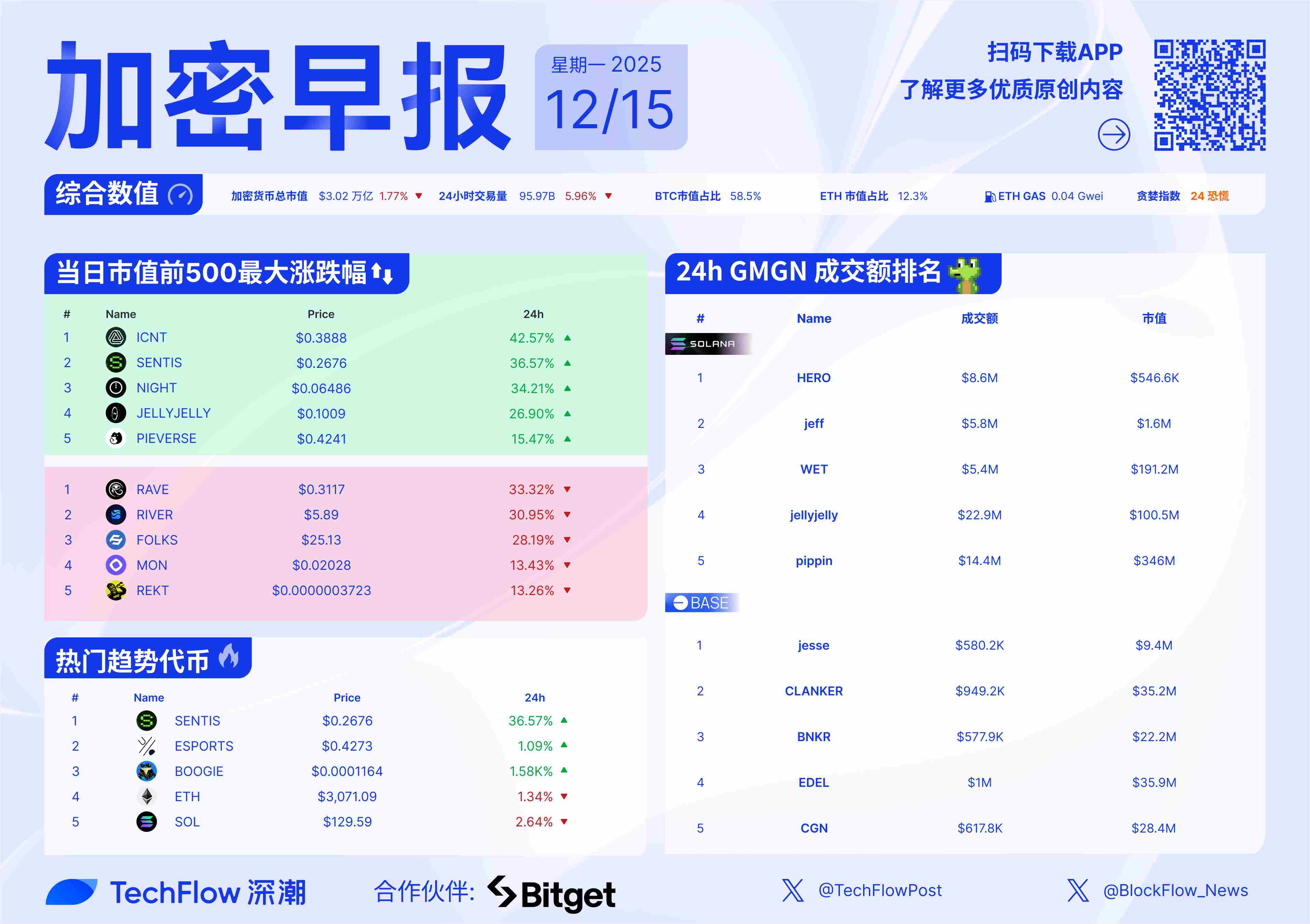
Market Dynamics
Recommended Reading
Silver Crisis: When the Paper System Begins to Fail
This article analyzes the sharp fluctuations in the silver market and the underlying reasons, revealing the crisis behind the rise in silver prices and structural issues in the market. It points out that due to the effects of financialization, trust in the silver market's "paper system" is gradually eroding, while physical demand is increasing. The article also discusses market manipulation in silver and the key role of JPMorgan in detail.
x402 V2 Launch: When AI Agents Start Having "Credit Cards", Which Projects Will Be Revalued?
This article explores the x402 V2 protocol in the crypto market and its profound impact on the financial behavior of AI Agents. The core updates of x402 V2 include delayed payments, full-chain compatibility, and hybrid payment rails, features designed to build a financial infrastructure suitable for a machine-driven commercial society. The article also analyzes related narratives and potential investment opportunities, discussing future trends in the AI economy.
a16z's View of Crypto 2026: These 17 Trends Will Reshape the Industry
This article, by several partners at a16z, summarizes 17 key trends regarding the future development of the crypto space, including insights on privacy technology, prediction markets, stablecoins, blockchain, tokenized assets, and the integration of AI and crypto technology. These trends will have a profound impact on technological progress, financial innovation, and the socio-economy of the crypto industry.
Oracle Plummets 40%, Will AI Over-Infrastructure Topple Giants?
This article discusses the significant challenges Oracle and other tech giants face in AI infrastructure construction. Although AI is considered a crucial direction for the future, giants are under pressure regarding capital investment, increasing debt, and market demand uncertainty. Whether AI infrastructure can deliver expected returns remains to be seen over time, while the market also questions the sustainability of startups and giants.
Big Short's Burry Warns: Fed's RMP Aims to Conceal Banking System Fragility, Essentially a Restart of QE
This article primarily discusses the Fed's latest Reserve Management Purchase (RMP) program and its impact on the banking system and financial markets. Michael Burry warns that this move is essentially covert quantitative easing (QE), intended to掩盖 (mask/conceal) the fragility of the banking system. The article analyzes repo market volatility, funding squeeze concerns, and the potential impact of the Fed's balance sheet expansion on markets, while also exploring the banking system's reliance on central bank liquidity.