Bitcoin Price Tanks, But Miners Flex With Record Hashrate

bitcoinistPublicado a 2025-09-24Actualizado a 2025-09-24

Resumen

On-chain data shows the Bitcoin miners have pushed their Hashrate to a new all-time high (ATH) despite the plunge in...

Trusted Editorial content, reviewed by leading industry experts and seasoned editors. Ad Disclosure

On-chain data shows the Bitcoin miners have pushed their Hashrate to a new all-time high (ATH) despite the plunge in the asset’s price.

7-Day Average Bitcoin Hashrate Has Shot Up Recently

The “Hashrate” is a Bitcoin indicator that keeps track of the total amount of computing power that the miners have connected to the network for the purpose of mining. This metric is measured in terms of hashes per second (H/s), or the more practical exahashes per second (EH/s).

When the value of the indicator rises, it means new miners are joining the blockchain and/or old ones are expanding their facilities. Such a trend implies the miners are finding the network to be profitable.

On the other hand, the metric going down suggests some miners are disconnecting their machines from the blockchain, potentially because they are no longer able to break even on BTC mining.

Now, here is a chart from Blockchain.com that shows how the 7-day average value of the Bitcoin Hashrate has changed over the past year:
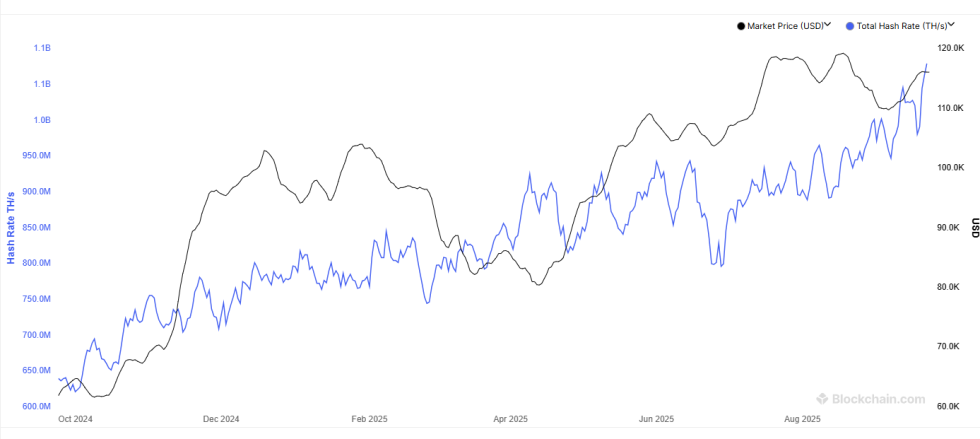
Bitcoin Hashrate

The 7-day average value of the metric appears to have sharply been going up in recent days | Source: Blockchain.com

As displayed in the above graph, the Bitcoin Hashrate registered a steep climb earlier in the month and set a new record of 1,045 EH/s on September 12th. With the extra computing power, miners started mining blocks at a notably faster pace than usual.

There exists a rule on the BTC network, however, that the block time should stay constant at 10 minutes. To ensure that this is followed, Satoshi built the “Difficulty” into the blockchain, a metric that controls how hard miners would find it to mine on the chain. The network automatically changes its Difficulty in biweekly adjustments to correct for increases or decreases in the Hashrate.

In response to the earlier rise in the indicator, the Bitcoin blockchain significantly increased its Difficulty. From the chart, it’s visible that this led to a plunge in the Hashrate, as miners not able to cope with the harder Difficulty dropped out.

Interestingly, though, it didn’t take long for miners to resume expansion. In fact, not only have they started expanding again, they have been doing so at an explosive pace during the last few days.

This has resulted in a fresh ATH of 1,079 EH/s. The growth in the Hashrate has come despite the fact that the Bitcoin price has observed a plummet toward the $112,000 level.

Generally, miners expand or decommission their facilities depending on the price trend, as the asset’s USD value directly impacts the value of their mining rewards. It would appear, though, that miners are this time betting in advance on the cryptocurrency’s trajectory reversing in the near future. It only remains to be seen whether the gamble will work out.

BTC Price

At the time of writing, Bitcoin is floating around $112,200, down around 2.5% over the last seven days.

Bitcoin Price Chart

Looks like the price of the coin has gone down recently | Source: BTCUSDT on TradingView
Featured image from Dall-E, Blockchain.com, chart from TradingView.com
Editorial Process for bitcoinist is centered on delivering thoroughly researched, accurate, and unbiased content. We uphold strict sourcing standards, and each page undergoes diligent review by our team of top technology experts and seasoned editors. This process ensures the integrity, relevance, and value of our content for our readers.

Keshav is a Physics graduate who has been employed as a writer with Bitcoinist since June 2021. He is passionate about writing and through the years, he has gained experience working in a variety of niches. Keshav holds an active interest in the cryptocurrency market, with on-chain analysis being an area he particularly likes to research and write about.

Lecturas Relacionadas

Los ETF spot de Bitcoin y Ethereum atraen 2.600 millones de dólares en una semana: récord desde octubre de 2025

Los ETF de Bitcoin y Ethereum registraron una entrada neta de 2.600 millones de dólares la semana pasada, el mayor flujo semanal desde octubre de 2025, según SoSoValue. Los ETF de Bitcoin captaron 1.900 millones de dólares, mientras que los de Ethereum sumaron 697,2 millones. Este resultado supone un cambio radical respecto a la salida de 392 millones de dólares de la semana anterior. El volumen de negociación de los ETF de Bitcoin se triplicó, superando los 22.100 millones de dólares, y sus activos gestionados crecieron un 25,4%, hasta los 96.100 millones. El mayor impulso se produjo los días 19 y 20 de agosto, destacando el fondo IBIT de BlackRock con una entrada diaria de 503 millones el 20 de agosto. Los ETF de Ethereum también tuvieron su mejor semana desde octubre de 2025, con un volumen de negociación que aumentó un 259,4%, hasta los 6.900 millones de dólares. Sus activos gestionados crecieron un 35,9%, hasta los 14.300 millones. A pesar de esta fuerte semana, los ETF de Bitcoin y Ethereum siguen mostrando salidas netas en 2026 de unos 2.900 millones y 191,8 millones de dólares, respectivamente. El análisis de la estructura del flujo revela una alta concentración en un solo fondo (IBIT de BlackRock), lo que, según una perspectiva de IA, introduce una vulnerabilidad, ya que un cambio de sentimiento en un actor principal podría revertir rápidamente la tendencia actual.

cryptonews.ruHace 12 min(s)

Los ETF spot de Bitcoin y Ethereum atraen 2.600 millones de dólares en una semana: récord desde octubre de 2025

cryptonews.ruHace 12 min(s)

El misterioso modelo de gran tamaño «Ox Alpha» causa sensación, gratuito por tiempo limitado

El misterioso modelo de IA "Ox Alpha", apodado "Llega el Buey", está causando revuelo al aparecer de forma anónima en OpenRouter, ofreciéndose de forma gratuita y limitada. Con un contexto de 1 millón de tokens y capacidades multimodales (texto, imagen, video), ha llamado la atención por su destacado rendimiento en tareas de programación. En pruebas iniciales del benchmark DeepSWE, que evalúa habilidades reales de ingeniería de software, logró una tasa de éxito del 80%, aproximándose a los principales modelos de código actuales, aunque resultados posteriores sugieren un 63%. Su identidad es un enigma. La evidencia más fuerte apunta a que podría ser una versión no lanzada de Zhipu AI, posiblemente GLM-5.3 Flash o una variante multimodal. Las pistas incluyen similitudes exactas en el tokenizador visual y de texto con modelos GLM, así como estilos de respuesta y comportamientos de agente similares. Mientras tanto, otro modelo anónimo llamado "korrine" aparece en Code Arena, con especulaciones que lo vinculan a Kimi, Qwen o MiMo. Este fenómeno de pruebas anónimas o "con identidad oculta" permite una evaluación más objetiva, libre de sesgos de marca, y sirve como una prueba de estrés pública para los desarrolladores antes del lanzamiento oficial. También se ha convertido en una efectiva herramienta de marketing que genera expectación. Si "Llega el Buey" es efectivamente un modelo "Flash" (optimizado en eficiencia), su alto rendimiento sugiere que las versiones completas podrían establecer nuevos estándares de capacidad.

marsbitHace 4 hora(s)

El misterioso modelo de gran tamaño «Ox Alpha» causa sensación, gratuito por tiempo limitado

marsbitHace 4 hora(s)

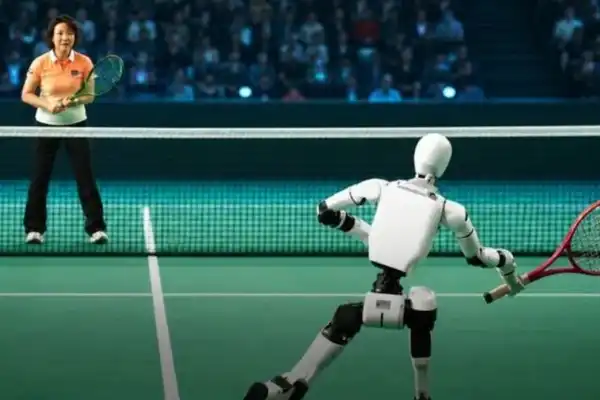
Hace un momento, se disputó el primer partido de tenis humano-máquina del mundo, el robot salvó la pelota al límite, dejando a Zheng Jie boquiabierta

El primer partido de tenis entre un humano y un robot humanoide del mundo se ha celebrado, protagonizado por la tenista profesional Zheng Jie y un robot desarrollado por Galaxy General. El evento, retransmitido en directo a nivel global, marcó un hito en el campo de la inteligencia encarnada, mostrando cómo la IA puede enfrentarse a desafíos físicos en tiempo real y bajo presión. Durante el partido, el robot demostró habilidades notables: movimientos ágiles, coordinación en dobles, golpes de derecha y revés, e incluso logró levantarse rápidamente tras una caída. Respondió a pelotas altas, efectos y cambios de ritmo, con reacciones en décimas de segundo ante saques de más de 100 km/h. Este logro supera las pruebas anteriores de IA, como AlphaGo, porque el tenis requiere integrar percepción, toma de decisiones y control motor en un entorno físico impredecible y en tiempo real. La clave es el modelo "AstraBrain" de Galaxy, que unifica en una sola arquitectura la planificación cognitiva y el control motor, evitando retrasos y desconexiones. El entrenamiento combinó datos de movimientos humanos (aunque imperfectos) con millones de partidas en simulaciones virtuales, donde el robot evolucionó mediante aprendizaje por refuerzo, desarrollando habilidades no programadas explícitamente, como rescates extremos o recuperarse de caídas. El momento "AstraTennis" simboliza el avance de la IA desde el dominio digital al físico, destacando el papel innovador de China en la creación de sistemas de inteligencia encarnada capaces de interactuar y competir en el mundo real.

marsbitHace 5 hora(s)

Hace un momento, se disputó el primer partido de tenis humano-máquina del mundo, el robot salvó la pelota al límite, dejando a Zheng Jie boquiabierta

marsbitHace 5 hora(s)

Trading

Spot
活动图片