SEC Eyes More Crypto Clarity: ‘Innovation Exemption’ Could Come By Year-End – Chair Atkins

bitcoinistPublicado a 2025-09-24Actualizado a 2025-09-24

Resumen

In a recent interview, the Securities and Exchange Commission (SEC) Chairman discussed the importance of establishing a crypto market structure...

Trusted Editorial content, reviewed by leading industry experts and seasoned editors. Ad Disclosure

In a recent interview, the Securities and Exchange Commission (SEC) Chairman discussed the importance of establishing a crypto market structure legislation and the regulatory agency’s effort to implement a rule exception for digital asset firms in the coming months.

SEC To Offer More Crypto Clarity By Year-End

On Tuesday, SEC Chairman Paul Atkins joined FOX Business to discuss the US Congress’s crypto legislation and the agency’s measures to make the industry “stand on firm ground” and provide the long-awaited regulatory clarity to advance the digital assets sector in America.

Atkins stated that the Commission is “trying to get the marketplace some kind of stable platform upon which they can introduce new products,” citing the recently approved new generic listing standards for spot crypto exchange-traded funds (ETFs) as one big step toward their goals.

The SEC Chief affirmed that “a lot is going on” for the agency, including working on rulemaking and setting an innovation exemption for crypto firms by the end of 2025. Following the successful “Crypto Week” in July, he revealed that the Commission was exploring some regulatory changes to boost innovation.

As reported by Bitcoinist, the Chairman shared that the agency was considering an innovation exemption that would “permit novel ways of trading and more narrowly tailored forms of relief to facilitate the building of other components of a tokenized securities ecosystem.”

The rule exemption would allow crypto firms to quickly launch products without having to comply with “burdensome prescriptive regulatory requirements that hinder productive economic activity.”

Instead, crypto firms would “be able to comply with certain principles-based conditions designed to achieve the core policy aims of the federal securities laws,” Atkins detailed in a late July speech.

CFTC, SEC To Work ‘Hand in Glove’

During the interview, the SEC Chairman also discussed the regulator’s ongoing collaboration with the Commodity Futures Trading Commission (CFTC) and the potential consolidation of the two agencies, with Atkins as the leader.

It’s worth noting that the CFTC is currently in leadership limbo as the confirmation process of President Trump’s nominee for Chairman, Brian Quintenz, has stalled following a request from the White House.

The regulatory agency, intended to be a five-person, bipartisan commission, is down to only acting Chair Caroline Pham, who is also expected to depart from the agency once a permanent chief is appointed.

“I have my hands full right now,” Atkins said, shutting down the idea. “We are working hand in glove right now with the CFTC, so harmonization is what I envision. People have been discussing this issue for a long time, and I think we’re at a point now, especially when we look at the changes in the digital asset area, that it’s incumbent on the two agencies to work hand in glove.”

What we have to really focus on is that over the years, there’s been (…) jockeying for position, and we don’t need regulatory turf battles. The field is littered with bodies of would-be products (…) that over the years have been torpedoed by the lack of certainty as between what falls within the SEC’s realm and what’s the CFTC’s realm.

Speaking about crypto market structure legislation, the regulator highlighted the importance of the bill. He explained that with the enactment of the GENIUS Act for stablecoin regulations, the market structure must be a priority “so that there’s certainty in the marketplace and direction to the SEC and CFTC to work together.”

Ultimately, he anticipated that the two regulatory agencies would work on joint rulemaking to “try to future-proof these rules and the relationships from some rogue regulations in the future.”
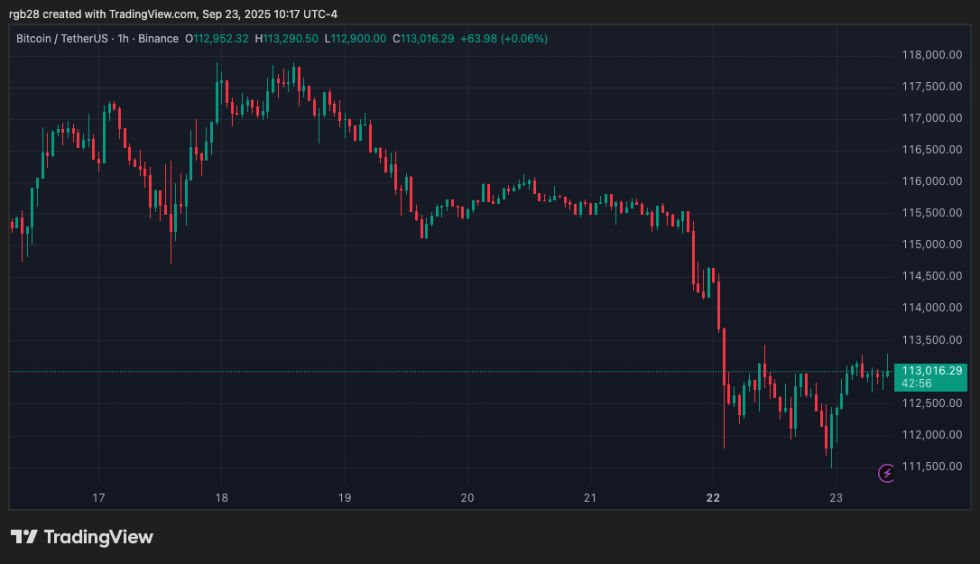
crypto, bitcoin, btc, btcusdt

Bitcoin (BTC) trades at $113,016 in the one-week chart. Source: BTCUSDT on TradingView
Featured Image from NBC News, Chart from TradingView.com
Editorial Process for bitcoinist is centered on delivering thoroughly researched, accurate, and unbiased content. We uphold strict sourcing standards, and each page undergoes diligent review by our team of top technology experts and seasoned editors. This process ensures the integrity, relevance, and value of our content for our readers.

Rubmar is a crypto enthusiast who likes learning and improving constantly. She enjoys reporting on the latest news and developments in the crypto industry. Rubmar also enjoys scrapbooking, crafting, simulation games, and watching football.

Lecturas Relacionadas

Interpretación de Informe de Investigación: El Sector Semiconductores Subió un 155%, Bernstein Dice que NVDA y AVGO Siguen "Absurdamente Baratas"

Análisis del informe: El sector de semiconductores subió un 155%, y Bernstein dice que NVDA y AVGO siguen "absurdamente baratas" Bernstein publicó una revisión trimestral del sector el 23 de junio. Su tesis central es que la IA es ahora el "único juego" que impulsa al sector, con fundamentales sólidos, aunque las valoraciones y la concentración de inversión están en máximos históricos. El índice SOX ha subido un 155,6% en el último año, impulsado principalmente por un crecimiento de los beneficios (EPS) del 75%, no por una burbuja de valoración. Bernstein recomienda **NVDA y AVGO** (calificación: "Outperform"), considerándolas los principales beneficiarios de la cadena de suministro de IA. A pesar del fuerte desempeño del sector, estas acciones han tenido un rendimiento relativamente atrasado este año. El analista Stacy Rasgon las describe como "absurdamente baratas", señalando que NVDA cotiza a un P/E de 25x para 2027 frente al 34x del sector, y que AVGO tiene un camino claro hacia los 100.000 millones de dólares en ingresos relacionados con la IA para 2030. **AMD** fue actualizada a "Outperform" debido a su oportunidad dual en GPU para IA y CPU. Por el contrario, **QCOM** mantiene una calificación "Market-Perform" debido a la debilidad persistente en el mercado de smartphones, que presiona su negocio principal. Los fabricantes de equipos semiconductores (como AMAT, LRCX, KLAC) siguen siendo favorecidos ("Outperform") por la fuerte demanda de construcción de capacidad. Sin embargo, Bernstein es cauteloso con los chips analógicos (ADI, TXN, calificación "Market-Perform"), cuyas valoraciones parecen elevadas. El informe advierte sobre dos riesgos clave: 1) La **congestión** del sector está en niveles históricamente altos. 2) Los niveles de **inventario** siguen siendo elevados, lo que podría generar presión si la demanda flaquea. La conclusión es que, en este entorno, la selección de acciones individuales es más crucial que nunca.

marsbitHace 45 min(s)

Interpretación de Informe de Investigación: El Sector Semiconductores Subió un 155%, Bernstein Dice que NVDA y AVGO Siguen "Absurdamente Baratas"

marsbitHace 45 min(s)

Entrevista de 10,000 palabras con el CEO de Anthropic: Cuando la IA se convierte en un arma súper potente, ¿cómo encontrar el equilibrio entre negocios y seguridad?

**Fuente:** Bloomberg **Resumen de la entrevista al CEO de Anthropic, Dario Amodei** Dario Amodei, CEO de Anthropic, habla sobre la trayectoria de su empresa en el centro del universo de la IA. Explica que su enfoque en aplicaciones empresariales (como Claude Code y Claude Cowork) se debe a su compatibilidad con sus valores de seguridad y responsabilidad, a diferencia de los modelos de negocio orientados al consumo. Reconoce que la IA podría eliminar muchos trabajos de cuello blanco junior, pero subraya la necesidad de una transición manejada y de que las empresas busquen una "suma positiva" utilizando las ganancias de eficiencia para nuevas tareas. Amodei aborda su salida de OpenAI, citando diferencias en valores y una falta de confianza. Aunque compite con empresas como OpenAI y Google, enfatiza la importancia de la colaboración en seguridad entre actores confiables para elevar los estándares de la industria. En cuanto a la seguridad nacional, justifica el trabajo de Anthropic con el Departamento de Defensa de EE. UU. como una necesidad para contrarrestar amenazas de regímenes autoritarios, pero establece límites claros, como no participar en vigilancia masiva o armas autónomas. También explica la decisión de no lanzar públicamente el potente modelo "Mythos", considerado un "súper arma" cibernética, hasta que existan salvaguardias defensivas más robustas. Finalmente, Amodei discute los riesgos a largo plazo de la IA y la necesidad de un equilibrio de poder entre el sector privado y la regulación gubernamental para gestionar esta tecnología transformadora de manera segura.

marsbitHace 56 min(s)

Entrevista de 10,000 palabras con el CEO de Anthropic: Cuando la IA se convierte en un arma súper potente, ¿cómo encontrar el equilibrio entre negocios y seguridad?

marsbitHace 56 min(s)

Trading

Spot
Futuros
活动图片